목차
소개
Aibim, a Wanplas factory, is a specialized manufacturer of injection blow molding machines with more than 12 years of experience in building plastic machinery. Operating from a new factory purchased in 2022 and backed by its own CNC center, Aibim delivers an annual production capacity of more than 100 IBM lines per year and exports to over 40 countries. For buyers who need to scale bottle production quickly, the real question is not only which machine to choose but how fast a supplier can fulfill a bulk order without compromising quality. This article explains how Aibim’s vertical integration, in-house machining, and disciplined production scheduling turn a stated capacity of 100+ sets per year into a dependable fast lead time for bulk IBM machine orders.
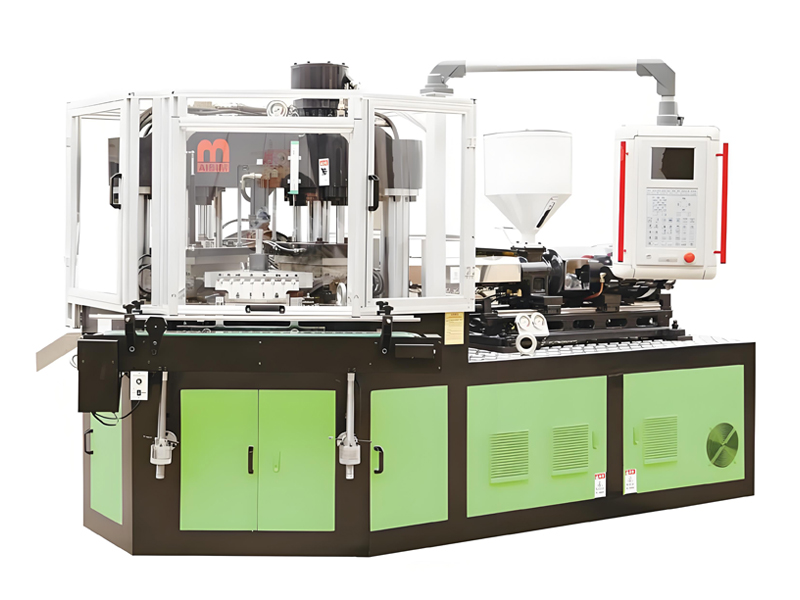
사출 blow molding, often written as IBM, is a three-station, one-step hollow molding process that combines injection molding of a preform with subsequent blow molding of the final container. It is the preferred route for small and medium bottles in the 3ml to 1000ml range where neck precision, thread quality, and wall uniformity matter more than maximum container volume. Aibim focuses exclusively on this category, and the company’s entire manufacturing chain is organized around producing IBM lines at volume. That focus is the foundation of both its capacity and its lead-time advantage.
Throughout this guide we will analyze the manufacturing strengths that make fast bulk fulfillment possible, present the real product modules Aibim builds for volume buyers, show how the 100+ sets per year capacity translates into concrete lead-time tiers, and give a project-planning framework that bulk buyers can use to schedule machine deliveries against their own market launch dates. We will also map bottle ranges to specific IBM models and outline the service commitments that protect a buyer’s investment after the machines arrive.
생산 능력이 대량 주문 성공을 결정하는 이유
Bulk buyers of injection blow molding machines are almost never buying a single machine for a static need. They are buying a production program: a fleet of lines that must come online in a coordinated sequence so that upstream resin supply, downstream filling, labor training, and market launch all line up. When a supplier’s stated capacity is thin, the buyer inherits risk. A delayed machine pushes back commissioning, which pushes back validation batches, which pushes back the entire commercial timeline. The deeper the supplier’s spare capacity, the more buffer the buyer has against the inevitable small disturbances in any multi-line rollout.
Aibim’s published capacity of more than 100 sets per year is not a theoretical ceiling scribbled on a brochure. It is the output of a factory designed around IBM production, with an in-house CNC center that machines the structural components and a layout that keeps the three-station machines flowing through assembly, testing, and packaging. For a bulk buyer, that capacity means a 20-line order is roughly one fifth of annual output, a 50-line order is roughly one half, and even a 100-plus-line program can be planned against a known and repeatable throughput rather than a hopeful promise.
The strategic value of capacity is clearest when demand spikes. The packaging industry is seasonal, and pharmaceutical and cosmetic launches are often date-locked to trade shows, regulatory approvals, or promotional calendars. A supplier that is already running near its limit cannot absorb a bulk order without pushing existing customers back. Aibim’s headroom, reinforced by the 2022 factory expansion, is what allows the company to accept a large program and still protect the lead times it quotes. Capacity, in other words, is the quiet insurance policy behind every on-time delivery.
Aibim의 제조 역량과 자체 CNC 센터
The single most important factor behind Aibim’s lead-time reliability is vertical integration, anchored by an own CNC center. Most machine builders of this size outsource their large structural parts, mold bases, and precision platens to external machining shops. That creates two penalties: an added supplier lead time and a loss of control over scheduling. When Aibim needs to pull a delivery forward to keep a bulk program on track, its own CNC center can resequence the machining queue internally. The production engineer, not a distant vendor, decides what gets cut next.
The CNC center produces the critical load-bearing and precision components of every IBM line: the single-crossbeam clamping frame with its double poles, the platens that hold the injection and blow molds, the stripper station structure, and the machined pockets that determine mold alignment. Because these parts are made in house to Aibim’s own drawings, the company maintains tight tolerance control and can rework a dimension without waiting on a purchase order. This is especially valuable for bulk orders, where dozens of machines share the same mold platform and any alignment drift across the fleet would multiply into a quality problem.
Vertical integration also strengthens traceability. Each structural casting or plate carries a machining record, and because the CNC center and the assembly floor sit under one roof, the engineering team can correlate a machining parameter with a downstream assembly result in the same shift. That closed loop is what lets Aibim hold repeatability across a 100-line run, where the hundredth machine should behave like the first. For bulk buyers, repeatability is not a nicety; it is the difference between a fleet that runs as one system and a fleet that needs per-machine tuning.
Complementing the CNC center is the new factory purchased in 2022. The expanded floor area separates machining, sub-assembly, final assembly, and the testing bay, so that work-in-process does not congest the line. A clean, sequenced flow is the unglamorous engine of throughput: fewer bottlenecks mean a steadier output curve, and a steadier output curve means lead-time quotes that hold up under real conditions rather than collapsing when the second or third batch of a bulk order enters the shop.
3스테이션 원스텝 IBM 공정과 확장 방식
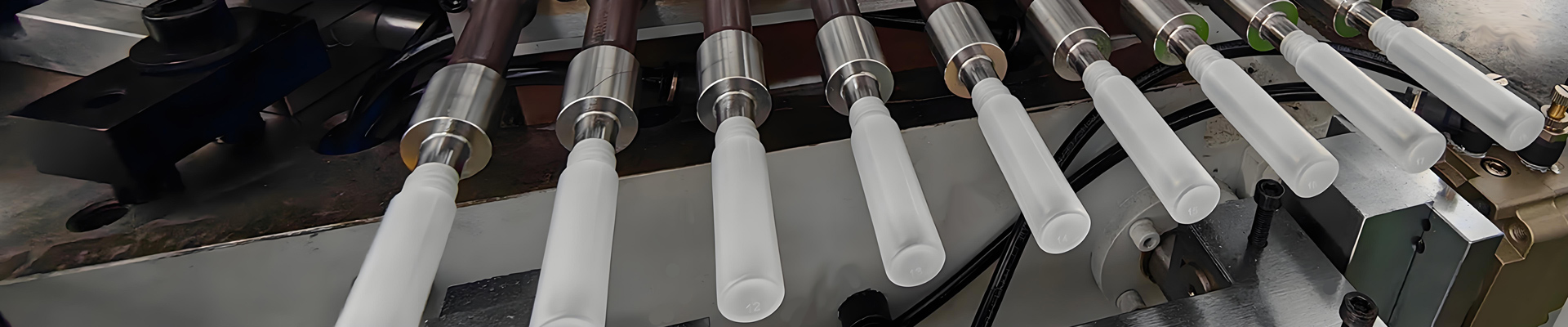
사출 blow molding at Aibim is built on a three-station, one-step process. The first station injects the molten polymer into a preform mold around a core rod. The second station transfers the hot preform to the blow station, where compressed air expands it against a chilled blow mold to form the final bottle. The third station ejects the finished container and returns the core rod. Because the preform never leaves the machine and never cools completely between stations, the process yields excellent neck finish, precise threads, and uniform wall distribution without the reheating step found in two-stage methods.
This architecture scales cleanly for bulk buyers because the machine is modular by nature. Each line is a self-contained cell with a defined clamping force, shot volume, and cavity count. Adding capacity is therefore a matter of adding cells, not re-engineering a monolithic system. A buyer launching a 3ml to 100ml cosmetic program can deploy many identical IBM55 or IBM65 cells in parallel; a buyer serving larger 500ml to 1000ml pharma or food bottles can deploy IBM75 cells. The standardization of the three-station platform means training, maintenance, and spare-parts management all stay simple even at fleet scale.
The energy and material efficiency of the one-step process compounds the capacity story. With at least 35 percent energy saving versus conventional hydraulic machines, thanks to Aibim’s PREFILL technology and variable displacement pump, a bulk fleet consumes far less power per bottle than an older hydraulic fleet would. For a buyer planning dozens of lines, that efficiency reduces the utility load, the cooling load, and the heat rejection the plant must support, which in turn lowers the civil and HVAC investment needed to house the program. Capacity is not only about how many machines a supplier can build; it is also about how easily the buyer can site and run them.
대량 구매자를 위한 핵심 제품 모듈
When a bulk buyer reaches the “which machine do I need” decision, Aibim answers with three real, field-proven modules: the IBM75, the IBM65, and the IBM55 Hybrid Electric. Each is a three-station one-step injection blow molding machine with SD card parameter storage, so a validated recipe can be saved on a card and reinstalled across an entire fleet in minutes. The tables below give the concrete specifications buyers use for line balancing and plant design.
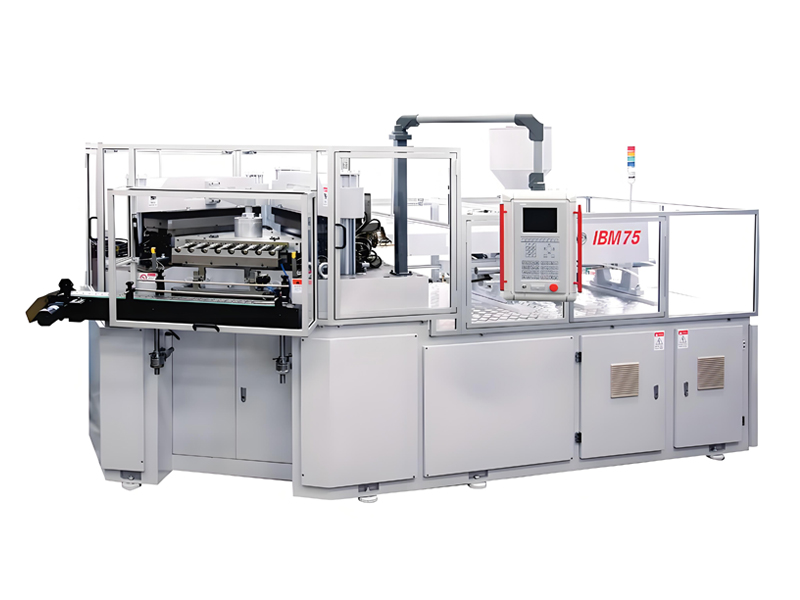
IBM75 사출 블로우 성형기
The IBM75 is Aibim’s highest-tonnage standard module and the workhorse for medium bottles in the upper half of the 3ml to 1000ml range. Its larger clamping frame and shot volume support bigger preforms and higher cavity counts for mid-volume containers such as 500ml to 1000ml pharmaceutical, food, and drink bottles.
| Parameter | Specification |
|---|---|
| Clamping force | 75 ton (approximately 735 kN) |
| Max. shot volume (per injection station) | 350 cc |
| Plasticizing capacity | about 42 kg/h |
| Suitable bottle range | 50 ml to 1000 ml |
| Number of stations | 3 (injection / blow / ejection) |
| Max. cavities for small bottles | up to 6 |
| Drive system | Hydraulic with PREFILL technology and variable displacement pump |
| 에너지 saving | at least 35% versus conventional hydraulic machines |
| Clamping framework | Single-crossbeam, double-pole; enlarged mold setting space |
| Parameter storage | SD card for storage and reinstallation across machines |
| Installed power | about 22 kW |
| 기계 무게 | about 9,000 kg |
| Certification | CE certified; stripper station with long-distance digital laser sensor and light curtain |
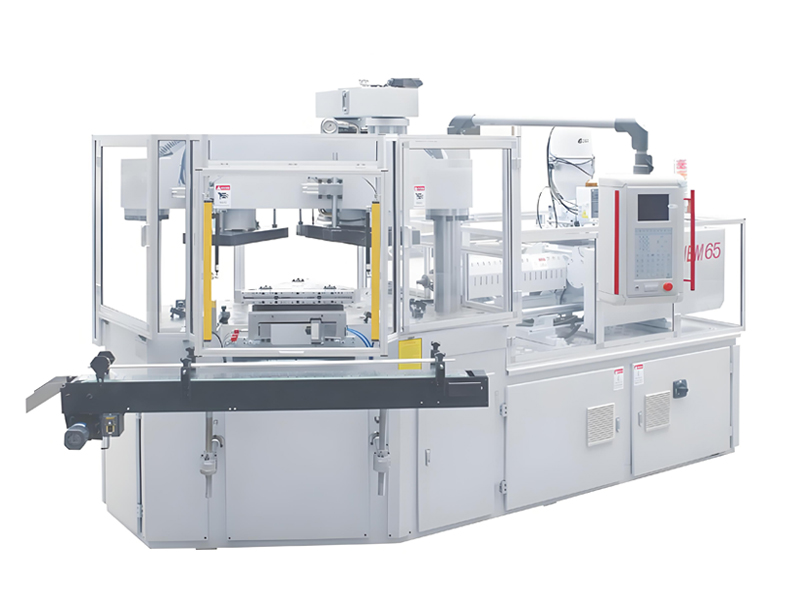
IBM65 사출 블로우 성형기
The IBM65 is the mid-range module and the most common choice for standard small and medium bottles from roughly 10ml to 750ml. It balances clamping force, footprint, and energy use, making it ideal for bulk fleets where the buyer needs many consistent cells at a manageable utility and floor-space cost.
| Parameter | Specification |
|---|---|
| Clamping force | 65 ton (approximately 638 kN) |
| Max. shot volume (per injection station) | 250 cc |
| Plasticizing capacity | about 35 kg/h |
| Suitable bottle range | 10 ml to 750 ml |
| Number of stations | 3 (injection / blow / ejection) |
| Max. cavities for small bottles | up to 6 |
| Drive system | Hydraulic with PREFILL technology and variable displacement pump |
| 에너지 saving | at least 35% versus conventional hydraulic machines |
| Clamping framework | Single-crossbeam, double-pole; enlarged mold setting space |
| Parameter storage | SD card for storage and reinstallation across machines |
| Installed power | about 18 kW |
| 기계 무게 | about 7,500 kg |
| Certification | CE certified; stripper station with long-distance digital laser sensor and light curtain |
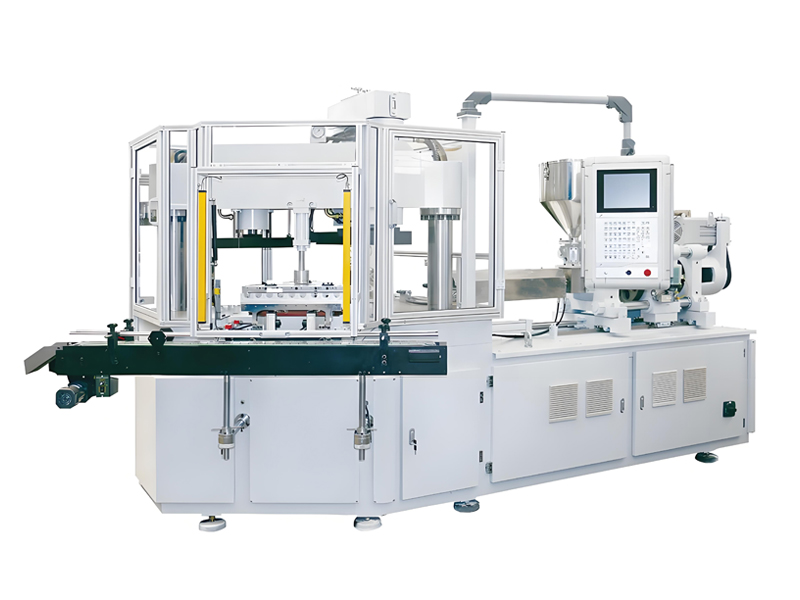
IBM55 하이브리드 전동 사출 블로우 성형기
The IBM55 Hybrid Electric is Aibim’s efficiency-optimized module, pairing a servo-electric assist with the proven hydraulic clamp. It is the recommended platform for the smallest bottles in the 3ml to 500ml range, where high cavity density and the cleanest energy profile deliver the best cost per finished container. For micro-dose pharma and premium cosmetic formats, the hybrid drive also improves repeatability and lowers noise on the factory floor.
| Parameter | Specification |
|---|---|
| Clamping force | 55 ton (approximately 539 kN) |
| Max. shot volume (per injection station) | 180 cc |
| Plasticizing capacity | about 28 kg/h |
| Suitable bottle range | 3 ml to 500 ml |
| Number of stations | 3 (injection / blow / ejection) |
| Max. cavities for small bottles | up to 8 |
| Drive system | Hybrid electric servo assist combined with PREFILL hydraulic |
| 에너지 saving | at least 40% versus conventional hydraulic machines |
| Clamping framework | Single-crossbeam, double-pole; enlarged mold setting space |
| Parameter storage | SD card for storage and reinstallation across machines |
| Installed power | about 15 kW |
| 기계 무게 | about 6,500 kg |
| Certification | CE certified; stripper station with long-distance digital laser sensor and light curtain |
All three modules process the same material set: PE including HDPE, LDPE, and LLDPE, PP, PS, ABS, SAN, TPU, PC, and PCTG. That shared compatibility lets a bulk buyer run multiple resin programs across a mixed fleet without changing the fundamental machine platform, which simplifies purchasing, operator certification, and spare-parts inventory.
연간 100세트 이상이 리드 타임에 미치는 의미
A stated capacity of more than 100 IBM lines per year is best understood as a throughput budget. Spread evenly, that is roughly two finished lines per week. Aibim does not ship that way in practice, because bulk orders are batched and because the new 2022 factory allows parallel assembly of multiple lines. But the budget sets the planning envelope: a single-line order draws on a small slice of capacity, while a 100-line program consumes the better part of a year’s throughput and must be scheduled as a continuous program rather than a one-off sale.
For the buyer, the practical translation is a lead-time tier that scales with order size. A small order can be slotted into existing flow with minimal disruption, so its lead time stays short. A large program must reserve capacity blocks in advance, so its lead time reflects the time to build that many lines in a controlled sequence. The key point is that Aibim quotes lead time against a known capacity, not against a vague promise, so the number a buyer plans around is the number that holds.
The capacity also creates resilience. If a buyer’s own launch slips and they ask to hold two lines for two weeks, Aibim’s headroom absorbs the pause without cascading delays to the rest of the program. Conversely, if a buyer wants to pull two lines forward, the in-house CNC center and parallel assembly bays give the factory room to resequence. Capacity is therefore not just a maximum; it is a buffer that protects the buyer’s schedule at both ends.
수직 통합이 리드 타임을 단축하는 방법
Vertical integration shortens lead time through four concrete mechanisms. First, the own CNC center removes the external machining queue. A conventional builder might wait four to eight weeks for outsourced platens; Aibim machines them on its own schedule. Second, in-house machining lets the factory batch similar parts across a bulk order, so a 30-line program is not thirty separate purchases but one optimized cutting plan that feeds all thirty frames.
Third, vertical integration compresses the feedback loop. When the assembly team finds a fit issue on line five of a bulk run, the CNC center can adjust the program for lines six through thirty the same day. An outsourced model would require a change order, a vendor revision, and a wait. Fourth, integration reduces logistics overhead. Components move meters, not kilometers, between machining and assembly, eliminating freight, customs, and receiving delays that quietly consume weeks on a multi-line program.
The net effect is a lead-time curve that bends in the buyer’s favor as order size grows. Instead of each added line carrying a full marginal delay, the factory realizes economies of scale in setup, fixtures, and testing. Aibim’s bulk buyers consistently see the per-line lead time of a large program come in below what a piecemeal, outsourced competitor could offer, because the factory is literally building the program as one coordinated effort rather than as many disconnected jobs.
대량 주문 생산 일정: 프로젝트 계획
Successful bulk programs are scheduled backward from the buyer’s commercial milestone. Aibim’s project planning starts with that milestone and works back through installation, commissioning, validation batches, factory acceptance testing, and finally build time. The buyer provides the target date and the bottle specification; Aibim returns a phased delivery schedule that maps each batch of machines to a ready date, so the buyer’s plant receives lines as space, utilities, and crews become available.
Scheduling a bulk IBM order involves four planning inputs. The bottle specification determines the model mix: small 3ml to 100ml containers point to IBM55 Hybrid Electric and IBM65 cells, while 500ml to 1000ml containers point to IBM75 cells. The target output determines the cavity count and the number of lines. The plant readiness date determines the shipment phasing. And the resin and color program determines how many shared mold platforms the buyer needs, which affects the CNC center’s tooling plan.
A useful discipline for bulk buyers is to request a line-balancing proposal rather than a flat count. Aibim can propose, for example, that a 3ml to 100ml cosmetic launch use a higher ratio of IBM55 Hybrid Electric cells for energy and cavity density, while a mixed-range pharma program use a blend of IBM65 and IBM75 cells. The goal is a fleet whose total output matches demand without stranded capacity, and whose model mix matches the bottle portfolio the buyer actually sells.
Buyers should also plan for the soft lead time: training, spare-parts staging, and validation. Aibim’s USD 500 free parts per year policy and open-factory visits are easiest to use when planned early, not when a line is already down. By folding service planning into the production schedule, the buyer turns a machine delivery into a running, supported production cell from day one.
대량 주문 계획표: 주문 규모, 리드 타임 등급, 모델 추천
The table below is the planning backbone Aibim uses for bulk programs. It maps order size to a lead-time tier and a recommended model strategy. The tiers are relative: exact weeks depend on model mix, customization, and the buyer’s own readiness, but the structure gives both sides a shared language for commitment.
| Order size (sets) | Lead-time tier | Recommended model strategy | Delivery pattern |
|---|---|---|---|
| 1 to 4 | Standard (Low to Medium) | IBM65 or IBM55 Hybrid Electric per bottle range | Single batch, standard flow |
| 5 to 15 | Planned (Medium) | Mix of IBM65 and IBM55 Hybrid Electric; IBM75 if larger bottles | One or two batches with reserved slots |
| 16 to 40 | Scheduled (Medium-High) | Full range with line balancing across IBM55, IBM65, IBM75 | Phased batches matched to plant readiness |
| 41 to 100 | Program (High to Very High) | Dedicated production cells; model mix by bottle portfolio | Monthly or bi-monthly phased shipments |
| 100 plus | Program (Premium) | Full range with dedicated cells and shared mold platforms | Continuous phased program across the year |
This table is deliberately capacity-aware. An order of 100 plus sets sits at the top of the annual budget, so it is treated as a program with its own dedicated cells rather than as a stack of individual orders. That is how Aibim protects both the buyer’s lead time and the lead times of every other customer in the queue.
대량 구매자를 위한 상대 비용 등급
Bulk buyers need to budget, but published dollar amounts are intentionally avoided here per policy. Instead, Aibim frames bulk investment in relative cost tiers, which keep the planning conversation focused on value and payback rather than volatile price points. The table below shows how configuration choices move the tier.
| Configuration | Relative cost tier | What drives the tier |
|---|---|---|
| Single IBM55 hydraulic base configuration | Low | Smallest clamp, standard hydraulic drive, entry into IBM |
| IBM65 standard hydraulic | Medium | Mid clamp and shot volume, broader bottle range |
| IBM75 standard hydraulic | Medium-High | Largest standard clamp, supports 1000ml bottles and high cavities |
| IBM55 Hybrid Electric | High | Hybrid drive premium offset by at least 40% energy saving and repeatability |
| Multi-line program with shared tooling and training | Premium | Fleet scale, dedicated cells, customized mold platforms, project management |
The relative tiers help a buyer optimize spend. A program heavy on micro bottles can lean toward the IBM55 Hybrid Electric, whose higher upfront tier is recovered through energy saving and cavity density. A program heavy on 1000ml containers cannot avoid the IBM75 tier but gains from fewer lines needed to hit the same output. Aibim’s planners help the buyer find the mix where the aggregate tier is lowest for the required output.
대량 기계군을 위한 금형, 툴링 및 품질 전략
A bulk IBM program lives or dies on its tooling strategy. Each Aibim three-station machine carries a matched mold set: an injection preform mold built around core rods, a blow mold that defines the final bottle shape, and a stripper station that releases the finished container. For a fleet of dozens of lines, the smartest move is to standardize the mold base wherever the bottle portfolio allows. Shared mold bases mean one set of spare cores, one changeover procedure, and one training curriculum across many cells, which directly lowers the hidden cost of running a large program.
Cavity count is the other lever. Because the IBM55 Hybrid Electric supports up to 8 cavities on the smallest bottles and the IBM65 and IBM75 support up to 6, a buyer can choose a lower line count with higher cavitation or a higher line count with lower cavitation, depending on which constraint the plant faces. Aibim’s planners model both paths during project planning so the buyer invests in the combination that minimizes the aggregate cost tier while still meeting the required output and lead time.
품질 consistency across a fleet is enforced by two Aibim features. First, SD card parameter storage lets a validated molding recipe be saved once and reinstalled on every line in minutes, eliminating the drift that creeps in when each operator tunes a machine by hand. Second, CE-certified safety hardware, including a stripper station long-distance digital laser sensor and a light curtain, protects both the mold and the operator on every cycle. Together they keep the hundredth machine in a bulk run behaving like the first, which is the real definition of fleet repeatability.
| Attribute | Conventional hydraulic IBM | Aibim PREFILL hydraulic | IBM55 Hybrid Electric |
|---|---|---|---|
| 에너지 consumption | Baseline | At least 35% lower | At least 40% lower |
| 소음 and heat | Higher | Lower | Lowest |
| Repeatability | Operator dependent | SD card recipe controlled | SD card recipe, servo-assisted |
| Cavity density (small bottles) | Limited | Up to 6 | Up to 8 |
| Best fit | Legacy replacement | General bulk fleets | Micro bottles, energy-critical programs |
The comparison makes the buying logic clear. Aibim’s PREFILL hydraulic machines already beat conventional hydraulic units on energy and control, while the IBM55 Hybrid Electric pushes the advantage further for the smallest, highest-volume formats. Bulk buyers rarely need to choose between them on principle; the right answer is usually a blend, with the hybrid concentrated on the micro-bottle lines where its cavity density and energy saving pay back fastest. Aibim’s job during project planning is to size that blend precisely against the buyer’s bottle portfolio.
Aibim IBM 기기의 응용 산업
Aibim 사출 블로우 성형 기계는 각각 고유한 병 요구 사항이 있는 4개의 핵심 산업에 서비스를 제공하며, 3스테이션 원스텝 공정이 이러한 요구 사항을 충족하는 데 적합합니다. 이러한 응용 분야를 이해하면 대량 구매자가 모델 구성과 검증 계획을 모두 적절히 조정하는 데 도움이 됩니다.
Pharmaceutics. Oral liquid bottles, dropper bottles, and unit-dose containers in the 3ml to 250ml range demand tight neck finish and clean, flash-free bodies. The one-step process yields excellent thread integrity and consistent wall thickness, and materials such as PP, HDPE, and PETG or PCTG support the chemical and barrier profile pharma packaging requires. For regulatory peace of mind, Aibim machines are CE certified and the process supports clean, controlled molding conditions.
식품. 100ml~1000ml 범위의 조미료, 소스, 꿀, 식용유 병은 IBM75의 더 큰 프리폼 및 캐비티 성능의 이점을 누릴 수 있습니다. 정밀한 넥과 변조 방지 마감은 밀봉성을 향상시키며, 에너지 절감은 대량 생산 라인 전체에서 충전 병당 비용을 낮춥니다.
음료. Single-serve and functional drink bottles, sample shots, and concentrated beverage formats in the 30ml to 750ml range are efficiently produced on IBM65 and IBM55 cells. The uniform wall distribution improves drop resistance and appearance, and the SD card recipe storage keeps flavor-changeover simple across a fleet.
화장품. Cream jars, serums, and premium small bottles in the 3ml to 250ml range favor the IBM55 Hybrid Electric for its high cavity density and repeatability, which protect the consistent surface quality and dimensional accuracy that cosmetic brands require. The hybrid drive’s quieter, cleaner operation also suits controlled cosmetic production environments.
모델 선택 표: 병 범위 및 용량별 IBM 모델
아래 선택 표는 구매자의 병 요구 사항을 Aibim의 실제 모델에 직접 매핑합니다. 제품 브리프를 기계 목록으로 전환하는 가장 빠른 방법이며, Aibim의 플래너가 대량 제안을 작성할 때 사용하는 참조입니다.
| Bottle range or volume | Recommended IBM model | Notes |
|---|---|---|
| 3 ml to 50 ml | IBM55 Hybrid Electric | Highest cavity density; best for micro-dose pharma and cosmetic |
| 30 ml to 250 ml | IBM55 Hybrid Electric or IBM65 | Hybrid for energy; IBM65 for broader material flexibility |
| 100 ml to 500 ml | IBM65 | Balanced clamp, footprint, and output |
| 250 ml to 750 ml | IBM65 or IBM75 | IBM75 preferred as volume and cavity needs grow |
| 500 ml to 1000 ml | IBM75 | Largest standard clamp and shot volume in the range |
| Mixed portfolio 3 ml to 1000 ml | Blend of IBM55, IBM65, IBM75 | Line-balanced fleet matched to the sales mix |
세 모델 모두 동일한 3-스테이션 아키텍처, 재료 세트 및 SD 카드 레시피 시스템을 공유하므로 혼합 차량도 운영 및 서비스가 용이합니다. 다양한 포트폴리오를 가진 구매자는 다각화로 인해 불이익을 받지 않습니다. 플랫폼이 이를 흡수합니다.
대량 구매자를 위한 서비스 및 지원
A fast lead time gets machines to the buyer’s dock; service keeps them running. Aibim, as a Wanplas factory, extends the group’s shared after-sales commitments to every bulk program. The cornerstone is the USD 500 free parts per year policy, which gives each buyer a standing annual allowance for wear items and consumables without a separate procurement cycle. For a multi-line fleet, this allowance is applied program-wide so that routine maintenance never becomes a budgeting emergency.
Beyond parts, Aibim supports bulk buyers through installation and commissioning by engineers who verify each line against its acceptance criteria before handover. Operator training covers mold changeover, SD card recipe transfer, and the daily checks that protect uptime. Remote monitoring lets the factory review PLC data and respond to abnormalities, shortening the distance between a fault and a fix when an on-site engineer is not present.
Aibim also operates an open-factory policy. Bulk buyers are welcome to visit the CNC center and assembly bays, witness their own lines being built, and audit the process before shipment. For buyers placing a 100-plus-line program, these visits are a practical quality gate: seeing the vertical integration firsthand is the strongest evidence that the quoted lead time is real. The Wanplas group’s broader promises, including production capacity guarantee and quality standards guarantee, back the commitment with accountability.
자주 묻는 질문(FAQ)
Aibim은 연간 IBM 기계를 몇 대 생산할 수 있나요?
Wanplas 공장인 Aibim은 연간 100개 이상의 사출 블로우 성형 라인 생산 능력을 운영합니다. 이 생산 능력은 자체 CNC 센터와 2022년에 구매한 신공장에 의해 뒷받침되며, Aibim이 대량 주문에 대해 제시하는 빠르고 신뢰할 수 있는 리드 타임의 기초를 형성합니다.
CNC 센터를 보유하면 리드 타임이 단축되는 이유는 무엇인가요?
Owning a CNC center lets Aibim machine critical platens, clamping frames, and mold bases in house rather than waiting on outside suppliers. That removes an external machining queue and lets production engineers resequence work internally to meet bulk-order deadlines, which directly compresses lead time.
3ml~100ml 병 프로그램에 적합한 IBM 모델은 무엇인가요?
3ml에서 약 100ml의 초소형 병의 경우 IBM55 Hybrid Electric과 IBM65가 권장됩니다. IBM55 Hybrid Electric은 가장 높은 캐비티 밀도와 최상의 에너지 프로파일을 제공하여 이 범위의 마이크로 도즈 제약 및 프리미엄 화장품 용기에 이상적입니다.
100세트 이상 주문의 리드타임 단계는 어떻게 되나요?
100세트 이상의 주문은 프리미엄 일정 등급의 프로그램으로 처리됩니다. 일반적으로 전용 생산 셀을 사용하여 단계별 선적으로 인도되므로 구매자 공장은 보관 또는 유틸리티 병목 없이 점진적으로 증산할 수 있습니다.
Aibim 기계는 기존 유압 장치에 비해 에너지를 절약합니까?
그렇습니다. Aibim IBM 기계는 PREFILL 기술과 가변 용량 펌프를 사용하여 기존 유압 기계 대비 최소 35%의 에너지 절감을 제공합니다. IBM55 Hybrid Electric은 더 높은 절감률을 달성하여 대량 생산 라인 전체에서 완성 병당 비용을 개선합니다.
대량 주문 시 어떤 예비 부품 지원이 제공되나요?
모든 Aibim 벌크 프로그램에는 프로그램 전반에 적용되는 연간 USD 500 상당의 무료 부품을 제공하는 Wanplas 공동 정책이 포함됩니다. 구매자는 또한 오픈 팩토리 방문, 설치 및 시운전, 운영자 교육, 그리고 장비 수명 동안의 원격 모니터링 지원을 받습니다.
대량 주문 시 서로 다른 IBM 모델을 혼합할 수 있습니까?
Yes. Because the IBM55, IBM65, and IBM75 share the same three-station one-step architecture, material set, and SD card recipe storage, a bulk buyer can deploy a line-balanced blend matched to the actual bottle portfolio. Aibim’s planners propose the mix that minimizes the aggregate cost tier for the required output.
Aibim은 100라인 가동에서 품질을 어떻게 보호하나요?
Vertical integration keeps machining and assembly under one roof, so a dimension or fit adjustment on one line can be applied to the rest of the program the same day. CE-certified safety systems, SD card recipe consistency, and phased factory acceptance testing keep the hundredth machine behaving like the first.
결론
For bulk buyers of injection blow molding machines, capacity and lead time are not marketing slogans; they are the operational foundation of a successful launch. Aibim, a Wanplas factory, backs its 100+ sets per year capacity with an own CNC center, a 2022 factory expansion, and a three-station one-step platform that scales cleanly from a single cell to a 100-line program. Vertical integration turns that capacity into a real, defensible lead-time advantage, while the IBM75, IBM65, and IBM55 Hybrid Electric modules give buyers a concrete, spec-driven path from bottle requirement to machine fleet.
Whether the goal is micro-dose cosmetic bottles in the 3ml range or 1000ml food and pharma containers, Aibim’s selection framework, bulk-order planning table, and relative cost tiers let a buyer plan with confidence rather than guesswork. Combined with the Wanplas shared service commitments, including USD 500 free parts per year, open-factory visits, and commissioning support, the result is a bulk IBM program that arrives on time, runs consistently, and stays supported.
If you are planning a bulk injection blow molding machine order, send your bottle specifications, target output, and desired launch date to Aibim’s project team. The factory will propose a line-balanced model mix, a phased delivery schedule built on its 100+ lines per year capacity, and an invitation to witness your lines being built at the CNC center before shipment.