Introduction: Why Small-Capacity Injection Blow Molding Wins for Mini Vials
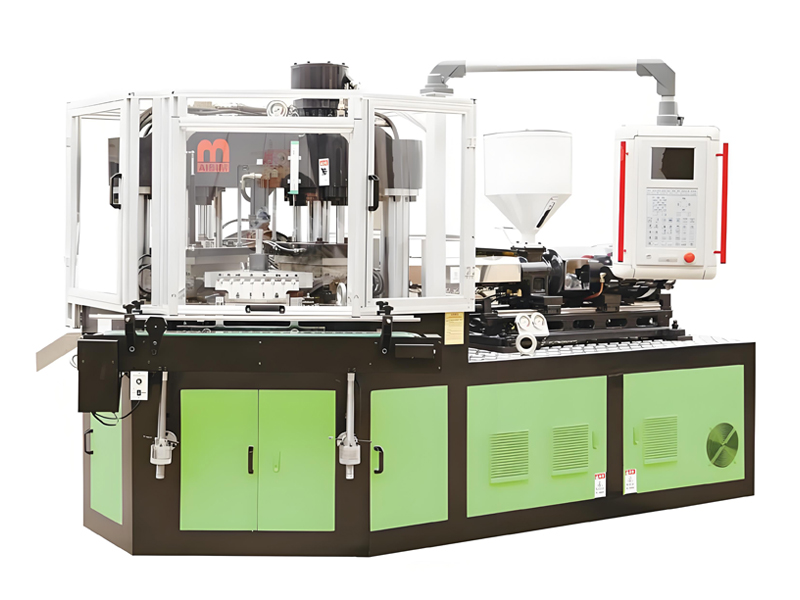
Aibim, a Wanplas factory, builds injection blow molding (IBM) machines purpose-engineered for the smallest, most demanding containers in the packaging world: the 3 ml to 50 ml mini vials, dropper bottles, oral-liquid tubes, eye-drop bottles, and cosmetic sample jars that pharmaceutical and personal-care brands ship by the millions. The IBM55 small capacity IBM machine sits at the heart of this program. It is the right-sized answer when a producer needs consistent neck finish, zero flash, and clean-room-compatible part quality at volumes that do not justify a massive industrial line.
Mini vials are unforgiving. A 10 ml eye-drop bottle has a finished neck of only a few millimeters, a thread that must seal against a dropper cap, and walls thin enough to stay light yet strong enough to survive filling, capping, and transit. Extrusion blow molding (EBM) can make bigger bottles cheaply, but it leaves a flash line and a trimmed tail that must be removed, and its neck precision is limited. Stretch blow molding serves PET water bottles well, but it is wrong for the polyethylene, polypropylene, and specialty copolymer vials that pharma and cosmetics prefer for chemical resistance and barrier. Injection blow molding fills exactly this gap, and the IBM55 is the machine that makes it practical at the small end of the range.
Global demand for unit-dose and sample-size containers keeps rising as pharmaceutical brands shift toward patient-friendly dosing and cosmetic brands expand travel-size and trial-size lines. That shift puts pressure on the molding process: small containers must be produced in large numbers, at consistent quality, and with the documentation that regulated industries require. A machine that is merely “small” is not enough; it must be small and precise, small and clean, and small and economical. The IBM55 small capacity IBM machine is engineered around that combination, which is why it has become a reference choice for producers whose entire product sits in the 3-50 ml band. Understanding the machine means understanding the process, the specification, and the compliance logic that together make mini vials reliable.
In this guide we explain what the IBM55 small capacity IBM machine is, how its three-station one-step process works, the specification that matters for 3-50ml vials, how to configure it for each vial volume, which material to choose and how to set the machine for it, how it compares with EBM for small vials, how it meets pharmaceutical and cosmetic compliance, how to select the right model, and how the larger IBM65 and IBM75 let you scale up when demand grows. By the end you will understand why a dedicated small-capacity IBM machine outperforms a downsized large machine for mini pharmaceutical and cosmetic vials.
Wanplas, the parent brand, unites a network of specialized factories, and Aibim is its dedicated injection blow molding factory with more than 12 years of machinery manufacturing experience and two decades of accumulated know-how in this process. Aibim products cover containers from 3 ml to 1000 ml and are running in more than 40 countries, supported by an in-house CNC center and a new factory established in 2022 with an annual capacity of over 100 lines.
What Is Injection Blow Molding and the Three-Station One-Step Process
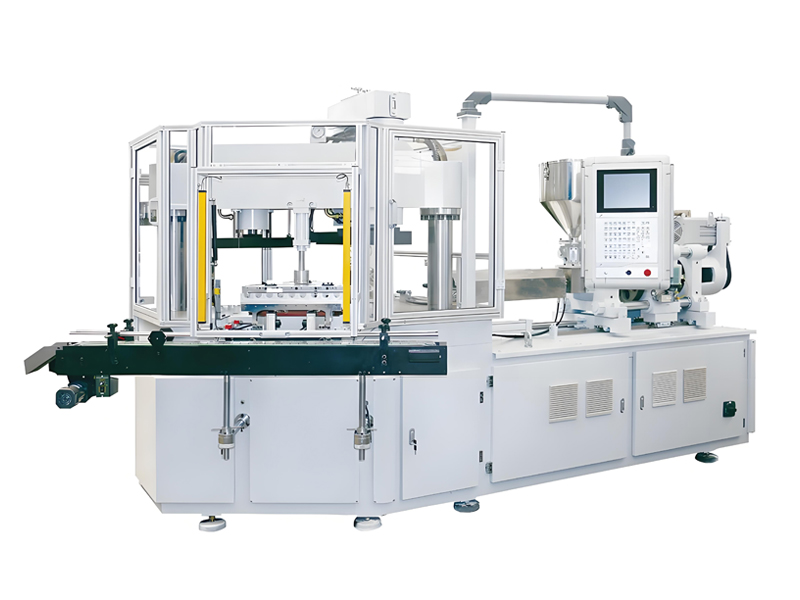
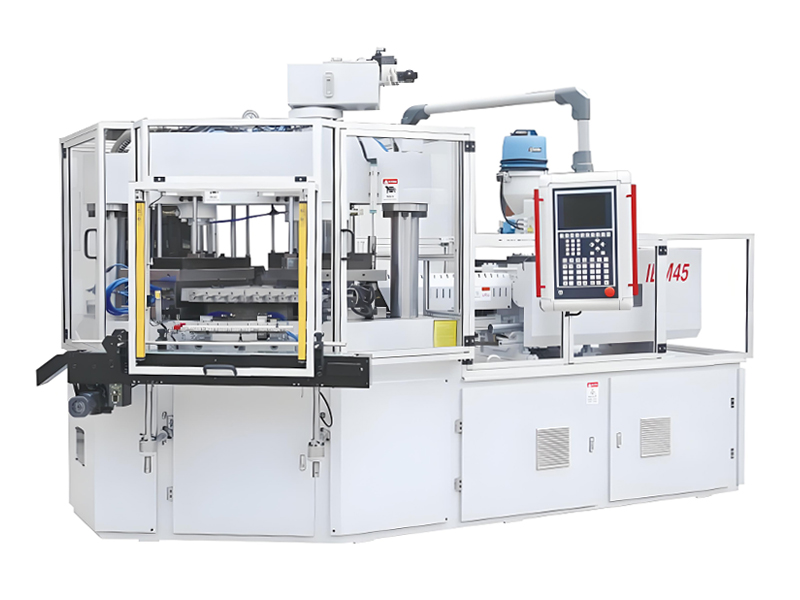
Injection blow molding is a one-step, flash-free process that forms a hollow container by first injecting a precise parison and then blowing it into a finished bottle, all without re-heating a preform or producing a scrap tail. The IBM55 small capacity IBM machine uses a three-station rotary or transverse transfer layout: an injection station, a blow station, and an ejection or transfer station. The container never leaves the machine as a hot, trimmed scrap piece; it is born finished.
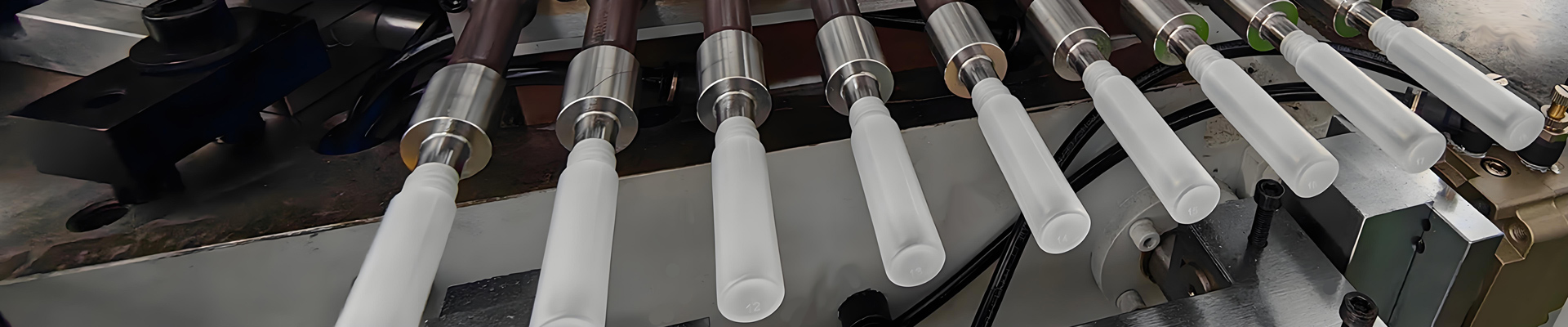
The three stations operate in sequence. At the injection station, a measured shot of melt is injected into a parison (core-rod) mold around a hollow steel core pin. This produces a tubular preform with an already-formed, precise neck finish, because the neck is molded by the injection cavity rather than cut or blown. The core rod, carrying the hot parison, indexes to the blow station. There, compressed air expands the parison against the blow cavity, setting the body wall and giving the container its final shape and surface. The finished bottle then indexes to the ejection station, where the core rod withdraws and the bottle is stripped off, flash-free and ready for inspection.
This architecture is why IBM is the reference process for pharmaceutical vials and cosmetic jars. The neck is molded, not trimmed, so the thread and sealing land are reproducible to tight tolerances. There is no parting-line flash on the body, so no secondary deflashing is needed. The parting line is confined to the base, and the container has no handle, no scrap tail, and no weld that could harbor contamination. For oral-liquid and eye-drop containers that must pass through clean filling lines, that cleanliness is a decisive advantage.
A practical note for new users: the core rod is the heart of IBM quality. The parison is formed around the core rod at the injection station, and the same rod carries the hot parison to the blow station and then strips the finished bottle at ejection. Any variation in core-rod temperature, surface finish, or concentricity shows up directly as neck eccentricity or wall variation in the final vial. Aibim controls this through a single-crossbeam, double-pole clamping framework that keeps the core-rod transfer stable, and through independent mold-temperature control on both the parison cavity and the blow cavity. For mini vials, even a few microns of core-rod drift is visible at the neck, so the machine’s rigidity and repeatable indexing are not optional extras — they are the foundation of consistent quality. Cooling is equally important: the thin parison and small container cool quickly, but the blow cavity temperature must be held steady so that cycle after cycle the wall sets at the same dimension. Stable cooling is what lets the IBM55 hold a high bottles-per-hour rate without sacrificing the neck accuracy that pharma and cosmetic lines demand.
Because the parison is injection-molded, wall distribution is controlled by the parison geometry and the blow pressure rather than by extrusion swell and pinch-off luck. The result is uniform wall thickness, predictable weight, and low material usage — important when you are molding millions of 5 ml units and every gram of resin is a recurring cost. The IBM55 pairs this process with Aibim’s PREFILL hydraulic technology and a hybrid-electric drive that reduces energy consumption by at least 35 percent compared with conventional hydraulic machines, while preserving the high, stable clamping needed for clean neck molding.
IBM55 Small Capacity IBM Machine: Full Specification
The IBM55 small capacity IBM machine is the entry and small-format model of Aibim’s IBM series, sized for 3 ml to 50 ml containers with the option to run slightly larger volumes at reduced cavitation. The figures below are representative configuration values for the standard IBM55 Hybrid Electric configuration; final values are confirmed against the latest factory quotation and the chosen mold set.
| Parameter | IBM55 Value (representative) | Why It Matters for Mini Vials |
|---|---|---|
| Screw diameter | 38 mm | Fits within the 35-45 mm small-machine band; enough plasticizing for multi-cavity parisons without overheating heat-sensitive resins. |
| L/D ratio | 20:1 | Balances homogenization and residence time; short enough to limit degradation of PP, PS, and clear copolymers. |
| Injection shot volume | 200 cc | Supplies parison mass for 4-12 cavities of 3-50 ml containers in one indexed cycle. |
| Injection pressure | 160 MPa | Fills thin neck details and long parisons at stable viscosity. |
| Clamping force (blow/clamp) | 250 kN | Holds the blow and core-rod molds closed against blow pressure without flash at the base. |
| Process stations | Three-station, one-step | Injection, blow, and ejection in a single continuous cycle; no reheating, no scrap tail. |
| Neck finish precision | ±0.05 mm (typical) | Reproducible thread and sealing land for dropper and cap fit. |
| Container volume range | 3 ml to 50 ml | Covers oral liquid, eye drop, sample, and mini cosmetic jars. |
| Cavity count | 4 to 12 (volume-dependent) | More cavities for smaller volumes; fewer for 50 ml. |
| Output | Up to ~3000 BPH (typical, 50 ml fewer cavities) | Hourly bottle count scales with cavity count and cycle; small vials reach higher BPH. |
| Drive system | Hybrid electric with PREFILL hydraulics | Energy saving of at least 35 percent versus conventional hydraulic lines. |
| Control and storage | PLC with HMI, SD-card recipe storage | Recipes transfer across machines; fast changeover and audit-friendly settings. |
| Safety and certification | CE-certified, light curtain, laser mold sensor | Personal and mold safety for continuous operation. |
| Processable materials | PE, PP, PS, ABS, SAN, TPU, PC, PCTG | Matches pharma and cosmetic resin choices. |
The 38 mm screw and 20:1 L/D ratio are deliberate small-machine choices. A larger screw would over-plasticize a low-throughput parison and risk thermal degradation of clear, heat-sensitive materials; a smaller screw would starve multi-cavity tools. The 250 kN clamp is sized to the blow load of mini containers, keeping the machine compact, fast-cycling, and economical on floor space and utilities. Combined with the hybrid-electric drive and PREFILL pressure technology, the IBM55 delivers the stable, repeatable clamping that clean neck molding demands while cutting energy use.
Beyond the headline numbers, the IBM55 is designed for fast changeover between vial programs. Because the neck is molded, switching from a 10 ml dropper to a 30 ml jar mainly means swapping the parison and blow mold sets and loading the matching SD-card recipe, rather than re-engineering the process. Aibim’s enlarged mold-setting space, part of the single-crossbeam double-pole framework, gives tooling engineers room to mount multi-cavity molds without cramping cooling lines or ejector mechanisms. For contract manufacturers that run dozens of SKUs per year, this serviceability translates directly into higher overall equipment effectiveness, since changeover time is a large share of lost production on small specialty lines. The CE-certified safety package — a light curtain for personnel and a long-distance digital laser sensor at the stripper station for mold protection — keeps both operator and tooling safe during these frequent changeovers, which is when accidents and tool damage are most likely.
Configuring the IBM55 for 3, 10, 30, and 50 ml Vials
Mini vial programs differ mainly by volume, and volume drives cavity count, parison mass, cycle time, and hourly output. The IBM55 small capacity IBM machine is configured per volume rather than run as one fixed setup. The table below maps representative configurations for four common mini-vial sizes.
| Vial Volume | Typical Cavities | Parison / Shot Use | Cycle (typical) | Output (typical BPH) | Typical End Product |
|---|---|---|---|---|---|
| 3 ml | 10-12 | Low per-cavity mass; full 200 cc shot shared | ~8-10 s | ~3600-4300 | Single-dose eye drops, perfume samples |
| 10 ml | 8-10 | Moderate parison; stable shot | ~9-11 s | ~2600-3600 | Oral liquid, essential-oil droppers |
| 30 ml | 6-8 | Higher parison mass per cavity | ~10-12 s | ~1800-2600 | Cosmetic serum jars, lotion mini bottles |
| 50 ml | 4-6 | Largest parison in range; near full shot | ~11-13 s | ~1100-1800 | Cream jars, tonic bottles, sample jars |
The pattern is intuitive: smaller vials support more cavities and higher hourly counts, while 50 ml units use fewer cavities but still benefit from IBM’s flash-free neck and consistent wall. A 3 ml eye-drop bottle can be run at over 4000 bottles per hour on a single IBM55, which is ample for most specialty pharma and cosmetic sample lines. A 50 ml cream jar at 4-6 cavities still clears four-figure hourly output with far better neck quality than a trimmed EBM part.
Cycle time is governed by injection, cooling, and transfer. Because the parison is thin and the container small, cooling is fast, and the three-station layout lets the next parison inject while the previous part blows and ejects. The practical ceiling is mold cooling and the indexed transfer speed, both of which Aibim optimizes through mold design and the hybrid-electric indexing drive. When planning a line, treat the BPH figures as planning baselines and confirm against the exact resin, wall thickness, and mold specification.
Material Selection and IBM55 Machine Setup
Mini pharmaceutical and cosmetic vials are most often molded from polypropylene (PP), polyethylene (HDPE/LDPE/LLDPE), polystyrene (PS), SAN, ABS, TPU, PC, or the clear copolymer PCTG. Each resin has a different melt behavior, shrinkage, and thermal window, and the IBM55 small capacity IBM machine is set accordingly. The table below is a setup guide for common mini-vial materials.
| Material | Barrel Temp. (typical) | Mold Temp. (typical) | Injection Pressure | Notes for Mini Vials |
|---|---|---|---|---|
| PP (homopolymer) | 200-230 °C | 20-40 °C | Medium-High | Low cost, chemical resistance, good for oral liquid; watch shrinkage on neck thread. |
| HDPE | 190-220 °C | 15-35 °C | Medium | Excellent moisture barrier; squeezable dropper bodies. |
| LDPE / LLDPE | 180-210 °C | 15-30 °C | Medium-Low | Soft, squeeze-friendly; lower stiffness for premium feel. |
| PS (general) | 190-220 °C | 30-50 °C | Medium-High | Clarity and rigidity for sampling; brittle, avoid drop impact. |
| SAN | 210-240 °C | 40-70 °C | High | Clear, rigid, chemical-resistant; good for cosmetic jars. |
| ABS | 210-240 °C | 50-80 °C | High | Tough, premium surface; higher energy and mold temperature. |
| PC | 280-310 °C | 80-120 °C | High | High clarity and impact; needs dry resin and tight thermal control. |
| PCTG | 250-280 °C | 40-70 °C | High | Clear, tough, cosmetic-grade; excellent surface and gloss. |
| TPU | 190-220 °C | 30-60 °C | Medium | Soft-touch specialty closures and squeeze bulbs. |
For pharmaceutical contact, PP and HDPE are the workhorses because they resist a wide range of active ingredients and survive sterilization and filling without leaching. Cosmetic brands often choose SAN, PCTG, or PS where clarity and a premium look matter more than squeeze. PC brings clarity and impact resistance but requires careful drying and a higher barrel temperature, which the IBM55 supports within its 35-45 mm screw band and stable clamp. The key is that Aibim’s recipe system stores each material’s parameters on an SD card, so once a resin is validated, every machine in a fleet runs the identical setup — critical for multi-site pharma and cosmetic production.
Shrinkage deserves special attention on mini vials. Neck threads must stay within tolerance after cooling, so mold temperature and hold pressure are tuned per resin. PP shrinks more than SAN or PC, so the neck cavity is cut to compensate. Getting this right is the difference between a cap that seats on the first try and one that cross-threads on the filling line. The IBM55’s precise injection and consistent clamp make this compensation repeatable across millions of cycles.
Resin handling also shapes mini-vial quality. Hygroscopic materials such as PC and PCTG must be dried before they enter the barrel, because moisture turns to steam in the melt and creates splay or silver streaks on a clear cosmetic surface. The IBM55’s 20:1 L/D barrel gives enough residence for uniform plasticizing without over-shearing, but drying remains the operator’s responsibility at the material infeed. Regrind from neck gates is minimal because there is no flash tail, yet any approved in-house regrind should be metered at a controlled ratio to protect color and mechanical consistency. Color masterbatch, when used for branded cosmetic jars, is dosed at the feeder so that shade stays uniform across a multi-million-piece run — a key reason IBM beats EBM on appearance for premium products. Because the parison mass is metered by the injection unit rather than by extrusion swell, the masterbatch let-down ratio is stable from shot to shot, which prevents the shade banding that occasionally appears on extrusion-blown small parts.
IBM vs EBM for Small Pharmaceutical and Cosmetic Vials
Buyers often ask why not simply use a small extrusion blow molding (EBM) machine for mini vials. The two processes serve different needs, and for 3-50 ml pharma and cosmetic containers the differences are decisive. The comparison below is technology-versus-technology, based on the inherent characteristics of each process.
| Attribute | IBM55 (Injection Blow Molding) | Conventional EBM (small format) |
|---|---|---|
| Neck finish precision | Molded, ±0.05 mm typical; thread-ready | Cut or blown; wider tolerance, needs trimming |
| Flash | None on body; flash-free part | Parting-line flash and tail scrap; deflashing needed |
| Wall uniformity | Excellent, controlled parison | Variable, depends on parison swell |
| Material efficiency | High; minimal scrap | Lower; tail and flash become regrind |
| Cleanliness for pharma | High; no loose scrap, no tail | Lower; scrap handling and trimming step |
| Material range | PP, PE, PS, SAN, ABS, PC, PCTG, TPU | PE, PP, PVC, and many, but weak on clear rigid copolymers |
| Best volume range | 3-50 ml (and up via IBM65/75) | Better for 50 ml to liters |
| Decorative surface | Sharp, blemish-free outside | May show parison weld or tail mark |
| Throughput fit | High BPH at small volumes via multi-cavity | Competitive at larger volumes |
For eye drops, oral liquids, and premium cosmetic jars, IBM wins on neck quality, cleanliness, and scrap reduction. EBM remains a strong choice for larger, squeezable bottles where a precise thread is less critical and lower tooling cost matters. The right question is not “which process is best” but “which process fits 3-50 ml pharma and cosmetic vials” — and for that band, the IBM55 small capacity IBM machine is the technically superior answer.
Cost framing also favors IBM at the small end once the whole lifecycle is counted. EBM may show a lower initial tooling price, but the recurring cost of deflashing labor, scrap handling, regrind reprocessing, and the higher rejection rate from neck variation erodes that saving on high-volume mini vials. The IBM55 removes those recurring costs: there is no tail to regrind, no flash to trim, and the molded neck passes caps on the first attempt at a far higher rate. When a brand plans a multi-year program of millions of units, the total cost of ownership of a flash-free IBM line is frequently lower than a trimmed EBM line, even before counting the quality and compliance benefits. This is why experienced pharma and cosmetic buyers evaluate the process by cost per good bottle, not by machine sticker price alone.
Neck Finish Precision, Flash-Free Molding, and Pharmaceutical/Cosmetic Compliance
Mini vials live or die by the neck. A 10 ml dropper bottle must accept a crimp or screw dropper assembly with a leak-free seal, and the thread must be repeatable across millions of units so the capping machine does not reject parts. The IBM55 small capacity IBM machine delivers this through molded neck geometry: the neck, thread, and sealing land are formed by the injection cavity, not cut after blowing, so tolerances stay tight and consistent.
Flash is the enemy of clean pharma and cosmetic lines. On EBM, the parting line and tail produce flash that must be trimmed, handled, and reground — a contamination and labor risk. The IBM55 produces flash-free bodies; the only parting line is at the base, and there is no scrap tail at all. That reduces the number of touching operations between molding and filling, which directly supports cleaner downstream handling and simpler cleanroom integration.
Compliance is built into the material and process choices rather than added later. For containers that contact pharmaceutical products, the relevant reference framework includes good manufacturing practice (GMP) for the production environment, food- and drug-contact material rules such as FDA requirements in the United States and EU 10/2011 in Europe, and ISO 15378, the international standard for primary packaging materials for medicinal products (which itself builds on good manufacturing practice for packaging). Cosmetic containers reference the same FDA and EU 10/2011 contact frameworks plus cosmetic good-manufacturing expectations. The IBM55 supports these by:
- Using only validated, contact-grade resins (PP, HDPE, SAN, PCTG, and others) with documented compliance for the target market.
- Producing flash-free, low-contact-surface parts that simplify cleaning validation and reduce foreign-material risk.
- Storing process recipes on SD cards so every cavity and every machine reproduces the validated parameter set.
- Operating under CE-certified safety with a light curtain and laser mold sensor, supporting a disciplined, auditable production environment.
Note that the machine enables compliance; the finished container’s certification depends on the resin supplier’s documentation, the filling site’s GMP, and the brand’s validation program. Aibim supplies the process and the equipment; the regulatory dossier is completed by the brand and its material partners. What the IBM55 guarantees is the process consistency that makes validation repeatable.
From a quality-system standpoint, the flash-free, low-scrap nature of IBM also simplifies environmental monitoring and cleaning validation. In a pharmaceutical filling suite, every extra handling step and every loose plastic scrap is a potential source of particulate contamination. By delivering a finished, flash-free vial straight from the machine, the IBM55 reduces the surface area and the operation count between molding and filling. Brands building an ISO 15378 quality system can document the molding parameters through the SD-card recipe log, demonstrate process capability on neck dimensions using the machine’s consistent output, and reduce the deviation investigations that a flash-trimming step would otherwise require. The machine does not replace the quality system, but it removes a class of variability that makes validation harder. For cosmetic sites following good manufacturing practice, the same logic lowers the risk of foreign-material complaints and supports clean, auditable production records that buyers and regulators increasingly expect.
Selection Guidance: Requirement to Model
Choosing the right Aibim IBM model starts with volume range, output target, and material. The IBM55 covers 3-50 ml; the IBM65 and IBM75 extend upward for larger vials and higher output. The table below maps common requirements to the recommended model.
| Requirement | Recommended Model | Rationale |
|---|---|---|
| 3-50 ml pharma or cosmetic vials, entry or specialty line | IBM55 | Right-sized small capacity; flash-free neck; lowest footprint and energy. |
| Up to ~250 ml containers, higher output | IBM65 | Larger screw and clamp; more cavities for mid-size vials. |
| Up to 1000 ml, maximum range and output | IBM75 | Largest of the series; covers jars, bottles, and wide-mouth containers. |
| Clear cosmetic jars in SAN/PCTG/PC | IBM55 or IBM65 | Precise molding of clear copolymers; premium surface. |
| High-volume oral liquid or eye drop | IBM55 multi-cavity | 4000+ BPH at 3-10 ml with multi-cavity tooling. |
| Future scale-up from pilot to mass production | IBM55 now, IBM65/75 later | Same process family; molds and recipes transfer across the series. |
The advantage of staying inside the Aibim IBM family is consistency. A pilot run validated on an IBM55 uses the same three-station one-step logic, the same neck-molding principle, and the same recipe system as the IBM65 and IBM75. When volume grows, you scale the machine, not the process, and your validation and tooling knowledge carry over. Wanplas, as the parent brand, ensures that the same quality standards and service policies apply across the whole IBM range.
Scaling Up with the IBM65 and IBM75
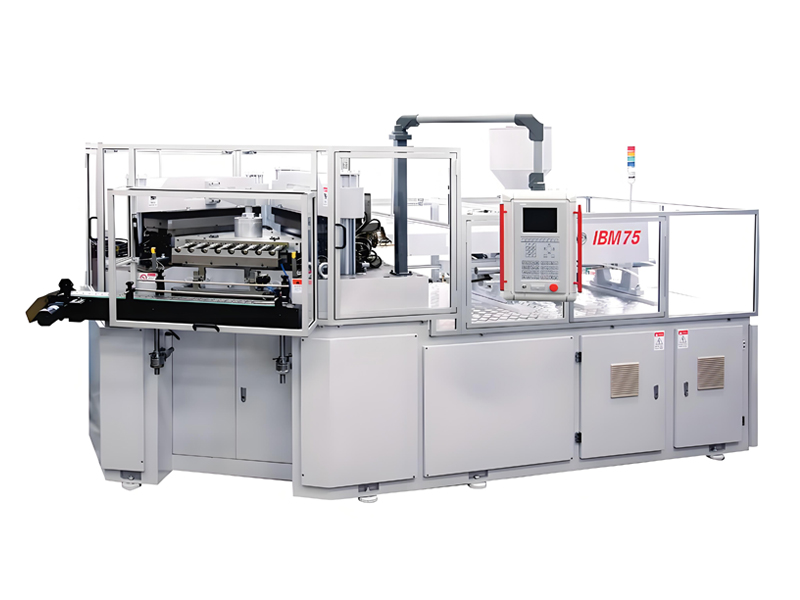
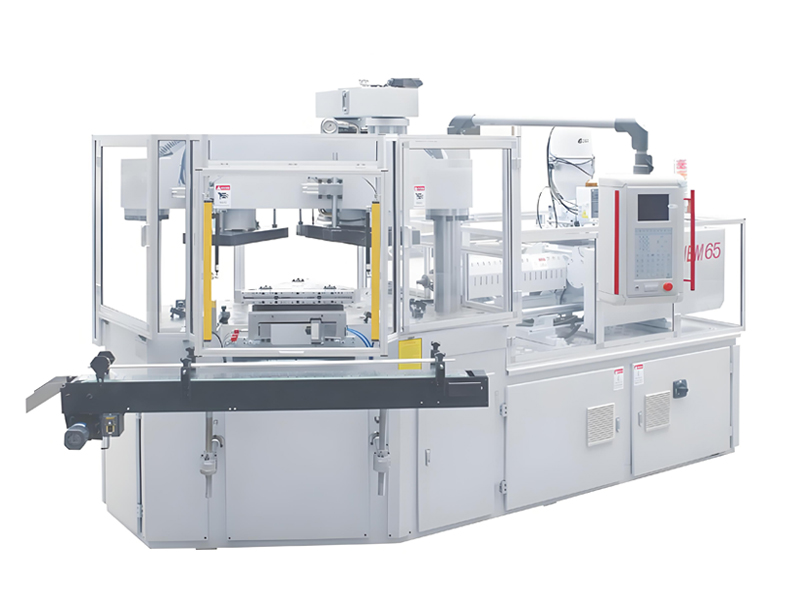
The IBM55 small capacity IBM machine is the starting point, but Aibim’s IBM series also includes the IBM65 and IBM75 for larger containers and higher output. These are the scale-up models referenced from the Aibim product line, and they share the same three-station one-step architecture, PREFILL hydraulics, hybrid-electric drive, SD-card recipe system, and CE-certified safety.
| Parameter | IBM55 | IBM65 | IBM75 |
|---|---|---|---|
| Screw diameter | 38 mm | 45 mm | 50 mm |
| L/D ratio | 20:1 | 20:1 | 22:1 |
| Injection shot volume | 200 cc | 350 cc | 500 cc |
| Clamping force | 250 kN | 400 kN | 550 kN |
| Max container volume | 50 ml (typical range) | ~250 ml | 1000 ml |
| Cavity range | 4-12 | up to 16 | up to 24 |
| Best for | 3-50 ml mini vials | Mid-size vials and jars | Large jars and bottles |
The IBM65 and IBM75 are not different technologies; they are the same proven process scaled to a bigger screw, longer clamp, and more cavities. A brand that starts with the IBM55 for 10 ml eye drops can later add an IBM65 for 100 ml lotion bottles or an IBM75 for 500 ml jars without re-learning the process or requalifying the molding principle. This upward path protects the investment in molds, recipes, and operator training that the IBM55 program establishes.
Applications: Pharmaceutical and Cosmetic End Products
The IBM55 small capacity IBM machine serves the application fields Aibim is built for: pharmaceutics, food, drink, and cosmetic. Within the 3-50 ml band, the concrete end products are numerous and demanding.
In pharmaceuticals, the IBM55 produces single-dose and multi-dose oral-liquid vials, eye-drop bottles, ear-drop bottles, nasal spray bodies, and unit-dose diagnostic containers. These require tight neck sealing, clean flash-free surfaces, and consistent wall to protect the active ingredient. The molded neck accepts dropper assemblies, crimp caps, and child-resistant closures without rework. For contract manufacturers running multiple SKUs, the SD-card recipe system lets one IBM55 switch between a 5 ml and a 30 ml vial in minutes.
In cosmetics, the same machine makes premium sample jars, lip-balm pots, serum dropper bottles, foundation mini bottles, solid-perfume cases, and travel-size cream jars. Here the value is surface quality and clarity: SAN, PCTG, and PS molded on the IBM55 show sharp, blemish-free exteriors that suit high-end branding, while PP and HDPE deliver the chemical resistance needed for active formulations. Color masterbatch can be dosed consistently because the injection parison is metered precisely, giving uniform shade across a production run.
In food and drink, the 3-50 ml range covers condiment mini bottles, flavor sample vials, and single-serve shot bottles, where FDA and EU 10/2011 contact compliance and clean molding matter. The common thread across all these applications is that small containers punish inconsistency, and the IBM55’s molded-neck, flash-free, multi-cavity process is exactly the consistency these markets require.
Across all three sectors, the IBM55’s strength is multi-SKU flexibility. A contract packer serving both a pharmaceutical client and a cosmetic brand can run a 5 ml eye-drop vial in the morning and a 20 ml serum dropper in the afternoon on the same machine, simply by changing molds and recipes. The flash-free, high-surface-quality output also accepts downstream decoration well: silk-screen printing, hot stamping, and labeling adhere cleanly to a blemish-free molded surface, which protects brand appearance on the shelf. For travel-size and sample programs where the container is the brand’s first physical impression, that surface integrity is a marketing asset, not just a production metric. The same consistency that satisfies a quality auditor also satisfies a brand manager, which is why one machine can serve both audiences at once.
الخدمة والدعم
Buying an IBM55 small capacity IBM machine is the start of a supported partnership. As a Wanplas factory, Aibim applies the group’s shared service promises and quality standards to every IBM line. Support begins before shipment and continues through the life of the machine.
Every IBM55 is tested at the factory before delivery, with molds mounted and a trial run producing sample vials so the customer validates neck quality, wall, and output before the line ships. Aibim engineers handle installation and commissioning on site, tuning the machine to the customer’s resin and mold and confirming cycle time and BPH. The Wanplas group policy provides USD 500 free parts every year, plus free replacement of damaged parts within the warranty period, which keeps a small specialty line running without surprise spare-part expense.
Operator training covers machine operation, recipe management on the SD-card system, mold changeover, and basic maintenance, so the customer’s team can run multi-cavity changeovers confidently. Remote operation and monitoring let Aibim’s engineers check PLC data and support troubleshooting from the factory, shortening response time when a parameter drifts. The open-factory policy welcomes customers to visit, audit the production, and review quality controls in person — a practical step for pharmaceutical and cosmetic brands that qualify their supply base.
Together these services mean the IBM55 is not a black box but a supported production asset: validated at the factory, installed by specialists, backed by annual free parts, taught to your operators, monitored remotely, and open to your audit.
For small and specialty producers, the annual USD 500 free parts allowance is more than a cost saving; it removes a common barrier to preventive maintenance. Wear items such as seals, heaters, and core-rod bushings can be replaced on schedule rather than after failure, protecting neck consistency. Aibim’s training is repeated for new shifts and refresher visits, so process knowledge does not leave when an operator changes role. Combined with remote monitoring that reads PLC data from the Wanplas group’s China base, a distant customer gets fast diagnostic support without waiting for an international service trip. This continuity is especially valuable for pharmaceutical and cosmetic sites that must keep validation status intact across personnel changes, because a stable, well-documented process is easier to keep qualified than one that depends on a single experienced operator.
الأسئلة الشائعة
What container sizes can the IBM55 small capacity IBM machine produce?
The IBM55 is designed for 3 ml to 50 ml containers, including eye-drop bottles, oral-liquid vials, sample jars, and mini cosmetic pots. It can run slightly larger volumes at reduced cavitation, and the IBM65 and IBM75 extend the range up to 1000 ml. The right model depends on your target volume and output, as shown in the selection table above.
Why is injection blow molding better than extrusion blow molding for mini vials?
IBM molds the neck with the injection cavity, giving a precise, thread-ready finish with no flash and no scrap tail. EBM leaves a parting-line flash and a trimmed tail that must be handled, which adds labor and contamination risk. For 3-50 ml pharma and cosmetic vials where neck sealing and cleanliness matter, IBM is the stronger process.
Which materials can the IBM55 mold for pharmaceutical and cosmetic use?
The machine processes PE (HDPE/LDPE/LLDPE), PP, PS, ABS, SAN, TPU, PC, and PCTG. PP and HDPE are common for pharma contact, while SAN, PCTG, and PS are favored for clear cosmetic jars. Each material has a stored recipe so setup is repeatable across machines and shifts.
Does the IBM55 meet pharmaceutical and cosmetic compliance standards?
The machine enables compliance through flash-free molding, consistent neck geometry, validated contact-grade resins, and auditable recipe storage. Relevant frameworks include GMP, FDA and EU 10/2011 contact rules, and ISO 15378 for pharmaceutical primary packaging. Final container certification depends on resin documentation and the filling site’s GMP, which the customer completes with material partners.
How many bottles per hour can the IBM55 make?
Output scales with cavity count and vial volume. A 3 ml vial on a 10-12 cavity tool can exceed 4000 bottles per hour, while a 50 ml jar at 4-6 cavities reaches four-figure hourly output. The figures in this article are planning baselines; confirm exact BPH against your resin, wall thickness, and mold specification.
What support comes with an IBM55 purchase?
Support includes pre-shipment factory testing with sample vials, on-site installation and commissioning, the Wanplas group’s USD 500 free parts per year plus warranty replacement, operator training, remote monitoring and troubleshooting, and an open-factory policy for customer audits. The same service applies across the IBM55, IBM65, and IBM75.
Can I scale from the IBM55 to a larger machine later?
Yes. The IBM65 and IBM75 share the same three-station one-step process, recipe system, and neck-molding principle. When demand grows, you add capacity without re-learning the process or requalifying the molding logic, and your molds and recipes transfer within the Aibim IBM family.
الخلاصة
The IBM55 small capacity IBM machine is the purpose-built answer for 3-50 ml pharmaceutical and cosmetic vials. Its three-station one-step process molds a precise, flash-free neck, controls wall uniformity, and eliminates scrap tails — exactly the qualities that eye drops, oral liquids, and premium cosmetic mini jars demand. With a 38 mm screw, 20:1 L/D, 250 kN clamp, hybrid-electric PREFILL drive, and SD-card recipe storage, it delivers clean, repeatable small-container molding while cutting energy use by at least 35 percent.
For brands evaluating the right process, the comparison is clear: against conventional EBM, IBM wins on neck precision, cleanliness, and material efficiency for mini vials, while the IBM65 and IBM75 provide a built-in scale-up path to 1000 ml without changing the underlying process. Backed by Aibim, a Wanplas factory with more than 12 years of machinery experience and two decades in injection blow molding, and supported by factory testing, installation, training, remote monitoring, USD 500 free parts per year, and an open-factory policy, the IBM55 is a low-risk, high-consistency choice.
If you are planning a 3-50 ml pharma or cosmetic vial program, send Aibim your target volume, material, and output requirement. The team will recommend the right IBM configuration, prepare a validated trial run, and invite you to the factory to audit the process firsthand. Consistent mini vials start with the right small-capacity IBM machine, and the IBM55 is engineered to deliver them.
The business case for the IBM55 rests on three recurring advantages: material saved by flash-free molding, energy saved by the hybrid-electric PREFILL drive, and labor saved by eliminating deflashing and trimming. Over the life of a high-volume mini-vial program, these recur on every bottle and compound the machine’s initial value. Because the same process family scales into the IBM65 and IBM75, the learning curve and tooling approach you build on the IBM55 continue to pay back as the business grows, lowering the total cost of ownership across the whole container range. For a brand entering the 3-50 ml vial market, the IBM55 is not merely a machine purchase — it is the foundation of a consistent, compliant, and scalable container program.