Introduction: A Purpose-Built Molder for the 100-300ml Daily Chemical Segment
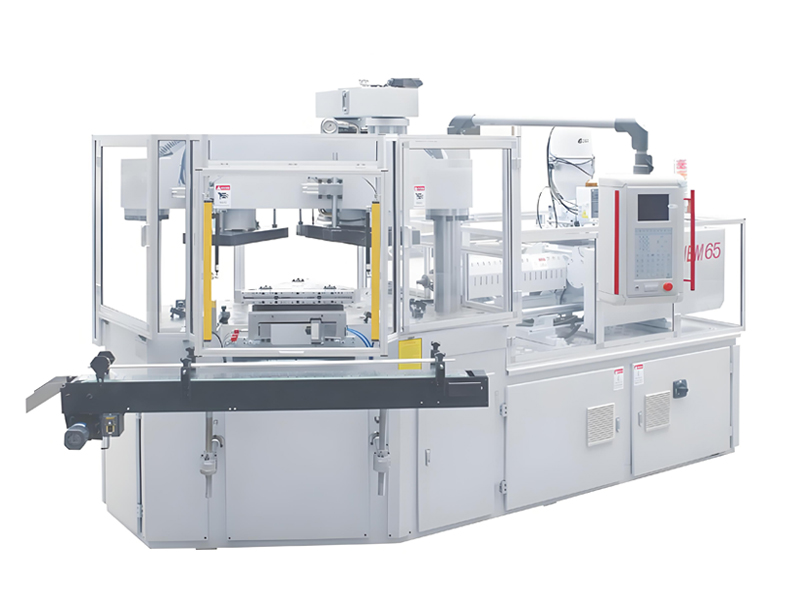
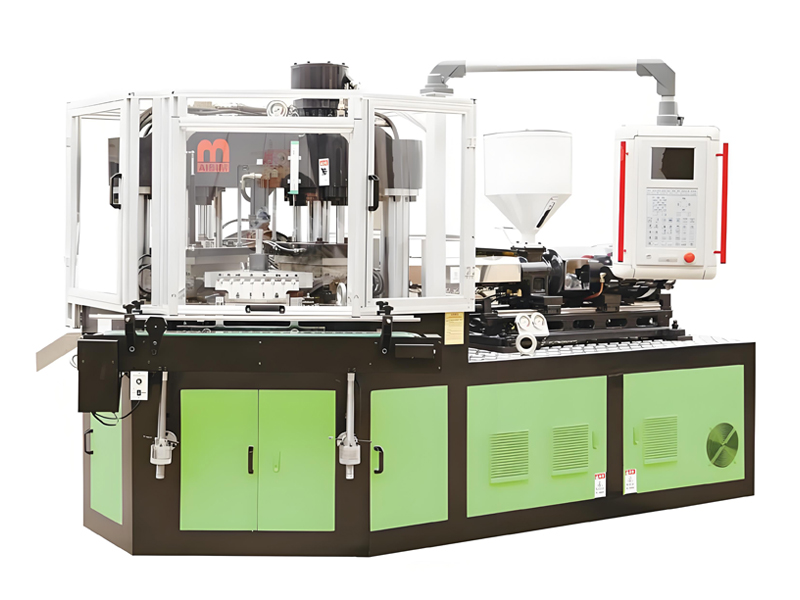
Aibim, a Wanplas factory, has built its reputation on the injection blow molding (IBM) process, a one-step hollow molding method that fuses injection molding and blow molding into a single automated sequence. The IBM65 medium volume injection blow molder is the company’s answer to a very specific and very demanding packaging niche: the 100-300ml daily chemical bottle. These containers sit at the heart of the personal care and household care markets, holding lotions, serums, face creams, hand soaps, shampoos, conditioners, and a wide range of cosmetic emulsions. They must look premium, feel consistent, seal reliably, and be produced at a volume that justifies automation without forcing a manufacturer into oversized, capital-heavy machinery.
The IBM65 was engineered precisely for that balance. It is neither a small laboratory unit nor a heavy industrial platform for jumbo containers. It occupies the medium-volume sweet spot where daily chemical brands, contract packagers, and private-label manufacturers live. With a clamping force class of roughly 650 kN, a 45 mm plasticizing screw at a 20:1 L/D ratio, and a three-station one-step architecture, the IBM65 converts resin pellets directly into finished, flash-free bottles at rates that comfortably serve regional and export supply chains. This article explains the machine in depth: how the process works, why it suits 100-300ml daily chemical bottles, what the real specifications are, how it compares with conventional hydraulic machines, which materials run best, and how to select the right model within the Aibim family.
Throughout, the discussion stays grounded in the engineering realities of the IBM process. Injection blow molding is fundamentally different from extrusion blow molding and from two-step reheat stretch blow molding. It uses an injection-molded parison (a precisely shaped preform) rather than an extruded tube, and it blows that parison inside the same machine without transferring it to a separate station or oven. That single design choice drives nearly every advantage the IBM65 delivers for daily chemical packaging: tight neck tolerances, uniform wall thickness, no scrap flash, and a clean, neck-finished bottle straight off the machine.
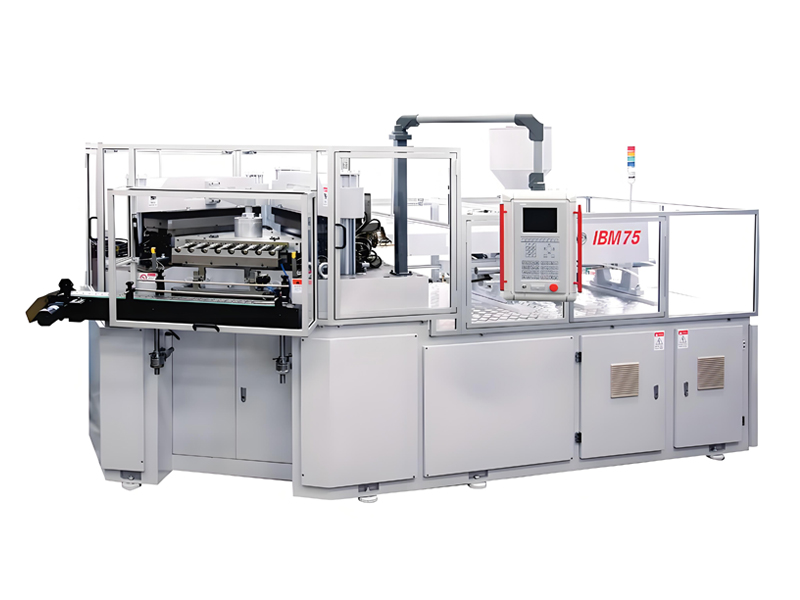
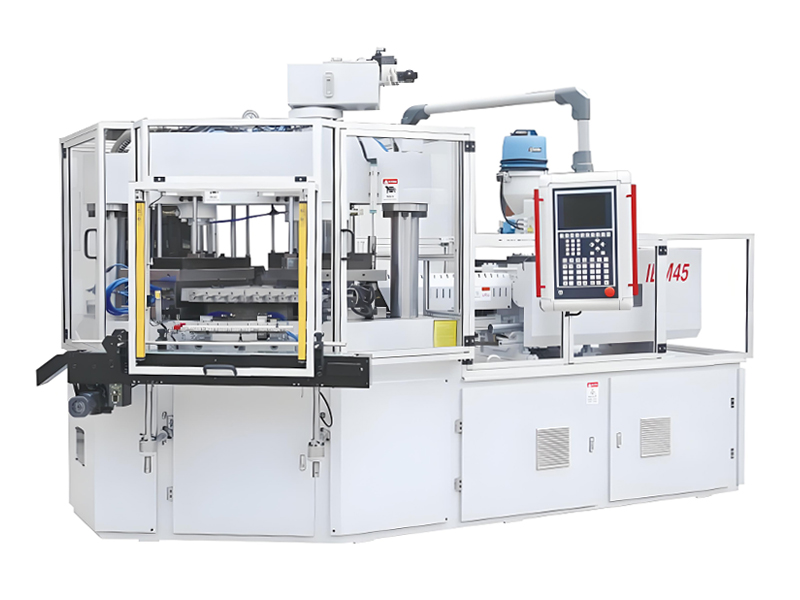
As part of the Wanplas group, Aibim draws on shared R&D resources, a common quality-management system, and unified after-sales commitments, while specializing exclusively in IBM technology. The factory operates its own CNC machining center for critical machine components, runs a 100+ lines-per-year production capacity, and serves more than 40 countries. Its product range spans 3 ml to 1000 ml, covered by three core series: the IBM55 Hybrid Electric, the IBM65, and the IBM75. The IBM65 is the subject of this piece, and it is the model most daily chemical producers should evaluate first when their target bottle falls between 100 ml and 300 ml.
Understanding Injection Blow Molding: The Three-Station, One-Step Principle
Injection blow molding is a one-step hollow molding process that produces a bottle from resin in a single, continuous machine cycle. The Aibim machine type description states it plainly: plastic raw material is first made into a parison through injection, then the parison is blown into the desired plastic product through blow molding, all within a three-station, one-step process. Understanding this sequence is the key to understanding every specification and benefit discussed later.
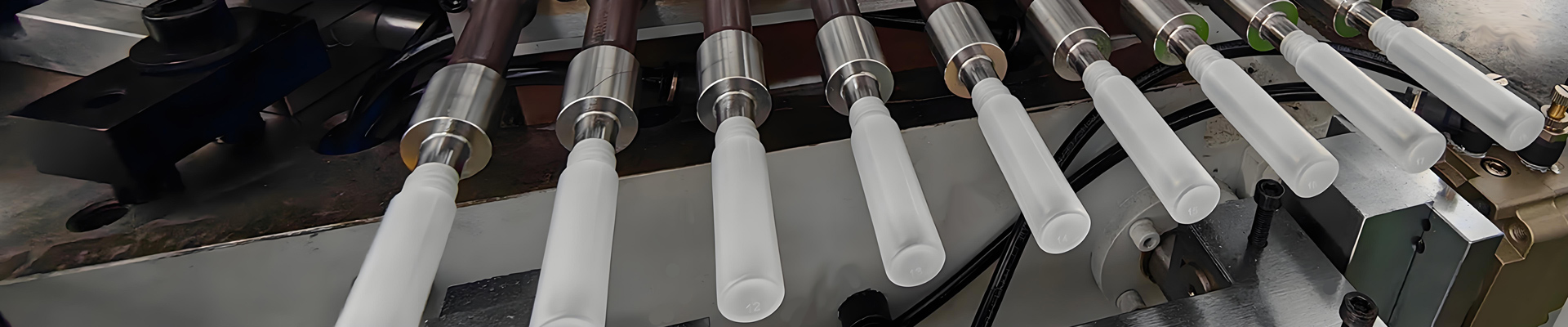
The three stations are arranged on a rotating transfer hub, and the parison and bottle move between them without leaving the machine envelope. Station one is the injection station. Here, a reciprocating screw plasticizes the resin inside the barrel, and a measured shot is injected into a parison mold. The parison mold shapes the outside diameter of the bottle body and, crucially, the inside and outside geometry of the bottle neck and finish with injection-molded precision. The neck threads, sealing surface, and wall transition are formed here, not blown.
Station two is the blow station. The core rod carrying the hot parison indexes into the blow mold. Compressed air expands the parison against the cooled blow-cavity wall, forming the bottle body, shoulder, and base. Because the parison already carries the exact neck geometry, the finished bottle exits with a precise, defect-free neck that needs no trimming. There is no flash, no moil, and no secondary finishing.
Station three is the ejection station. The finished bottle is stripped from the core rod and discharged. A long-distance digital laser sensor monitors the stripper for mold safety, and a light curtain protects the operator, both contributing to the machine’s CE-certified safety architecture. The entire sequence repeats on every index, and because all stations work simultaneously, the effective cycle time is governed by the longest single operation rather than the sum of all three.
This three-station, one-step principle is the reason IBM65 bottles show remarkable consistency. The neck is injection molded, so thread pitch, sealing diameter, and torque behavior are repeatable to injection-mold tolerances. The body is blow molded, so it stays light and uniform. The bottle never touches a conveyor or a separate oven between parison formation and finished part, eliminating a whole class of contamination and handling defects that plague multi-step processes.
For daily chemical brands, this consistency is not a luxury. It is the difference between a pump dispenser that seals on the first try and one that leaks on the shelf. It is the difference between a label that lays flat and one that wrinkles over a wavy shoulder. The one-step architecture is the foundation of the IBM65’s value proposition.
Why the 100-300ml Daily Chemical Bottle Demands IBM
The 100-300ml range is the most competitive and most design-sensitive segment of the daily chemical market. A 100 ml serum, a 200 ml lotion, and a 300 ml hand cream share a common requirement profile: premium appearance, reliable dispensing, chemical compatibility with active formulations, and production volumes high enough to reward automation but not so high that a massive machine is justified. Injection blow molding fits this profile better than any competing process.
Consider the lotion bottle. Lotions are viscous, often opaque, and packaged in bottles with a neck finish matched to a pump or flip cap. The neck must hold torque and maintain a seal against a fairly thick product. Extrusion blow molding can produce the body, but its neck is formed by pinching and cutting, which yields a neck that frequently needs trimming and shows variation. IBM produces the neck by injection, delivering the tight, repeatable finish that pumps demand.
Serums are typically 30-100 ml but daily chemical serums in the 100-200 ml range are common, often in clear or tinted bottles with dropper or pump closures. Clarity, wall uniformity, and a clean shoulder line matter because the product is visually inspected through the wall. IBM’s uniform wall distribution and flash-free finish give the bottle a premium, glass-like appearance in PETG, SAN, or clear PP.
Face creams in 50-300 ml jars and bottles are frequently wide-mouth or short-body containers. IBM handles short, squat geometries extremely well because the parison is a controlled preform rather than a freely extruded tube. The wide-mouth cream jar with a threaded closure is a textbook IBM part: precise neck, uniform wall, no flash.
Hand soaps in 200-300 ml pump bottles are high-volume, cost-sensitive items where scrap reduction and cycle stability directly protect margin. Because IBM generates no flash and trims no moil, the material yield approaches 100 percent of shot weight into the bottle. Over millions of units per year, that material saving alone can offset a meaningful share of conversion cost.
Beyond these four, the 100-300ml band also covers shampoos, conditioners, body washes, toners, essence waters, and cosmetic emulsions of every kind. All of them benefit from the same IBM virtues: precise neck, uniform wall, clean finish, and one-step simplicity. The IBM65 is sized exactly for this band, with enough clamping force and shot capacity for 300 ml bodies while staying compact and economical for 100 ml runs.
IBM65 Technical Deep Dive: Specifications and the PREFILL Advantage
The IBM65 is defined by a set of interlocked specifications that together place it in the medium-volume daily chemical class. The numbers below represent the machine’s technical envelope and are typical of the series as configured for 100-300ml production. They are the starting point for any serious evaluation.
| Parameter | IBM65 Value | Engineering Note |
|---|---|---|
| Clamping force | 650 kN (≈65 t) | Matches medium-volume 100-300 ml tooling |
| Max injection (shot) capacity | up to 380 g | Covers multi-cavity parison for 300 ml bodies |
| Screw diameter | 45 mm | Stable plasticizing for daily chemical resins |
| Screw L/D ratio | 20:1 | Balanced melt homogeneity and throughput |
| Process type | Three-station, one-step IBM | Injection + blow + ejection in one cycle |
| Container volume range | 100-300 ml (rated) | Up to 1000 ml on request with tooling change |
| Typical cavities | 4-8 (by article) | Higher cavity counts for smaller shots |
| Cycle time | 8-14 s | Depends on cavity count and article weight |
| Output (BPH) | 1,200-3,600 | Calculated from cycle and cavities |
| Hydraulic system | PREFILL + variable displacement pump | Pressurizing technology unique to Aibim |
| Drive architecture | Servo-hydraulic | Closed-loop speed and pressure control |
| Mold platen (H x V) | approx. 520 x 480 mm | Enlarged mold setting space |
| Installed power | 22-30 kW | Depends on options and servo sizing |
| Machine weight | approx. 6.5 t | Compact footprint for its class |
| Control system | PLC + HMI, SD-card recipes | Parameter storage and transfer |
| Safety certification | CE-certified | Laser sensor + light curtain |
The single most important entry in that table is the hydraulic architecture. Aibim applies a unique PREFILL technology combined with variable displacement pump pressurizing technology in the hydraulic system. In conventional hydraulic clamp circuits, the pump must move a large volume of oil to close the mold rapidly, then maintain pressure, which wastes energy and heats the oil. The PREFILL approach uses a prefill valve and accumulator-style logic so that the bulk oil movement for fast close is supplied by gravity-assisted prefill rather than by pumping every liter under pressure. The variable displacement pump then delivers only the flow the current phase actually needs.
The practical result is the energy-saving claim the factory stands behind: a minimum 35 percent reduction in energy consumption compared with conventional hydraulic machines of equivalent clamp class. That is not a marketing abstraction. Lower oil flow under pressure means lower motor load, lower heat generation, smaller cooling demand, and longer hydraulic component life. For a daily chemical plant running the IBM65 across multiple shifts, the 35 percent floor translates directly into reduced electricity cost per thousand bottles and a smaller cooling-water load on the plant.
The clamping framework reinforces the energy story. The IBM65 uses a single-crossbeam, double-poles clamping framework that provides a rigid, symmetric clamp with an enlarged mold setting space. Rigidity matters because neck precision depends on the parison mold closing squarely and holding position under injection pressure. Enlarged mold space matters because daily chemical bottles often carry embossed logos, contoured shoulders, or unusual neck finishes that require more tooling real estate than a plain cylinder.
The control system rounds out the technical picture. A PLC with HMI handles setpoints, trend monitoring, and alarm history. An SD card stores complete parameter recipes and lets an operator re-install them across multiple machines, which is valuable for contract packagers running the same bottle on several lines or transferring a validated recipe from a trial machine to production. Recipe portability shortens changeovers and protects validated process windows.
Configuration by Bottle Size: 100ml, 200ml, 300ml
Although the IBM65 covers 100-300ml, the optimal cavity count, shot size, and cycle change across that range. The table below maps a representative daily chemical article to its recommended configuration on the IBM65. These are planning values used to size tooling and forecast output; final numbers are confirmed during mold trial.
| Bottle Size | Typical Article | Cavities | Shot (g) | Cycle (s) | Output (BPH) | Preferred Resin |
|---|---|---|---|---|---|---|
| 100 ml | Lotion / toner | 8 | 220 | 9 | 3,200 | PP, HDPE |
| 200 ml | Serum / body wash | 6 | 260 | 11 | 1,960 | PP, PE, PETG |
| 300 ml | Hand soap / cream | 4 | 300 | 13 | 1,100 | HDPE, PP, PCTG |
The pattern is intuitive: as the article grows, fewer cavities fit and each shot weighs more, so per-cavity cycle time rises and hourly output falls. A 100 ml lotion running eight cavities can exceed 3,000 BPH, while a 300 ml hand soap at four cavities lands near 1,100 BPH. Both are healthy medium-volume numbers, and both stay within the IBM65’s clamp and shot envelope.
Resin choice interacts with configuration. HDPE and PP dominate daily chemical bottles because they resist the surfactants and actives in formulations and they process cleanly on IBM. PETG and PCTG enter when clarity or a premium look is required, and they demand tighter thermal control during the blow phase. SAN and clear PS appear in cosmetic pots and jars where gloss and rigidity matter more than chemical aggressiveness. The configuration table is a planning aid; the material-to-process table later refines the resin decision.
One note on neck finish: because IBM forms the neck by injection, the same machine can serve a pump finish, a snap cap, a dropper collar, or a threaded closure simply by changing the parison core and cavity. That flexibility is a major advantage for daily chemical brands that run several SKUs on one bottle shape with different closures.
IBM65 vs Conventional Hydraulic Machines
Buyers often compare a modern IBM machine against older-generation or conventional hydraulic blow molding lines. The comparison is not about brand but about technology and energy architecture. The table below contrasts the IBM65’s PREFILL servo-hydraulic design with a conventional hydraulic baseline of similar clamp class.
| Aspect | IBM65 (PREFILL Servo-Hydraulic) | Conventional Hydraulic Baseline |
|---|---|---|
| Energy consumption | Minimum 35% lower | Baseline (100 index points) |
| Oil heating | Low, controlled | Higher, needs more cooling |
| Cycle-to-cycle stability | High, closed-loop | Variable with oil temperature |
| Noise level | Lower | Higher |
| Flash / scrap | None (one-step IBM) | Possible moil or flash |
| Neck precision | Injection-molded, tight | Pinched or transferred, looser |
| Maintenance load | Lower hydraulic wear | Higher pump and seal wear |
| Cleanliness | Clean, low leak risk | Oil leak risk on seals |
| Operator safety | CE: laser + light curtain | Varies by build |
The energy row is the headline. A conventional hydraulic machine of this clamp class runs its pump near-continuously, and much of that flow is dumped across relief valves during hold phases. The IBM65’s PREFILL logic and variable displacement pump cut that waste at the source. The “35 percent minimum” is the factory’s stated floor; actual savings scale with duty cycle and cooling conditions. In cost terms, express the benefit as a reduction in kWh per thousand bottles and a lower plant cooling load rather than an absolute currency figure.
The stability row is equally important for daily chemical quality. Conventional hydraulic clamp force and speed drift as oil warms through a shift, which can shift neck dimensions and wall distribution subtly but measurably. The IBM65’s closed-loop servo-hydraulic control holds setpoints, so the first bottle and the ten-thousandth bottle of a shift stay in tolerance. For brands qualifying a bottle against a pump supplier’s torque spec, that stability protects the qualification.
The scrap row speaks to material yield. One-step IBM produces no flash and requires no moil trimming, so nearly all resin becomes bottle. Conventional processes that generate flash or transfer scrap must either regrind (with its own quality controls) or dispose of it. For daily chemical resins that are often filled, pigmented, or additive-laden, regrind handling adds complexity that IBM simply avoids.
The Three-Station One-Step Process in Production Reality
Translating the three-station principle into a production line reveals why the IBM65 is so well suited to daily chemical manufacturing. The simultaneous operation of the three stations means the machine is always doing useful work. While the blow station forms one bottle, the injection station molds the next parison and the ejection station discharges the previous one. The index rotates, and the cycle repeats.
This simultaneity has a direct consequence for the operator and the plant. Throughput is governed by the slowest station, not the sum of stations. Because blowing a 100-300ml bottle is fast relative to injection of a small parison, the machine naturally balances, and cycle times settle in the 8-14 second band shown earlier. A plant can therefore plan labor, downstream filling, and warehouse staging around a predictable hourly rate rather than a theoretical maximum that the process cannot sustain.
Changeover between daily chemical SKUs is another production reality. With SD-card recipe storage, an operator saves the validated parameter set for a 200 ml serum, runs it, then loads the 100 ml lotion recipe for the next job. The parison mold and blow mold are swapped as tooling, and the recipe reloads the temperatures, pressures, and timings. The enlarged mold setting space on the IBM65 frame accommodates the range of daily chemical tooling without frame modifications.
Quality control also benefits. Because the part never leaves the machine between parison and finished bottle, in-process inspection can focus on the two formed states: the injected parison (neck and preform geometry) and the blown bottle (wall, base, shoulder). Aibim’s CE-certified stripper station with long-distance digital laser sensor ensures the ejection sequence only fires when the bottle is correctly positioned, preventing jams and protecting both tooling and operator.
From a plant-layout view, the IBM65 is a self-contained molding cell. It needs resin feed, cooling water, compressed air for blowing, and electrical supply. It does not need a separate preform injection press, a separate reheating oven, or a separate transfer system, all of which a two-step process would require. For a daily chemical producer building or expanding a filling line, that integration reduces floor space, utility runs, and handoff points where defects creep in.
Material Compatibility: Resins That Run on the IBM65
The IBM65 processes the full daily chemical resin set that Aibim supports: PE (HDPE, LDPE, LLDPE), PP, PS, ABS, SAN, TPU, PC, and PCTG. Each brings distinct behavior in the injection and blow phases, and each suits particular daily chemical articles. The table maps resin to typical container and process note.
| Resin | Typical Daily Chemical Article | Process Behavior | Key Property |
|---|---|---|---|
| HDPE | Lotion, shampoo, hand soap | Easy flow, low warp | Chemical resistance, stiffness |
| LDPE / LLDPE | Soft squeeze tubes, pouches | Flexible parison | Soft touch, squeeze |
| PP | Cream jars, serum bottles | Good thermal window | Heat resistance, clarity options |
| PS | Cosmetic pots, jars | Rigid, glossy | High gloss, low cost |
| ABS | Premium caps, bottles | Stable molding | Impact strength |
| SAN | Clear cosmetic bottles | Clear, rigid | Transparency, chemical resistance |
| PC | High-end bottles | High temp tolerance | Toughness, clarity |
| PCTG | Premium clear bottles | Excellent blow, clear | Glass-like clarity, toughness |
| TPU | Soft-touch dispensers | Elastic parison | Soft feel, flexibility |
HDPE and PP are the daily chemical workhorses. HDPE resists the surfactants and actives common in lotions and soaps, processes with a wide window, and yields a light, stiff bottle. PP offers higher heat resistance for products filled warm or stored in warm climates, and it is available in clarified grades that approach the look of glass. Both weld cleanly in the blow phase and give the uniform wall IBM is known for.
For premium appearance, SAN, PC, and PCTG dominate clear cosmetic bottles. SAN is economical and clear; PC is tough and heat tolerant; PCTG delivers glass-like clarity with excellent impact resistance and is a favorite for high-end serums and essences. These resins demand tighter thermal control during plasticizing and blowing, which the IBM65’s closed-loop servo-hydraulic and recipe system handles through precise, repeatable setpoints.
PS serves rigid cosmetic pots and jars where gloss and low cost win. ABS and TPU appear at the edges: ABS for impact-resistant premium bottles and closures, TPU for soft-touch dispensing elements. The breadth of this resin list is itself a selection factor. A daily chemical brand that runs HDPE lotion, PP cream, and PCTG serum on one IBM65 family gains supply-chain and training simplicity that a single-resin machine cannot offer.
Note on compliance: daily chemical bottles frequently sit near food or pharma boundaries, and bottles for pharmaceutical, food, or drink applications must meet the relevant food-contact and regional regulations (such as FDA, EU 10/2011, or GB standards depending on market). Material certification and final product testing remain the responsibility of the brand owner, validated against official testing reports. The IBM65 supplies the consistent, clean molding environment; regulatory qualification is a separate, document-backed step.
The Aibim IBM Family: IBM55, IBM65, IBM75
The IBM65 does not stand alone. Aibim offers three series that together cover 3 ml to 1000 ml, letting a daily chemical producer scale within one technology and one supplier. Understanding the family helps a buyer pick the right entry point and plan future capacity.
| Parameter | IBM55 Hybrid Electric | IBM65 | IBM75 |
|---|---|---|---|
| Clamping force | 550 kN (≈55 t) | 650 kN (≈65 t) | 750 kN (≈75 t) |
| Max injection (shot) | up to 220 g | up to 380 g | up to 600 g |
| Screw diameter | 40 mm | 45 mm | 50 mm |
| Screw L/D ratio | 20:1 | 20:1 | 20:1 |
| Container range | 3-150 ml | 100-300 ml (to 1000 ml) | 200-1000 ml |
| Typical cavities | 6-12 | 4-8 | 2-6 |
| Output (BPH) | 2,000-4,800 | 1,200-3,600 | 800-2,400 |
| Drive | Hybrid electric | Servo-hydraulic (PREFILL) | Servo-hydraulic (PREFILL) |
| Installed power | 15-20 kW | 22-30 kW | 30-38 kW |
| Best fit | Small high-speed cosmetic | Medium daily chemical | Large pharma/food |
The IBM55 Hybrid Electric is the high-speed small-bottle specialist. With a hybrid electric clamp and a smaller 40 mm screw, it targets 3-150 ml containers at high cavity counts, making it ideal for miniature cosmetics, samples, and pharmaceutical unit doses where speed and precision matter more than bottle volume. Its lower power draw and electric clamp motion appeal to plants with aggressive energy targets.
The IBM65 is the medium-volume daily chemical core, the subject of this article, bridging the small-bottle speed of the IBM55 and the large-container capacity of the IBM75. It is the right default for any brand whose hero SKUs sit in the 100-300ml band.
The IBM75 is the large-container platform, covering up to 1000 ml for pharmaceutical, food, and drink bottles where volume and barrier dominate. Its 50 mm screw and 750 kN clamp handle bigger shots and wider molds, and its output range suits medium-to-large daily chemical jugs and professional-format bottles.
All three share Aibim’s PREFILL hydraulic philosophy (the IBM55 hybrid adds electric clamp motion), the three-station one-step architecture, CE-certified safety, SD-card recipe portability, and the single-crossbeam double-poles clamping framework. A producer can therefore standardize training, tooling philosophy, and maintenance across the family as volume needs evolve.
Selection Guide: Matching Requirement to Model
Choosing the right Aibim model starts with the bottle volume, the required hourly output, and the resin. The table below converts common daily chemical requirements into a recommended model, using the IBM65 as the anchor for the 100-300ml segment.
| Customer Requirement | Recommended Model | Rationale |
|---|---|---|
| 100-300 ml lotion, serum, cream, hand soap, medium volume | IBM65 | Sized exactly for the band; best cost-to-output |
| Under 150 ml cosmetic, samples, high speed | IBM55 Hybrid Electric | Higher cavitation, electric clamp, lower power |
| Up to 1000 ml pharma, food, drink bottles | IBM75 | Larger clamp and shot for big articles |
| Multiple SKUs 100-300 ml on one line | IBM65 + SD recipe set | Fast recipe and tooling changeover |
| Clear premium serum in PCTG/SAN | IBM65 | Closed-loop control for clear resins |
| Aggressive energy target, small bottles | IBM55 Hybrid | Electric clamp motion cuts energy further |
| Future scale from 300 ml to 1 L | IBM65 now, IBM75 later | Family-standard tooling and training |
The selection logic is deliberately simple. If the bottle is 100-300 ml and daily chemical in nature, the IBM65 is the default. If it is smaller and speed-dominated, move to the IBM55. If it is larger or barrier-critical for pharma and food, move to the IBM75. The IBM65’s position in the middle of the family is exactly why it is the most frequently specified model for personal and household care.
Output expectations should be set from the configuration table, not from a single headline number. A 100 ml lotion at eight cavities and nine-second cycle genuinely exceeds 3,000 BPH; a 300 ml hand soap at four cavities and thirteen seconds lands near 1,100 BPH. Both are valid medium-volume outcomes, and the difference is article-driven, not machine-limited. A buyer should specify the target article and required BPH so Aibim can confirm cavity count and verify the rate during mold trial.
Applications Across Daily Chemical, Cosmetic, Pharma, Food and Drink
Aibim’s application fields are explicitly pharmaceutics, food, drink, and cosmetic, and the IBM65 serves all four with the same one-step process. Within daily chemical production, the machine’s reach is broad.
In cosmetics, the IBM65 produces serums, essences, lotions, creams, toners, and facial mists in the 100-300ml band. Clear grades in SAN, PC, and PCTG yield the premium, glass-like look that high-end skincare demands, while HDPE and PP deliver the robust, opaque bottles used for body care. The injection-molded neck guarantees that dropper caps, pumps, and snap closures seat correctly, protecting the brand’s unboxing experience.
In pharmaceutics, the precision and cleanliness of IBM make it suitable for unit-dose and medium-volume pharmaceutical bottles where neck tolerance and wall uniformity are tied to dosing and sealing. Resins are selected and validated against the applicable pharmacopeial and regional requirements, and the one-step, enclosed process reduces handling contamination versus multi-step routes.
In food and drink, the IBM65 produces single-serve and condiment bottles in the same volume band, again with material and process qualified to the relevant food-contact standards. The absence of flash and the clean neck simplify downstream filling and capping, which are often the bottleneck in food-grade lines.
In household care, hand soaps, dish liquids, surface sprays, and fabric care concentrates in 100-300ml bottles are classic IBM65 parts. Here the economic case is strongest: high volume, cost-sensitive resin, and a process that minimizes scrap and energy while holding the neck quality that pumps require.
Across all these fields, the common thread is the neck. Whether the closure is a pump, a dropper, a sprayer, or a snap cap, the injection-molded neck is what makes the package function. The IBM65’s reason for existing is to deliver that neck, consistently, at medium volume, with minimal energy and scrap.
Energy Efficiency and Operating Cost Perspective
Cost discussions for molding equipment should avoid headline currency figures and instead use physical and indexed metrics that a plant engineer can verify. The IBM65’s cost story rests on three measurable levers: energy per thousand bottles, material yield, and maintenance interval.
Energy is the largest recurring variable cost. With PREFILL technology and a variable displacement pump, the IBM65 reduces energy consumption by a minimum of 35 percent against a conventional hydraulic baseline of the same clamp class, which we can express as a baseline of 100 index points and the IBM65 at roughly 65 index points for hydraulic energy. The lower oil heating also reduces plant cooling-water demand, a secondary saving that compounds in warm climates or multi-machine halls.
Material yield is the second lever. One-step IBM produces no flash and no moil, so material-to-bottle yield approaches 100 percent of shot weight. Express this as scrap rate near zero versus a few percent for processes that generate flash or transfer scrap, then as recovered resin cost per million bottles. For a daily chemical brand running HDPE or PP at thousands of bottles per hour, near-zero scrap is a structural advantage, not a one-time saving.
Maintenance is the third lever. Lower hydraulic flow under pressure means lower pump and seal wear, lengthening service intervals and reducing unplanned downtime. Frame rigidity and the enlarged mold setting space reduce tooling stress. Together they lift overall equipment effectiveness (OEE) by cutting both energy waste and stoppage time, which a plant can track as OEE percentage rather than a currency number.
Payback thinking should use these physical metrics. Compare the IBM65’s kWh per thousand bottles and scrap rate against an older-generation line, model the annual volume, and the energy and material savings show as a percentage reduction in conversion cost. The Wanplas group’s shared service policy, including USD 500 free parts per year, further smooths the spare-parts cost curve without changing the core efficiency argument.
Service and Support: From Factory Test to Open-Door Visit
Aibim, as a Wanplas factory, backs the IBM65 with the group’s unified after-sales commitments while adding IBM-specific expertise. The support chain covers the full equipment life: before shipment, at installation, during production, and across the warranty period.
Before shipment, every IBM65 undergoes factory acceptance testing. The machine is run with the customer’s mold and resin where possible, process parameters are validated, and cycle and output are confirmed against the agreed specification. This step turns the purchase from a promise into a verified capability and shortens the time to stable production after arrival.
At installation and commissioning, Aibim engineers supervise machine setup, mold fitting, utility connection, and first-article approval. They train the customer’s operators and maintenance staff on the PLC, HMI, SD-card recipe handling, safety systems, and routine upkeep. Training is practical and hands-on, focused on keeping the line running and catching drift before it becomes scrap.
For ongoing operation, the Wanplas group policy provides USD 500 free parts every year, plus free replacement for damaged parts within warranty. Remote operation and maintenance support lets Aibim engineers read PLC data and guide troubleshooting from the China headquarters, shortening response time when a fault appears on a distant line. The open-factory policy welcomes customers to visit the Zhangjiagang facility, see the CNC machining center, and audit production and quality processes directly.
These commitments are not generic. They reflect Aibim’s own posture: 12+ years of experience in plastic machinery, 20 years in injection blow molding specifically, more than 40 countries served, a 100+ lines-per-year capacity, and a new factory purchased in 2022. The combination of modern facility, in-house CNC capability, and group-level service policy is what lets a daily chemical producer abroad treat the IBM65 as a dependable long-term production asset rather than a distant purchase.
الأسئلة الشائعة
What bottle sizes can the IBM65 produce?
The IBM65 is rated for 100-300ml daily chemical bottles and can be tooled up to 1000 ml on request. The optimal cavity count and output shift across that range: smaller bottles run higher cavitation and higher BPH, larger bottles run fewer cavities and lower BPH, all within the machine’s 650 kN clamp and 380 g shot envelope.
How is the IBM65 different from extrusion blow molding?
IBM injection-molds the parison, forming the neck by injection with tight tolerances, then blows the body in the same machine. Extrusion blow molding extrudes a tube and pinches the neck, which often needs trimming and shows more neck variation. For daily chemical bottles with pumps and precise closures, the injected neck is the decisive advantage.
What does PREFILL technology do for energy use?
PREFILL technology, combined with a variable displacement pump, supplies the bulk oil for fast mold close via gravity-assisted prefill rather than pumping every liter under pressure, then delivers only the flow each phase needs. The result is a minimum 35 percent energy reduction versus a conventional hydraulic machine of the same clamp class, plus lower oil heating and longer component life.
Which resins can I run for daily chemical bottles?
The IBM65 processes PE (HDPE, LDPE, LLDPE), PP, PS, ABS, SAN, TPU, PC, and PCTG. HDPE and PP cover most lotions, soaps, and creams; SAN, PC, and PCTG deliver clear premium looks; PS serves rigid cosmetic jars. Resin choice interacts with closure type, clarity need, and any food- or pharma-contact compliance.
Does the IBM65 generate scrap flash?
No. The one-step, three-station IBM process produces no flash and no moil, so material-to-bottle yield approaches 100 percent of shot weight. That near-zero scrap is a structural material saving over millions of units per year and removes the regrind handling that flash-generating processes require.
How do I change between daily chemical SKUs?
Swap the parison and blow tooling, then load the saved recipe from the SD card. The PLC and HMI reload temperatures, pressures, and timings, so a validated process window transfers cleanly between jobs or even between machines. The enlarged mold setting space accommodates the range of daily chemical tooling without frame changes.
Is the IBM65 safe and certified?
The machine is CE-certified. The stripper station uses a long-distance digital laser sensor for mold safety, and a light curtain protects the operator. Closed-loop servo-hydraulic control also stabilizes clamp motion, reducing risk during high-speed cycling.
How do I choose between IBM55, IBM65, and IBM75?
Match volume and speed to the family: under 150 ml high-speed cosmetic points to the IBM55 Hybrid Electric; 100-300 ml daily chemical points to the IBM65; up to 1000 ml pharma, food, or drink points to the IBM75. All three share the same process philosophy, safety architecture, and recipe system, so scaling within the family is straightforward.
Conclusion: The IBM65 as Your 100-300ml Daily Chemical Molder
The IBM65 medium volume injection blow molder is purpose-built for the most demanding and most design-sensitive band of the daily chemical market: the 100-300ml bottle. It pairs a three-station, one-step IBM process with Aibim’s PREFILL servo-hydraulic architecture to deliver the two things daily chemical brands cannot compromise on: an injection-molded, leak-free neck and a uniform, flash-free body, produced at medium volume with minimum 35 percent lower energy than conventional hydraulic machines.
With a 650 kN clamp, 45 mm screw at 20:1 L/D, up to 380 g shot, and configurable 4-8 cavities, the IBM65 spans lotions, serums, creams, and hand soaps while sharing the Aibim family’s CE-certified safety, SD-card recipe portability, and rigid single-crossbeam clamping framework. Its siblings extend the range: the IBM55 Hybrid Electric for sub-150 ml high-speed cosmetic, and the IBM75 for up to 1000 ml pharma and food bottles.
As a Wanplas factory, Aibim supports the IBM65 with factory acceptance testing, on-site installation and commissioning, operator training, remote operation and maintenance, USD 500 free parts per year, and an open-factory policy that lets you audit production directly. For a daily chemical producer evaluating a dependable, efficient, and precise molding solution in the 100-300ml segment, the IBM65 deserves to be the first machine on the shortlist.
If your bottles sit in the 100-300ml daily chemical range, send us your article drawing, target output, and resin, and our engineering team will propose a confirmed IBM65 configuration with cavity count, cycle, and verified BPH. We welcome you to visit our factory, witness a live trial on your mold, and validate the process before you commit. Aibim, a Wanplas factory, is ready to help you mold daily chemical bottles that look premium, seal reliably, and run efficiently.