1. أربع طرق للحصول على تشطيب مصنفر للزجاجات
A frosted or matte surface on a plastic bottle is not a single technology but a family of approaches, each with a distinct cost profile, appearance consistency, and recyclability trade-off. For brand owners who specify injection blow molded (IBM) bottles, the most reliable route is to carve the texture directly into the blow mold cavity so that the parison replicates it during blow-up. Yet the market still uses at least three other routes, and a sourcing or product engineer should understand where each one wins and where it fails. This opening table is the backbone of the entire article because every downstream process decision flows from which frosting route you choose.
The first and most relevant route for this article is in-mold texture, also called mold cavity sandblasting or chemical etching. The bottle wall itself carries the frosted look; nothing is added or removed after molding. The second route is additive matting inside the resin: a nucleating agent in PP, a filler in PE, or a matting masterbatch in PS/SAN. The third route is secondary processing such as spray coating, acid etching, or mechanical sandblasting of the finished bottle. The fourth route is multi-layer co-injection or surface modification, where a thin matte skin is placed on a clear or colored substrate.
| Route | How the frost is created | Appearance consistency | Relative cost | Cycle time impact | Recyclability |
|---|---|---|---|---|---|
| In-mold texture (cavity sandblast / etch, VDI 3400 grade 21–45, SPI surface finish, etch depth a few μm) | Parison touches a textured blow mold cavity and copies the micro-relief during blow-up | Excellent, repeatable shot to shot | Medium (one-time mold texturing cost, then free) | Minor: needs slightly higher blow mold temperature and longer cooling | Best, single-material, no additives or coatings |
| Additive matting (nucleating agent in PP, filler in PE, matting masterbatch in PS/SAN) | Light scatters inside the bulk resin from dispersed particles or crystallinity changes | Good, but batch-dependent and limited haze ceiling | Low to Medium (continuous additive cost) | Low, but may need longer cooling for high crystallinity | Good, single polymer, though some masterbatches reduce clarity grade |
| Secondary processing (spray matte paint, acid etch, mechanical blast) | Frost applied to the finished bottle off-line | Medium, depends on operator and line stability | High to Very High (extra line, labor, scrap) | Large, adds off-line steps and drying | Poor, coating or mixed surface defeats mono-material recycling |
| Multi-layer co-injection / surface modification | A thin matte skin layer over a clear or colored core | Good to excellent | Premium (multi-barrel machine or co-extrusion) | Moderate to large, layer balance adds complexity | Medium, multi-layer but same-family polymer is acceptable |
The table already tells the central story. For an IBM line that must hold a consistent frosted look across millions of bottles, in-mold texture is the only route that combines single-material recyclability with zero recurring consumable cost. Additive matting is cheaper to start and works well when a soft haze is enough rather than a true sand-blasted grip. Secondary processing is the most flexible for prototype runs but the least sustainable and the most expensive at volume. Multi-layer co-injection is a specialist answer for premium dual-tone bottles.
This article focuses on the in-mold texture route executed on an injection blow molding machine, because that is where Aibim, a Wanplas factory, delivers the deepest value: the machine, the mold, the cavity etching, and the process recipe that reproduces the frost shot after shot. Everything below explains how to set that process so the frosted finish is uniform, the cycle stays competitive, and the scrap rate stays low.
2. سلسلة عمليات IBM و ISBM ودور نسيج القالب
الحقن blow molding is a one-step, multi-station process that converts plastic pellets into a finished bottle without a separate reheat stage. Understanding where the frosted texture is formed is the single most important concept before any parameter is set. The frost lives on the blow mold cavity, not on the injection mold that forms the parison.
2.1 البرج الدوار IBM ثلاثي المحطات ورباعي المحطات
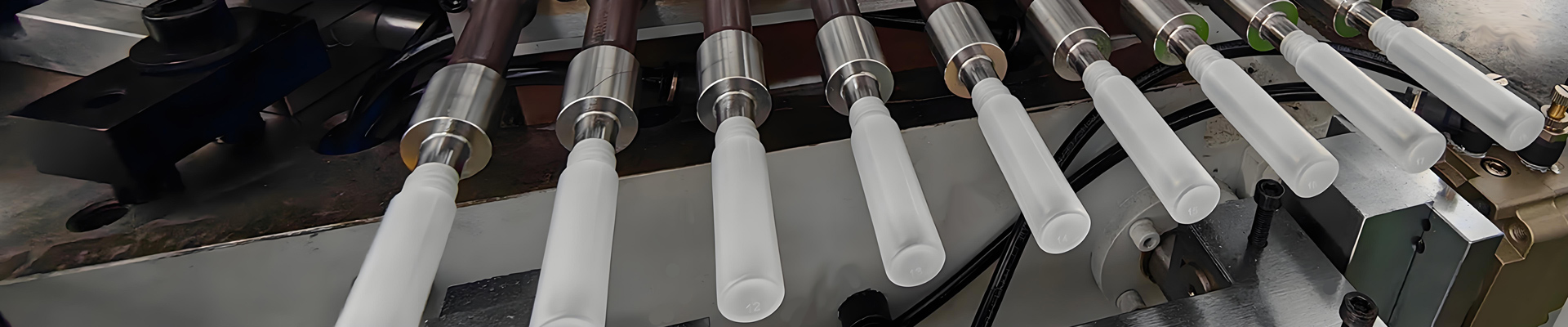
A standard IBM machine runs a rotating turret through stations. The classic layout is three stations: injection (melt is injected around a core rod to form the parison), blow (the parison on the core rod transfers to the blow station, the blow mold closes, and compressed air expands the hot parison against the textured cavity), and strip (the finished bottle is ejected from the core rod). Some machines add a fourth conditioning station between injection and blow where the parison wall temperature is equalized before blow-up, which is valuable for frosted finishes because uniform wall temperature protects texture fidelity.
The sequence is continuous: while one core rod is being injected, another is being blown, and a third is being stripped. This is why IBM is called a one-step process. The bottle neck threads, the parison, and the blown body are all made in a single machine cycle, and the neck finish is molded to final dimension with no flash and no post-trim.
2.2 أين يتم نسخ الملمس
The parison is injected as a smooth-surfaced tube on the core rod. It has no frost. When the turret indexes to the blow station, the parison is clamped inside the blow mold whose cavity walls carry the sandblasted or chemically etched relief. Compressed air pushes the parison outward until it conforms to the cavity, and in doing so the parison skin takes a negative impression of the micro-texture. Because the parison is still soft and tacky at blow temperature, it copies the relief faithfully. That is the key reason the texture belongs on the blow mold, never on the injection mold: the injection mold only shapes the parison exterior, which is then stretched and pressed into the blow cavity where the visible bottle surface is born.
2.3 الفرق بين IBM وISBM في خطوة واحدة
الحقن stretch blow molding (ISBM) also runs one-step on some machines, but it adds a stretch rod that pulls the parison biaxially before or during blow. ISBM is the standard for PET and for materials where molecular orientation improves barrier and top-load. For frosted bottles, the difference matters in two ways. First, ISBM typically runs a higher stretch ratio, which thins and elongates the parison skin; a deep frost texture can be partially ironed out by high stretch, so ISBM frosted bottles need a slightly coarser cavity grade and a stretch ratio tuned to preserve texture. Second, IBM keeps the parison wall thicker and the blow ratio lower, so the texture transfers with less distortion, which is why IBM is the preferred platform for precision frosted cosmetic and pharmaceutical bottles. Aibim machines cover both IBM and ISBM within the same turret family, letting a buyer choose orientation only where the material demands it.
الخلاصة العملية: اختر تجويف قالب النفخ كحامل للملمس، وقرر بين IBM وISBM حسب المادة والحاجة إلى الحاجز، وعامل درجة حرارة الباريسون عند النقل كمتغير يحدد ما إذا كان السطح المصنفر يبدو حادًا أم باهتًا.
3. توافق المواد للزجاجات المصنفرة
Not every resin freezes a frosted texture with the same clarity contrast. The table below maps the common IBM materials to their melt and mold temperature windows, the haze and gloss ranges you can expect, and a frosted suitability grade. These numbers are typical engineering ranges; validate against the resin data sheet for the exact grade you run.
| Material | Melt temperature (°C) | Blow mold temp (°C) | Haze range (%) | Gloss 60° range | Frosted suitability | Notes |
|---|---|---|---|---|---|---|
| PP homopolymer / random copolymer, MFR 10–30 g/10min | 190–230 | 25–45 | Controllable 15–60 | 20–55 | Best | Most controllable frost, low haze base, wide etch tolerance |
| PE HDPE / LDPE / LLDPE | 160–220 | 15–35 | Natural 20–50 | 15–40 | Low to Medium | Already semi-opaque; added frost contrast is weak |
| PS / SAN | 200–240 | 30–55 | High contrast 5–40 | 10–45 | High | Clear base gives strong matte contrast; brittle, watch impact |
| PET (ISBM) | 260–290 | Optional warmed 60–110 | Medium contrast | 20–50 | Medium | Needs high stretch ratio with frost; texture can be ironed |
| PETG | 220–250 | 20–40 | Soft 10–45 | 25–55 | Medium-High | Soft, pleasant frost; low heat deflection limits hot fill |
| PCTG | 230–260 | 25–45 | Soft 10–45 | 25–55 | Medium-High | Tougher than PETG, good for cosmetic droppers |
| PC / acrylic blend | 280–320 | 60–110 | Medium | 30–60 | Medium | High heat and clarity; premium cost |
| ABS / TPU | 200–250 | 30–60 | Medium | 20–55 | Medium | Specialty look; TPU for soft-touch squeeze bottles |
PP is the workhorse of frosted bottles. Its naturally low haze lets the etched relief read as a clean, even matte, and its broad melt window tolerates the slightly higher blow mold temperature that texture transfer demands. Random copolymer PP gives lower neck crystallization and fewer stress whiten marks around the finish, which is why many cosmetic lotion bottles pick it. PS و SAN deliver the strongest contrast because the clear base makes the matte pop, but their brittleness means drop performance and thread torque must be engineered carefully; SAN also resists many cosmetic oils better than PS.
PE is the least rewarding for a true frost because it is already translucent and its surface tends to look waxy rather than sand-blasted. PET and PETG work in ISBM when the stretch ratio is set to preserve the relief, and PETG/PCTG give a soft, premium satin that suits high-end droppers and jars. PC and acrylic blends are premium choices where heat resistance or optical depth is required.
4. إعدادات معاملات العملية للتشطيب المصنفر (القلب)
This is the heart of the article. A frosted finish is won or lost in the process window, and the parameters below are the ones an Aibim process engineer tunes on every texture trial. Read them as a connected system: the parison must be injected clean, conditioned even, blown with the right pressure profile, and cooled against a warm enough cavity to lock the texture.
4.1 إعدادات محطة الحقن (الباريسون)
يجب أن يكون الباريسون كثيفًا وخاليًا من خطوط النفث وثابتًا أبعاديًا بحيث يستقر نظيفًا في تجويف النفخ. الإعدادات الأساسية:
| Parameter | PP typical | PS typical | Why it matters for frost |
|---|---|---|---|
| Barrel zone 1 (feed) | 190–200 °C | 200–210 °C | Stable feeding, no premature melt |
| Barrel zone 2 (compression) | 205–215 °C | 215–225 °C | Uniform plasticizing |
| Barrel zone 3 (metering) | 215–225 °C | 225–235 °C | Consistent melt viscosity |
| Nozzle / adaptor | 220–230 °C | 230–240 °C | Prevent freeze-off at gate |
| الحقن pressure | 90–140 MPa | 100–150 MPa | Fill thin parison without hesitation |
| Holding pressure (profile) | 60–90 MPa | 70–100 MPa | Compensate shrinkage, avoid sink at neck |
| الحقن speed | Slow–fast–slow | Slow–fast–slow | Avoid jetting marks that show through frost |
| Back pressure | 3–8 bar | 3–8 bar | Homogenize melt, remove trapped gas |
| Screw rotation speed | 60–120 rpm | 50–100 rpm | Match plasticizing to cycle |
| Core rod (mandrel) temperature | 60–100 °C | 70–100 °C | Controls parison skin set and transfer |
| الحقن mold (parison) temperature | 15–35 °C | 20–40 °C | Cool parison enough to strip, not so cold it stresses |
The slow–fast–slow injection speed is not optional for frosted bottles. A single fast shot causes a jetting streak that becomes a shiny line on the matte surface, visible under retail lighting. Ramping to fast in the middle fills the parison, then slowing at the end prevents flash at the gate and reduces internal stress that later shows as whiten around the neck. Back pressure of 3–8 bar keeps the melt homogeneous; too low invites silver streaks that read as defects on a matte field.
The core rod temperature is a lever unique to IBM. A warmer core rod keeps the parison interior soft so it slides off cleanly at strip and reduces residual stress; a colder rod gives a stiffer parison that holds shape but risks transfer drag. For frosted PP, 60–100 °C is the workable band, with higher values used when the bottle has long vertical walls that must not buckle during transfer.
4.2 محطة تهيئة الباريسون (عند وجودها)
On four-station machines, the conditioning station equalizes the parison wall temperature before blow. For frosted bottles this is valuable because it removes hot and cold spots that would otherwise copy the texture unevenly. Set the conditioning station to hold the parison at a uniform 95–125 °C for PP, slightly higher for PS, and let the wall thickness and blow-up ratio guide timing. Target a blow-up ratio of 2.5–4.5; ratios above 4.5 thin the skin so much that deep textures get smoothed away, while ratios below 2.5 leave too much material and a soft, undefined frost.
4.3 إعدادات محطة النفخ — خطوة نقل الملمس
هنا تولد الضبابية فعليًا، ويسيطر إعدادان: ملف ضغط النفخ وتصميم فتحات التهوية.
| Parameter | Typical setting | Effect on frosted finish |
|---|---|---|
| Low-pressure pre-blow | 2–4 bar | Gently seats parison to cavity, pre-forms without blasting texture flat |
| High-pressure blow | 6–10 bar | Forces skin into micro-relief for sharp, full texture transfer |
| Blow delay (ms) | 50–300 ms after clamp | Lets parison relax so texture copies without drag lines |
| Blow flow rate | High, short burst | Fast contact improves fidelity; too slow = soft frost |
| Vent / exhaust design | 0.02–0.05 mm deep, densified | Critical: texture traps air, so vents must be finer and more numerous |
The vent detail is the single most overlooked point in frosted bottle production. A smooth cavity vents air through the parting line and a few milled grooves. A textured cavity, however, creates thousands of tiny pockets that trap air between the parison and the relief; if the air cannot escape, the parison floats off the cavity and the frost comes out patchy or missing entirely. The correction is to densify the exhaust grooves to a depth of 0.02–0.05 mm and increase their number around the textured zone, especially near the shoulder and base where air pockets form first. This is the difference between a crisp frost and a rejected batch.
The pressure profile should start low to let the parison gently contact the cavity, then step to high pressure to push the skin into every micro-notch of the etched relief. A single high-pressure blast too early can stretch the parison so fast that it bridges over the texture instead of copying it, leaving glossy islands.
4.4 درجة حرارة قالب النفخ — دافئة بما يكفي للنقل
A frosted bottle needs a higher blow mold temperature than a glossy bottle. The slight extra heat keeps the parison skin soft long enough to flow into the relief. For PP, run the blow mold at 25–45 °C, which is roughly 5–15 °C above the mold temperature you would use for a clear glossy PP bottle. Too cold and the texture is only partially transferred; too warm and the cycle stretches and the bottle may stick or show gate stress.
| Surface goal | PP blow mold temp | Result |
|---|---|---|
| Glossy clear | 15–30 °C | Sharp mirror, no texture |
| Frosted (light) | 30–38 °C | Soft matte, fine relief |
| Frosted (full sand-blast) | 38–45 °C | Deep, even frost, longer cooling needed |
المقايضة هي زمن التبريد. القالب الأكثر دفئًا يعني أن الزجاجة يجب أن تبقى مثبتة لفترة أطول لتثبت، مما يضيف ثوانٍ إلى الدورة. يحدد الجدول أدناه تحليل الدورة النموذجي والزيادة المصنفرة مقارنة بزجاجة لامعة من نفس الحجم.
| Cycle segment | Glossy (s) | Frosted (s) | Frosted increment |
|---|---|---|---|
| الحقن (parison) | 2.0–3.0 | 2.0–3.2 | +0.0–0.2 |
| Holding / pack | 1.5–2.5 | 1.5–2.5 | 0 |
| Cooling (parison) | 3.0–5.0 | 3.0–5.0 | 0 |
| Turret rotation / transfer | 0.8–1.2 | 0.8–1.2 | 0 |
| Blow / expand | 1.0–1.8 | 1.2–2.2 | +0.2–0.4 |
| Blow mold cooling (set) | 4.0–6.0 | 5.5–8.5 | +1.5–2.5 |
| Strip / eject | 0.6–1.0 | 0.6–1.0 | 0 |
| Total per cavity-set | 13–20 | 15–23 | +1.5–3.0 |
The honest conclusion is that a frosted bottle costs about 1.5–3.0 seconds more per cycle than its glossy twin, almost all of it in blow mold cooling. That penalty is recovered by raising mold temperature control precision and by designing the cooling circuit so the textured zone is held within ±2 °C, which lets you run at the low end of the warmer band rather than over-cooling.
5. العيوب الشائعة والإجراءات المضادة
تضخم الأسطح المصنفرة بعض العيوب وتخفي أخرى. يخفي الحقل المطفي خطوط التدفق البسيطة ولكنه يضخم اللمعان غير المنتظم وفقدان الملمس. يسرد الجدول أدناه العيوب التي يراها فريق عمليات Aibim غالبًا على زجاجات IBM المصنفرة، مع السبب الجذري والحل.
| # | Defect | Root cause | Countermeasure |
|---|---|---|---|
| 1 | Texture transfer incomplete (glossy patches) | Blow mold too cold; high pressure too early; poor venting | Raise blow mold temp 5–15 °C; use 2–4 bar pre-blow then 6–10 bar; densify 0.02–0.05 mm vents |
| 2 | Patchy / uneven gloss | Uneven wall temperature; inconsistent parison temp; mold temp drift | Add or tune conditioning station; tighten mold temp control to ±2 °C; verify core rod temp |
| 3 | Texture worn to gloss (after run) | Mold steel too soft; abrasive masterbatch; long run | Use hardened steel or PVD coating; plan re-etch cycle; reduce filler abrasion |
| 4 | White specks / silver streaks | Trapped moisture or gas; low back pressure; degraded resin | Dry resin; raise back pressure to 3–8 bar; lower melt temp; check regrind ratio |
| 5 | Demolding drag marks (matte scraped shiny) | Texture increases release friction; draft angle too small | Increase draft angle from 0.5° to 1–1.5°; improve ejection; verify mold release |
| 6 | Neck finish flash | Parison over-pack; mold parting not sealed; clamp low | Reduce holding pressure; check parting line; verify clamp force |
| 7 | Wall thickness uneven | Parison programming off; core rod eccentric; transfer misalign | Re-profile parison; center core rod; verify turret indexing |
| 8 | Sink marks at neck or base | Insufficient holding; thick section; cooling unequal | Raise holding pressure and time; balance cooling circuit |
| 9 | Bubbles / voids | Volatiles in melt; moisture; screw decompress | Dry material; lower melt temp; adjust back pressure and decompression |
| 10 | Color shade variation | Masterbatch let-down drift; batch change; shear heat | Stabilize let-down; lock recipe on SD card; monitor melt temp |
| 11 | Fingerprint visibility on matte | Matte surface traps oils; low surface energy | Specify finer etch for less oil grab; advise handling; consider soft-touch top coat offline |
| 12 | Base ovality / poor standing | Blow ratio too high; base not supported; cooling short | Reduce blow-up ratio toward 2.5–4.5; extend base cooling; check base vent |
Two of these deserve emphasis because they are unique to frosted bottles. Number 5, demolding drag, appears because the micro-relief that creates the frost also increases the surface area and mechanical interlock at release; the standard 0.5° draft angle that works on a glossy bottle is often insufficient, and raising it to 1–1.5° is the routine correction. Number 1, incomplete texture transfer, is almost always a venting or mold-temperature problem, not a material problem, which is why the vent depth of 0.02–0.05 mm and the warmer mold band are stressed throughout this article.
6. نقاط تصميم القالب للتشطيب المصنفر
قالب النفخ هو الأداة الحقيقية للزجاجة المطفية. تصميمه جيدًا يحدد ما إذا كان الملمس سيبقى لمليون دورة. النقاط التالية توجه القالب الذي تبنيه Aibim وتضفي عليه الملمس لخطوط IBM الخاصة بها.
Texture uniformity and parting-line transition. The etch must wrap the cavity continuously, including across the shoulder and into the base. Where the parting line crosses the textured zone, the two halves must align within a few microns or a visible seam appears. Aibim programs the etch mask so the parting line falls in a non-critical area or is blended by a transition zone.
صقل السطح الأساسي قبل الحفر. يعمل الحفر على تضخيم أي سطح يبدأ منه. يتم أولاً صقل التجويف إلى تشطيب أساسي نظيف SPI بحيث يظهر السطح المصنفر كحبيبات متسقة بدلاً من تنقير عشوائي. الأساس الرديء يعطي مظهرًا غير لامع متبقعًا وقذرًا.
Coating choice. Hard chrome, electroless nickel-phosphorus, and PVD coatings each change the texture. Chrome is hard and releases well but can soften fine etch edges over re-chromes; nickel-phosphorus holds micro-relief precisely and resists many cosmetic oils; PVD gives the highest wear resistance for long abrasive runs. The coating is matched to the resin and run length.
Mold material. A frosted cavity wears faster than a glossy one because the relief edges are thin and carry release stress. Aibim uses pre-hardened tool steel (P20-type) for most runs and stainless tool steel (420-type) where corrosion resistance against cleaning and certain formulations is required. Both are selected for higher wear resistance than a standard mold steel.
Texture repair and re-etch cycle. After a production run the relief can round off; rather than scrap the mold, the cavity is re-polished and re-etched to the same VDI 3400 grade, restoring the original frost. Planning this cycle into preventive maintenance keeps the finish consistent across years of production.
تخطيط التبريد. يجب الحفاظ على المنطقة المحببة ضمن ±2 درجة مئوية. تصمم Aibim تبريدًا بالحواجز والفقاعات بحيث يتلقى الكتف والجسم والقاعدة جميعًا تدفقًا متوازنًا، لأن نقطة ساخنة في الشريط المحبب تنتج بقعة لامعة لا يمكن لأي تعديل معايير إخفاءها بالكامل.
7. فحص الجودة والقبول الكمي
تُقبل الزجاجة المطفية على كل من المظهر والأداء الفيزيائي. المعايير القابلة للقياس أدناه هي التي تسجلها Aibim في تجربة النسيج وفي دفعات الإنتاج الواردة.
| Test | Standard | Typical frosted acceptance | Purpose |
|---|---|---|---|
| Haze | ASTM D1003 | 15–60 % depending on grade | Confirms matte diffusion level |
| Gloss 60° | ASTM D2457 | 10–55 GU | Confirms low-reflective finish |
| Surface roughness Ra | ISO 4287 / profile | 0.4–3.0 μm on etched zone | Quantifies micro-relief depth |
| Texture depth | Profilometer | 2–25 μm by VDI grade | Links etch grade to look |
| Color ΔE | CIE Lab | < 1.5 between lots | Batch-to-batch consistency |
| Abrasion / rub | Taber / crock | No gloss rise after set cycles | Frost durability in handling |
| Drop test | Internal / ASTM D5276 | No crack at specified height | Transport robustness |
| Sealing integrity | Leak / torque | No leak at cap torque | Closure performance |
The two optical measures, haze per ASTM D1003 and gloss 60° per ASTM D2457, are the daily checks. A frosted bottle that drifts above its gloss ceiling is reading as too shiny; one that climbs in haze beyond spec is reading as too cloudy, usually from contamination or an additive shift. Surface roughness Ra and profilometer texture depth tie the look back to the VDI 3400 etch grade so the finish is documented, not guessed. Color ΔE under 1.5 keeps a brand’s matte bottle identical across reorders, which is exactly what cosmetic and pharmaceutical buyers require.
8. آلات الحقن والنفخ من Aibim
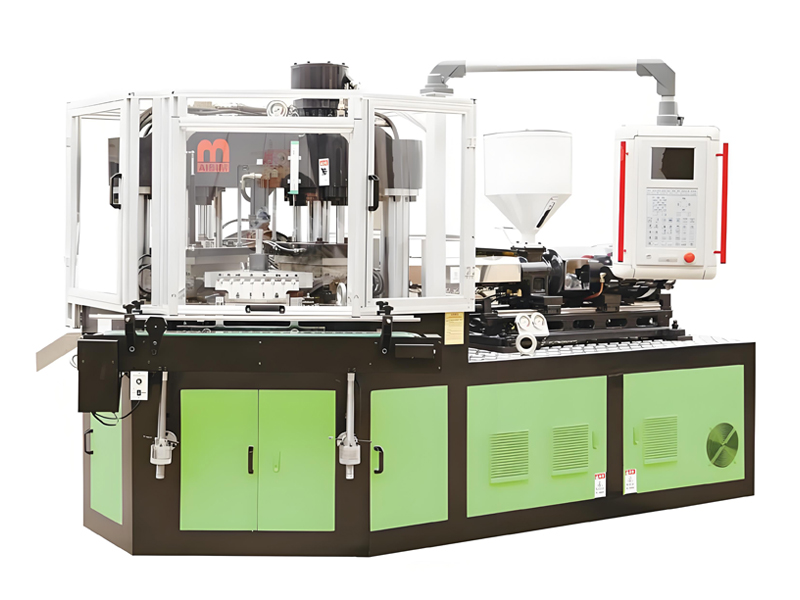
Aibim, a Wanplas factory with 12+ years in plastic machine manufacturing and 20 years in injection blow molding, builds three-station one-step I(S)BM machines from 3 mL to 1000 mL, with its own CNC center and a 100+ lines-per-year capacity from a new factory established in 2022. The machines carry CE certification, a minimum 35% energy saving through PREFILL technology and variable displacement pump pressurizing, and SD-card recipe storage so a validated frosted process moves from one machine to another without re-tuning. Below are two of the real series used for frosted bottle programs.
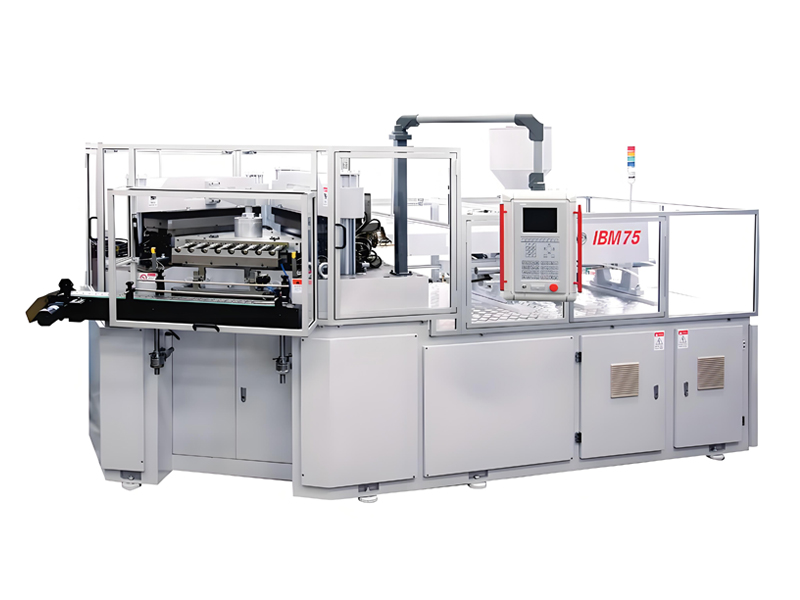
8.1 آلة IBM75 للحقن والنفخ
The IBM75 is the flagship for mid-to-large frosted bottles such as 200 mL lotion bottles, 500 mL toner bottles, and 1000 mL body wash containers. Its wider platen and higher clamp accept multi-cavity molds with deep-etched blow cavities, and its conditioning-friendly turret supports the even-wall temperature that frosted finishes need.
| Specification | IBM75 |
|---|---|
| Clamping force | 75 ton (750 kN) |
| الحقن screw diameter | 45 mm |
| Screw L/D ratio | 20:1 |
| Theoretical shot volume | 290 cm³ |
| Max. preform weight | 280 g |
| Max. bottle volume | 1000 mL |
| Cavity number | 2–8 (by bottle size) |
| Mold platen size (H×V) | 460 × 460 mm |
| Max. bottle height | 240 mm |
| وقت دورة التجفيف | ~2.0 s |
| Installed power | 33 kW |
| Heating power | 14 kW |
| وزن الماكينة | ~4.8 t |
| Machine dimensions | 3.6 × 1.6 × 2.2 m |
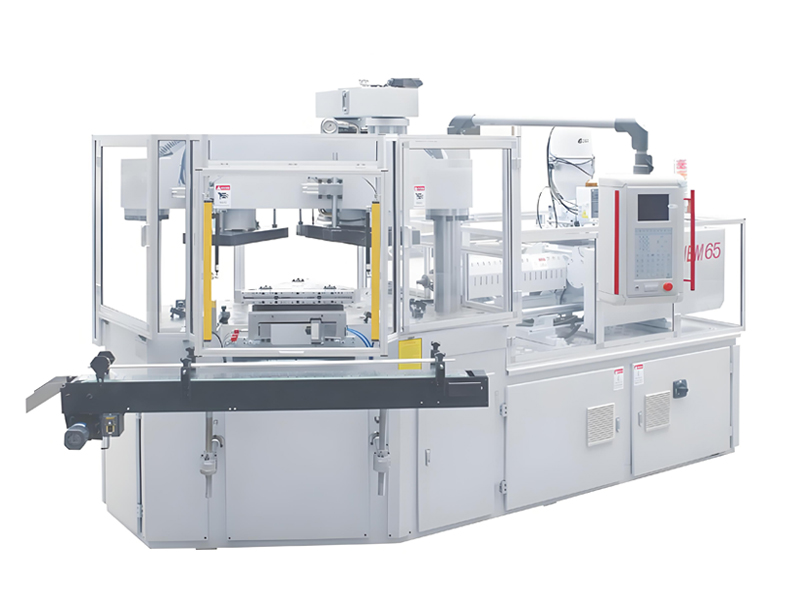
8.2 آلة IBM65 للحقن والنفخ
إن IBM65 هو الحصان المتوازن للزجاجات التجميلية والصيدلانية المصنفرة بحجم 30–500 مل. فهو يجمع بين مساحة أصغر قليلاً وعدد تجاويف كافٍ لإنتاج جاد، مما يجعله الخيار الشائع لقطارات السيروم وزجاجات الإكسير والتونر بحجم 100 مل.
| Specification | IBM65 |
|---|---|
| Clamping force | 65 ton (650 kN) |
| الحقن screw diameter | 40 mm |
| Screw L/D ratio | 20:1 |
| Theoretical shot volume | 220 cm³ |
| Max. preform weight | 210 g |
| Max. bottle volume | 500 mL |
| Cavity number | 2–6 (by bottle size) |
| Mold platen size (H×V) | 420 × 420 mm |
| Max. bottle height | 200 mm |
| وقت دورة التجفيف | ~1.8 s |
| Installed power | 28 kW |
| Heating power | 12 kW |
| وزن الماكينة | ~4.0 t |
| Machine dimensions | 3.3 × 1.5 × 2.1 m |
For buyers prioritizing the lowest energy use on smaller 10–250 mL frosted bottles, the IBM55 Hybrid Electric adds a servo-electric assist to the hydraulic clamp, extending the 35% energy saving further on light parts while keeping the same three-station one-step process and the same textured blow mold standard. All three machines share Aibim’s SD-card recipe system, so a frosted process developed on an IBM75 transfers to an IBM55 without re-deriving the window.
9. صناعات التطبيق وأحجام الحاويات
تخدم آلات Aibim أسواق الأدوية والأغذية والمشروبات ومستحضرات التجميل، وتُقدَّر التشطيبات المصنفرة بشكل خاص حيث ينقل المظهر الفاخر غير القابل للانزلاق والمشتت للضوء الجودة. المنتجات النهائية الملموسة والأحجام التي تستخدمها عادةً:
- مستحضرات التجميل والعناية الشخصية: زجاجات المستحلب (30 / 50 / 100 مل)، وزجاجات السيروم والخلاصات (10 / 30 مل)، وزجاجات التونر (100 / 200 مل)، وزجاجات رذاذ وغسول الوجه (100 / 200 مل). يهيمن هنا PP وPETG المصنفران للحصول على الملمس غير اللامع الناعم.
- العطور: زجاجات رذاذ ودوارة مصنفرة سعة 10 / 30 / 50 مل حيث يشتت السطح غير اللامع الضوء ويخفي تغيرات مستوى السائل.
- السائل الفموي الدوائي: زجاجات PP أو PS/SAN مطفية من 10/30 مل لشراب ومحاليل الجرعات المقاسة، مع تشطيب غير لامع يساعد كبار السن على الإمساك.
- المكملات الصحية: زجاجات قطارة سعة 50 / 100 مل من PETG أو PCTG بمصنفر ناعم يشير إلى تموضع طبيعي.
- المواد الكيميائية اليومية: زجاجات معقم اليدين واللوشن سعة 100 / 200 مل حيث يكون السطح غير اللامع المضاد للانزلاق وظيفيًا.
- العناية بالرضع والأطفال: زجاجات تركيبة لطيفة سعة 30 / 50 مل حيث يقترن مصنفر شفاف لكن ناعم براتنجات من درجة السلامة.
- عبوات المشروبات الروحية الفاخرة الصغيرة: زجاجات عينات سعة 50 / 100 مل حيث يكون الجسم المصنفر جزءًا من تقديم الهدية.
سلم 10 / 30 / 50 / 100 / 200 مل المتكرر هو الخريطة العملية: الأحجام الصغيرة تفضل IBM55 Hybrid، والأحجام المتوسطة IBM65، والزجاجات المطفية الأكبر من 200-1000 مل IBM75 بأدوات متعددة التجاويف.
10. جدول اختيار الطراز حسب المتطلبات
يربط الجدول متغيرات المشتري الحقيقية — حجم الزجاجة والمادة والإنتاج السنوي ومستوى التصنفر المطلوب — بطراز Aibim الموصى به وعدد التجاويف. تفترض أرقام الإنتاج تشغيل ورديتين ودورة قياسية؛ تحقق منها مقابل الزجاجة والقالب الدقيقين.
| Bottle volume | Material | Annual output | Frost level | Recommended model | Cavities |
|---|---|---|---|---|---|
| 10–30 mL | PP / PETG | Low–Medium | Light–Full | IBM55 Hybrid | 4–8 |
| 30–50 mL | PP / PS / SAN | Medium | Full sand-blast | IBM65 | 4–6 |
| 50–100 mL | PP / PETG / PCTG | Medium–High | Light–Full | IBM65 | 2–6 |
| 100–200 mL | PP / PETG | Medium–High | Full | IBM65 / IBM75 | 2–4 |
| 200–500 mL | PP / PETG | High | Full | IBM75 | 2–4 |
| 500–1000 mL | PP | High | Medium–Full | IBM75 | 2 |
| Any, multi-resin trial | PP / PS / PETG | العمالةatory | All grades | IBM65 (R&D mold) | 1–2 |
The selection logic is simple: pick the smallest machine whose clamp and platen can hold the required cavity count at the target bottle size, then choose the etch grade (VDI 3400 21–45) that delivers the frost level, and set the blow mold temperature at the warmer band with densified vents. Aibim’s process team locks this recipe to an SD card so reorders run identically.
11. الخدمة والدعم من Aibim
شراء خط زجاجات مطفي هو شراء عملية قابلة للتكرار، وليس مجرد فولاذ. تدعم Aibim، كمصنع من Wanplas، كل ماكينة بالتزامات المجموعة المشتركة وخبرتها الخاصة في IBM.
- الاختبار قبل الشحن: تشغل كل ماكينة تجربة مستمرة، بما في ذلك قالب محكم، بحيث يُتحقق من الناتج المطفي قبل مغادرة الخط للمصنع.
- تجربة القالب وأخذ عينات النسيج: تجري Aibim حفر التجاويف وتجارب النفخ على راتنج العميل، وتقدم عينات ضبابية ولمعان معتمدة (وفق ASTM D1003 وASTM D2457) قبل الإنتاج بالكميات.
- التركيب والتشغيل: يضبط المهندسون الماكينة والقالب والتبريد على الوصفة المعتمدة في موقع العميل.
- قطع الغيار: توفر سياسة مجموعة Wanplas قطعًا مجانية بقيمة 500 دولار أمريكي كل عام، مع استبدال بالضمان للقطع التالفة.
- التدريب: يتعلم المشغلون برمجة الباريسون والتحكم في درجة حرارة القالب وصيانة فتحات التهوية وجدولة إعادة نقش الملمس.
- التشغيل والصيانة عن بُعد: يتيح نظام الوصفات على بطاقة SD والمراقبة عن بُعد الاختيارية لـ Aibim فحص بيانات العملية ودعم استكشاف الأخطاء وإصلاحها بسرعة.
- المصنع المفتوح: العملاء مرحب بهم لزيارة منشأة Zhangjiagang ورؤية مركز CNC وتدقيق خط الإنتاج قبل الشراء وبعده.
لأن Wanplas تدير شبكة من المصانع المتخصصة، يمكن تنسيق القدرات المجاورة مثل التعبئة المطابقة والتغليف النهائي من خلال مجموعة Wanplas، مما يبقي المشروع ضمن سلسلة توريد موثوقة واحدة.
Closing invitation. If you are specifying frosted finish bottles — whether a 10 mL serum dropper or a 1000 mL body wash container — send Aibim your bottle drawing, target material, required frost level, and annual volume. The team will propose the right IBM model, design and etch the blow mold, run a texture sample on your resin, and invite you to the factory for a trial run and audit. No two frosted finishes are identical, and the fastest path to a consistent matte is a jointly developed, documented process.
12. الأسئلة الشائعة
ما أفضل طريقة لصنع زجاجة بلمسة مصنفرة على آلة قولبة النفخ بالحقن؟
The most reliable route is in-mold texture: etch or sandblast the blow mold cavity to a VDI 3400 grade of 21–45, then blow the parison against the warm cavity so the skin copies the relief. It gives single-material recyclability, no recurring consumable cost, and shot-to-shot consistency that additive or post-coat methods cannot match.
لماذا يوضع الملمس على قالب النفخ بدلاً من قالب الحقن؟
The parison injected on the core rod is smooth, and the visible bottle surface is created only when the soft parison is expanded against the blow cavity. Etching the blow cavity lets the relief transfer during blow-up; etching the injection mold would only texture the parison exterior, which is then stretched and pressed into the blow cavity where the texture would be lost or distorted.
أي مادة تعطي المظهر المصنفر الأنقى؟
PP is the best all-round choice because its naturally low haze lets the etched relief read as an even matte, and its broad melt window tolerates the slightly higher blow mold temperature that texture transfer needs. PS و SAN give the strongest contrast on a clear base but are more brittle, while PETG and PCTG give a softer premium satin.
لماذا تحتاج الزجاجات المصنفرة إلى درجة حرارة قالب نفخ أعلى وتبريد أطول؟
The slightly warmer cavity keeps the parison skin soft long enough to flow into the micro-relief, so the frost transfers fully. For PP, run the blow mold at 25–45 °C, about 5–15 °C above a glossy bottle. The cost is roughly 1.5–3.0 extra seconds of blow mold cooling per cycle, recovered by tight ±2 °C mold temperature control.
لماذا تعتبر فتحات التهوية مهمة جداً للزجاجات المصنفرة؟
A textured cavity traps air in thousands of tiny pockets; if that air cannot escape, the parison floats off the relief and the frost comes out patchy or missing. The correction is to densify the vent grooves to a depth of 0.02–0.05 mm and increase their number around the textured zone, especially at the shoulder and base.
لماذا تظهر أحيانًا علامات سحب لامعة على الزجاجات المصنفرة بعد القذف؟
تزيد النقوش الدقيقة من احتكاك الانفصال، لذا فإن زاوية السحب القياسية 0.5 درجة المستخدمة على الزجاجات اللامعة غالبًا ما تكون غير كافية ويُخدش السطح المطفي ليصبح لامعًا أثناء إزالة القالب. رفع زاوية السحب إلى 1-1.5 درجة والتحقق من انفصال القالب يزيل العيب عادةً.
كيف يتم قياس التشطيب المصنفر وقبوله؟
تُقاس الضبابية وفق ASTM D1003 واللمعان بزاوية 60° وفق ASTM D2457، مدعومة بخشونة السطح Ra وعمق الملمس بمقياس الملف الشخصي اللذين يربطان المظهر بدرجة الحفر VDI. يُتتبع اتساق اللون بـ ΔE أقل من 1.5 بين الدفعات، مع اختبارات السقوط والختم والتآكل التي تؤكد الأداء الفيزيائي.
أي آلة Aibim يجب أن أختار لزجاجة مستحضرات تجميل مصنفرة بسعة 100 مل؟
لزجاجة بلورية بحجم 100 مل من PP أو PETG بإنتاج متوسط إلى عالٍ، فإن IBM65 مع 2-6 تجاويف هو الخيار النموذجي؛ دفعات أصغر من 10-30 مل تناسب IBM55 Hybrid، وزجاجات بلورية أكبر من 200-1000 مل تنتقل إلى IBM75. يعتمد عدد التجاويف الدقيق على الحجم السنوي وهدف الدورة.