Mục lục
- Tại sao chai IBM trong suốt bị đục hoặc xuất hiện vết chảy
- Vật lý của độ trong suốt: Độ đục, độ trong và tán xạ ánh sáng
- Cách ép phun thổi tạo ra chai trong suốt
- Độ đục: Năm nguyên nhân gốc rễ và cách loại bỏ từng nguyên nhân
- Vết chảy: Nguyên nhân gốc rễ và biện pháp khắc phục
- Ma trận biện pháp khắc phục khuyết tật bốn chiều
- Thông số sấy vật liệu
- Cửa sổ quy trình ép phun và thổi
- Các yếu tố khuôn và thiết bị kiểm soát độ trong suốt
- Dòng máy IBM Aibim cho chai trong suốt
- So sánh độ trong suốt của vật liệu
- Hướng dẫn lựa chọn từ yêu cầu đến model
- Kiểm tra độ trong suốt và kiểm soát chất lượng
- Bảng tra cứu nhanh khuyết tật-nguyên nhân-biện pháp khắc phục
- Chi phí và đầu tư tương đối của các biện pháp khắc phục
- Dịch vụ và hỗ trợ Aibim
- Câu hỏi thường gặp
- Kết luận và lời mời
Tại sao chai IBM trong suốt bị đục hoặc xuất hiện vết chảy
Transparent bottles produced on injection blow molding (IBM) lines are in high demand for pharmaceutical, cosmetic, food, and beverage packaging because they let the consumer see the product and signal purity. Yet many producers discover that a bottle that should be crystal clear comes out cloudy, milky, or marked with wavy streaks called flow marks. Aibim, a Wanplas factory (Zhangjiagang AiBiM Plastics Machinery Co., Ltd.), has specialized in injection (stretch) blow molding machines for more than 12 years in machinery manufacturing and 20 years in the IBM field. Our three-station, one-step IBM lines run in 40-plus countries, are built with our own CNC center, and our 2022 new factory ships 100-plus lines per year for containers from 3 mL to 1000 mL. The slogan on every machine we build is simple: “Máy ép thổi khuôn Manufacturer.”
The single most useful fact for any engineer chasing clarity is this: core idea cloudiness and flow marks on an IBM transparent bottle are never one problem. They are four families of problems — crystallization, orientation and stress, cooling, and melt flow — and each family has its own machine, mold, process, and material countermeasures. A bottle can be cloudy because its polymer spherulites are too large, because residual moisture hydrolyzed the resin, because internal stress caused stress whitening, because the mold surface scattered light, or because trapped gas formed bubbles. Likewise, flow marks can come from the injection station, the blow station, the gate design, or the parison temperature profile. If you treat all “haze” as one defect, you will chase the wrong lever.
This article is a complete field manual. It explains the physical basis of transparency, walks through the IBM process, then breaks cloudiness and flow marks into their individual root causes with concrete fixes across the four dimensions of machine, mold, process, and material. It includes the four-dimension countermeasure matrix, a material drying table, an injection and blow process window, a defect quick-reference table with more than 14 rows, product specification tables for the IBM75, IBM65, and IBM55 Hybrid Electric machines, a requirement-to-model selection table, and a relative cost ranking so you can plan investment. By the end, you will be able to read a cloudy or streaked bottle like a diagnostic chart and pick the right correction.
Vật lý của độ trong suốt: Độ đục, độ trong và tán xạ ánh sáng
Transparency is not a single number; it is the result of how a polymer transmits and scatters light. Two measurements matter most. Clarity (or light transmittance) describes how much light passes straight through the wall. Haze is the percentage of transmitted light that is scattered more than 2.5 degrees from the straight path. A bottle can have high light transmittance yet still look milky if its haze is high, because the scattered light diffuses the image behind it. For a transparent pharmaceutical or cosmetic bottle, both high transmittance and low haze are required.
Light is scattered by any interface where the refractive index changes. In a clear amorphous polymer with no crystals, the refractive index is uniform and light passes through. In a semi-crystalline polymer, the crystalline regions have a different refractive index from the amorphous regions, so every spherulite boundary becomes a tiny scattering site. The larger and more numerous the spherulites, the higher the haze. This is why polypropylene, a semi-crystalline resin, tends to look translucent or milky unless it is quenched rapidly or modified with a clarifying agent, while polystyrene, SAN, PC, PCTG, and PMMA are naturally transparent because they are largely amorphous.
Các nguồn chính gây tán xạ hoặc mất ánh sáng trong chai trong suốt IBM là:
- Các bông cầu tinh thể trong nhựa bán tinh thể (PP, PE, PET khi kết tinh).
- Ứng suất nội và hiện tượng lưỡng chiết do làm nguội không đều hoặc định hướng phân tử, khiến ánh sáng bị bẻ cong khác nhau trên thành sản phẩm.
- Khuyết tật bề mặt — đánh bóng khuôn kém, hiện tượng vỏ cam, vết kéo — làm tán xạ ánh sáng tại bề mặt thành sản phẩm.
- Bọt khí và lỗ rỗng từ khí hoặc chất bay hơi bị kẹt, mỗi cái hoạt động như một thấu kính siêu nhỏ.
- Tạp chất và hạt cacbon hóa từ vật liệu nhiễm bẩn hoặc nhựa bị phân hủy trong trục vít.
- Sự phân hủy thủy phân của PET, PC hoặc PCTG không được sấy khô, tạo ra thành sản phẩm trắng, giòn và mờ đục.
Two more physical effects deserve attention before moving to process. The first is refractive-index mismatch. Even within one amorphous resin, a region that is stretched (oriented) has a slightly different refractive index from a relaxed region. Where these regions meet at a sharp boundary, light bends and a faint line appears. This is the optical signature of frozen-in orientation, and it is why a bottle can look clear in the center yet show faint rings near the neck or shoulder where shear was highest. The second is surface scatter versus volume scatter. Surface scatter comes from the mold finish and is corrected by polishing; volume scatter comes from crystals, bubbles, and stress inside the wall and is corrected by material and process. A quick diagnostic is to wet the bottle surface with a clear oil: if the haze disappears, the problem is surface (mold) finish; if it remains, the problem is inside the wall (volume). This single test tells you whether to send the mold to the polisher or to re-tune the process and material.
Measurement discipline also matters. A haze meter gives a repeatable number, but the number is meaningless without a defined sample, light path, and reference. Establish a master sample for each bottle and measure it on the same instrument under the same conditions, then hold production parts to a tolerance band around that master. Visual grading under a standard light box is a useful secondary check, but it should never replace the numeric haze reading for release decisions. Remember that haze and light transmittance move independently: a bottle can stay bright yet grow hazier, so track both.
Bảng dưới đây tóm tắt cách hoạt động của các vật liệu IBM phổ biến. Lưu ý rằng “cấp độ trong suốt” là đặc tính của vật liệu, nhưng độ trong suốt thực tế của chai được quyết định bởi cách bạn gia công. Một loại nhựa tự nhiên trong suốt vẫn có thể bị hỏng do sấy kém hoặc làm nguội chậm.
| Material | Transparency class | Key clarity risk | IBM relevance |
|---|---|---|---|
| PP (homopolymer / copolymer) | Semi-crystalline | Spherulite growth, milky haze | Very common for pharmaceutics and food; needs quench + clarifier |
| HDPE / LDPE / LLDPE | Semi-crystalline | Naturally translucent, not clear | Used when clarity not required |
| PS | Amorphous | Brittle, low chemical resistance | Naturally clear, easy haze control |
| SAN | Amorphous | Needs drying; stress crack risk | Clear, rigid, good for cosmetics |
| ABS | Amorphous (with rubber) | Rubber phase scatters light slightly | Translucent, not fully clear |
| PC | Amorphous | Hydrolysis whitening if wet | Premium clear, high heat |
| PCTG / PETG | Amorphous copolyester | Hydrolysis; needs drying | Excellent clarity, tough, cosmetic-grade |
| PET (rare in IBM) | Semi-crystalline | Crystallizes fast, turns opaque | Usually ISBM; if IBM, control crystallization |
| TPU | Segmented, often hazy | Inherent softness/cloud | Specialty soft-touch bottles |
Cách ép phun thổi tạo ra chai trong suốt
Ép phun blow molding is a one-step, three-station process that combines injection molding and blow molding on a single rotating machine. In the first station, the machine injects the melt into a parison (also called a preform) cavity around a core rod. In the second station, the heated parison on its core rod is transferred to the blow station, where compressed air expands it against a cold blow mold to form the bottle. In the third station, the finished bottle is stripped off the core rod. There is no flash, the neck finish is molded to high precision, and the parison wall thickness is uniform by design.
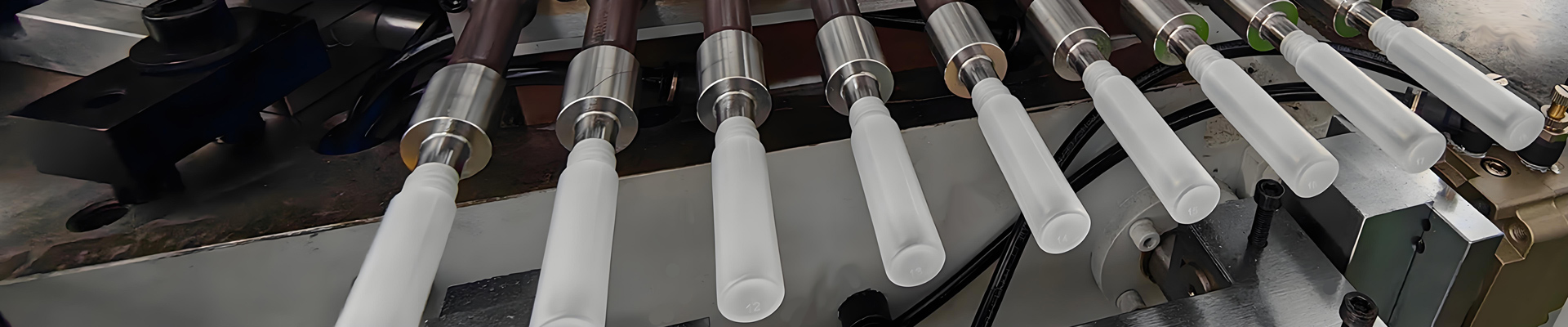
The core rod is the silent hero of IBM clarity. The parison is molded around a heated core rod at the first station, then the rod carries that parison, still at a controlled temperature, to the blow station. Because the parison never leaves the rod and is never dropped or re-gripped, its temperature profile is preserved and its surface is not scuffed by handling. At the blow station the rod acts as the internal blow mandrel: compressed air enters through it and expands the warm parison against the cold mold. The rod temperature, therefore, directly sets the parison temperature that the blow station sees — and parison temperature is the single biggest driver of even wall stretch and mark-free surfaces. Aibim machines hold this temperature with dedicated control so the parison arrives at blow neither too cold (which marks) nor too hot (which sags and thins).
This structure matters for clarity. Because the parison is injection-molded rather than extruded, its wall is consistent and free of the thickness variations and weld lines that often appear in extrusion blow molding. Because the whole cycle is one step inside the machine, the parison is not handled, cooled, and reheated as in a two-step process, so contamination and moisture pickup are minimized. The trade-off is that IBM is best suited to small, high-precision containers from 3 mL to 1000 mL — exactly the transparent pharmaceutical, cosmetic, and single-serve bottles where clarity is most valuable.
So với ép đùn thổi và thổi gia nhiệt lại hai bước, IBM cho khả năng kiểm soát chặt chẽ nhất về độ đồng đều của thành sản phẩm, đây là nền tảng của sự truyền ánh sáng đều. So sánh dưới đây là giữa các công nghệ với nhau, không phải giữa các thương hiệu:
| Process | Parison formation | Flash | Wall uniformity | Typical clarity control | Best container size |
|---|---|---|---|---|---|
| Ép phun blow molding (IBM) | Ép phun, 3-station one-step | None | Excellent | Very high, controlled parison temp | 3–1000 mL |
| Two-step blow (reheat) | Ép phun preform, then reheat-blow | None | Good | High, but reheating variance | 100 mL–2 L |
| Extrusion blow molding | Extruded parison | Some | Fair | Lower, wall variation | 50 mL–20 L+ |
Độ đục: Năm nguyên nhân gốc rễ và cách loại bỏ từng nguyên nhân
Độ đục là thuật ngữ chung cho hiện tượng mờ không mong muốn. Trong chai trong suốt IBM, nó thường bắt nguồn từ một trong năm nguyên nhân. Chẩn đoán dựa trên vị trí xuất hiện của độ mờ và điều kiện xuất hiện, sau đó áp dụng biện pháp khắc phục tương ứng.
Nguyên nhân 1: Đục do kết tinh (PP, PE, PET)
PP and PE are semi-crystalline. If the parison or bottle wall cools slowly, spherulites have time to grow into large light-scattering structures, and the bottle looks milky instead of clear. The fix is to force rapid, uniform cooling and to keep crystals small. Lower the blow mold temperature, increase coolant flow, and consider a nucleating or clarifying agent that multiplies the number of crystal nuclei so each spherulite stays tiny. For PET processed by IBM, control residence time and temperature so it does not crystallize into an opaque wall.
Nguyên nhân 2: Độ đục do thủy phân và phân hủy (PET, PC, PCTG, SAN)
PET, PC, PCTG, and to a lesser degree SAN are hygroscopic. If they are not dried to a low moisture level before plasticizing, water reacts with the polymer chain during melt processing, breaking it and producing a white, brittle, hazy wall. The cure is disciplined drying in a dehumidifying dryer at the correct temperature, dew point, and residence time (see the drying table in section 7). Barrel temperature must also stay within the safe window so the melt does not degrade.
Nguyên nhân 3: Trắng do ứng suất và ứng suất nội
When a bottle is cooled too fast or the parison temperature is uneven, frozen-in orientation and internal stress create birefringence that scatters light, and in severe cases visible stress whitening. Balance the holding pressure and cooling, keep the parison temperature profile even across the core, and avoid over-cooling that locks in stress. A polarized-light inspection (section 13) reveals stress you cannot see with the eye.
Nguyên nhân 4: Tạp chất và chấm đen
Contaminated regrind, dust on pellets, or carbonized material baked onto the barrel wall or screw shows up as black dots and gray haze. Clean the material path, use a dehumidifying dryer with a clean hopper, purge the barrel regularly, and control barrel temperature so the resin does not over-shear and degrade. Material that has sat in a humid warehouse should be screened and re-dried.
Nguyên nhân 5: Bọt khí và vết bạc (vệt trắng bạc)
Water or volatile trapped in the melt becomes bubbles or silver streaks inside the wall, scattering light and looking foggy. The remedies are thorough drying, adequate barrel decompression and venting, and a segmented injection speed that prevents the melt front from trapping air. Excess back pressure that packs volatiles into the melt should also be reduced.
Trình tự chẩn đoán thực tế cho hiện tượng đục
When a bottle comes out hazy, do not change five things at once. Work the cheapest, highest-probability cause first. Step one: confirm the material was dried to spec and the dryer dew point is correct — most “mystery haze” on PET, PC, and PCTG is simply water. Step two: wet the surface with clear oil; if haze stays, the problem is internal, so move to cooling and crystallization. Step three: check mold temperature and coolant flow; for PP, drop the mold temperature and add a clarifier. Step four: inspect the barrel and screw for carbon and contamination. Step five: only then consider mold re-polish or a new mold. This order fixes the majority of cases with the least spent, and it keeps your process change history clean so you can trust the result.
Vết chảy: Nguyên nhân gốc rễ và biện pháp khắc phục
Vết dòng chảy là các đường, gợn hoặc sóng trên bề mặt chai — dễ thấy nhất ở vai và thân chai. Chúng là khuyết tật lịch sử dòng chảy: nhựa nóng chảy hoặc parison chuyển động theo cách để lại dấu vết nhìn thấy được. Chúng khác với độ đục vì chúng có hướng và cục bộ, không phải độ mờ đồng đều.
Vết chảy tại trạm ép phun trên ống phôi
The parison is formed by injection, so its surface quality is set first. If the melt-front temperature is uneven, if injection speed or pressure is wrong, if the gate is poorly sized, or if cold material enters the cavity, the parison carries a snake-like mark that later appears on the bottle. Countermeasures: use segmented (profiled) injection speed, keep the hot runner and nozzle at a stable temperature, enlarge or reposition the gate to reduce shear, and make sure the mold temperature is uniform around the cavity.
Vết chảy và vết kéo giãn tại trạm thổi
At the blow station, an uneven parison temperature profile or a poor wall-thickness transition causes the air to stretch the wall unevenly, leaving stretch lines. Control the parison temperature distribution, tune the pre-blow timing so the wall begins to expand before full pressure, and match blow pressure to the parison temperature. A parison that is too cold flows sluggishly and marks; one that is too hot sags and thins.
Phun dòng (vết ngoằn ngoèo hoặc vết xoắn ốc)
Jetting happens when melt enters the cavity as a narrow jet through a gate that is too small or at too high an initial speed, freezing a worm-like pattern before the cavity fills. Enlarge the gate, lower the initial injection speed, and raise the melt temperature slightly so the front spreads instead of shooting.
Đường hàn
Where melt fronts meet — around the core rod or at multiple gates — a weld line can form. It is a thin ridge that catches light. Raise melt and mold temperature to improve fusion, improve venting so gas does not block the meeting front, and design the gate and runner so fronts meet in a low-visibility area.
Phân biệt vết chảy ép phun với vết chảy thổi
A fast way to localize a flow mark is to look at where it sits and how it runs. Marks that follow the parison injection direction and appear as regular ripples or a snake pattern are almost always set at the injection station and copied onto the bottle. Marks that run circumferentially or appear only after expansion, often on the body away from the gate, are set at the blow station by an uneven parison temperature or wrong pre-blow timing. Because the parison is formed first, any injection-station defect is “locked in” and cannot be removed by blow tuning — you must fix it where it started. This is why Aibim’s stable hot-runner temperature control and segmented injection profiling are central to a clean surface: they prevent the mark before the parison ever reaches the blow mold.
Ma trận biện pháp khắc phục khuyết tật bốn chiều
Cách đáng tin cậy nhất để xử lý khuyết tật là xem xét nó trên bốn khía cạnh — thông số máy, khuôn, quy trình và vật liệu — và chọn đòn bẩy cho từng khía cạnh. Ma trận dưới đây đối chiếu các khuyết tật trong suốt phổ biến với các hành động cụ thể.
| Defect | Machine / parameter | Mold | Process | Material |
|---|---|---|---|---|
| Cloudiness (crystallization) | Higher cooling capacity, stable barrel temp | More uniform cooling circuits, low Ra polish | Lower mold temp, faster cooling | Nucleating / clarifying agent for PP |
| Cloudiness (hydrolysis) | Dryer control, dew-point monitor | Clean feed, sealed hopper | Lower melt temp, shorter residence | Thorough drying of PET/PC/PCTG/SAN |
| Stress whitening | Even parison temp control | Balanced cooling | Lower holding pressure, balanced cooling | Lower-orientation grade if needed |
| Black specks | Barrel clean, temp control | Clean cavity | Regular purge, lower shear | Clean, screened resin; no wet regrind |
| Bubbles / splay | Back-pressure tuning, vent | Vent slots | Segmented speed, dry material | Dry resin; reduce volatiles |
| Ép phun flow marks | Stable hot runner, nozzle temp | Gate size/position, polish | Segmented injection speed | Proper viscosity grade |
| Blow flow marks | Parison temp zones | Blow mold surface | Pre-blow timing, blow pressure | Consistent lot |
| Jetting | Ép phun profiling | Larger gate | Lower initial speed, higher melt temp | Right MFI grade |
| Weld line | Temp control | Gate/runner design, vents | Higher melt/mold temp | Clean, dry resin |
| Surface roughness / orange peel | Stable clamp, temp | Mirror polish, Ra control | Adequate pack, cooling | Low-contamination resin |
Thông số sấy vật liệu
Drying is the cheapest, highest-leverage clarity step for hygroscopic resins. The values below are typical engineering ranges for a dehumidifying dryer; the exact setting depends on the resin grade and the dryer model. Always confirm against the material supplier’s data sheet. PP is shown for completeness because light drying removes surface moisture even though PP is hydrophobic.
| Material | Dry temp (°C) | Dew point (°C) | Time (h) | Melt / process temp (°C) | Clarity note |
|---|---|---|---|---|---|
| PET (if used in IBM) | 150–180 | ≤ -40 | 4–6 | 260–290 | Must dry or hydrolyzes white |
| PC | 110–130 | ≤ -30 | 3–4 | 280–320 | Hydrolysis causes brittle haze |
| PCTG / PETG | 65–80 | ≤ -30 | 3–4 | 250–290 | Dry well; sensitive to moisture |
| SAN | 70–85 | ≤ -20 | 2–3 | 200–250 | Dry to avoid splay |
| PS | 70–80 | ≤ -20 | 1–2 | 180–240 | Low moisture need, easy clarity |
| ABS | 80–90 | ≤ -20 | 2–3 | 200–250 | Dry to prevent silver streaks |
| PP | 80–100 | ≤ -20 | 1–2 | 200–260 | Hydrophobic; light drying for surface moisture |
Cửa sổ quy trình ép phun và thổi
The table below gives typical windows for the injection and blow phases of an IBM cycle. Treat these as starting points; optimize per material, bottle geometry, and cavity count. The blow pressures in IBM are generally lower than in stretch blow molding because the parison is already at blow temperature and only needs to be formed, not biaxially stretched.
| Parameter | Typical window | Purpose / effect on clarity |
|---|---|---|
| Rear barrel zone | 200–240 °C | Stable plasticizing, avoid degradation |
| Middle barrel zone | 220–255 °C | Uniform melt, fewer flow marks |
| Front / nozzle zone | 230–265 °C | Melt front quality at gate |
| Ép phun speed | 30–70% (segmented) | Too fast → jetting; too slow → cold flow marks |
| Ép phun pressure | 80–140 MPa (800–1400 bar) | Fill without over-shear |
| Holding pressure | 40–70% of injection | Pack without stress whitening |
| Mold (blow) temperature | 10–90 °C by material | PP low for clarity; PC/PCTG higher |
| Parison temperature | Near melt, 100–200 °C window | Even temp → even stretch, no marks |
| Pre-blow pressure | 6–12 bar | Start expansion before full pressure |
| Blow pressure | 8–20 bar | Form wall; too high can stress |
| Cooling time | 2–8 s | Quench crystals; longer for thick walls |
Các yếu tố khuôn và thiết bị kiểm soát độ trong suốt
No amount of process tuning rescues a poor mold. For transparent bottles the blow mold cavity should be polished to a high mirror finish — measured as low Ra (surface roughness). The lower the Ra, the less the surface scatters light. Visible orange peel or drag marks come straight from the mold surface and must be corrected by re-polishing, not by changing parameters.
Other mold factors include vent slots that let air escape so the wall seats fully against the cavity, uniform cooling circuits so the wall cools evenly without stress, and a temperature-controlled core rod that sets the parison temperature profile entering the blow station. On the machine side, the stability of the injection unit (steady shot, steady melt temperature), the precision of barrel temperature control, and the clamping accuracy that keeps wall thickness even all contribute to clarity. Aibim machines are built with our own CNC center so mold and core-rod precision are held tightly, and the single-crossbeam, double-pole clamping framework gives an enlarged, stable mold-setting space for even clamping.
Dòng máy IBM Aibim cho chai trong suốt
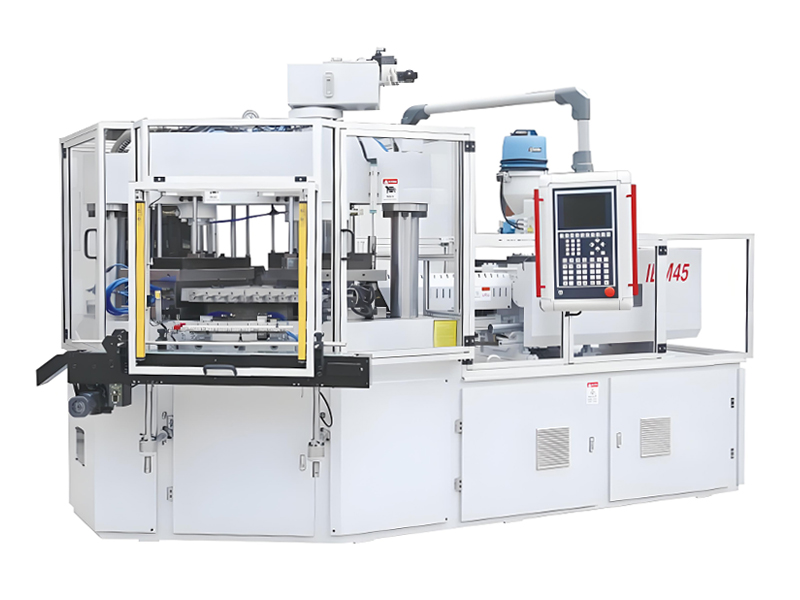
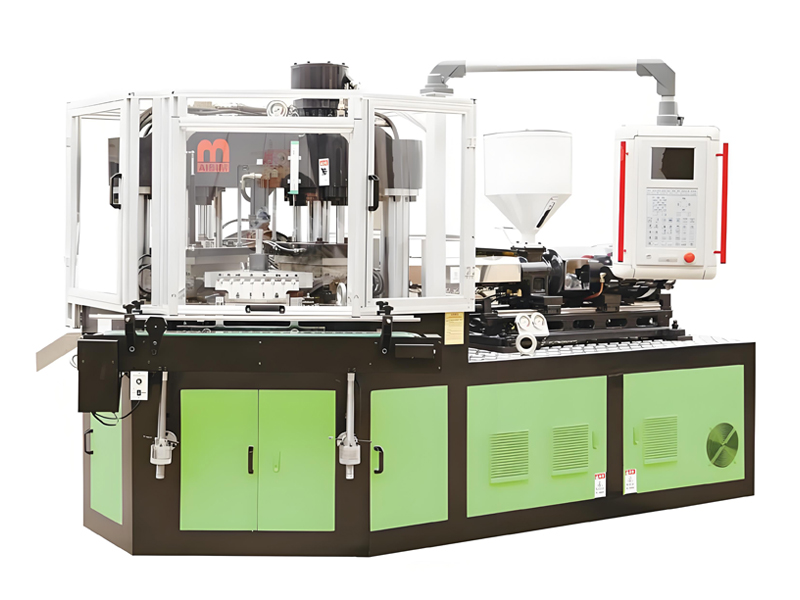
Aibim offers three IBM platforms that cover the full 3 mL to 1000 mL transparent container range. Each is a three-station, one-step machine with the PREFILL hydraulic technology, SD-card parameter storage, and the energy-saving package. The specification values below are typical engineering ranges for each model family; final figures are confirmed against the ordered configuration and cavity count.
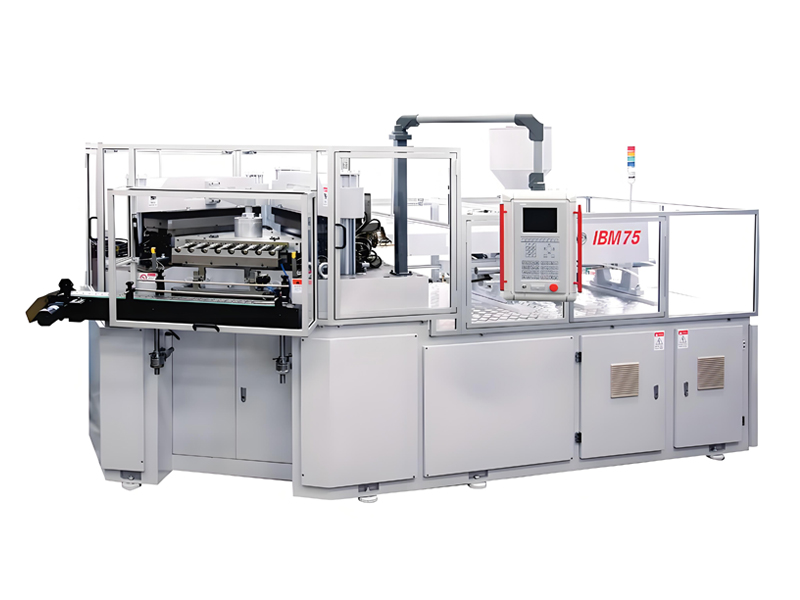
Máy ép phun thổi chai IBM75
IBM75 là máy chủ lực cho các chai trong suốt cỡ trung đến lớn lên đến 1000 mL — chai tinh chất mỹ phẩm, chai siro dược phẩm và chai mẫu đồ uống. Bộ phận phun lớn hơn và lực kẹp lớn hơn hỗ trợ parison lớn hơn và nhiều khoang hơn.
| Specification | IBM75 (typical range) |
|---|---|
| Model | IBM75 |
| Ép phun screw diameter | 45–55 mm |
| Shot size (injection weight) | 200–400 g |
| Clamping force | 450–750 kN (approx. 45–75 ton) |
| Container volume range | 50–1000 mL |
| Stations | 3 stations, one-step (injection / blow / ejection) |
| Drying / heating zones | 4–6 zones (dehumidifying dryer + barrel) |
| Cycle time / output | 6–12 s cycle, output scales with cavities |
| Installed power | 30–55 kW |
| Dimensions & weight | approx. 4.5 × 1.8 × 2.2 m; 8–12 ton |
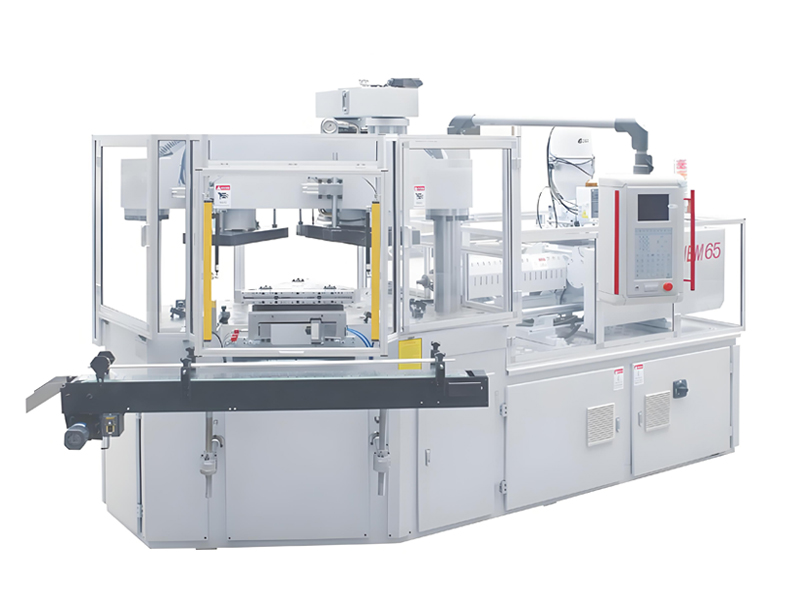
Máy ép phun thổi chai IBM65
IBM65 phù hợp với các chai trong suốt cỡ nhỏ đến trung từ 10 mL đến 500 mL — chai thuốc nhỏ mắt, chai dung dịch uống và chai nhỏ giọt mỹ phẩm. Đây là lựa chọn phổ biến nhất cho công việc đòi hỏi độ trong suốt trong dược phẩm vì nó kết hợp kiểm soát parison chính xác với diện tích chiếm chỗ nhỏ gọn.
| Specification | IBM65 (typical range) |
|---|---|
| Model | IBM65 |
| Ép phun screw diameter | 38–48 mm |
| Shot size (injection weight) | 120–260 g |
| Clamping force | 350–550 kN (approx. 35–55 ton) |
| Container volume range | 10–500 mL |
| Stations | 3 stations, one-step (injection / blow / ejection) |
| Drying / heating zones | 3–5 zones |
| Cycle time / output | 5–11 s cycle, output scales with cavities |
| Installed power | 22–40 kW |
| Dimensions & weight | approx. 4.0 × 1.6 × 2.0 m; 6–9 ton |
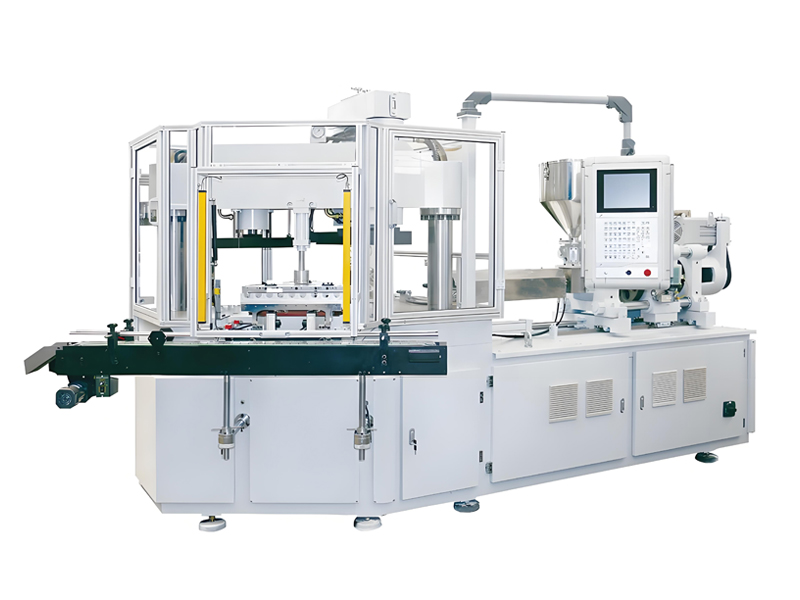
Máy ép phun thổi chai IBM55 lai điện-thủy lực
The IBM55 Hybrid Electric adds electric clamping and metering to the hybrid hydraulic package, giving the finest parison repeatability for the smallest, most demanding transparent bottles from 3 mL to 250 mL — micro-dose pharmaceutical vials and precision cosmetic samples. Its lower installed power and fast response suit clean-room and high-consistency production.
| Specification | IBM55 Hybrid (typical range) |
|---|---|
| Model | IBM55 Hybrid Electric |
| Ép phun screw diameter | 30–40 mm |
| Shot size (injection weight) | 60–150 g |
| Clamping force | 250–400 kN (approx. 25–40 ton) |
| Container volume range | 3–250 mL |
| Stations | 3 stations, one-step; hybrid electric/hydraulic |
| Drying / heating zones | 2–4 zones |
| Cycle time / output | 4–10 s cycle, output scales with cavities |
| Installed power | 15–30 kW |
| Dimensions & weight | approx. 3.5 × 1.4 × 1.9 m; 4.5–7 ton |
So sánh độ trong suốt của vật liệu
Bảng xếp hạng các vật liệu có thể gia công bằng IBM theo hiệu suất chai trong suốt thực tế để bạn có thể khớp nhựa với mục tiêu độ trong suốt. “Cấp độ trong suốt” là đặc tính vốn có của vật liệu; “kết quả độ trong suốt IBM” là những gì một dây chuyền Aibim vận hành tốt thường đạt được.
| Material | Clarity class | IBM clarity result | Effort to stay clear | Typical transparent use |
|---|---|---|---|---|
| PCTG / PETG | Amorphous, very clear | Excellent | Medium (dry well) | Premium cosmetic, display bottles |
| PC | Amorphous, clear | Excellent | Medium-High (dry, temp) | High-heat pharma, reusable |
| SAN | Amorphous, clear | Very good | Medium (dry) | Mỹ phẩm, rigid clear |
| PS | Amorphous, clear | Very good | Low | Single-use pharma, sampling |
| PP + clarifier | Semi-crystalline | Good (with quench) | Medium-High | Pharma, food, droppers |
| ABS | Amorphous, slightly hazy | Fair | Medium | Translucent, not fully clear |
| TPU | Soft, often hazy | Fair | High | Soft-touch specialty |
| HDPE / LDPE | Semi-crystalline, opaque | Poor (by nature) | Very High | Used when clarity not needed |
Hướng dẫn lựa chọn từ yêu cầu đến model
Sử dụng bảng này để chuyển từ yêu cầu về chai sang mẫu máy Aibim được khuyến nghị. Khuyến nghị giả định mục tiêu trong suốt, không khuyết tật và số khoang tiêu chuẩn; sản lượng rất cao hoặc hình dạng bất thường có thể thay đổi lựa chọn.
| Container volume | Material | Transparency target | Output need | Recommended model |
|---|---|---|---|---|
| 3–50 mL | PP, PS, SAN, PC, PCTG | High | High | IBM55 Hybrid Electric |
| 10–250 mL | PP, PS, SAN, PC, PCTG | High | Medium-High | IBM65 or IBM55 Hybrid |
| 50–500 mL | PP, PS, SAN, PC, PCTG | High | Medium | IBM65 |
| 100–1000 mL | PP, PS, SAN, PC, PCTG | High | Medium-High | IBM75 |
| 250–1000 mL | PP, PCTG, PC | Premium | High | IBM75 |
| Micro-dose <15 mL | PP, PS, PC | Critical (pharma) | High repeatability | IBM55 Hybrid Electric |
Kiểm tra độ trong suốt và kiểm soát chất lượng
Clarity must be measured, not guessed. A haze meter quantifies the percentage of scattered light and is the standard instrument for release testing of transparent bottles. Pair it with a light-transmittance measurement and a visual comparison against an approved master sample under defined lighting. Wall-thickness uniformity should be checked with a thickness gauge, because even a clear wall looks uneven if thickness varies. Internal stress is best seen with a polarized-light (polariscope) inspection, which reveals frozen-in orientation invisible to the naked eye.
For production control, Aibim recommends a first-article confirmation on every new mold and material lot, then periodic batch sampling of haze, wall thickness, and visual clarity. Because Aibim machines store full process recipes on an SD card, the validated clarity recipe for a bottle can be saved and reloaded on any same-model machine, removing operator drift between shifts and between lines.
Bảng tra cứu nhanh khuyết tật-nguyên nhân-biện pháp khắc phục
Bảng dưới đây là bảng chẩn đoán nhanh. Đối chiếu triệu chứng, đọc nguyên nhân có khả năng, áp dụng biện pháp khắc phục. Bảng bao gồm hơn 14 hàng nên hầu hết các trường hợp thực tế đều được đề cập.
| # | Symptom | Likely cause | Primary countermeasure |
|---|---|---|---|
| 1 | Milky PP bottle | Spherulite growth (crystallization) | Lower mold temp, faster cooling, add clarifier |
| 2 | White brittle PET/PC wall | Hydrolysis from wet resin | Dry to spec; check dew point |
| 3 | General stress whitening | Internal frozen-in stress | Balance holding/cooling; even parison temp |
| 4 | Black specks / gray haze | Contamination or barrel carbon | Clean path, purge, control barrel temp |
| 5 | Bubbles inside wall | Trapped moisture / volatiles | Dry resin; vent; reduce back pressure |
| 6 | Silver streaks (splay) | Gas in melt front | Dry, segment injection speed, vent |
| 7 | Snake-like shoulder mark | Jetting at gate | Enlarge gate; lower initial speed |
| 8 | Wavy body ripples | Ép phun flow mark | Segmented speed; stabilize hot runner |
| 9 | Stretch lines on body | Uneven parison temp at blow | Control parison temp; tune pre-blow |
| 10 | Thin ridge (weld line) | Melt fronts meet poorly | Raise temp; improve venting; gate design |
| 11 | Orange peel surface | Mold surface roughness | Re-polish cavity to low Ra |
| 12 | Drag marks | Mold finish / ejection | Polish, check ejection, draft |
| 13 | Cloudy only on thick sections | Slow cooling in thick areas | Improve cooling circuits; reduce thickness |
| 14 | Haze after storage | Post-crystallization or moisture | Stable material; dry storage; clarifier |
| 15 | Gloss loss vs. master | Mold polish or process drift | Recalibrate recipe via SD card; repolish |
| 16 | Cloudy ring at neck | Orientation / shear at gate area | Tune gate, speed, holding pressure |
Chi phí và đầu tư tương đối của các biện pháp khắc phục
Không phải mọi biện pháp khắc phục đều có cùng chi phí. Xếp hạng dưới đây sử dụng chỉ số mốc 100 cho một thiết lập IBM tối ưu độ trong suốt tiêu chuẩn, với mức đầu tư tương đối được thể hiện dưới dạng cấp độ, tỷ lệ phần trăm ước tính trên mốc và một bội số. Không đưa ra số tiền cụ thể; mục đích là giúp bạn xác định ưu tiên.
| Countermeasure | Investment level | vs. baseline | Multiple | Index points |
|---|---|---|---|---|
| Process tuning (speed, pressure, temp) | Low | +0% | 1.0× | 100 |
| Material drying upgrade (dehumidifying dryer) | Low | +5% | 1.05× | 105 |
| Mold re-polish to mirror Ra | Medium | +15% | 1.15× | 115 |
| Clarifying / nucleating agent (per lot) | Low | +3% | 1.03× | 103 |
| Cooling circuit redesign | Medium | +20% | 1.20× | 120 |
| Gate / runner rework | Medium | +18% | 1.18× | 118 |
| New high-precision mold (CNC) | High | +60% | 1.60× | 160 |
| IBM55 Hybrid Electric upgrade | High | +70% | 1.70× | 170 |
| Full turnkey clarity cell (machine+mold+dryer) | Very High | +120% | 2.20× | 220 |
| Premium closed-loop optical QC line | Premium | +200% | 3.00× | 300 |
Dịch vụ và hỗ trợ Aibim
Chọn đúng máy chỉ là một nửa công việc; vận hành máy cho ra sản phẩm trong suốt ở mọi ca là nửa còn lại. Aibim hỗ trợ mọi dây chuyền bằng các cam kết dịch vụ của tập đoàn Wanplas và các năng lực riêng của Aibim:
- Chạy thử và kiểm tra trước khi giao hàng: mỗi dây chuyền được vận hành và kiểm chứng tại nhà máy trước khi giao, bao gồm an toàn chứng nhận CE — trạm tách sản phẩm sử dụng cảm biến laser kỹ thuật số tầm xa để bảo vệ khuôn, và rèm ánh sáng bảo vệ nhân viên.
- Lắp đặt và chạy thử tại hiện trường: Kỹ sư Aibim đến địa điểm của khách hàng để lắp đặt, hiệu chỉnh và bàn giao dây chuyền theo các mục tiêu độ trong suốt và sản lượng đã thỏa thuận.
- Chính sách phụ tùng: 500 USD phụ tùng miễn phí mỗi năm, cộng với việc thay thế miễn phí các bộ phận hư hỏng trong thời gian bảo hành.
- Quản lý công thức bằng thẻ SD: các công thức quy trình — bao gồm các cài đặt độ trong suốt đã kiểm chứng — được lưu trên thẻ SD và có thể nạp lại trên nhiều máy, loại bỏ sai lệch do vận hành viên.
- Tiết kiệm năng lượng: Công nghệ PREFILL và bơm thể tích biến thiên mang lại mức tiết kiệm năng lượng tối thiểu 35% so với các thiết bị thủy lực thông thường.
- Phát triển khuôn và mẫu: Aibim thiết kế và thử nghiệm khuôn, sản xuất mẫu chai để mục tiêu độ trong suốt được chứng minh trước khi sản xuất hàng loạt.
- Đào tạo và nhà máy mở: vận hành viên được đào tạo tại chỗ, và khách hàng được chào đón đến thăm nhà máy Zhangjiagang để kiểm tra xưởng và chứng kiến các buổi chạy thử.
- Cam kết vận chuyển, công suất và chất lượng: tập đoàn Wanplas cam kết đảm bảo vận chuyển, đảm bảo công suất sản xuất và tiêu chuẩn chất lượng kèm bồi thường nếu chất lượng không đạt.
Câu hỏi thường gặp
Tại sao chai PP trong của tôi trông đục như sữa thay vì trong suốt?
PP là polyme bán kết tinh. Nếu parison hoặc thành chai nguội chậm, các cầu tinh thể phát triển đủ lớn để tán xạ ánh sáng, tạo ra độ mờ trắng sữa. Tăng tốc độ làm nguội, hạ nhiệt độ khuôn và sử dụng chất làm trong hoặc chất tạo mầm để giữ tinh thể nhỏ và thành chai trong suốt.
Điều gì gây ra vết chảy trên vai chai của chi tiết ép phun thổi khuôn?
Flow marks on the shoulder usually originate at the injection station. Uneven melt-front temperature, too-high initial injection speed, a small gate, or cold material produces a visible snake-like ripple. Use segmented injection speed, enlarge or relocate the gate, and stabilize hot-runner and mold temperature.
Tôi có cần sấy khô PP trước khi ép phun thổi khuôn không?
PP kỵ nước và chỉ cần sấy nhẹ để loại bỏ độ ẩm bề mặt, nhưng PET, PC, PCTG, SAN, PS và ABS phải được sấy đến mức độ ẩm thấp trong máy sấy hút ẩm. Nhựa hút ẩm không được sấy sẽ bị thủy phân và chuyển sang màu trắng hoặc mờ sương.
Tôi nên chọn máy Aibim nào cho chai mỹ phẩm trong suốt 100 mL bằng PETG?
Đối với chai mỹ phẩm PETG 100 mL, IBM75 bao phủ lên đến 1000 mL và là lựa chọn tiêu chuẩn, trong khi IBM65 xử lý 10 đến 500 mL. PETG cần sấy kỹ và nhiệt độ khuôn vừa phải, cả hai đều được hỗ trợ bởi các gói sấy khô và kiểm soát nhiệt độ của Aibim.
Chỉ riêng độ hoàn thiện bề mặt khuôn có khắc phục được hiện tượng đục không?
Đánh bóng khuôn là cần thiết nhưng chưa đủ. Bề mặt gương giảm tán xạ bề mặt, nhưng sự kết tinh bên trong, độ ẩm và hiện tượng trắng do ứng suất đến từ vật liệu và quy trình. Bạn cần cách tiếp cận bốn khía cạnh: máy, khuôn, quy trình và vật liệu cùng nhau.
Ép phun thổi khuôn khác thổi khuôn hai bước như thế nào về độ trong?
IBM forms the parison by injection in the first station, so the parison wall is uniform, flash-free, and precisely controlled, giving better wall consistency and fewer weld lines than many two-step or extrusion blow routes. The one-step three-station process also reduces contamination and handling haze.
Mức tiết kiệm năng lượng tối thiểu của máy Aibim IBM là bao nhiêu?
Máy Aibim IBM sử dụng công nghệ PREFILL và bơm thể tích biến thiên, và dây chuyền tiết kiệm tối thiểu 35% năng lượng tiêu thụ so với các thiết bị thủy lực thông thường có kích thước tương tự.
Kết luận và lời mời
Cloudiness and flow marks on transparent injection blow molding bottles are solvable once you stop treating them as one problem. They are the visible result of four underlying families — crystallization, orientation and stress, cooling, and melt flow — and each has a clear lever across the machine, mold, process, and material dimensions. Dry hygroscopic resins, quench semi-crystalline walls, polish the mold to a mirror finish, segment the injection, and control the parison temperature, and clarity follows.
Whether you run pharmaceutical vials, cosmetic essence bottles, food sampling bottles, or transparent health-product containers, Aibim — a Wanplas factory with 12-plus years of machine-building experience, 20 years in the IBM field, and 100-plus lines shipped per year from our 2022 Zhangjiagang plant — can configure the right IBM75, IBM65, or IBM55 Hybrid Electric line for your clarity target. We invite you to send us your bottle sample, the material you plan to use, and your transparency goal. Our engineers will propose the process and machine configuration to eliminate haze and flow marks, and we welcome you to send samples for molding trials and to visit our factory for a live test run and audit.