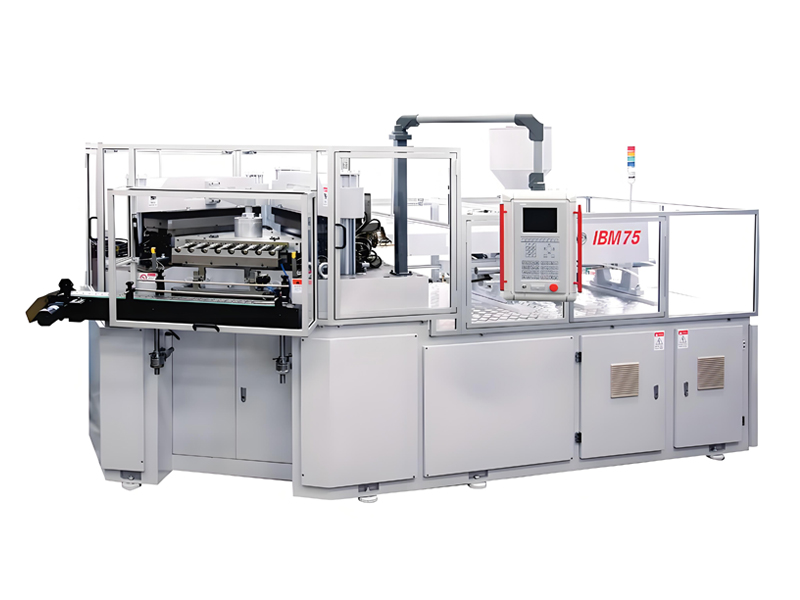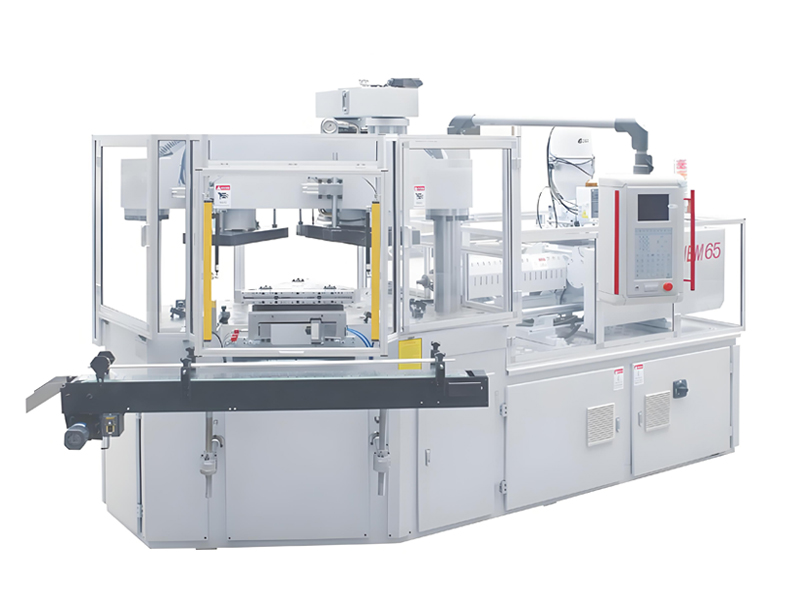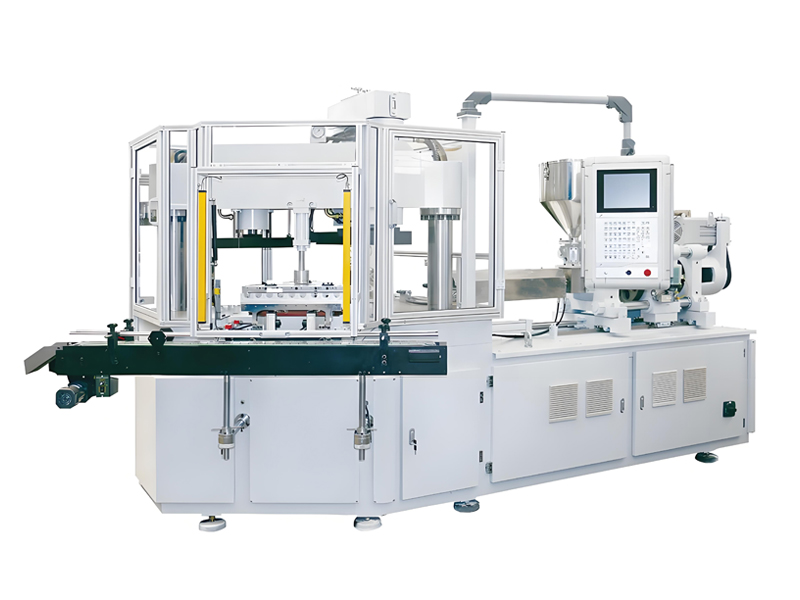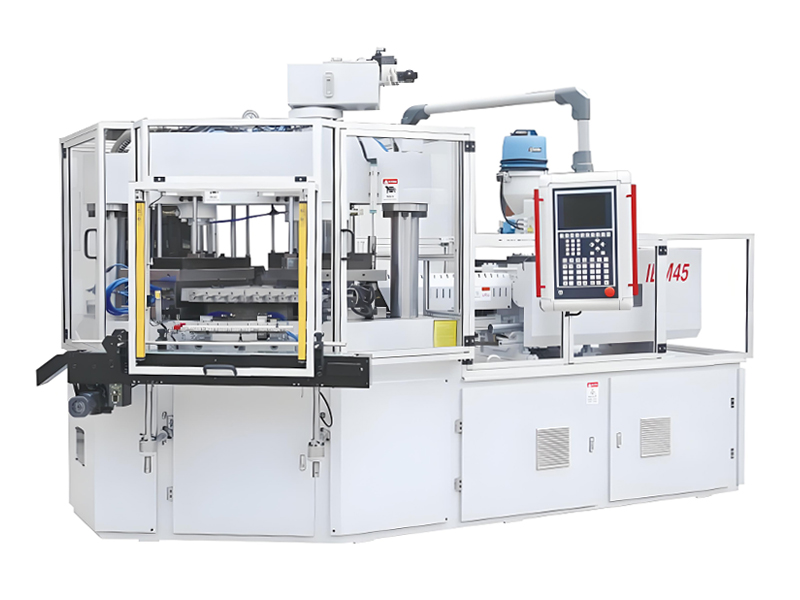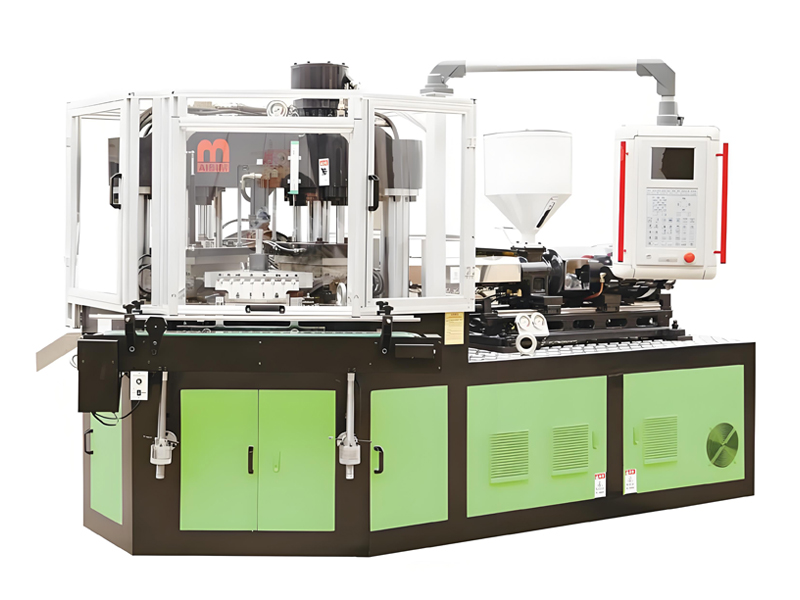
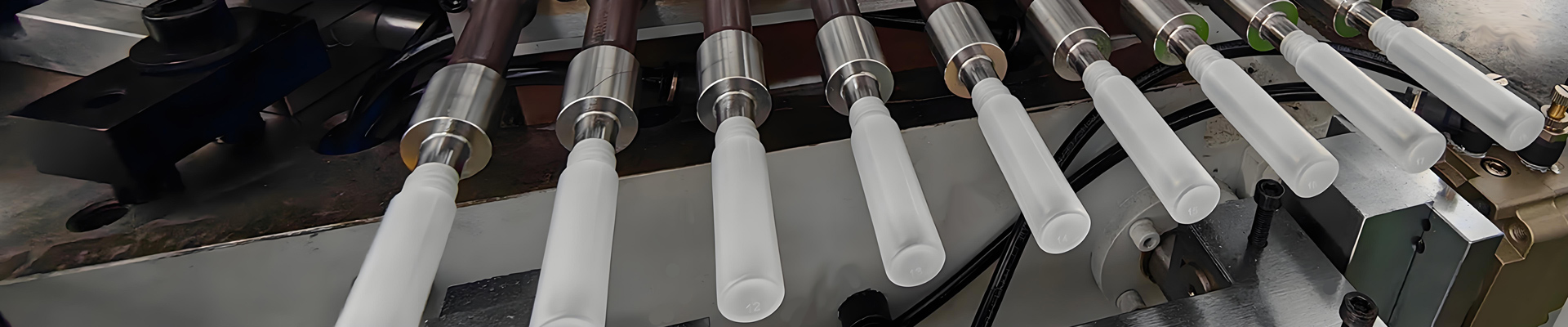
Styrene Acrylonitrile (SAN) copolymer is a high-performance engineering plastic widely used in precision transparent containers, industrial packaging, electronic accessories, and daily consumer goods. Featuring excellent transparency, high rigidity, chemical resistance, and mechanical toughness, SAN material outperforms ordinary PP, PE, and PET plastics in dimensional uniformity and surface finish, making it the preferred material for high-precision small and medium-sized hollow plastic products. The Injection Blow Molding Machine is the core specialized equipment for one-step integrated molding of SAN hollow products, realizing injection parison forming, blow molding stretching, and cooling shaping in a single continuous process.
Compared with traditional two-step blow molding equipment, AiBiM professional injection blow molding machine integrates optimized mechanical structure and intelligent process control system, which is highly compatible with SAN material molding characteristics. However, SAN material has inherent thermal shrinkage characteristics and sensitive molding parameter requirements. Unreasonable equipment parameter setting, mold design, and process debugging will easily cause product shrinkage deviation, dimensional instability, warping deformation, and size tolerance overrun in mass production. This article systematically analyzes the shrinkage mechanism of SAN materials in injection blow molding production, summarizes targeted dimensional stability control skills, combines AiBiM equipment technical advantages and actual production cases, and adds detailed cost and price benefit analysis, providing comprehensive technical guidance for enterprises to achieve high-precision and stable SAN product mass production.
1. Basic Characteristics and Molding Challenges of SAN Materials
1.1 Core Physical and Chemical Properties of SAN Copolymer
SAN is an amorphous copolymer formed by copolymerization of styrene and acrylonitrile monomers. Its internal molecular structure is dense and uniform without obvious crystal orientation, endowing the material with ultra-high transparency, excellent surface gloss, and stable mechanical properties. The material has a heat distortion temperature of 95℃ to 110℃, good low-temperature toughness, and strong resistance to chemical corrosion such as alcohol, weak acid, and weak alkali, which can maintain stable structural performance in complex use environments.
In terms of molding characteristics, SAN material has moderate melt fluidity, low molding shrinkage compared with crystalline plastics such as PP and PE, but extremely sensitive shrinkage stability. The shrinkage rate of qualified SAN products is stably controlled at 0.3% to 0.7%, with small overall shrinkage range and high uniformity requirements. Once the molding temperature, pressure, and cooling parameters fluctuate slightly, it will directly lead to inconsistent shrinkage of products, resulting in dimensional deviation and batch quality difference.
In addition, SAN material has low thermal conductivity and slow cooling shaping speed, and residual internal stress is easily generated during rapid molding. Uncontrolled residual stress will cause secondary shrinkage and warping deformation of finished products after demolding and long-term placement, which is the key difficulty restricting the dimensional stability of SAN injection blow molding products.
1.2 Unique Molding Difficulties of SAN in Injection Blow Molding
Different from extrusion blow molding and pure injection molding processes, the injection blow molding process completes parison injection and hollow blow molding stretching in one step, and SAN materials face dual shrinkage risks of injection stage and blow molding stage. In the injection parison stage, uneven melt temperature and injection pressure will cause inconsistent molecular density of the parison, resulting in differential shrinkage of the product wall thickness. In the blow molding stretching stage, unreasonable stretching speed and blowing pressure will lead to uneven molecular orientation, further enlarging dimensional tolerance deviation.
SAN material is sensitive to temperature changes. Excessively high molding temperature will cause material thermal relaxation and increased shrinkage, while excessively low temperature will lead to insufficient melt filling and incomplete product molding. The narrow parameter adaptation range makes SAN injection blow molding higher in process difficulty than ordinary plastic materials. Traditional ordinary injection blow molding machines with low parameter control accuracy cannot meet the high-precision shrinkage control requirements of SAN materials, resulting in high defective rate and low product qualification rate in mass production.
1.3 Industry Problems Caused by Uncontrolled Shrinkage and Dimensional Instability
In actual industrial production, uncontrolled SAN material shrinkage will bring multiple operational losses to enterprises. First, product dimensional tolerance overrun leads to unqualified assembly and matching, making precision electronic accessories and sealed container products unable to meet customer delivery standards, resulting in order return and rework losses. Second, uneven shrinkage causes bottle body warping, surface depression, and structural asymmetry, seriously affecting product appearance and market competitiveness.
Third, unstable batch dimensional consistency makes it impossible to form standardized mass production, reducing production efficiency and increasing manual sorting and inspection costs. In addition, long-term residual stress caused by poor shrinkage control will lead to delayed deformation and cracking of SAN products in the later use stage, triggering after-sales quality disputes and damaging enterprise brand reputation. Therefore, precise shrinkage control and dimensional stability optimization are essential core links for SAN material injection blow molding production.
2. Working Principle and Structural Advantages of AiBiM Injection Blow Molding Machine for SAN Production
2.1 One-Step Integrated Molding Working Principle
AiBiM injection blow molding machine adopts advanced three-station rotary one-step molding technology, integrating injection parison, blow molding stretching, and cooling demolding processes into one continuous automatic production line. The whole process does not require manual transfer of preforms, avoiding secondary deformation and contamination of semi-finished products. In the injection station, the high-precision injection system melts SAN particles evenly and injects them into the preform mold to form high-density uniform parisons.
Then the rotary turntable accurately transfers the parison to the blow molding station. The precise blowing and stretching system performs constant-pressure and constant-speed stretching and blowing on the SAN parison to make it closely fit the mold cavity. Finally, the product is cooled and shaped at the cooling station and automatically demolded. The whole process is completed in a closed and stable mechanical environment, providing a fundamental guarantee for uniform shrinkage and stable size of SAN products.
2.2 Core Equipment Configuration for SAN Shrinkage Control
Aiming at the molding characteristics and shrinkage control difficulties of SAN materials, AiBiM injection blow molding machine has carried out targeted structural optimization and system upgrading. The equipment is equipped with a high-precision servo injection system, with injection pressure accuracy controlled within ±0.2MPa and injection speed fluctuation less than 1%, ensuring uniform melt filling and consistent parison density, and eliminating the initial shrinkage difference caused by uneven injection.
The independent constant-temperature mold temperature control system realizes precise temperature control of the injection mold and blow mold, with temperature control accuracy up to ±0.5℃. It solves the problem of uneven mold surface temperature leading to differential cooling and inconsistent shrinkage of SAN products. The optimized low-resistance blowing system realizes stable constant-pressure blowing, avoiding local over-stretching or insufficient stretching of SAN materials, and ensuring uniform molecular orientation and consistent shrinkage rate of the product wall.
In addition, the equipment is equipped with an intelligent closed-loop parameter monitoring system, which can real-time monitor the key parameters such as melt temperature, injection pressure, blowing pressure, and cooling time during the production process, automatically correct parameter fluctuations, and maintain long-term stable operation of the equipment, effectively ensuring the batch dimensional consistency of SAN products.
2.3 Brand Technical Advantages of AiBiM Injection Blow Molding Equipment
As a professional manufacturer of high-precision injection blow molding equipment, AiBiM has long focused on the process adaptation and precision molding of high-performance engineering plastics such as SAN, PMMA, and PC. Different from ordinary universal injection blow molding machines on the market, AiBiM equipment is calibrated for the shrinkage characteristics of SAN materials in the whole machine design, with more precise mechanical transmission accuracy and more stable parameter control performance.
The equipment adopts high-rigidity integral frame structure and high-precision rotary positioning technology, with turntable rotation error less than 0.01mm, ensuring accurate mold closing and positioning each time, and avoiding dimensional deviation caused by mechanical displacement. The self-developed intelligent process system has built-in exclusive SAN material molding parameter database, which can realize one-click parameter calling and rapid debugging, greatly reducing the difficulty of shrinkage control and process adjustment.
3. Root Causes of SAN Product Shrinkage and Dimensional Deviation
3.1 Raw Material Formula and Quality Factor
The purity, melt index, and monomer ratio of SAN raw materials directly affect the molding shrinkage rate. SAN raw materials with unstable styrene and acrylonitrile component ratios have inconsistent molecular structure density, resulting in large shrinkage differences in different batches of products. Impurities, moisture, and uneven particle size in raw materials will cause local uneven melting of the melt, forming internal density differences of the product, and leading to irregular shrinkage and dimensional deviation.
Recycled SAN materials have aging molecular chains and reduced melt uniformity. Random addition of recycled materials will significantly increase product shrinkage fluctuation. Many enterprises ignore raw material pretreatment and formula stability, resulting in uncontrollable basic shrinkage rate of products, which is the primary cause of dimensional instability.
3.2 Molding Process Parameter Fluctuation
Temperature parameter deviation is the most important factor affecting SAN shrinkage. Excessively high barrel melting temperature leads to excessive material fluidity and increased thermal shrinkage; excessively low temperature causes insufficient melting, incomplete filling, and increased post-shrinkage. Uneven temperature distribution in each section of the extruder barrel will lead to inconsistent melt viscosity, resulting in differential shrinkage of different parts of the product.
Injection pressure and holding pressure also have a decisive impact on shrinkage stability. Insufficient holding pressure will cause product shrinkage and depression after cooling; excessive pressure will lead to residual internal stress, causing delayed shrinkage and warping. Unstable blowing pressure and stretching speed in the blow molding stage will disrupt the uniform orientation of SAN molecular chains, resulting in inconsistent wall thickness shrinkage.
3.3 Mold Design and Temperature Control Defects
Unreasonable mold cooling water circuit design is a key hidden danger of SAN product shrinkage deviation. Uneven cooling water distribution leads to inconsistent cooling speed of each part of the mold surface. The product area with fast cooling shrinks first and has small shrinkage rate, while the area with slow cooling shrinks later and has large shrinkage rate, resulting in overall dimensional distortion and warping deformation of the product.
Mold exhaust insufficiency will cause air residue in the mold cavity, forming incomplete product molding and local thin walls, leading to uneven shrinkage. In addition, excessive mold surface wear and inaccurate mold positioning will cause flash and wall thickness deviation, indirectly affecting the overall dimensional stability of SAN products.
3.4 Equipment Operation and Post-Molding Processing Factors
Mechanical vibration, positioning deviation, and parameter drift of ordinary injection blow molding machines in long-term operation will lead to inconsistent molding conditions of each product, resulting in batch dimensional difference. Improper post-molding placement and natural cooling of products will also cause secondary shrinkage deformation. SAN products are sensitive to ambient temperature and humidity. Placement in high-temperature and high-humidity environment will accelerate molecular relaxation and cause dimensional change.
4. Core Shrinkage Control & Dimensional Stability Technical Tips
4.1 Raw Material Pretreatment and Formula Standardization Control
To stabilize the basic shrinkage rate of SAN products, raw material standardization management must be implemented first. Enterprises should select SAN raw materials with stable melt index and fixed monomer ratio, and prioritize high-purity new materials for high-precision product production. If recycled materials need to be added, the proportion shall be strictly controlled within 10%, and the recycled materials must be screened, cleaned, and fully dried to remove impurities and aging materials.
Strict raw material drying pretreatment process is essential. SAN materials are slightly hygroscopic, and residual moisture will cause melt bubbles and uneven density. The drying temperature is controlled at 75℃ to 85℃, and the drying time is 3 to 4 hours, ensuring the material moisture content is lower than 0.03%. Uniformly dried and purified SAN materials can form stable melt density after melting, laying a foundation for consistent product shrinkage.
4.2 Precision Molding Parameter Matching for AiBiM Injection Blow Molding Machine
Aiming at the shrinkage characteristics of SAN materials, the exclusive optimized parameter scheme of AiBiM injection blow molding machine can effectively control dimensional deviation. In terms of melting temperature, segmented temperature control is adopted: rear barrel temperature 190℃ to 200℃, middle barrel temperature 200℃ to 210℃, front barrel temperature 210℃ to 220℃, and nozzle temperature 215℃ to 225℃. This temperature gradient ensures full and uniform melting of SAN materials, avoids overheating decomposition or insufficient melting, and stabilizes the basic shrinkage rate of the melt.
In terms of injection and holding pressure, the injection pressure is stably set at 55 to 65MPa, with medium-speed uniform injection to ensure full mold filling. The secondary holding pressure is set at 30 to 35MPa, and the holding time is 2 to 3 seconds, which can effectively compensate the volume shrinkage of SAN materials during cooling and avoid product depression and size shrinkage.
In the blow molding stage, the constant blowing pressure is controlled at 0.65 to 0.75MPa, with uniform stretching speed and stable mold cavity pressure. The balanced stretching process ensures consistent molecular tension of the product wall, eliminates local shrinkage difference, and maintains the overall dimensional uniformity of SAN hollow products.
4.3 Mold Temperature and Cooling System Optimization Skills
Uniform mold temperature control is the core key to SAN dimensional stability. The mold temperature of AiBiM injection blow molding machine is stably controlled at 45℃ to 55℃, which is the optimal temperature range for SAN material molding and shrinkage balance. Too high mold temperature will prolong cooling time and increase shrinkage; too low mold temperature will cause excessive internal stress and delayed deformation.
Optimize the mold cooling water circuit layout to ensure uniform water flow and consistent cooling speed in all parts of the mold cavity. The cooling water temperature is controlled at 20℃ to 25℃, and the segmented cooling time is set according to the product wall thickness. For SAN products with wall thickness of 1.5mm to 3mm, the cooling shaping time is controlled at 12 to 18 seconds, realizing synchronous cooling and uniform shrinkage of the inner and outer walls of the product.
Regularly clean the cooling water circuit and scale of the mold to avoid poor heat dissipation caused by pipeline blockage, ensure long-term stable cooling efficiency of the mold, and maintain consistent shrinkage rate of batch products.
4.4 Internal Stress Elimination and Post-Molding Stability Treatment
Residual internal stress is the main cause of delayed shrinkage and deformation of SAN products. After demolding, targeted stress elimination treatment can effectively improve long-term dimensional stability. Place the newly demolded SAN products in a constant-temperature and constant-humidity environment of 23℃±2℃ for 24 hours of natural aging, release residual internal stress slowly, and complete secondary micro-shrinkage in advance to avoid dimensional change in the sales and use stage.
For high-precision SAN products with strict tolerance requirements, low-temperature annealing treatment can be adopted. Keep the products at 60℃ to 70℃ for 1 to 2 hours and then cool them slowly, which can completely eliminate internal stress and ensure permanent dimensional stability of the products.
4.5 Equipment Daily Calibration and Batch Production Stability Maintenance
During long-term batch production, regular calibration of AiBiM injection blow molding machine parameters and mechanical accuracy is required. Calibrate the injection pressure, blowing pressure, and mold temperature parameters every week to eliminate parameter drift. Check the turntable positioning accuracy and mold closing tightness monthly to avoid dimensional deviation caused by mechanical errors.
Use the intelligent parameter storage function of AiBiM equipment to save the optimal SAN molding parameter formula, and realize one-click calling for each batch of production to avoid quality fluctuation caused by manual parameter adjustment. Real-time monitor product dimensional data during production, trace abnormal shrinkage problems in time, and realize closed-loop optimization of production process.
5. Common SAN Shrinkage Defects and Targeted Solutions
5.1 Overall Product Shrinkage and Small Size Tolerance
The overall shrinkage of SAN products and smaller finished size than the standard value are mainly caused by insufficient holding pressure, short holding time, and excessively low mold temperature. The optimization solution is to appropriately increase the secondary holding pressure and extend the holding time to fully compensate the cooling shrinkage volume of the material. Appropriately increase the mold temperature within the safe process range to reduce the shrinkage difference between the surface and the inner layer of the product, and calibrate the mold size compensation value to ensure that the finished product size meets the standard tolerance range.
5.2 Local Depression and Uneven Partial Shrinkage
Local depression and uneven partial shrinkage of SAN products usually occur in thick wall areas and product corners, caused by insufficient melt filling and inconsistent cooling speed. It is necessary to optimize the mold exhaust structure to improve the filling fluidity of thick wall areas, appropriately increase the injection speed and holding time, and adjust the local cooling water circuit to balance the cooling speed of thick and thin wall areas, so as to solve the problem of uneven local shrinkage and product depression.
5.3 Product Warping and Angular Dimensional Deviation
Product warping and angular dimensional deviation are typical defects caused by uneven internal stress and differential shrinkage. The solution is to optimize the segmented temperature control parameters to balance the melt viscosity, adjust the blowing pressure and stretching speed to ensure uniform molecular orientation, and match the balanced cooling process to eliminate stress concentration. For products with serious warping, the mold temperature difference can be fine-tuned to offset the shrinkage stress and correct product deformation.
5.4 Batch Dimensional Inconsistency
Large dimensional fluctuation of SAN products in different batches is caused by unstable raw material quality, equipment parameter drift, and inconsistent pretreatment processes. The solution is to standardize raw material procurement and pretreatment standards, unify drying and mixing processes, use AiBiM equipment intelligent fixed-value parameter system to lock molding parameters, and regularly calibrate equipment accuracy to ensure consistent molding conditions for each batch of products and stabilize batch dimensional consistency.
6. 2026 AiBiM Injection Blow Molding Machine Project Cost & Price Analysis
6.1 Equipment Procurement Price Grading Estimation
Combined with the 2026 market quotation of high-precision injection blow molding equipment, the procurement price of AiBiM injection blow molding machine dedicated to SAN material precision molding is divided into three configuration grades. The standard basic configuration model, suitable for ordinary SAN daily product production, with basic parameter control and stable molding function, is priced at 26,000 to 29,000 US dollars per set. This model meets the basic shrinkage control requirements of conventional SAN products and is suitable for small-batch production enterprises.
The mainstream high-precision configuration model, equipped with full servo precise control, constant-temperature mold system, and intelligent parameter closed-loop monitoring system, specially optimized for SAN material shrinkage control, is priced at 30,000 to 34,000 US dollars per set. This is the optimal configuration for mass production of high-precision SAN products, with stable dimensional tolerance and low defective rate.
The high-end customized precision model, with ultra-high precision parameter calibration, automatic stress adjustment system, and intelligent quality detection function, is priced at 35,000 to 39,000 US dollars per set, suitable for high-precision electronic accessories and medical-grade SAN product production with strict dimensional tolerance requirements.
6.2 Annual Operation and Maintenance Cost Analysis
AiBiM injection blow molding machine adopts servo energy-saving design and high-rigidity wear-resistant structural parts, with low long-term operation cost. The annual power consumption cost of a single equipment is 2,400 to 2,800 US dollars, which is 25% lower than that of ordinary injection blow molding machines. The annual routine maintenance, lubrication, and vulnerable parts replacement cost is only 320 to 500 US dollars, due to the stable mechanical performance and low failure rate of the equipment.
In contrast, ordinary universal injection blow molding machines have unstable parameters and high failure rate, with annual maintenance and power consumption costs up to 4,000 to 5,000 US dollars. AiBiM equipment has prominent long-term operation cost advantages, which can effectively reduce the comprehensive production expenditure of enterprises.
6.3 Quality Loss and Comprehensive Cost Saving Benefit
Ordinary injection blow molding machines have poor shrinkage control ability for SAN materials, with a product defective rate of 5% to 8%. Calculated based on the annual output of 4 million SAN products, the annual raw material waste, rework, and sorting loss is 6,000 to 9,500 US dollars. AiBiM professional equipment stabilizes the SAN product defective rate below 1.5%, reducing annual quality loss to less than 1,800 US dollars, saving a large amount of invalid production cost for enterprises every year.
At the same time, stable dimensional consistency reduces manual detection and sorting workload, saving 3,000 to 4,500 US dollars in annual labor costs. The standardized high-precision products can meet high-end customer order standards, improve product unit price profit margin, and bring stable incremental benefits to enterprises.
6.4 Investment Return Cycle Evaluation
The comprehensive annual cost savings of AiBiM injection blow molding machine in energy consumption, maintenance, quality loss, and labor cost reach 9,000 to 12,000 US dollars. The one-time equipment investment can be fully recovered within 2.5 to 3 years. The equipment has a service life of more than 10 years, with long-term stable operation and ultra-high cost performance. For enterprises upgrading old equipment, the return cycle can be shortened to 2 years, which quickly realizes cost recovery and profit growth.
7. SAN Injection Blow Molding Production Standardized Operation Specification
7.1 Pre-Production Debugging and Parameter Confirmation
Before formal mass production, complete pre-production debugging and parameter verification work. Preheat the equipment and mold for 30 minutes to ensure stable temperature of each system. Test produce 20 to 50 sample products, detect product dimensional tolerance, surface flatness, and shrinkage uniformity, fine-tune process parameters according to sample detection data, and lock the optimal parameter formula after confirming that the products are fully qualified.
7.2 In-Production Real-Time Monitoring and Sampling Inspection
During continuous production, set up hourly sampling inspection mechanism to detect product key dimensions and shrinkage changes. Real-time monitor equipment operation parameters through the AiBiM intelligent control system, find parameter fluctuation and abnormal product shrinkage in time, and adjust and optimize immediately to avoid batch defective products.
7.3 Post-Production Equipment Maintenance and Parameter Backup
After daily production, clean the equipment barrel, nozzle, and mold cavity to avoid residual material coking affecting subsequent production quality. Back up the optimized SAN molding parameter formula to the equipment system to realize rapid parameter calling for the next production. Regularly maintain the equipment transmission system, cooling system, and pressure system to ensure long-term stable and precise operation of the equipment.
8. Industry Development Trend of SAN Precision Injection Blow Molding
With the continuous upgrading of consumer electronics, precision packaging, and medical product standards, the market has higher and higher requirements for the dimensional accuracy and stability of SAN products. The future SAN injection blow molding industry will develop towards intelligent precision control, low-stress molding, and batch standardized production. Traditional manual parameter debugging and experience-based production modes will be gradually eliminated.
AiBiM new-generation intelligent injection blow molding machine will realize full-automatic intelligent identification of SAN material characteristics and adaptive parameter matching, further improve the precision of shrinkage control and dimensional stability. The integrated technology of stress monitoring and automatic correction will completely solve the problem of delayed deformation of SAN products, promote the overall upgrading of the precision injection blow molding industry, and provide more efficient and stable production solutions for high-end plastic product manufacturing enterprises.
9. Conclusion
Shrinkage control and dimensional stability are the core technical difficulties restricting the high-quality mass production of SAN material injection blow molding products. The shrinkage deviation and dimensional instability of SAN products are affected by multiple factors such as raw material performance, equipment precision, process parameters, mold cooling, and post-molding treatment. Adopting standardized raw material pretreatment, precise equipment parameter matching, optimized mold cooling system, and scientific stress elimination technology can effectively control the shrinkage rate of SAN products within the standard range and realize batch dimensional consistency.
As a high-precision professional processing equipment, AiBiM injection blow molding machine has inherent technical advantages in SAN material precision molding and shrinkage control. Its intelligent closed-loop parameter control system, constant-temperature mold system, and stable mechanical operation performance can perfectly adapt to the sensitive molding characteristics of SAN materials. By matching the professional shrinkage control skills and standardized production specifications summarized in this article, enterprises can effectively reduce product defective rate, improve production efficiency, reduce comprehensive production costs, produce high-stability and high-precision SAN hollow products, and enhance core market competitiveness in the field of precision plastic packaging and accessories manufacturing.