Daftar Isi
- Mengapa Botol IBM Transparan Menjadi Keruh atau Menunjukkan Bekas Aliran
- Fisika Transparansi: Kekeruhan, Kejernihan, dan Hamburan Cahaya
- Bagaimana Cetak Tiup Injeksi Membuat Botol Bening
- Kekeruhan: Lima Akar Penyebab dan Cara Menghilangkan Masing-masing
- Bekas Aliran: Akar Penyebab dan Tindakan Penanggulangan
- Matriks Penanggulangan Cacat Empat Dimensi
- Parameter Pengeringan Material
- Jendela Proses Cetak Injeksi dan Tiup
- Faktor Cetakan dan Peralatan yang Mengontrol Transparansi
- Jajaran Mesin Aibim IBM untuk Botol Transparan
- Perbandingan Transparansi Material
- Panduan Pemilihan Kebutuhan-ke-Model
- Inspeksi Transparansi dan Kontrol Kualitas
- Referensi Cepat Cacat-Penyebab-Penanggulangan
- Biaya Relatif dan Investasi Tindakan Penanggulangan
- Layanan dan Dukungan Aibim
- Pertanyaan yang Sering Diajukan
- Kesimpulan dan Undangan
Mengapa Botol IBM Transparan Menjadi Keruh atau Menunjukkan Bekas Aliran
Transparent bottles produced on injection blow molding (IBM) lines are in high demand for pharmaceutical, cosmetic, food, and beverage packaging because they let the consumer see the product and signal purity. Yet many producers discover that a bottle that should be crystal clear comes out cloudy, milky, or marked with wavy streaks called flow marks. Aibim, a Wanplas factory (Zhangjiagang AiBiM Plastics Machinery Co., Ltd.), has specialized in injection (stretch) blow molding machines for more than 12 years in machinery manufacturing and 20 years in the IBM field. Our three-station, one-step IBM lines run in 40-plus countries, are built with our own CNC center, and our 2022 new factory ships 100-plus lines per year for containers from 3 mL to 1000 mL. The slogan on every machine we build is simple: “Mesin injection blow molding Manufacturer.”
The single most useful fact for any engineer chasing clarity is this: core idea cloudiness and flow marks on an IBM transparent bottle are never one problem. They are four families of problems — crystallization, orientation and stress, cooling, and melt flow — and each family has its own machine, mold, process, and material countermeasures. A bottle can be cloudy because its polymer spherulites are too large, because residual moisture hydrolyzed the resin, because internal stress caused stress whitening, because the mold surface scattered light, or because trapped gas formed bubbles. Likewise, flow marks can come from the injection station, the blow station, the gate design, or the parison temperature profile. If you treat all “haze” as one defect, you will chase the wrong lever.
This article is a complete field manual. It explains the physical basis of transparency, walks through the IBM process, then breaks cloudiness and flow marks into their individual root causes with concrete fixes across the four dimensions of machine, mold, process, and material. It includes the four-dimension countermeasure matrix, a material drying table, an injection and blow process window, a defect quick-reference table with more than 14 rows, product specification tables for the IBM75, IBM65, and IBM55 Hybrid Electric machines, a requirement-to-model selection table, and a relative cost ranking so you can plan investment. By the end, you will be able to read a cloudy or streaked bottle like a diagnostic chart and pick the right correction.
Fisika Transparansi: Kekeruhan, Kejernihan, dan Hamburan Cahaya
Transparency is not a single number; it is the result of how a polymer transmits and scatters light. Two measurements matter most. Clarity (or light transmittance) describes how much light passes straight through the wall. Haze is the percentage of transmitted light that is scattered more than 2.5 degrees from the straight path. A bottle can have high light transmittance yet still look milky if its haze is high, because the scattered light diffuses the image behind it. For a transparent pharmaceutical or cosmetic bottle, both high transmittance and low haze are required.
Light is scattered by any interface where the refractive index changes. In a clear amorphous polymer with no crystals, the refractive index is uniform and light passes through. In a semi-crystalline polymer, the crystalline regions have a different refractive index from the amorphous regions, so every spherulite boundary becomes a tiny scattering site. The larger and more numerous the spherulites, the higher the haze. This is why polypropylene, a semi-crystalline resin, tends to look translucent or milky unless it is quenched rapidly or modified with a clarifying agent, while polystyrene, SAN, PC, PCTG, and PMMA are naturally transparent because they are largely amorphous.
Sumber utama cahaya yang tersebar atau hilang pada botol transparan IBM adalah:
- Sferulit kristalin pada resin semi-kristalin (PP, PE, PET saat mengkristal).
- Tegangan internal dan birefringence akibat pendinginan atau orientasi yang tidak merata, yang membelokkan cahaya secara berbeda di seluruh dinding.
- Cacat permukaan — polesan cetakan yang buruk, kulit jeruk (orange peel), bekas tarikan (drag marks) — yang menghamburkan cahaya pada permukaan dinding.
- Gelembung dan rongga dari gas atau zat volatil yang terperangkap, masing-masing bertindak sebagai lensa mikroskopis.
- Kotoran dan bintik hangus dari material terkontaminasi atau resin terdegradasi di dalam laras.
- Degradasi hidrolitik pada PET, PC, atau PCTG yang tidak dikeringkan, menghasilkan dinding yang putih, rapuh, dan berkabut.
Two more physical effects deserve attention before moving to process. The first is refractive-index mismatch. Even within one amorphous resin, a region that is stretched (oriented) has a slightly different refractive index from a relaxed region. Where these regions meet at a sharp boundary, light bends and a faint line appears. This is the optical signature of frozen-in orientation, and it is why a bottle can look clear in the center yet show faint rings near the neck or shoulder where shear was highest. The second is surface scatter versus volume scatter. Surface scatter comes from the mold finish and is corrected by polishing; volume scatter comes from crystals, bubbles, and stress inside the wall and is corrected by material and process. A quick diagnostic is to wet the bottle surface with a clear oil: if the haze disappears, the problem is surface (mold) finish; if it remains, the problem is inside the wall (volume). This single test tells you whether to send the mold to the polisher or to re-tune the process and material.
Measurement discipline also matters. A haze meter gives a repeatable number, but the number is meaningless without a defined sample, light path, and reference. Establish a master sample for each bottle and measure it on the same instrument under the same conditions, then hold production parts to a tolerance band around that master. Visual grading under a standard light box is a useful secondary check, but it should never replace the numeric haze reading for release decisions. Remember that haze and light transmittance move independently: a bottle can stay bright yet grow hazier, so track both.
Tabel di bawah ini merangkum perilaku material IBM yang umum. Perhatikan bahwa “kelas transparansi” adalah sifat material, tetapi kejernihan botol yang sebenarnya ditentukan oleh cara Anda memprosesnya. Resin yang secara alami jernih pun dapat rusak oleh pengeringan yang buruk atau pendinginan yang lambat.
| Material | Transparency class | Key clarity risk | IBM relevance |
|---|---|---|---|
| PP (homopolymer / copolymer) | Semi-crystalline | Spherulite growth, milky haze | Very common for pharmaceutics and food; needs quench + clarifier |
| HDPE / LDPE / LLDPE | Semi-crystalline | Naturally translucent, not clear | Used when clarity not required |
| PS | Amorphous | Brittle, low chemical resistance | Naturally clear, easy haze control |
| SAN | Amorphous | Needs drying; stress crack risk | Clear, rigid, good for cosmetics |
| ABS | Amorphous (with rubber) | Rubber phase scatters light slightly | Translucent, not fully clear |
| PC | Amorphous | Hydrolysis whitening if wet | Premium clear, high heat |
| PCTG / PETG | Amorphous copolyester | Hydrolysis; needs drying | Excellent clarity, tough, cosmetic-grade |
| PET (rare in IBM) | Semi-crystalline | Crystallizes fast, turns opaque | Usually ISBM; if IBM, control crystallization |
| TPU | Segmented, often hazy | Inherent softness/cloud | Specialty soft-touch bottles |
Bagaimana Cetak Tiup Injeksi Membuat Botol Bening
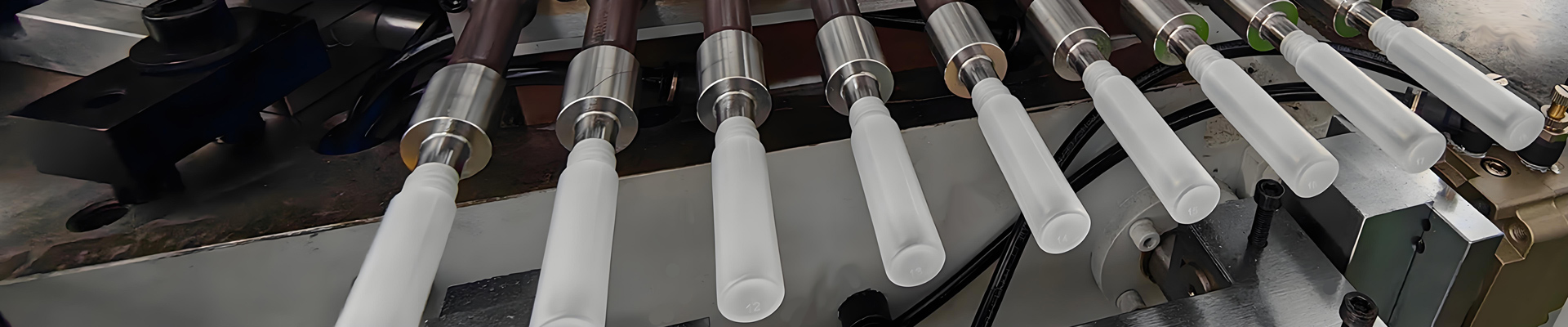
Injeksi blow molding is a one-step, three-station process that combines injection molding and blow molding on a single rotating machine. In the first station, the machine injects the melt into a parison (also called a preform) cavity around a core rod. In the second station, the heated parison on its core rod is transferred to the blow station, where compressed air expands it against a cold blow mold to form the bottle. In the third station, the finished bottle is stripped off the core rod. There is no flash, the neck finish is molded to high precision, and the parison wall thickness is uniform by design.
The core rod is the silent hero of IBM clarity. The parison is molded around a heated core rod at the first station, then the rod carries that parison, still at a controlled temperature, to the blow station. Because the parison never leaves the rod and is never dropped or re-gripped, its temperature profile is preserved and its surface is not scuffed by handling. At the blow station the rod acts as the internal blow mandrel: compressed air enters through it and expands the warm parison against the cold mold. The rod temperature, therefore, directly sets the parison temperature that the blow station sees — and parison temperature is the single biggest driver of even wall stretch and mark-free surfaces. Aibim machines hold this temperature with dedicated control so the parison arrives at blow neither too cold (which marks) nor too hot (which sags and thins).
This structure matters for clarity. Because the parison is injection-molded rather than extruded, its wall is consistent and free of the thickness variations and weld lines that often appear in extrusion blow molding. Because the whole cycle is one step inside the machine, the parison is not handled, cooled, and reheated as in a two-step process, so contamination and moisture pickup are minimized. The trade-off is that IBM is best suited to small, high-precision containers from 3 mL to 1000 mL — exactly the transparent pharmaceutical, cosmetic, and single-serve bottles where clarity is most valuable.
Dibandingkan dengan cetakan tiup ekstrusi dan tiup pemanasan ulang dua langkah, IBM memberikan kontrol paling ketat atas keseragaman dinding, yang merupakan dasar transmisi cahaya yang merata. Perbandingan di bawah ini adalah teknologi-ke-teknologi, bukan merek-ke-merek:
| Process | Parison formation | Flash | Wall uniformity | Typical clarity control | Best container size |
|---|---|---|---|---|---|
| Injeksi blow molding (IBM) | Injeksi, 3-station one-step | None | Excellent | Very high, controlled parison temp | 3–1000 mL |
| Two-step blow (reheat) | Injeksi preform, then reheat-blow | None | Good | High, but reheating variance | 100 mL–2 L |
| Extrusion blow molding | Extruded parison | Some | Fair | Lower, wall variation | 50 mL–20 L+ |
Kekeruhan: Lima Akar Penyebab dan Cara Menghilangkan Masing-masing
Kekeruhan adalah istilah umum untuk kabut yang tidak diinginkan. Pada botol transparan IBM, biasanya bersumber dari salah satu dari lima penyebab. Diagnosis berdasarkan di mana kabut muncul dan dalam kondisi apa, lalu terapkan penanggulangan yang sesuai.
Penyebab 1: Kabut Kristalisasi (PP, PE, PET)
PP and PE are semi-crystalline. If the parison or bottle wall cools slowly, spherulites have time to grow into large light-scattering structures, and the bottle looks milky instead of clear. The fix is to force rapid, uniform cooling and to keep crystals small. Lower the blow mold temperature, increase coolant flow, and consider a nucleating or clarifying agent that multiplies the number of crystal nuclei so each spherulite stays tiny. For PET processed by IBM, control residence time and temperature so it does not crystallize into an opaque wall.
Penyebab 2: Hidrolisis dan Kabut Degradasi (PET, PC, PCTG, SAN)
PET, PC, PCTG, and to a lesser degree SAN are hygroscopic. If they are not dried to a low moisture level before plasticizing, water reacts with the polymer chain during melt processing, breaking it and producing a white, brittle, hazy wall. The cure is disciplined drying in a dehumidifying dryer at the correct temperature, dew point, and residence time (see the drying table in section 7). Barrel temperature must also stay within the safe window so the melt does not degrade.
Penyebab 3: Pemutihan Tegangan dan Tegangan Internal
When a bottle is cooled too fast or the parison temperature is uneven, frozen-in orientation and internal stress create birefringence that scatters light, and in severe cases visible stress whitening. Balance the holding pressure and cooling, keep the parison temperature profile even across the core, and avoid over-cooling that locks in stress. A polarized-light inspection (section 13) reveals stress you cannot see with the eye.
Penyebab 4: Kotoran dan Bintik Hitam
Contaminated regrind, dust on pellets, or carbonized material baked onto the barrel wall or screw shows up as black dots and gray haze. Clean the material path, use a dehumidifying dryer with a clean hopper, purge the barrel regularly, and control barrel temperature so the resin does not over-shear and degrade. Material that has sat in a humid warehouse should be screened and re-dried.
Penyebab 5: Gelembung dan Splay (Garis Perak)
Water or volatile trapped in the melt becomes bubbles or silver streaks inside the wall, scattering light and looking foggy. The remedies are thorough drying, adequate barrel decompression and venting, and a segmented injection speed that prevents the melt front from trapping air. Excess back pressure that packs volatiles into the melt should also be reduced.
Urutan Diagnostik Praktis untuk Kekeruhan
When a bottle comes out hazy, do not change five things at once. Work the cheapest, highest-probability cause first. Step one: confirm the material was dried to spec and the dryer dew point is correct — most “mystery haze” on PET, PC, and PCTG is simply water. Step two: wet the surface with clear oil; if haze stays, the problem is internal, so move to cooling and crystallization. Step three: check mold temperature and coolant flow; for PP, drop the mold temperature and add a clarifier. Step four: inspect the barrel and screw for carbon and contamination. Step five: only then consider mold re-polish or a new mold. This order fixes the majority of cases with the least spent, and it keeps your process change history clean so you can trust the result.
Bekas Aliran: Akar Penyebab dan Tindakan Penanggulangan
Bekas aliran adalah garis, riak, atau gelombang permukaan pada botol — paling terlihat di bahu dan badan. Ini adalah cacat riwayat aliran: lelehan atau parison bergerak dengan cara yang meninggalkan jejak yang terlihat. Bekas ini berbeda dari kekeruhan karena bersifat terarah dan terlokalisasi, bukan kabut yang seragam.
Bekas Aliran di Stasiun Injeksi pada Parison
The parison is formed by injection, so its surface quality is set first. If the melt-front temperature is uneven, if injection speed or pressure is wrong, if the gate is poorly sized, or if cold material enters the cavity, the parison carries a snake-like mark that later appears on the bottle. Countermeasures: use segmented (profiled) injection speed, keep the hot runner and nozzle at a stable temperature, enlarge or reposition the gate to reduce shear, and make sure the mold temperature is uniform around the cavity.
Bekas Aliran dan Garis Regangan di Stasiun Tiup
At the blow station, an uneven parison temperature profile or a poor wall-thickness transition causes the air to stretch the wall unevenly, leaving stretch lines. Control the parison temperature distribution, tune the pre-blow timing so the wall begins to expand before full pressure, and match blow pressure to the parison temperature. A parison that is too cold flows sluggishly and marks; one that is too hot sags and thins.
Jetting (Bekas Seperti Ular atau Spiral)
Jetting happens when melt enters the cavity as a narrow jet through a gate that is too small or at too high an initial speed, freezing a worm-like pattern before the cavity fills. Enlarge the gate, lower the initial injection speed, and raise the melt temperature slightly so the front spreads instead of shooting.
Garis Las
Where melt fronts meet — around the core rod or at multiple gates — a weld line can form. It is a thin ridge that catches light. Raise melt and mold temperature to improve fusion, improve venting so gas does not block the meeting front, and design the gate and runner so fronts meet in a low-visibility area.
Membedakan Bekas Aliran Injeksi dari Bekas Aliran Tiupan
A fast way to localize a flow mark is to look at where it sits and how it runs. Marks that follow the parison injection direction and appear as regular ripples or a snake pattern are almost always set at the injection station and copied onto the bottle. Marks that run circumferentially or appear only after expansion, often on the body away from the gate, are set at the blow station by an uneven parison temperature or wrong pre-blow timing. Because the parison is formed first, any injection-station defect is “locked in” and cannot be removed by blow tuning — you must fix it where it started. This is why Aibim’s stable hot-runner temperature control and segmented injection profiling are central to a clean surface: they prevent the mark before the parison ever reaches the blow mold.
Matriks Penanggulangan Cacat Empat Dimensi
Cara paling andal untuk menangani cacat adalah dengan melihatnya dalam empat dimensi — parameter mesin, cetakan, proses, dan material — dan memilih tuas di masing-masing. Matriks di bawah ini memetakan cacat transparansi umum ke tindakan konkret.
| Defect | Machine / parameter | Mold | Process | Material |
|---|---|---|---|---|
| Cloudiness (crystallization) | Higher cooling capacity, stable barrel temp | More uniform cooling circuits, low Ra polish | Lower mold temp, faster cooling | Nucleating / clarifying agent for PP |
| Cloudiness (hydrolysis) | Dryer control, dew-point monitor | Clean feed, sealed hopper | Lower melt temp, shorter residence | Thorough drying of PET/PC/PCTG/SAN |
| Stress whitening | Even parison temp control | Balanced cooling | Lower holding pressure, balanced cooling | Lower-orientation grade if needed |
| Black specks | Barrel clean, temp control | Clean cavity | Regular purge, lower shear | Clean, screened resin; no wet regrind |
| Bubbles / splay | Back-pressure tuning, vent | Vent slots | Segmented speed, dry material | Dry resin; reduce volatiles |
| Injeksi flow marks | Stable hot runner, nozzle temp | Gate size/position, polish | Segmented injection speed | Proper viscosity grade |
| Blow flow marks | Parison temp zones | Blow mold surface | Pre-blow timing, blow pressure | Consistent lot |
| Jetting | Injeksi profiling | Larger gate | Lower initial speed, higher melt temp | Right MFI grade |
| Weld line | Temp control | Gate/runner design, vents | Higher melt/mold temp | Clean, dry resin |
| Surface roughness / orange peel | Stable clamp, temp | Mirror polish, Ra control | Adequate pack, cooling | Low-contamination resin |
Parameter Pengeringan Material
Drying is the cheapest, highest-leverage clarity step for hygroscopic resins. The values below are typical engineering ranges for a dehumidifying dryer; the exact setting depends on the resin grade and the dryer model. Always confirm against the material supplier’s data sheet. PP is shown for completeness because light drying removes surface moisture even though PP is hydrophobic.
| Material | Dry temp (°C) | Dew point (°C) | Time (h) | Melt / process temp (°C) | Clarity note |
|---|---|---|---|---|---|
| PET (if used in IBM) | 150–180 | ≤ -40 | 4–6 | 260–290 | Must dry or hydrolyzes white |
| PC | 110–130 | ≤ -30 | 3–4 | 280–320 | Hydrolysis causes brittle haze |
| PCTG / PETG | 65–80 | ≤ -30 | 3–4 | 250–290 | Dry well; sensitive to moisture |
| SAN | 70–85 | ≤ -20 | 2–3 | 200–250 | Dry to avoid splay |
| PS | 70–80 | ≤ -20 | 1–2 | 180–240 | Low moisture need, easy clarity |
| ABS | 80–90 | ≤ -20 | 2–3 | 200–250 | Dry to prevent silver streaks |
| PP | 80–100 | ≤ -20 | 1–2 | 200–260 | Hydrophobic; light drying for surface moisture |
Jendela Proses Cetak Injeksi dan Tiup
The table below gives typical windows for the injection and blow phases of an IBM cycle. Treat these as starting points; optimize per material, bottle geometry, and cavity count. The blow pressures in IBM are generally lower than in stretch blow molding because the parison is already at blow temperature and only needs to be formed, not biaxially stretched.
| Parameter | Typical window | Purpose / effect on clarity |
|---|---|---|
| Rear barrel zone | 200–240 °C | Stable plasticizing, avoid degradation |
| Middle barrel zone | 220–255 °C | Uniform melt, fewer flow marks |
| Front / nozzle zone | 230–265 °C | Melt front quality at gate |
| Injeksi speed | 30–70% (segmented) | Too fast → jetting; too slow → cold flow marks |
| Injeksi pressure | 80–140 MPa (800–1400 bar) | Fill without over-shear |
| Holding pressure | 40–70% of injection | Pack without stress whitening |
| Mold (blow) temperature | 10–90 °C by material | PP low for clarity; PC/PCTG higher |
| Parison temperature | Near melt, 100–200 °C window | Even temp → even stretch, no marks |
| Pre-blow pressure | 6–12 bar | Start expansion before full pressure |
| Blow pressure | 8–20 bar | Form wall; too high can stress |
| Cooling time | 2–8 s | Quench crystals; longer for thick walls |
Faktor Cetakan dan Peralatan yang Mengontrol Transparansi
No amount of process tuning rescues a poor mold. For transparent bottles the blow mold cavity should be polished to a high mirror finish — measured as low Ra (surface roughness). The lower the Ra, the less the surface scatters light. Visible orange peel or drag marks come straight from the mold surface and must be corrected by re-polishing, not by changing parameters.
Other mold factors include vent slots that let air escape so the wall seats fully against the cavity, uniform cooling circuits so the wall cools evenly without stress, and a temperature-controlled core rod that sets the parison temperature profile entering the blow station. On the machine side, the stability of the injection unit (steady shot, steady melt temperature), the precision of barrel temperature control, and the clamping accuracy that keeps wall thickness even all contribute to clarity. Aibim machines are built with our own CNC center so mold and core-rod precision are held tightly, and the single-crossbeam, double-pole clamping framework gives an enlarged, stable mold-setting space for even clamping.
Jajaran Mesin Aibim IBM untuk Botol Transparan
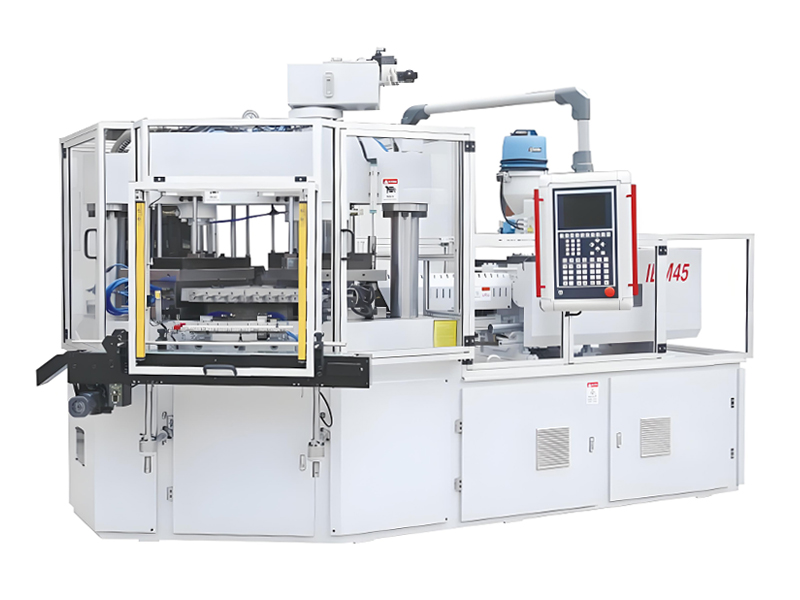
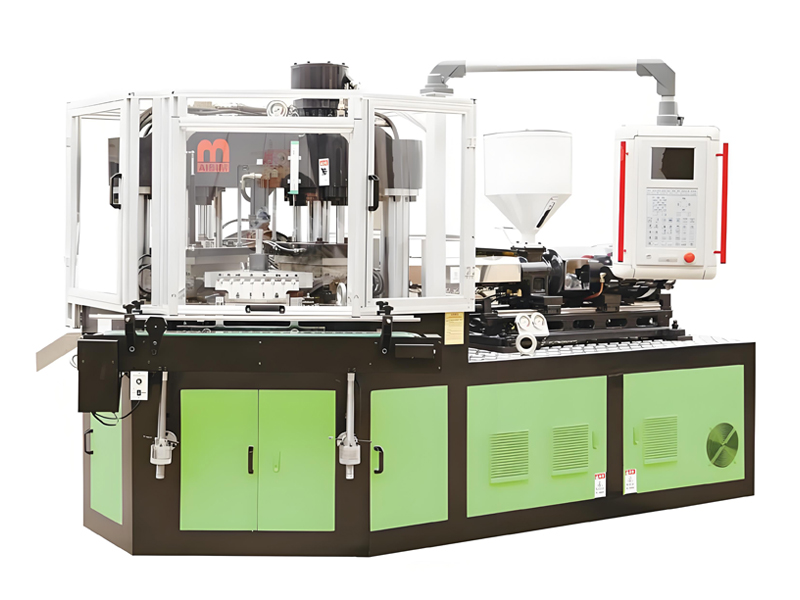
Aibim offers three IBM platforms that cover the full 3 mL to 1000 mL transparent container range. Each is a three-station, one-step machine with the PREFILL hydraulic technology, SD-card parameter storage, and the energy-saving package. The specification values below are typical engineering ranges for each model family; final figures are confirmed against the ordered configuration and cavity count.
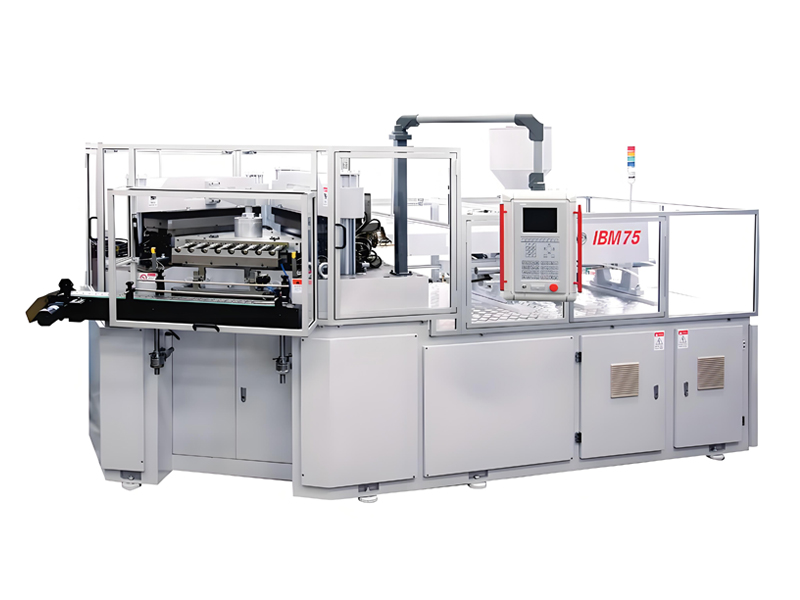
Mesin Cetak Tiup Injeksi IBM75
IBM75 adalah andalan untuk botol transparan berukuran sedang hingga besar hingga 1000 mL — botol esens kosmetik, botol sirup farmasi, dan botol sampel minuman. Satuan injeksi dan gaya penjepitnya yang lebih besar mendukung parison yang lebih besar dan lebih banyak rongga.
| Specification | IBM75 (typical range) |
|---|---|
| Model | IBM75 |
| Injeksi screw diameter | 45–55 mm |
| Shot size (injection weight) | 200–400 g |
| Clamping force | 450–750 kN (approx. 45–75 ton) |
| Container volume range | 50–1000 mL |
| Stations | 3 stations, one-step (injection / blow / ejection) |
| Drying / heating zones | 4–6 zones (dehumidifying dryer + barrel) |
| Cycle time / output | 6–12 s cycle, output scales with cavities |
| Installed power | 30–55 kW |
| Dimensions & weight | approx. 4.5 × 1.8 × 2.2 m; 8–12 ton |
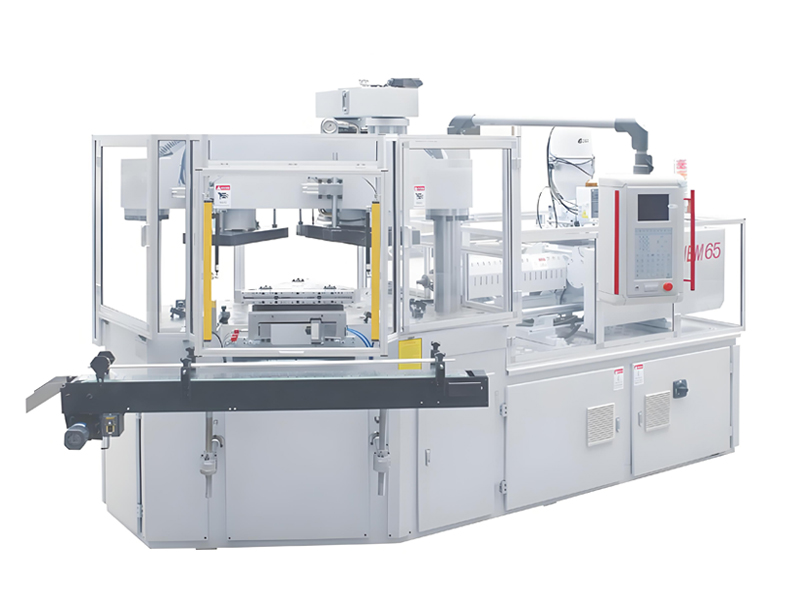
Mesin Cetak Tiup Injeksi IBM65
IBM65 cocok untuk botol transparan berukuran kecil hingga sedang dari 10 mL hingga 500 mL — botol obat tetes mata, botol cairan oral, dan penetes kosmetik. Ini adalah pilihan paling umum untuk pekerjaan kejernihan farmasi karena menggabungkan kontrol parison yang presisi dengan jejak yang ringkas.
| Specification | IBM65 (typical range) |
|---|---|
| Model | IBM65 |
| Injeksi screw diameter | 38–48 mm |
| Shot size (injection weight) | 120–260 g |
| Clamping force | 350–550 kN (approx. 35–55 ton) |
| Container volume range | 10–500 mL |
| Stations | 3 stations, one-step (injection / blow / ejection) |
| Drying / heating zones | 3–5 zones |
| Cycle time / output | 5–11 s cycle, output scales with cavities |
| Installed power | 22–40 kW |
| Dimensions & weight | approx. 4.0 × 1.6 × 2.0 m; 6–9 ton |
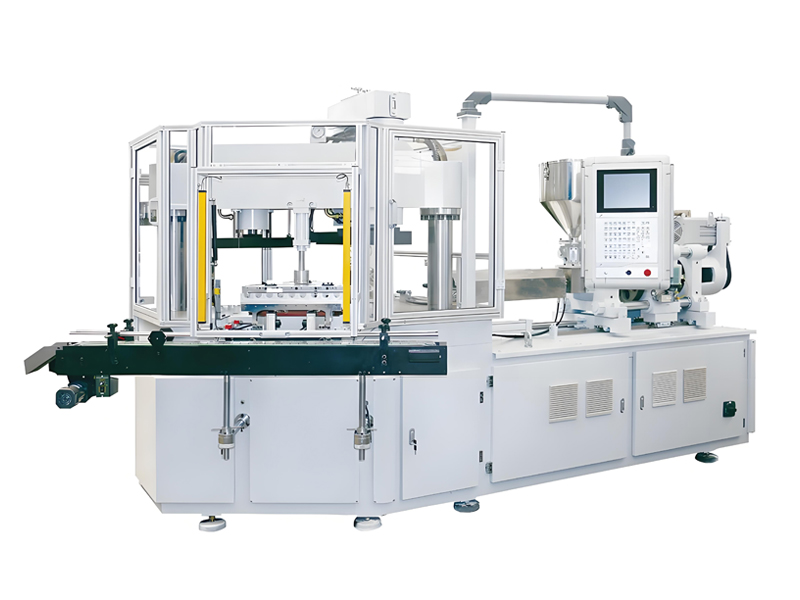
Mesin Cetak Tiup Injeksi Hibrida Elektrik IBM55
The IBM55 Hybrid Electric adds electric clamping and metering to the hybrid hydraulic package, giving the finest parison repeatability for the smallest, most demanding transparent bottles from 3 mL to 250 mL — micro-dose pharmaceutical vials and precision cosmetic samples. Its lower installed power and fast response suit clean-room and high-consistency production.
| Specification | IBM55 Hybrid (typical range) |
|---|---|
| Model | IBM55 Hybrid Electric |
| Injeksi screw diameter | 30–40 mm |
| Shot size (injection weight) | 60–150 g |
| Clamping force | 250–400 kN (approx. 25–40 ton) |
| Container volume range | 3–250 mL |
| Stations | 3 stations, one-step; hybrid electric/hydraulic |
| Drying / heating zones | 2–4 zones |
| Cycle time / output | 4–10 s cycle, output scales with cavities |
| Installed power | 15–30 kW |
| Dimensions & weight | approx. 3.5 × 1.4 × 1.9 m; 4.5–7 ton |
Perbandingan Transparansi Material
Tabel ini memberi peringkat material yang dapat diproses IBM berdasarkan kinerja botol transparan yang realistis sehingga Anda dapat mencocokkan resin dengan target kejernihan. “Kelas kejernihan” adalah perilaku bawaan material; “hasil kejernihan IBM” adalah apa yang biasanya dihasilkan oleh lini Aibim yang dijalankan dengan baik.
| Material | Clarity class | IBM clarity result | Effort to stay clear | Typical transparent use |
|---|---|---|---|---|
| PCTG / PETG | Amorphous, very clear | Excellent | Medium (dry well) | Premium cosmetic, display bottles |
| PC | Amorphous, clear | Excellent | Medium-High (dry, temp) | High-heat pharma, reusable |
| SAN | Amorphous, clear | Very good | Medium (dry) | Kosmetik, rigid clear |
| PS | Amorphous, clear | Very good | Low | Single-use pharma, sampling |
| PP + clarifier | Semi-crystalline | Good (with quench) | Medium-High | Pharma, food, droppers |
| ABS | Amorphous, slightly hazy | Fair | Medium | Translucent, not fully clear |
| TPU | Soft, often hazy | Fair | High | Soft-touch specialty |
| HDPE / LDPE | Semi-crystalline, opaque | Poor (by nature) | Very High | Used when clarity not needed |
Panduan Pemilihan Kebutuhan-ke-Model
Gunakan tabel ini untuk beralih dari kebutuhan botol ke model Aibim yang direkomendasikan. Rekomendasi ini mengasumsikan target yang jernih dan bebas cacat serta jumlah rongga standar; keluaran yang sangat tinggi atau geometri yang tidak biasa dapat mengubah pilihan.
| Container volume | Material | Transparency target | Output need | Recommended model |
|---|---|---|---|---|
| 3–50 mL | PP, PS, SAN, PC, PCTG | High | High | IBM55 Hybrid Electric |
| 10–250 mL | PP, PS, SAN, PC, PCTG | High | Medium-High | IBM65 or IBM55 Hybrid |
| 50–500 mL | PP, PS, SAN, PC, PCTG | High | Medium | IBM65 |
| 100–1000 mL | PP, PS, SAN, PC, PCTG | High | Medium-High | IBM75 |
| 250–1000 mL | PP, PCTG, PC | Premium | High | IBM75 |
| Micro-dose <15 mL | PP, PS, PC | Critical (pharma) | High repeatability | IBM55 Hybrid Electric |
Inspeksi Transparansi dan Kontrol Kualitas
Clarity must be measured, not guessed. A haze meter quantifies the percentage of scattered light and is the standard instrument for release testing of transparent bottles. Pair it with a light-transmittance measurement and a visual comparison against an approved master sample under defined lighting. Wall-thickness uniformity should be checked with a thickness gauge, because even a clear wall looks uneven if thickness varies. Internal stress is best seen with a polarized-light (polariscope) inspection, which reveals frozen-in orientation invisible to the naked eye.
For production control, Aibim recommends a first-article confirmation on every new mold and material lot, then periodic batch sampling of haze, wall thickness, and visual clarity. Because Aibim machines store full process recipes on an SD card, the validated clarity recipe for a bottle can be saved and reloaded on any same-model machine, removing operator drift between shifts and between lines.
Referensi Cepat Cacat-Penyebab-Penanggulangan
Tabel di bawah ini adalah diagnostik sekilas. Cocokkan gejalanya, baca kemungkinan penyebabnya, terapkan perbaikannya. Tabel ini mencakup lebih dari 14 baris sehingga sebagian besar kasus di lapangan dapat ditangani.
| # | Symptom | Likely cause | Primary countermeasure |
|---|---|---|---|
| 1 | Milky PP bottle | Spherulite growth (crystallization) | Lower mold temp, faster cooling, add clarifier |
| 2 | White brittle PET/PC wall | Hydrolysis from wet resin | Dry to spec; check dew point |
| 3 | General stress whitening | Internal frozen-in stress | Balance holding/cooling; even parison temp |
| 4 | Black specks / gray haze | Contamination or barrel carbon | Clean path, purge, control barrel temp |
| 5 | Bubbles inside wall | Trapped moisture / volatiles | Dry resin; vent; reduce back pressure |
| 6 | Silver streaks (splay) | Gas in melt front | Dry, segment injection speed, vent |
| 7 | Snake-like shoulder mark | Jetting at gate | Enlarge gate; lower initial speed |
| 8 | Wavy body ripples | Injeksi flow mark | Segmented speed; stabilize hot runner |
| 9 | Stretch lines on body | Uneven parison temp at blow | Control parison temp; tune pre-blow |
| 10 | Thin ridge (weld line) | Melt fronts meet poorly | Raise temp; improve venting; gate design |
| 11 | Orange peel surface | Mold surface roughness | Re-polish cavity to low Ra |
| 12 | Drag marks | Mold finish / ejection | Polish, check ejection, draft |
| 13 | Cloudy only on thick sections | Slow cooling in thick areas | Improve cooling circuits; reduce thickness |
| 14 | Haze after storage | Post-crystallization or moisture | Stable material; dry storage; clarifier |
| 15 | Gloss loss vs. master | Mold polish or process drift | Recalibrate recipe via SD card; repolish |
| 16 | Cloudy ring at neck | Orientation / shear at gate area | Tune gate, speed, holding pressure |
Biaya Relatif dan Investasi Tindakan Penanggulangan
Tidak setiap perbaikan memiliki biaya yang sama. Peringkat di bawah ini menggunakan indeks garis dasar 100 untuk pengaturan IBM standar yang dioptimalkan kejernihannya, dengan investasi relatif ditunjukkan sebagai tingkat, perkiraan persentase di atas garis dasar, dan kelipatan. Tidak ada jumlah mata uang yang diberikan; tujuannya adalah membantu Anda memprioritaskan.
| Countermeasure | Investment level | vs. baseline | Multiple | Index points |
|---|---|---|---|---|
| Process tuning (speed, pressure, temp) | Low | +0% | 1.0× | 100 |
| Material drying upgrade (dehumidifying dryer) | Low | +5% | 1.05× | 105 |
| Mold re-polish to mirror Ra | Medium | +15% | 1.15× | 115 |
| Clarifying / nucleating agent (per lot) | Low | +3% | 1.03× | 103 |
| Cooling circuit redesign | Medium | +20% | 1.20× | 120 |
| Gate / runner rework | Medium | +18% | 1.18× | 118 |
| New high-precision mold (CNC) | High | +60% | 1.60× | 160 |
| IBM55 Hybrid Electric upgrade | High | +70% | 1.70× | 170 |
| Full turnkey clarity cell (machine+mold+dryer) | Very High | +120% | 2.20× | 220 |
| Premium closed-loop optical QC line | Premium | +200% | 3.00× | 300 |
Layanan dan Dukungan Aibim
Memilih mesin yang tepat hanyalah setengah dari pekerjaan; menjalankannya dengan jernih di setiap shift adalah setengah lainnya. Aibim mendukung setiap lini dengan komitmen layanan grup Wanplas dan kemampuan khusus Aibim:
- Uji coba dan inspeksi sebelum pengiriman: setiap lini dijalankan dan diverifikasi di pabrik sebelum pengiriman, termasuk keamanan bersertifikat CE — stasiun stripper menggunakan sensor laser digital jarak jauh untuk melindungi cetakan, dan tirai cahaya melindungi personel.
- Instalasi dan komisioning di lokasi: teknisi Aibim datang ke lokasi pelanggan untuk memasang, menyetel, dan menyerahkan lini produksi sesuai target kejernihan dan keluaran yang disepakati.
- Kebijakan suku cadang: suku cadang gratis senilai USD 500 per tahun, ditambah penggantian gratis untuk suku cadang yang rusak selama masa garansi.
- Manajemen resep kartu SD: resep proses — termasuk pengaturan kejernihan yang telah divalidasi — disimpan pada kartu SD dan dapat dimuat ulang di berbagai mesin, menghilangkan penyimpangan operator.
- Hemat energi: Teknologi PREFILL dan pompa perpindahan variabel memberikan penghematan energi minimum 35% dibandingkan unit hidraulik konvensional.
- Pengembangan cetakan dan sampel: Aibim merancang dan menguji cetakan serta memproduksi sampel botol sehingga target kejernihan terbukti sebelum produksi massal.
- Pelatihan dan pabrik terbuka: operator dilatih di lokasi, dan pelanggan dipersilakan mengunjungi pabrik Zhangjiagang untuk mengaudit bengkel dan menyaksikan uji coba.
- Jaminan transportasi, kapasitas, dan kualitas: grup Wanplas menjanjikan jaminan transportasi, jaminan kapasitas produksi, dan standar kualitas dengan kompensasi jika kualitas gagal.
Pertanyaan yang Sering Diajukan
Mengapa botol PP bening saya terlihat keruh, bukan transparan?
PP adalah polimer semi-kristalin. Jika parison atau dinding botol mendingin perlahan, spherulit tumbuh cukup besar untuk menghamburkan cahaya, menghasilkan kabut seperti susu. Naikkan laju pendinginan, turunkan suhu cetakan, dan gunakan agen penjernih atau nukleasi untuk menjaga kristal tetap kecil dan dinding tetap jernih.
Apa yang menyebabkan bekas aliran pada bahu botol dari komponen injeksi molding tiup?
Flow marks on the shoulder usually originate at the injection station. Uneven melt-front temperature, too-high initial injection speed, a small gate, or cold material produces a visible snake-like ripple. Use segmented injection speed, enlarge or relocate the gate, and stabilize hot-runner and mold temperature.
Apakah saya perlu mengeringkan PP sebelum injeksi molding tiup?
PP bersifat hidrofobik dan hanya memerlukan pengeringan ringan untuk menghilangkan kelembapan permukaan, tetapi PET, PC, PCTG, SAN, PS, dan ABS harus dikeringkan hingga tingkat kelembapan rendah dalam pengering dehumidifikasi. Resin higroskopis yang tidak dikeringkan akan terhidrolisis dan berubah menjadi putih atau berkabut.
Mesin Aibim mana yang harus saya pilih untuk botol kosmetik transparan 100 mL berbahan PETG?
Untuk botol kosmetik PETG 100 mL, IBM75 mencakup hingga 1000 mL dan merupakan pilihan standar, sedangkan IBM65 menangani 10 hingga 500 mL. PETG memerlukan pengeringan menyeluruh dan suhu cetakan sedang, keduanya didukung oleh paket pengeringan dan kontrol suhu Aibim.
Bisakah finishing permukaan cetakan saja memperbaiki kekeruhan?
Polesan cetakan diperlukan tetapi tidak cukup. Hasil akhir cermin mengurangi hamburan permukaan, tetapi kristalisasi internal, kelembapan, dan pemutihan akibat tegangan berasal dari material dan proses. Anda memerlukan pendekatan empat dimensi: mesin, cetakan, proses, dan material secara bersama-sama.
Bagaimana injeksi molding tiup berbeda dari molding tiup dua langkah untuk kejernihan?
IBM forms the parison by injection in the first station, so the parison wall is uniform, flash-free, and precisely controlled, giving better wall consistency and fewer weld lines than many two-step or extrusion blow routes. The one-step three-station process also reduces contamination and handling haze.
Berapa penghematan energi minimum mesin IBM Aibim?
Mesin IBM Aibim menggunakan teknologi PREFILL dan pompa perpindahan variabel, dan lini ini menghemat konsumsi energi minimum 35% dibandingkan unit hidraulik konvensional dengan ukuran serupa.
Kesimpulan dan Undangan
Cloudiness and flow marks on transparent injection blow molding bottles are solvable once you stop treating them as one problem. They are the visible result of four underlying families — crystallization, orientation and stress, cooling, and melt flow — and each has a clear lever across the machine, mold, process, and material dimensions. Dry hygroscopic resins, quench semi-crystalline walls, polish the mold to a mirror finish, segment the injection, and control the parison temperature, and clarity follows.
Whether you run pharmaceutical vials, cosmetic essence bottles, food sampling bottles, or transparent health-product containers, Aibim — a Wanplas factory with 12-plus years of machine-building experience, 20 years in the IBM field, and 100-plus lines shipped per year from our 2022 Zhangjiagang plant — can configure the right IBM75, IBM65, or IBM55 Hybrid Electric line for your clarity target. We invite you to send us your bottle sample, the material you plan to use, and your transparency goal. Our engineers will propose the process and machine configuration to eliminate haze and flow marks, and we welcome you to send samples for molding trials and to visit our factory for a live test run and audit.