- 1. Qué hace que un frasco sea de “boca ancha” y por qué es difícil de moldear
- 2. IBM vs ISBM vs EBM para frascos de boca ancha
- 3. Seis desafíos principales y sus soluciones
- 4. Selección de materiales para frascos de boca ancha
- 5. Principios de diseño de moldes para IBM de boca ancha
- 6. Inspección de calidad y criterios de aceptación
- 7. Máquinas Aibim para producción de frascos de boca ancha
- 8. Industrias de aplicación y especificaciones típicas
- 9. Guía de selección de modelo según requisitos
- 10. Servicio, soporte y cómo comenzar
- 11. Preguntas frecuentes
Qué hace que un frasco sea de “boca ancha” y por qué es difícil de moldear
A wide mouth jar is defined by geometry, not by marketing language. In blow molding the controlling dimension is the neck-to-body diameter ratio, which is the finished neck opening diameter divided by the maximum body diameter of the container. A wide mouth jar carries a neck-to-body diameter ratio above 0.5, with the typical production window sitting between 0.55 and 0.85. By contrast a narrow neck bottle stays below 0.35, and many pharmaceutical dropper and beverage bottles sit well under 0.25. The moment the ratio climbs past 0.5 the part stops behaving like a bottle and starts behaving like a small open container, and that single change rewrites the way the parison must be formed, blown and ejected.
Wide mouth jars are produced across a broad range of opening sizes and volumes. The most common neck or finish diameters are 38 mm, 45 mm, 53 mm, 63 mm, 70 mm, 89 mm and 100 mm. Matching volumes usually run from 30 mL for sample and lab jars up to 1000 mL for food, confectionery and pet food containers. A 100 mm opening on a 1000 mL jar is at the upper edge of practical injection blow molding, while a 38 mm opening on a 120 mL jar is at the easy end of the range. The table below places these sizes on a single reference grid so the geometry is unambiguous before we discuss process behavior.
| Opening diameter (mm) | Typical volume range (mL) | Neck-to-body ratio | Common use |
|---|---|---|---|
| 38 | 30 – 250 | 0.55 – 0.70 | Sample jars, cosmetic cream cups, vitamin packs |
| 45 | 50 – 300 | 0.55 – 0.72 | Personal care, single-dose food |
| 53 | 100 – 400 | 0.58 – 0.75 | Cosmética, pharmacy powder |
| 63 | 150 – 500 | 0.60 – 0.78 | Honey, sauce, supplement jars |
| 70 | 200 – 750 | 0.62 – 0.80 | Jam, nuts, body butter |
| 89 | 400 – 900 | 0.70 – 0.83 | Pet food, confectionery, lab storage |
| 100 | 500 – 1000 | 0.75 – 0.85 | Large food, protein, industrial samples |
La razón por la que un frasco de boca ancha es más difícil de moldear que una botella de cuello estrecho no es una sola falla sino cuatro causas acopladas de mecánica y proceso. Comprender estas cuatro causas es la base de cada solución analizada más adelante en este artículo.
First cause: the blow-up ratio is locked down. In blow molding the blow-up ratio is the body diameter divided by the parison diameter at the point being blown. A narrow neck bottle is injected as a slim parison and blown outward many times, so the polymer stretches dramatically and fills the cavity. A wide mouth jar already starts with a parison that is nearly as wide as the final body, because the neck finish itself is wide. The available blow-up ratio collapses to roughly 2.0 to 3.5, sometimes less. With little stretch left, the polymer cannot redistribute itself to even out wall thickness, so the base and shoulder tend to stay thin while the body stays thick. This is the root of most wall balance complaints on wide mouth parts.
Second cause: the parison distribution is difficult to make uniform. Because the part is short and squat, the parison travels a short distance from the injection cavity to the blow cavity, but the cross-section changes are abrupt. The neck region must stay stiff and dimensionally exact, the shoulder must accept rapid expansion, and the base must fill without webbing. A uniform tubular parison that works for a tall bottle does not map onto a wide mouth jar, so the parison wall must be deliberately profiled along its length.
Third cause: the demolding path is obstructed. A narrow neck bottle is stripped off the core rod through a small opening, so the draft is gentle and the undercut risk is low. A wide mouth jar has a large opening and large side walls with threads or knurls, so the stripping travel is long and the friction against the core rod and cavity is high. The part wants to stick, gall, or stretch during ejection, and a single bad release can scar the sealing land.
Fourth cause: the neck lacks rigidity and deforms easily. The wide neck is both the largest opening and the most functionally critical surface. It carries the threads or snap feature, the sealing plane, and the torque load of the closure. Because the neck wall is necessarily thin relative to its diameter, it cools slowly and, if ejected while soft, relaxes into ovality or sink. A warped neck leaks, a low-torque neck cross-threads, and an out-of-round neck fails automated capping.
Un frasco de boca ancha es difícil no porque falle un solo paso, sino porque la relación de soplado, el perfil del párison, la trayectoria de liberación y la rigidez del cuello se oponen entre sí a la vez. El moldeo por inyección y soplado es el proceso que da el mayor control sobre los cuatro al mismo tiempo.
Aibim is a Wanplas factory with more than twelve years of experience building injection blow molding machines and molds, exporting to over forty countries, with its own CNC machining center and an annual capacity above one hundred lines per year. The wide mouth jar is one of the most demanding parts that an IBM line is asked to make, and the rest of this guide explains how to design the process, the mold and the material so the part consistently passes spec.
IBM frente a ISBM frente a EBM para frascos de boca ancha
Three blow molding routes can technically produce a wide mouth jar: injection blow molding (IBM), injection stretch blow molding (ISBM), and extrusion blow molding (EBM). They differ most at the neck finish, where the wide mouth jar lives or dies. The comparison below is a process-to-process benchmark, not a brand comparison, and it shows why IBM dominates precision wide mouth production.
| Attribute | Inyección Soplado (IBM) | Inyección Stretch Soplado (ISBM) | Extrusion Soplado (EBM) |
|---|---|---|---|
| Neck finish precision | Plus or minus 0.05 mm, no flash, no trim | Plus or minus 0.10 mm, no flash | Plus or minus 0.30 mm, flash requires trim |
| Minimum practical neck-to-body ratio | 0.50 and up (best for wide mouth) | 0.45 and up | 0.30 and up (best for very wide, low-precision) |
| Wall thickness uniformity | Good, controllable by parison profile | Excellent, biaxial orientation | Fair, parison programming needed |
| Material adaptability | PE, PP, PS, SAN, PC, PCTG, TPU | PET, PETG, PEN, some PP | PE, PP, PVC, PC, TPU |
| Scrap rate | Low, below 5 percent | Low, below 5 percent | Medium, flash and trim 15 to 25 percent |
| Cycle time | Medium | Medium | Medium |
| Mold complexity | Medium | Medium to High | Low |
| Cost level | Medium | Medium to High | Low |
The decisive column for a wide mouth jar is neck finish precision. The neck is the opening through which the product is filled and the closure is applied, and on a wide mouth jar that opening can be 100 mm across. IBM forms the neck by injecting molten polymer into a precision neck ring, so the threads, the sealing land and the inside diameter are fixed by steel, not by a cut parison. That yields a finish held to roughly plus or minus 0.05 mm with no flash and no secondary trimming operation. ISBM is excellent for oriented PET and gives the best wall distribution, but its neck precision and its material set (driven by PET and PETG) make it a second choice for PP and PS food jars. EBM is the cheapest route and handles very large openings, but the flash line and the plus or minus 0.30 mm neck tolerance force a trimming step and a looser closure fit, which is unacceptable for many food, pharmaceutical and cosmetic jars.
Desde la perspectiva del grupo Wanplas, cuando un proyecto necesita una línea aguas abajo compatible, como llenado o un proceso de extrusión complementario, esas capacidades se suministran bajo el nombre de Wanplas para que el cliente obtenga un proveedor responsable en lugar de varios vendedores desconectados.
Elija IBM cuando el frasco de boca ancha deba sellar, roscar y tapar con variación casi nula y sin recorte posterior. Elija ISBM para frascos de boca ancha de PET orientado con máxima claridad y resistencia a la caída. Elija EBM solo cuando la abertura sea muy grande y la tolerancia del cierre sea amplia.
Seis desafíos principales y sus soluciones
Los siguientes seis desafíos son los que se encuentran con más frecuencia en los programas de frascos de boca ancha. Cada uno está escrito como un bucle: fenómeno, mecanismo, contramedida de parámetro o estructura, y método de verificación. Use esta estructura en el piso de producción para diagnosticar una pieza defectuosa en lugar de adivinar.
Reto 1: el límite de la relación de soplado causa desequilibrio de pared en la base y el hombro
Fenómeno. La pared del cuerpo mide dentro de la tolerancia pero la base es lo suficientemente delgada como para perforarse en la prueba de caída, y el hombro muestra adelgazamiento local cerca de la transición al cuello. La pieza se ve bien hasta que falla en una prueba de caída de 1.2 m o en una prueba de carga superior.
Mechanism. The wide mouth geometry leaves only a 2.0 to 3.5 blow-up ratio. With little radial stretch available, the polymer cannot flow from the body into the base and shoulder during blowing. Where the parison was already thin, it stays thin; where it was thick, it stays thick. The classic symptom is a thick cylindrical body and a starved base.
Parameter and structure countermeasure. Profile the parison deliberately with a stepped core rod so the wall thickness tapers from the neck down to the base. A practical injection wall gradient runs from 1.5 mm at the neck region to 4.5 mm toward the base, putting more material where the blow-up ratio is lowest. Keep the blow-up ratio inside the 2.0 to 3.5 window by sizing the core rod diameter correctly, and apply a staged pre-blow: a low first pressure to seat the parison against the cavity, then a higher second pressure to complete the form. Avoid trying to compensate by raising blow pressure alone, which only bursts weak zones.
Verification method. Cut the jar at eight or more points (neck, shoulder, upper body, mid body, lower body, base radius, base center, side wall) and measure wall thickness. Confirm the thinnest point is above the drop-test minimum and that the ratio between the thickest and thinnest wall is inside the agreed spec. Re-run the drop test at 1.2 m full before releasing the setting.
Desafío 2: Deformación del cuello y ovalidad
Fenómeno. La abertura del cuello mide fuera de redondez más de lo que permite el dibujo, o muestra un hundimiento visible en el asiento de sellado. Las tapas se cruzan de rosca o gotean en la prueba de par.
Mechanism. The wide neck wall is thin relative to its diameter and has a large surface area, so it cools more slowly than the body. If the part is stripped while the neck polymer is still soft, the land relaxes under its own weight and the clamping load, producing ovality and sink. Low crystallinity control in PP makes the effect worse because the amorphous skin is soft at higher temperatures.
Parameter and structure countermeasure. Give the neck ring its own independent cooling circuit so the neck can be brought to temperature faster than the body. Control neck crystallinity by holding the neck ring temperature in the correct band for the grade. Keep the demold temperature below 70 degrees C for polypropylene. Extend the residence time on the turret at the blow or cooling station so the neck sets before transfer. Add 0.2 to 0.5 mm to the neck wall thickness compared with a narrow neck design to raise its stiffness without changing the opening.
Verification method. Measure neck inside diameter at two perpendicular axes with a bore gauge and compute ovality as the difference. Run a torque test with the production closure at the specified application torque and confirm no cross-thread and no leak under the seal test. Check the sealing land with a flatness indicator referenced to the datum plane.
Desafío 3: Desmoldeo difícil y rayado de la superficie
Fenómeno. El frasco muestra marcas de rayado vertical en el cuerpo o el cuello, o se pega en la varilla del núcleo y el robot de extracción no atrapa la pieza. La estabilidad del ciclo cae y el desperdicio aumenta.
Mechanism. A wide mouth jar has a large internal surface dragged along the core rod during stripping, and the threads or knurls add local undercut. The release travel is long, so friction is high and any sticking point galls the surface. A 0.5 degree draft angle that works on a bottle is insufficient here.
Parameter and structure countermeasure. Increase the draft angle to 1 to 2 degrees, roughly double the bottle norm. Use a stripper air pulse with a timed sequence so a short burst of compressed air breaks the vacuum seal at the start of ejection. Add a mechanical stripper plate that pushes the jar uniformly off the core rod instead of relying on air alone. Polish the cavity and core rod to a surface finish of Ra 0.2 micrometer or better so the polymer does not grip. Use a release agent only when absolutely necessary and only in a controlled, documented dose, because excess agent blooms to the surface and spoils printing or labeling.
Método de verificación. Ejecute un bloque continuo de ciclos y cuente los eventos de adherencia o rayado. Inspeccione la pared interna con luz rasante en busca de líneas de rayado. Confirme que el robot de extracción recoge cada pieza a lo largo del bloque sin una carrera fallida.
Desafío 4: adelgazamiento del hombro y las esquinas con agrietamiento por caída
Fenómeno. El frasco pasa la inspección inicial pero se agrieta en el hombro o en una esquina interna durante el llenado, el apilado o el transporte. El origen de la falla es una esquina delgada y altamente tensionada.
Mecanismo. Las esquinas internas afiladas concentran la tensión, y los hombros delgados no pueden absorber la energía de impacto. Si la varilla de núcleo está demasiado fría, el párison se congela antes de conformarse; si está demasiado caliente, el párison se comba. El grado incorrecto da una baja resistencia al impacto a la temperatura de uso.
Parameter and structure countermeasure. Run the core rod with zoned temperature control, typically 60 to 110 degrees C, so the parison stays formable long enough to fill the corners. Specify corner radii of R 2 mm or larger at every internal transition so stress does not concentrate. Choose a material with enough low-temperature impact, for example a polypropylene random co-polymer for improved toughness. Where the application allows, apply a short anneal step after molding to relax residual stress in the shoulder and corners.
Método de verificación. Seccione el hombro y las esquinas y confirme que los radios cumplen el dibujo. Realice la prueba de caída a 1.2 m con el frasco lleno hasta el volumen nominal, en cada una de las orientaciones de impacto requeridas, y repita después de un ciclo de acondicionamiento en frío si el mercado requiere rendimiento a baja temperatura.
Desafío 5: Tiempo de ciclo largo y baja producción
Fenómeno. El ciclo por cavidad es más largo que el objetivo comercial, por lo que la producción anual no alcanza el plan de negocio incluso a plena cavitación.
Mecanismo. Un frasco de boca ancha ocupa más área de plato por cavidad que una botella del mismo volumen, por lo que el número de cavidades está limitado por el plato, no por el tamaño de inyección. El enfriamiento es lento porque el cuello y la base gruesos retienen el calor, y la torreta pasa tiempo vacío moviéndose entre estaciones.
Parameter and structure countermeasure. Select a multi-cavity configuration that fits the platen, accepting that wide mouth jars rarely reach the cavitation of narrow neck programs. Drop the cooling water temperature to 8 to 15 degrees C and densify the water channels so heat leaves the mold faster. Use a servo-driven turret to shorten the non-productive transfer time between stations. Optimize the dry cycle by tightening the clamp open, transfer and close sequence without sacrificing safety.
| Cycle phase | Typical time (s) | Optimization lever |
|---|---|---|
| Inyección and parison hold | 1.4 – 2.2 | Balance pack pressure, avoid over-pack |
| Transfer to blow station | 0.4 – 0.7 | Servo turret, shorten dead stroke |
| Blow and cooling | 2.0 – 4.0 | Water at 8 to 15 C, denser channels |
| Transfer to eject station | 0.4 – 0.7 | Servo turret timing |
| Demold and reset | 0.8 – 1.4 | Stripper plate, stripper air timing |
| Dry cycle total | 3.8 – 5.0 | Machine dependent |
Método de verificación. Cronometre el ciclo de moldeo real durante un bloque de producción estable y compare cada fase con la tabla anterior. Confirme que la fase de enfriamiento, no la fase de transferencia, es el cuello de botella; si la transferencia domina, la ganancia proviene de la torreta servo en lugar del agua más fría.
Desafío 6: Planitud de la cara de sellado y ajuste del cierre
Fenómeno. El frasco pasa una prueba de fugas estática pero gotea después del ciclo térmico, el apilado o el envío, o el cierre aplica un par desigual alrededor del borde.
Mechanism. A wide mouth jar has a large sealing face, so a small absolute warp becomes a large leak path. Warp comes from uneven cooling across the wide land, from residual stress, and from a neck that was not fully set at demold. A mismatch between the thread form and the closure compounds the problem.
Parameter and structure countermeasure. Hold the seal face flatness to 0.15 mm or better by balancing the neck ring cooling and by gating the parison so the land fills symmetrically. Select the thread form to match the closure family: the 400, 415 and 425 series are the common continuous-thread finishes, and the choice sets the wall and torque behavior. For products needing a secondary barrier, design the land to accept an inner plug or an aluminum foil seal without distorting the plane. Validate the closure torque against the chosen finish so the cap seats uniformly.
Método de verificación. Mida la planitud de la cara de sellado con un comparador de carátula sobre una base de granito. Realice una prueba de vacío o retención de presión en el frasco lleno y tapado, luego repita después de un ciclo térmico. Confirme que el par de aplicación esté dentro del rango acordado en cada unidad muestreada.
Selección de materiales para frascos de boca ancha
Material choice sets the ceiling on clarity, impact, temperature resistance and food contact compliance. The table below lists the materials that run on IBM and ISBM wide mouth programs with their processing window and compliance reference. Compliance names are given as plain text for verification against the official regulation text.
| Material | Melt temp (C) | Mold temp (C) | Demold temp (C) | Shrinkage (%) | Impact grade | Transparency | Alimentos contact compliance |
|---|---|---|---|---|---|---|---|
| PP homo-polymer | 210 – 250 | 20 – 60 | < 70 | 1.5 – 2.0 | Medium | Opaque | FDA 21 CFR 177, EU 10/2011 |
| PP random co-polymer | 200 – 240 | 20 – 60 | < 70 | 1.4 – 1.9 | High | Opaque, slight clarity | FDA 21 CFR 177, EU 10/2011 |
| HDPE | 200 – 240 | 15 – 50 | < 65 | 1.5 – 2.5 | Medium-High | Opaque | FDA 21 CFR 177, EU 10/2011 |
| PS | 190 – 230 | 20 – 50 | < 60 | 0.4 – 0.7 | Low | High | FDA 21 CFR 177, EU 10/2011 |
| SAN | 220 – 260 | 50 – 80 | < 70 | 0.4 – 0.7 | Medium | High | FDA 21 CFR 177, EU 10/2011 |
| PET (ISBM) | 270 – 290 | 90 – 120 | < 90 | 0.2 – 0.5 | High | Very high | FDA 21 CFR 177, EU 10/2011 |
| PETG | 230 – 260 | 20 – 40 | < 65 | 0.3 – 0.6 | High | Very high | FDA 21 CFR 177, EU 10/2011 |
| PCTG | 240 – 270 | 30 – 60 | < 70 | 0.4 – 0.7 | Very high | Very high | FDA 21 CFR 177, EU 10/2011 |
| PC | 280 – 320 | 80 – 120 | < 100 | 0.5 – 0.7 | Very high | High | Check BPA compliance for baby-related items |
Polipropileno in homo-polymer or random co-polymer grade is the default for food jars such as jam, honey, nuts and confectionery because it resists heat, chemicals and grease while meeting food contact rules. The random co-polymer adds low-temperature impact, which helps jars that are filled hot or stored cold. HDPE serves pharmaceutical powder and tablet jars where squeezability and chemical resistance matter more than clarity. PS y SAN give transparent display jars for cosmetics and hardware, though their impact is lower so the wall must be tuned for drop performance. PET and PETG through ISBM produce the clearest wide mouth jars with the best barrier, but they need the higher stretch ratios and the hotter mold that ISBM provides. PCTG and PC deliver top impact and clarity for demanding items; for any baby-related product the PC grade must be verified for BPA compliance before use.
Principios de diseño de moldes para IBM de boca ancha
El molde es donde las cuatro causas de dificultad se resuelven en acero. Los moldes IBM de boca ancha difieren de los moldes de botella en tres aspectos estructurales: disposición de la torreta, construcción del anillo de cuello y rigidez de la varilla de núcleo.
Three-station and four-station turret layout. Aibim IBM machines use a three-station one-step process: injection, blow and ejection on a rotating turret. Some programs add a fourth station for extra cooling or in-mold labeling. A wide mouth mold occupies more platen area per cavity than a bottle mold, so the turret pitch and the platen size set the maximum cavity count directly. Plan the cavitation from the platen drawing, not from the shot size, because the wide body almost always runs out of platen before it runs out of polymer.
Neck ring split design and flash control. Because IBM injects the neck, the neck ring is a split steel insert that defines the finish. For a wide mouth jar the neck ring is large and must part cleanly without a flash line on the sealing land. Design the parting line away from the seal face, and hold the neck ring as a replaceable insert so wear does not force a full mold rebuild. Flash on the land is the fastest way to fail a closure leak test, so the neck ring fit is cut tighter than on a bottle mold.
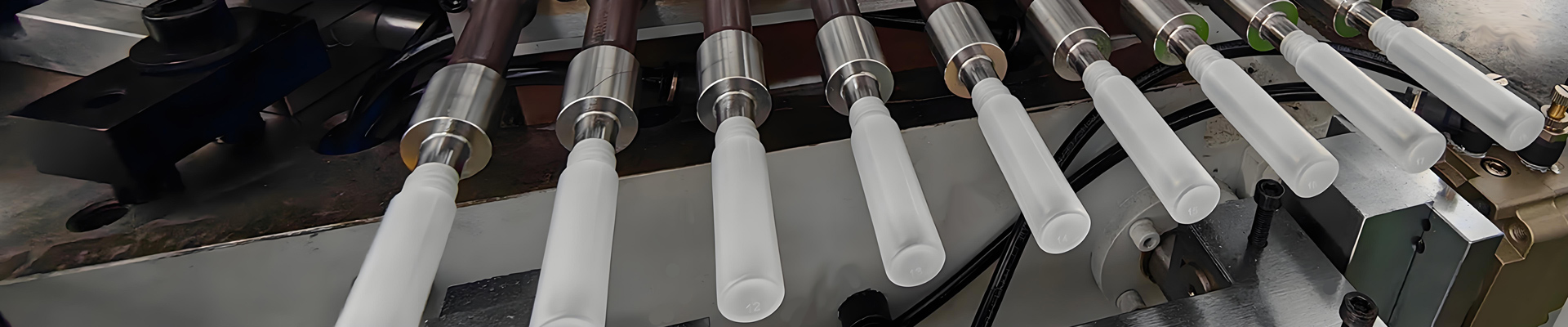
Core rod length-to-diameter ratio and rigidity. The core rod forms the internal shape and carries the parison between stations. A wide mouth jar needs a large-diameter core rod, and a large-diameter rod is more prone to deflection than a slim bottle rod. Keep the rod aspect ratio conservative, support it at both ends where the machine allows, and specify a stiff, dimensionally stable grade so the inside diameter stays round across the run. A deflecting rod produces an out-of-round inside wall that no blow setting can fix.
Water channel layout and uniform temperature. Wide mouth jars need the neck cooled faster than the body, so the neck ring gets its own circuit while the body cavity gets another. Lay the channels to hold the mold temperature uniform within plus or minus 2 degrees C across the cavity face; a 5 degree C spread across a wide land is enough to warp the seal plane. Denser channels near the base and shoulder pull heat from the thick sections that otherwise dictate the cycle.
Mold material and maintenance. Use pre-hardened tool steel (P20-type) for the body and cavity where the loads are moderate, and stainless tool steel (420-type) for necks and cores that contact food-grade or corrosive compounds and need corrosion resistance with a polish-ready surface. The cavity and core rod are finished to Ra 0.2 micrometer or better for clean demolding. With routine cleaning, channel descaling and rod inspection, a well-built wide mouth IBM mold runs a long life; schedule a full refurbish at the cavitation and wear interval defined in the mold maintenance plan rather than waiting for a failure.
Inspección de calidad y criterios de aceptación
Un frasco de boca ancha se acepta según criterios dimensionales, mecánicos y de sellado. La tabla siguiente es una lista de verificación de aceptación lista que mapea cada comprobación a su límite y método.
| Check | Aceptarance limit | Method |
|---|---|---|
| Capacity | Plus or minus 2 percent of rated volume | Fill to overflow, weigh or measure |
| Neck inside diameter | Per drawing, plus or minus 0.05 mm | Bore gauge at two axes |
| Neck ovality | Below drawing max, typically < 0.10 mm | Two-axis bore gauge |
| Seal face flatness | 0.15 mm or better | Dial indicator on datum |
| Wall thickness distribution | Minimum at or above spec, 8 plus points | Section and micrometer |
| Vertical top load | Per rated stack load in newtons | Compression test at set speed |
| Drop test | No leak or break at 1.2 m, full | Drop on required orientations |
| Seal retention | Hold vacuum or pressure per spec | Vacuum or pressure chamber |
| Light transmittance and haze | Per clarity grade for transparent jars | Haze meter or spectro |
Capacity is confirmed by filling the jar to the overflow line and weighing the contents against the rated volume, with the tolerance held to plus or minus 2 percent so filling lines stay accurate. Neck inside diameter and ovality are checked at two perpendicular axes because a wide mouth jar fails capping the moment the opening goes out of round. Seal face flatness is the single most important number for leak performance and is held to 0.15 mm or better. Wall thickness is measured at no fewer than eight points so a thin base or shoulder cannot hide in a single reading. Top load in newtons confirms the jar survives pallet stacking, and the 1.2 m full drop test confirms field performance. Transparent jars are additionally checked for light transmittance and haze so the display appearance is controlled.
Máquinas Aibim para la producción de frascos de boca ancha
When the technical discussion reaches the question of which machine to run, Aibim offers a focused IBM lineup built for precision hollow parts including wide mouth jars. Two representative models are described below with specification tables that include the two numbers that matter most for this application: maximum bottle mouth diameter and maximum bottle volume.
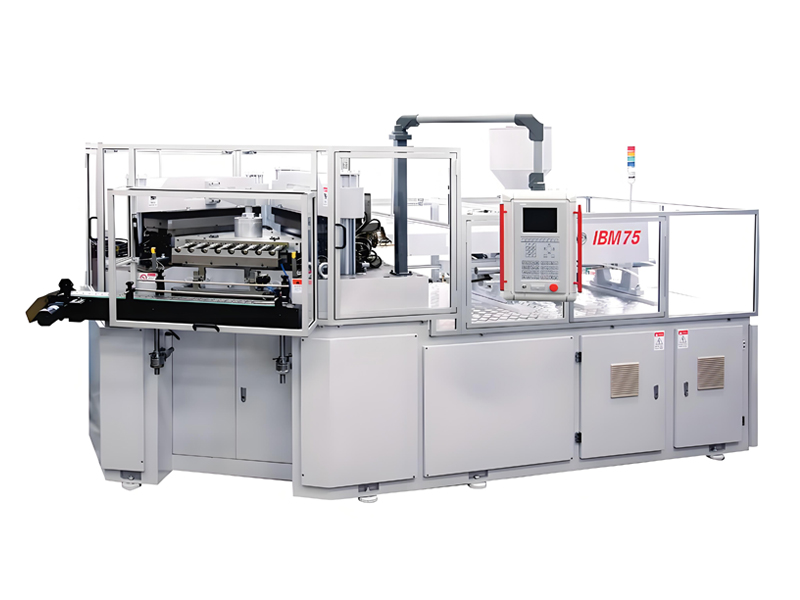
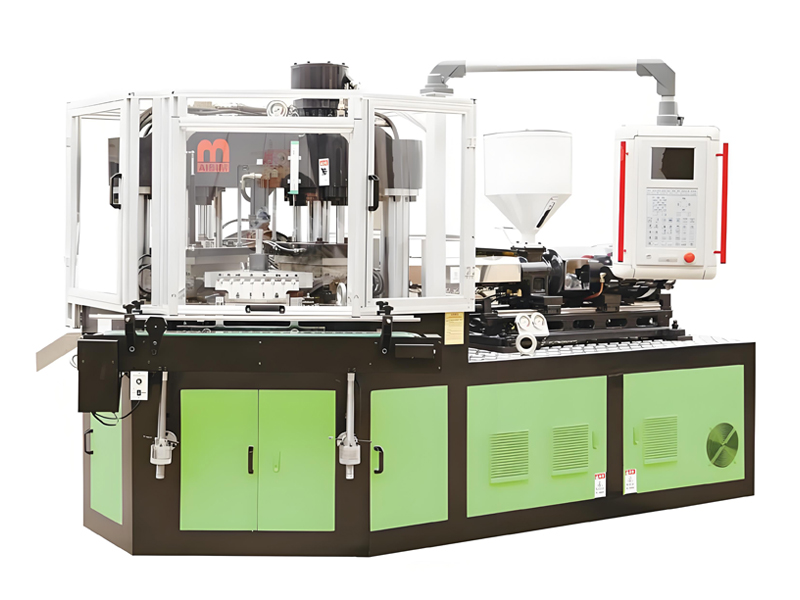
Máquina de moldeo por inyección y soplado Aibim IBM75
The IBM75 is the largest standard Aibim model and the natural choice for wide mouth jars up to 1000 mL and openings up to 120 mm. Its single-crossbeam, double-pole clamping framework enlarges the mold setting space, which is exactly what a wide mouth mold needs because the body footprint is large. The machine uses Aibim PREFILL technology with a variable displacement pump that cuts energy use by at least 35 percent compared with a conventional fixed-pump hydraulic unit.
| Specification | IBM75 value |
|---|---|
| Clamping force | 75 tf (750 kN) |
| Inyección capacity (shot) | 600 cm3 |
| Screw diameter | 45 mm |
| L/D ratio | 20:1 |
| Maximum cavities | Up to 8 for small parts; 2 to 4 for wide mouth jars |
| Maximum bottle mouth diameter | 120 mm |
| Maximum bottle volume | 1000 mL |
| Platen size | 520 x 520 mm |
| Installed power | 30 kW |
| Tiempo de ciclo seco | 4.5 s |
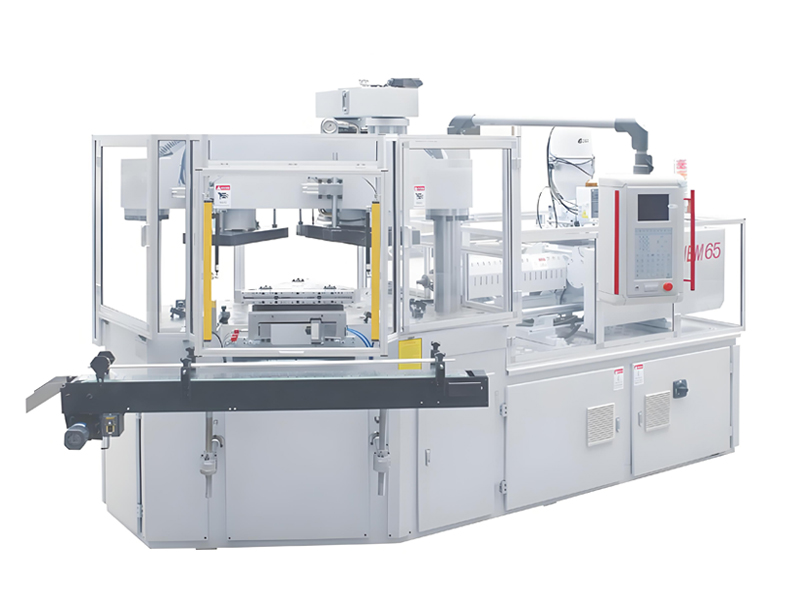
Máquina de moldeo por inyección y soplado Aibim IBM65
The IBM65 sits one step below the IBM75 and covers wide mouth jars up to 750 mL and openings up to 100 mm. It is the workhorse for food, cosmetic and pharmaceutical jars in the mid-volume band, with the same three-station one-step process and the same neck precision. Cavity count for a wide mouth jar is limited by platen space, so a 250 mL jar at 70 mm mouth can run four to six cavities while a 750 mL jar at 100 mm mouth runs two.
| Specification | IBM65 value |
|---|---|
| Clamping force | 65 tf (650 kN) |
| Inyección capacity (shot) | 450 cm3 |
| Screw diameter | 40 mm |
| L/D ratio | 20:1 |
| Maximum cavities | Up to 6 for small parts; 2 to 3 for wide mouth jars |
| Maximum bottle mouth diameter | 100 mm |
| Maximum bottle volume | 750 mL |
| Platen size | 460 x 460 mm |
| Installed power | 25 kW |
| Tiempo de ciclo seco | 4.0 s |
Aibim also offers the IBM55 Hybrid Electric model for smaller wide mouth jars up to 500 mL and openings up to 80 mm, where the electric clamp and servo plasticizing give the tightest energy and repeatability numbers for cleanroom and pharmaceutical use. All three models share the Aibim advantages: CE-certified safety with a stripper station laser sensor and light curtain, SD-card recipe storage that moves a proven setting from one machine to another, and the Wanplas group backing for service and spare parts.
Industrias de aplicación y especificaciones típicas
Los frascos de boca ancha fabricados por IBM sirven a industrias donde la abertura, el sello y la claridad importan. Las combinaciones a continuación son típicas, no exhaustivas, y cada una puede cotizarse como una configuración concreta de máquina y molde.
Alimentos. Frascos de mermelada y miel con abertura de 63 a 100 mm y 250 a 500 mL en PP; frascos de frutos secos y aperitivos de 70 a 89 mm y 400 a 750 mL en PP; frascos de comida infantil de 53 a 63 mm y 100 a 250 mL en copolímero aleatorio de PP; frascos de confitería de 63 a 89 mm y 200 a 500 mL en PP o PETG transparente mediante ISBM.
Salud y suplementos. Frascos de vitaminas y proteínas de 53 a 89 mm y 200 a 750 mL en PP, a menudo con un asiento de sellado de lámina de aluminio y un cierre de evidencia de manipulación.
Farmacéutico. Botellas de tabletas y polvos de 38 a 63 mm y 60 a 300 mL en HDPE o PP, donde la precisión del cuello soporta un cierre a prueba de niños y un inserto desecante.
Cosmético. Tarros de crema de 45 a 70 mm y 30 a 200 mL en SAN o PP; tarros de mantequilla corporal y loción de 63 a 89 mm y 200 a 500 mL en PP; tarros de mascarilla de 70 a 100 mm y 250 a 500 mL en PP o PETG.
Química diaria. Frascos de perlas y cápsulas de lavandería de 70 a 100 mm y 400 a 1000 mL en PP, diseñados con un cierre ancho a prueba de niños y una barrera de humedad.
Alimento para mascotas. Frascos de alimento húmedo y seco para mascotas de 89 a 100 mm y 500 a 1000 mL en PP, donde la abertura ancha facilita el cucharado y la precisión del cuello mantiene la tapa sellada.
Mano de obraatorio y muestra. Frascos de muestra y de reactivo de 38 a 63 mm y 30 a 250 mL en PP, PS o PCTG, donde se requieren tanto claridad como resistencia química.
Guía de selección de requisito a modelo
La tabla siguiente mapea un requisito del cliente a un modelo Aibim recomendado y una configuración de cavidades. Los números de cavidades se dan para moldes de boca ancha y suponen la distribución limitada por el plato descrita anteriormente; la cavitación final se confirma en la etapa de diseño del molde.
| Mouth diameter | Volume | Material | Annual output | Recommended model | Cavities | Key configuration |
|---|---|---|---|---|---|---|
| 38 – 45 mm | 30 – 150 mL | PP / PS | Low to medium | IBM55 Hybrid | 4 | Electric clamp, cleanroom option |
| 53 – 63 mm | 100 – 300 mL | PP / HDPE | Medium | IBM65 | 4 | Independent neck cooling |
| 63 – 70 mm | 200 – 500 mL | PP / PETG | Medium to high | IBM65 or IBM75 | 3 – 4 | Stepped core rod, stripper plate |
| 70 – 89 mm | 400 – 750 mL | PP | Medium to high | IBM75 | 2 – 3 | Dense cooling, servo turret |
| 89 – 100 mm | 500 – 1000 mL | PP | Medium | IBM75 | 2 | 120 mm max mouth, reinforced core rod |
| Up to 100 mm | 250 – 500 mL | PET / PETG (ISBM) | High | Wanplas ISBM line | Per project | Oriented clarity, barrier |
For projects that need an oriented PET or PETG wide mouth jar with maximum clarity and barrier, the Wanplas group supplies the matching ISBM line so the customer stays with one supplier and one service organization. For any configuration outside the table, Aibim engineers size the machine from the part drawing, the annual volume and the material data sheet rather than from a generic rule.
Servicio, soporte y cómo empezar
Comprar una línea de frascos de boca ancha es el comienzo de una relación de producción, no una transacción única. Aibim, como fábrica de Wanplas, respalda cada máquina con las promesas de servicio compartidas del grupo.
Prueba en fábrica antes del envío. Cada máquina realiza una prueba de continuidad y rendimiento en el piso de fábrica con el molde del cliente cuando está disponible, para que la línea esté probada antes de salir de Zhangjiagang. La prueba registra el tiempo de ciclo, el equilibrio de cavidades y las dimensiones de la primera pieza.
Prueba de molde e inspección de la primera pieza. El molde se prueba en la máquina real y se emite un informe de inspección de la primera pieza contra el dibujo, que cubre el diámetro del cuello, la ovalidad, la planitud de la cara de sellado, la distribución de pared y el rendimiento de caída. La pieza no se libera hasta que el informe se firma.
Instalación y puesta en marcha. Los ingenieros apoyan la instalación y puesta en marcha en sitio, transfieren la receta probada a la tarjeta SD de la planta y capacitan al equipo local para operar, limpiar y mantener la línea.
Política de repuestos. El grupo Wanplas proporciona USD 500 en repuestos gratuitos cada año para las máquinas cubiertas, y las piezas dañadas dentro de la garantía se reemplazan sin cargo. Esto mantiene funcionando una línea de frascos de boca ancha sin un gran inventario inmovilizado.
Capacitación y operación remota. Los operadores y el personal de mantenimiento se capacitan en el piso de producción, y la máquina soporta monitoreo remoto para que los ingenieros de Aibim puedan leer los datos del PLC y responder a condiciones anormales sin esperar una visita al sitio.
Fábrica abierta. Los clientes son bienvenidos a visitar la fábrica de Aibim para auditar la construcción, ver una prueba de funcionamiento y revisar el centro CNC que produce las piezas de la máquina.
If you are planning a wide mouth jar program, send your part drawing, target volume, material and annual output to Aibim. The engineering team will propose a machine model, a cavity layout and a process window, and invite you to the factory for a mold trial and a line audit before you commit. There is no substitute for seeing your jar come off the machine with the neck in tolerance and the seal flat.
Preguntas frecuentes
¿Qué relación de diámetro cuello-cuerpo define un frasco de boca ancha?
Un frasco de boca ancha tiene una relación diámetro de cuello a cuerpo superior a 0.5, típicamente de 0.55 a 0.85. Las botellas de cuello estrecho se sitúan por debajo de 0.35. Cuanto mayor es la relación, más cerca está la abertura del diámetro completo del cuerpo, lo que cambia la mecánica de soplado y hace más difícil controlar la distribución de pared.
¿Por qué se prefiere el moldeo por inyección y soplado para tarros de boca ancha sobre el moldeo por extrusión y soplado?
IBM produces the neck finish by injection in a precision neck ring, so the opening is held to roughly plus or minus 0.05 mm with no flash and no post trim. For a wide mouth jar the opening is the critical sealing and filling surface, and IBM holds that surface to the tightest tolerance of the three processes.
¿Qué material es mejor para un frasco de boca ancha de contacto alimentario?
For most food jars such as jam, honey, nuts and confectionery, polypropylene in homo-polymer or random co-polymer grade is the first choice because of its heat resistance, chemical inertness and food contact compliance. Transparent display jars use PS, SAN or PETG, while HDPE serves pharmaceutical powder and tablet jars.
¿Cuántas cavidades puede tener un molde de tarro de boca ancha en una sola máquina IBM?
Cavity count is limited by platen area because a wide mouth jar occupies far more mold space than a narrow neck bottle of equal volume. On an Aibim IBM75 a 1000 mL jar up to 120 mm mouth may run two cavities, while a 250 mL jar at 70 mm mouth can run four to six cavities. Larger cavitation is possible only on smaller diameter parts.
¿Qué causa la ovalidad o deformación del cuello de un frasco de boca ancha?
La ovalidad proviene de paredes de cuello delgadas, enfriamiento insuficiente del anillo del cuello y desmoldeo mientras el polímero aún está blando. Las contramedidas son un circuito de enfriamiento independiente en el anillo del cuello, mantener la temperatura de desmoldeo por debajo de 70 grados C para PP y añadir de 0.2 a 0.5 mm al espesor de la pared del cuello.
¿Cuál es la mejor relación de soplado para un tarro de boca ancha?
Mantenga la relación de soplado en el rango de 2.0 a 3.5. Por encima de eso, el párison no puede estirarse uniformemente, por lo que el hombro y la base se adelgazan mientras el cuerpo permanece grueso. Un perfil escalonado de varilla de núcleo y un gradiente de pared de inyección de 1.5 a 4.5 mm le permiten mantener la relación dentro de la ventana segura.
¿Cómo verifico que un frasco de boca ancha cumple su especificación de calidad?
Measure capacity at plus or minus 2 percent, neck inside diameter and ovality, seal face flatness at or below 0.15 mm, wall thickness at no fewer than eight points, top load in newtons, a 1.2 m full drop test, and seal retention under vacuum or pressure. Transparent jars also need light transmittance and haze checks.