مقدمة: منصة واحدة، نطاق حجم 300x
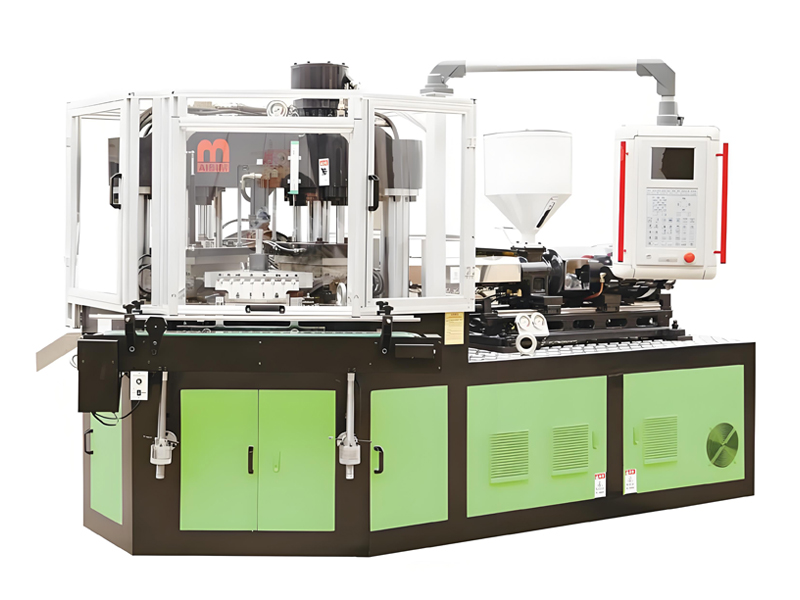
Aibim, a Wanplas factory, specializes in injection blow molding (IBM) machines engineered for small- to medium-capacity precision bottles. With more than 12 years of dedicated experience in blow molding and 20 years in the broader injection blow molding field, Aibim operates its own CNC center for machine-part production and runs a new factory purchased in 2022 with an annual capacity of over 100 production lines. The company exports machines to more than 40 countries and positions IBM as a three-station, one-step hollow molding solution covering the full range from 3 ml to 1000 ml.
The hardest question in bottle manufacturing is rarely “can a machine make one size well.” It is “can one machine make many sizes well, profitably, and without a second production line?” This article answers that question for the 3 ml to 1000 ml window. A 3 ml dropper vial and a 1000 ml lotion bottle differ by more than 300 times in volume, yet both can be produced on the same IBM platform through disciplined control of clamping force, shot size, core rod geometry, mold changeover, and screw plasticizing. The goal is to show procurement managers, process engineers, and factory planners exactly how a flexible IBM machine delivers that span, which real Aibim models fit which volume bands, and what it takes to run the platform at high yield.
الحقن blow molding is the right process when bottle neck finish precision, thread integrity, clean interiors, and absence of flash or post-trimming matter more than raw container volume. Pharmaceutical vials, oral-liquid bottles, reagent tubes, perfume flacons, cosmetic lotion and dropper bottles, and hand-sanitizer containers all live in the 3 ml to 1000 ml band where IBM shines. The remainder of this guide dissects the process, the volume-span mechanics, material behavior, precision windows, drive-train choices, compliance, molds, economics, defect correction, and model selection.
كيف يعمل الحقن والنفخ: عملية المحطات الثلاث
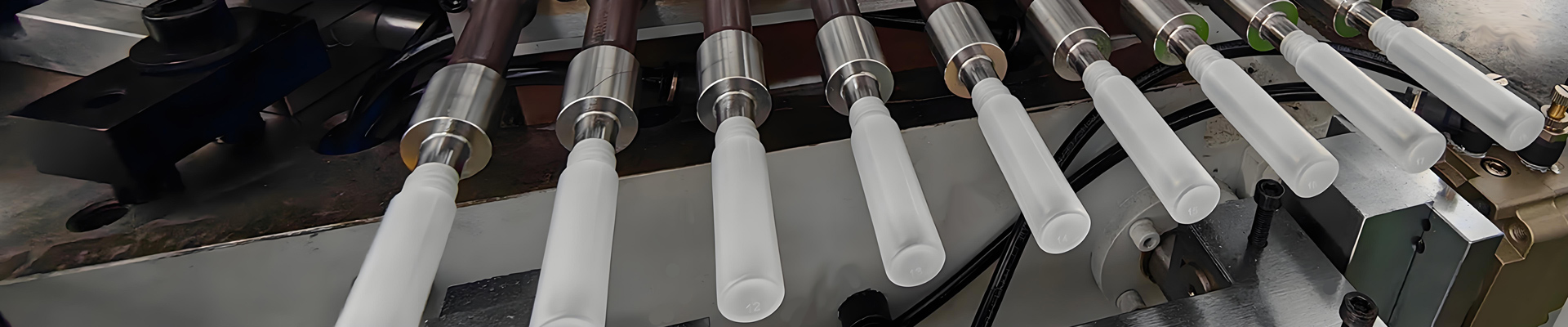
الحقن blow molding is a one-step, three-station process that converts plastic resin into a finished hollow bottle without intermediate handling of a preform. The defining component is the core rod, a steel mandrel that carries the molten parison from the injection station to the blow station and finally to the ejection station. Aibim machines use a rotary indexing table that moves the core rods through these three stations in sequence within a single cycle.
The first station is injection. Melt from the screw and barrel is injected into a cavity around the core rod, forming a parison (sometimes called a preform in IBM terminology) with the bottle neck finish, threads, and tamper band already fully molded. Because the neck is injection-molded rather than cut or blown, its dimensional accuracy is high and the threads are complete. The second station is blowing. The heated parison on the core rod is transferred into the blow cavity, where compressed air expands the soft parison against the cold mold wall. The third station is ejection. The finished bottle, now supported on the core rod, rotates to the stripper position where it is stripped off and discharged. No flash, no sprue, and no secondary trimming step exist in this loop.
هذا المنطق أحادي الخطوة هو ما يميز IBM عن عائلتي القولبة بالنفخ الأخريين. يقارن الجدول أدناه IBM مع القولبة بالنفخ بالبثق (EBM) وخط القولبة بالنفخ بالتمدد بالحقن ثنائية الخطوة (ISBM)، مع التركيز على الخصائص التقنية بدلاً من أي علامة تجارية.
| Attribute | IBM (الحقن النفخ) | EBM (Extrusion النفخ) | Two-Step ISBM Line |
|---|---|---|---|
| Process steps | One-step, three-station, parison injected then blown on same core rod | One-step, parison extruded then blown | Two-step, preform made then re-heated and stretch-blown |
| Flash / scrap | None, no flash, no post-trimming | Flash at parting line, pinch-off scrap | Minimal, preform gate trimmed |
| Neck finish precision | High, threads fully molded, ±0.05-0.1 mm | Lower, neck cut from parison | High, neck molded in preform |
| Interior cleanliness | Excellent, interior formed by core rod | Good, pinch weld may remain | Good, preform reheated |
| Biaxial orientation | Limited (standard IBM); stretch variant adds some | None | Strong biaxial orientation, best for carbonated PET |
| Typical volume window | 3 ml to 1000 ml (precision small/medium) | Up to very large, 100 ml to 1000 L | 100 ml to 3000 ml (PET, carbonated) |
| Preform inventory | None, made and blown in one cycle | None | Requires preform storage and reheating |
| Best fit | Pharma, cosmetic, food, lab small/medium precision bottles | Industrial, large containers, handles | Beverage PET, high-volume carbonated |
The comparison clarifies the central claim of this article: IBM is the most flexible choice when the product mix spans many small to medium volumes and precision at the neck is non-negotiable. It does not need preform inventory like a two-step ISBM line, and it eliminates flash and trimming that EBM inevitably produces.
لماذا صُممت IBM للزجاجات الدقيقة صغيرة السعة
Small bottles are unforgiving. A 0.1 mm error on a 28 mm neck finish is a minor percentage on a wide-mouth jar but a functional failure on a 3 ml dropper vial where the closure and dose-control orifice must seal tightly. IBM answers this with geometry molded at the injection station rather than formed or cut later.
Five attributes make IBM the natural process for the 3 ml to 300 ml precision band. First, neck finish dimensional accuracy typically lands within ±0.05 mm to ±0.1 mm because the threads, sealing surface, and tamper-evident ring are injection-molded on the core rod. Second, threads are complete and clean, with no parting-line witness marks that would interfere with caps or pumps. Third, there is no flash and no weld line at the base of the neck, so no deflashing or post-mold trimming is needed. Fourth, bottle weight tolerance stays around ±1 percent to ±2 percent, which matters for dosing accuracy in pharma and for resin-cost control in cosmetics. Fifth, the interior is shaped by the polished core rod, giving a smooth, clean inner surface that supports pharmaceutical and laboratory requirements without a secondary washing step.
The lower practical limit of IBM sits near 3 ml, which is exactly where Aibim positions its small-bottle models. Below that, micro-molding considerations dominate and cycle economics change, but for the dropper, sample, and unit-dose market the 3 ml floor is reachable with the right core rod and cavity design. IBM is therefore the process of choice whenever the brief includes “small, precise, clean, and consistent” in the same sentence.
Another reason IBM fits the small end is weight control. Because there is no flash and no gate scrap, every gram of resin becomes bottle. In a 5 ml vial where the part weight may be only a few grams, the absence of scrap directly protects margin and reduces resin handling. The closed-loop nature of the process also makes it easier to document and validate for regulated markets, since the bottle never leaves the core rod until it is a finished, sealed-shape article. That traceability is valued by pharmaceutical and diagnostic customers who must show control over every step from resin lot to filled container.
هندسة نطاق حجم من 3 مل إلى 1000 مل
The phrase “one machine, 3 ml to 1000 ml” is not magic. It is the result of four coupled engineering decisions: clamping force and shot size set the volume ceiling, core rod and blow-up geometry shape the wall, mold changeover lets one machine serve many sizes, and screw plasticizing matches melt supply to cavity count. This section is the core of the article.
It helps to think of the volume span as a ladder rather than a single setting. At the bottom rung the machine is configured for speed and cavity count; at the top rung it is configured for force and shot volume. The same frame, drive, and control platform simply wear different tooling and recipes at each rung. That is the practical meaning of flexibility, and it is why a buyer should size the platform for the largest volume they intend to run while trusting the modular tooling to cover the smaller ones.
كيف تحدد قوة الإغلاق وحجم الحقنة الحد الأعلى للحجم
Clamping force in kilonewtons (kN) must hold the blow mold closed against internal blow pressure. Larger bottles need larger cavities, more material, and higher projected area, so clamping force and shot size (gram weight the injection unit can deliver per shot) jointly determine the maximum single-bottle volume and the number of cavities that can be filled in one cycle. As volume rises, cavity count falls because the same shot must be divided among fewer, larger parts.
The table below maps the 3 ml to 1000 ml window into four working segments. The figures for clamping force, shot size, cavity count, single-mold cycle, and per-hour output are representative for a three-station IBM platform of the Aibim class and should be confirmed against the final mold and material, but they illustrate the engineering logic clearly.
| Volume segment | Recommended clamping force | Typical shot size | Typical cavities | Single-mold cycle | Output pcs/h (approx.) |
|---|---|---|---|---|---|
| 3-30 ml (micro) | 350-550 kN | 150-300 g | 8-24 cavities | 6-10 s | 3,000-10,000 |
| 30-200 ml (main) | 550-750 kN | 250-450 g | 6-12 cavities | 8-14 s | 1,500-5,000 |
| 200-500 ml (mid) | 750-1100 kN | 450-700 g | 4-8 cavities | 12-20 s | 700-2,500 |
| 500-1000 ml (large) | 1100-1600 kN | 700-1200 g | 2-4 cavities | 16-28 s | 250-900 |
Notice the inverse relationship: cavity count drops from 24 to 2 as volume climbs from 3 ml to 1000 ml, while clamping force and shot size rise severalfold. A machine sized only for the micro segment cannot reach 1000 ml, and a machine sized only for 1000 ml would be wasteful and slow on 3 ml work. The flexible solution is a mid-size clamping platform with enough shot capacity to grow into the large segment while still supporting high-cavity micro tooling.
طول وقطر قضيب القلب، ونسبة التمديد ونسبة النفخ
The core rod defines the inner bottle. Its length sets how deep the parison extends and thus the bottle height; its diameter sets the inner wall and, together with cavity diameter, the blow-up ratio. In IBM the blow-up ratio (final bottle diameter divided by parison diameter) typically runs between 2:1 and 4:1. Ratios above 4:1 thin the wall excessively and risk non-uniform expansion, while ratios below 2:1 waste material and reduce cycle efficiency.
Wall thickness distribution is the central challenge as volume grows. A 3 ml vial has a tiny parison that must expand only slightly, so wall uniformity is easy. A 1000 ml bottle must expand a much larger parison across a taller, wider cavity, and gravity, material cooling, and air-path length begin to matter. Engineering countermeasures include tapered core rod diameters, controlled core rod temperature profiles, and tuned blow-air timing so the parison stretches evenly before it freezes against the cavity wall. Stretch ratio (axial) is limited in standard IBM but becomes relevant on stretch-equipped variants where biaxial orientation improves clarity and drop resistance for materials like PETG and PP.
التغيير السريع للقوالب والمحطات المشتركة
المرونة lives or dies at changeover. Aibim machines use a single-crossbeam, double-pole clamping framework with enlarged mold-setting space, which makes it practical to run different molds on the same station set. Because the three stations share the indexing platen, a change in bottle size means swapping the injection core-rod set, the blow cavity, and the stripper tooling as a matched unit.
Changeover discipline matters more than raw speed. The key requirements are: (1) precise alignment of the core rod to the blow cavity so concentricity is preserved, (2) re-zeroing of the parison transfer position, (3) downloading the stored process recipe rather than re-tuning from scratch, and (4) a first-article inspection before ramp-up. With recipe management and a well-organized mold library, a trained crew can complete a size change in a target window measured in minutes to low tens of minutes depending on the volume jump. The point is that one machine covers many SKUs precisely because the station is shared and the tooling is modular.
مطابقة سعة تلدين اللولب
Plasticizing rate, measured in kilograms per hour, must satisfy the shot size multiplied by cavity count within the cycle. Micro bottles with 24 cavities need a high melt flow rate per second even though each part is tiny, because total shot weight is divided among many cavities and the cycle is short. Large bottles with 2 cavities need a larger absolute shot but a slower cycle, so the plasticizing demand per second is lower even though total material per bottle is higher.
This is why screw diameter and L/D ratio are tuned per platform. A smaller screw with a high-speed plasticizing profile serves the high-cavity micro segment; a larger screw with deeper metering serves the large single-shot segment. Aibim’s PREFILL technology and variable displacement pump in the hydraulic system shorten the plasticizing wait by pre-filling the injection cylinder, which helps both ends of the volume span without oversizing the drive.
سلسلة Aibim IBM لكامل نطاق الأحجام
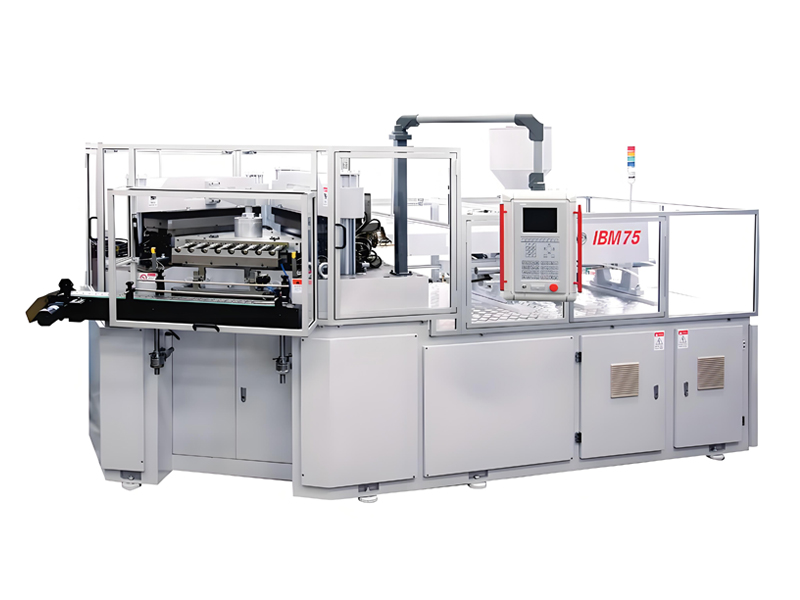
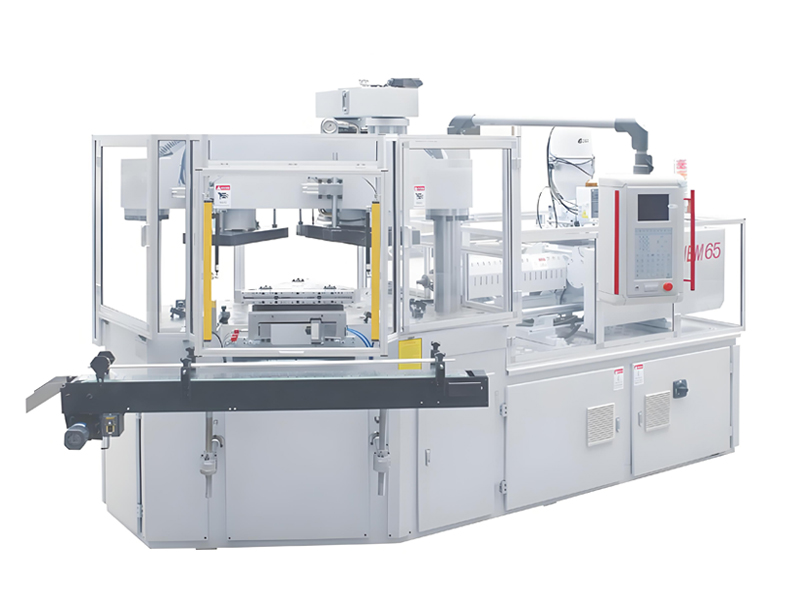
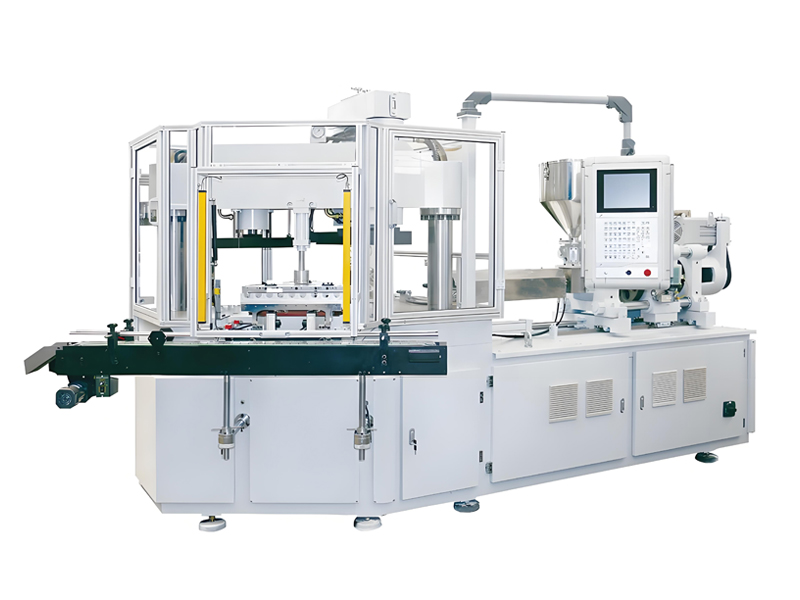
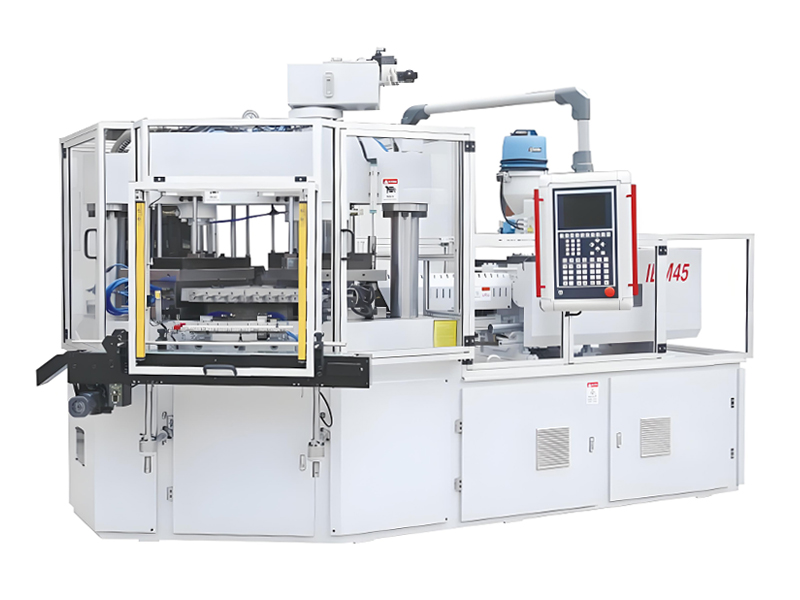
Aibim offers three real IBM models that together cover the 3 ml to 1000 ml range. The IBM55 Hybrid Electric is the specialist for the small-bottle precision band, the IBM65 covers the mid-range, and the IBM75 reaches the full 1000 ml ceiling. Specifications below are typical for each series and are finalized against the customer’s mold and material; they are presented to show how the platform scales across the volume window.
آلة قولبة النفخ بالحقن الكهربائية الهجينة IBM55 (3-300 مل)
The IBM55 Hybrid Electric is Aibim’s high-precision small-bottle platform. It integrates electric indexing and servo-assisted motions with a hydraulic clamp, delivering the repeatability that micro bottles demand while keeping energy use lower than conventional hydraulic units. It is the right base when the product mix centers on dropper bottles, eye-drop vials, and sample cosmetics below 300 ml.
| Specification | IBM55 Hybrid Electric |
|---|---|
| Clamping force | Approx. 550 kN |
| Shot size | Approx. 250 g |
| Screw diameter | 35-40 mm |
| L/D ratio | 20-22 |
| Volume range | 3 ml to 300 ml |
| Stations | 3 (injection, blow, ejection) |
| Installed power | Approx. 22-30 kW |
| وقت دورة التجفيف | Approx. 2.5-3.5 s |
| Machine dimensions | Approx. 3.4 x 1.5 x 2.0 m |
آلة القولبة بالنفخ بالحقن IBM65 (3-500 مل)
The IBM65 is the balanced workhorse of the family. With higher clamping force and shot size than the IBM55, it carries the main 30-200 ml segment at strong cavity counts and extends comfortably into the 200-500 ml mid-range. It is the most common choice for factories that run a broad daily-chemical and pharmaceutical mix on one line.
| Specification | IBM65 |
|---|---|
| Clamping force | Approx. 650 kN |
| Shot size | Approx. 400 g |
| Screw diameter | 40-45 mm |
| L/D ratio | 20-22 |
| Volume range | 3 ml to 500 ml |
| Stations | 3 (injection, blow, ejection) |
| Installed power | Approx. 30-40 kW |
| وقت دورة التجفيف | Approx. 3.0-4.0 s |
| Machine dimensions | Approx. 3.8 x 1.6 x 2.1 m |
آلة القولبة بالنفخ بالحقن IBM75 (3-1000 مل)
The IBM75 is the full-spectrum model. Its larger clamping force and shot size let it reach the 500-1000 ml ceiling at 2 to 4 cavities while still supporting micro tooling for the small end. For a factory that wants a single IBM platform to cover the entire 3 ml to 1000 ml range without a second machine, the IBM75 is the anchor of the flexible production plan.
| Specification | IBM75 |
|---|---|
| Clamping force | Approx. 750 kN |
| Shot size | Approx. 600 g (up to 1000 ml with 2-4 cavities) |
| Screw diameter | 45-50 mm |
| L/D ratio | 20-22 |
| Volume range | 3 ml to 1000 ml |
| Stations | 3 (injection, blow, ejection) |
| Installed power | Approx. 40-55 kW |
| وقت دورة التجفيف | Approx. 3.5-5.0 s |
| Machine dimensions | Approx. 4.2 x 1.7 x 2.2 m |
مصفوفة توافق المواد
Aibim IBM machines process a broad resin set: PE (HDPE, LDPE, LLDPE), PP, PS, ABS, SAN, TPU, PC, and PCTG, plus medical-grade copolymers such as COC/COP and recycled rPP where the application allows. Each material brings its own melt window, shrinkage, and typical volume band. The table below is a practical starting reference; exact setpoints are tuned per grade and mold.
| Material | Processing temperature | Shrinkage | Typical volume segment | Representative application |
|---|---|---|---|---|
| PP (random copolymer, medical) | 200-240 °C | 1.0-2.0% | 3-500 ml | Eye drops, oral liquid, reagent, food |
| HDPE / LDPE | 180-220 °C | 1.5-3.0% | 30-1000 ml | Hand sanitizer, lotion, pharma |
| PS / SAN | 190-230 °C | 0.4-0.7% | 3-200 ml | العمالةatory, cosmetic, display |
| PETG / PCTG | 220-250 °C | 0.3-0.7% | 10-500 ml | مستحضرات التجميل, clear pharma, premium |
| PC | 270-300 °C | 0.5-0.7% | 30-500 ml | Medical, reusable, high-clarity |
| TPU | 190-220 °C | 0.8-1.5% | 10-300 ml | Soft-touch, squeezable, comfort |
| COC / COP (medical high-end) | 220-260 °C | 0.5-0.8% | 3-100 ml | Diagnostics, injectables, purity |
| rPP (recycled) | 200-240 °C | 1.0-2.2% | 30-500 ml | Sustainable daily chemical |
PP leads the pharma and food bands thanks to its transparency in random-copolymer grades, low extractables, and easy regulatory profile. HDPE dominates squeezable personal-care bottles. PETG and PCTG win when clarity and premium shelf appearance matter. PC and COC/COP serve the high-end medical segment where biocompatibility and purity exceed ordinary requirements. rPP supports sustainability programs for non-critical daily-chemical packaging.
التحكم الدقيق ونافذة عملية IBM
Repeatability is what converts a capable machine into a profitable line. The IBM process window has five levers. الحقن pressure and holding pressure fill the neck and parison with controlled packing; the holding phase compensates for shrinkage so neck dimensions stay tight. Mold temperature is split between the core rod and the blow cavity, and in IBM the core rod often runs warmer than the cavity by roughly 20 °C to 60 °C so the parison stays formable during transfer yet freezes cleanly on the cavity side. Blow pressure typically sits at 0.4 MPa to 0.8 MPa, enough to expand the parison without over-stressing the wall. Cooling time and the indexed cycle are coupled: each station works in parallel, so the effective cycle is the longest of injection, blow, or ejection, and faster, balanced stations reduce it. Finally, servo and hybrid-electric motion control tighten repeatability so cycle-time variation can be held near ±1 percent, which directly stabilizes bottle weight and neck dimensions.
A practical formula for planning: total cycle equals the maximum of (injection + cooling at station one, blow + cooling at station two, strip + take-out at station three), because the three stations operate simultaneously on different core rods. Optimizing the slowest station — usually cooling on larger bottles — yields the biggest cycle gain. Hybrid-electric indexing reduces the mechanical variation between indexes, so the “maximum station” stays consistent shot after shot.
الهجين الكهربائي مقابل الهيدروليكي الكامل: مقارنة بيانات
تقدم Aibim طرازات هجينة كهربائية (مثل IBM55 Hybrid Electric) إلى جانب آلات IBM الهيدروليكية التقليدية. تستخدم المقارنة أدناه النسب المئوية والكميات الفيزيائية فقط — لا عملات — لأن الاختيار الصحيح يعتمد على مزيج المنتجات، وليس نقطة سعر واحدة.
| Metric | Hybrid Electric (servo-indexed) | Conventional Full Hydraulic |
|---|---|---|
| الطاقة per 1000 pieces | Baseline ~65% (up to 35% lower) | Baseline 100% |
| Cycle-time repeatability | ±1% variation | ±2-3% variation |
| الضوضاء level | ~68-72 dB(A) | ~78-85 dB(A) |
| Hydraulic oil temperature | Lower, less pump runtime | Higher, more cooling needed |
| Maintenance load | Lower (fewer hydraulic cycles) | Higher (seals, oil, filters) |
| Best scenario | Micro/high-cavity, pharma, cleanroom | Large single-shot, cost-sensitive volume |
The hybrid drive is not about a single dramatic saving; it is about lower and steadier energy, quieter operation, cooler oil, and tighter repeatability that compounds into yield and resin savings across millions of cycles. For the 3 ml to 300 ml precision band the hybrid is usually the stronger choice, while a full-hydraulic clamp remains a sensible option for the largest 1000 ml single-shot work where clamp force dominates over indexing speed.
إنتاج نظيف ومتوافق
Precision bottles for pharma and food must be made where cleanliness and compliance are designed in, not added later. IBM naturally supports clean production because the bottle interior is formed by the core rod and never touches the operator or open air during the cycle. Aibim configures clean-capable cells with a controlled environment rated at Class 100000 (ISO Class 8), maintained under positive pressure with laminar-flow hoods over the ejection and take-out zone. Oil-free compressed air protects the bottle interior from hydrocarbon contamination, and the machine’s CE-certified safety system uses a stripper-station digital laser sensor and light curtain for personnel protection.
On the regulatory side, the materials and processes align with recognized frameworks rather than any single geography. For pharmaceutical primary packaging the relevant references include ISO 15378 for primary packing materials for medicinal products, USP Class VI for plastic biocompatibility, and ISO 10993 for biological evaluation of medical devices. الغذاء-contact applications reference FDA and EU 10/2011 for food-contact plastics, while the Chinese market references GB 4806 for food-contact materials and articles. Good Manufacturing Practice (GMP) discipline governs the production environment and documentation. All of these are referenced as plain-text standards so that buyers can map the machine output to their own quality system.
أساسيات تصميم القوالب متعددة التجاويف لآلات IBM
The mold is where flexibility becomes real. A well-designed IBM mold set balances three jobs: it injects an identical parison at every cavity, it blows a uniform wall at every cavity, and it strips cleanly without distorting the neck. The first rule is cavity balance — fill variation across cavities should stay below 3 percent, which is achieved with balanced runner geometry and consistent gate restriction. Hot-runner systems reduce cold scrap and improve thermal consistency, while cold-runner layouts are simpler and cheaper for some applications; the choice depends on resin and cavity count.
Core rod cooling circuits are critical because the core rod carries heat from the injection station into the blow station. Independent cooling channels let the engineer hold the desired core-rod-to-cavity temperature differential. Venting at the cavity and at thread reliefs prevents trapped gas that would cause short fill or burn marks. Thread demolding needs precise draft and polished thread flanks so the molded neck releases without scoring. Anti-stick surface treatment and high polish on the cavity reduce ejection force and improve gloss. Mold materials are selected for wear resistance, and a well-maintained IBM mold runs into the millions of cycles, which is what makes the per-bottle tooling cost negligible across a long production run.
الطاقة الإنتاجية والاقتصاديات دون تخمين
Economic comparison across the volume span is clearer with indices and physical quantities than with absolute prices. The table below expresses unit conversion cost as an index where the main 30-200 ml segment is the baseline of 100 points; everything else is relative. الطاقة is shown as kWh per 1000 pieces, and performance as OEE and yield percentages. These are representative planning figures to be validated on the actual line.
| Volume segment | Annual capacity (pcs, 1 line) | OEE | Yield | الطاقة kWh/1000 pcs | Changeover loss | وحدة cost index |
|---|---|---|---|---|---|---|
| 3-30 ml | 20-60 million | 82-88% | 98-99% | Low | Low | 90-110 |
| 30-200 ml | 10-30 million | 85-90% | 98-99.5% | Low-Medium | Low | 100 (baseline) |
| 200-500 ml | 4-12 million | 80-87% | 97-99% | Medium | Low-Medium | 105-120 |
| 500-1000 ml | 1.5-6 million | 78-85% | 96-98.5% | High | Medium | 120-150 |
The pattern is intuitive: micro bottles win on volume throughput and low unit cost, while 1000 ml bottles carry higher energy and conversion cost but serve markets where the bottle value justifies it. The flexible IBM line earns its keep by shifting capacity to wherever margin is best on a given week, without a second machine investment.
تشخيص العيوب الشائعة
حتى الخط المرن يحتاج إلى انضباط في استكشاف الأخطاء. يربط الجدول عيوب IBM المعتادة بالسبب الجذري والإجراء التصحيحي حتى يتعافى المشغلون بسرعة.
| Phenomenon | Root cause | Corrective action |
|---|---|---|
| Neck flash | Clamp force low, mold mismatch, over-pack | Raise clamp force, check mold parting, reduce holding pressure |
| Uneven wall thickness | Blow-up ratio too high, poor parison temp | Re-profile core rod, adjust blow timing, balance temperature |
| Neck whitening / stress | Over-pack, cold core rod, fast ejection | Lower holding, raise core-rod temp, slow strip |
| Core rod sticking | Insufficient cooling, bad release, contamination | Improve cooling circuit, apply release, clean rod |
| Bottom sink mark | Insufficient cooling, low blow pressure | Extend cooling, raise blow pressure, check gate |
| Low clarity / haze | Moisture, wrong temp, degraded resin | Dry resin, tune barrel profile, reduce residence |
| Bottle weight drift | Shot variation, screw wear, unstable back pressure | Stabilize back pressure, inspect screw, lock recipe |
توصيات عملية للإنتاج المرن
Running many sizes on one IBM platform is a production-engineering discipline, not just a machine feature. Start with SKU scheduling that groups similar volumes and materials so changeovers are infrequent and predictable. Maintain a mold library with each tool’s cavity count, volume, material history, and last-service date, so the right tool is always staged. Store process recipes on the machine’s SD card (Aibim’s convenient parameter-storage system) so a recipe can be reloaded identically across machines and shifts, eliminating trial-and-error after a changeover.
Adopt a first-article inspection gate before every ramp-up: verify neck dimensions, weight, wall distribution, and closure fit on three to five samples before releasing the line. Apply SMED thinking to target a short changeover, with tooling pre-heated and aligned off-line where possible. Finally, track OEE and yield by SKU so the flexible line is steered toward the volume bands that maximize contribution, not just utilization.
صناعات التطبيق والمنتجات النهائية الفعلية
تخدم ماكينات Aibim قطاعات الأدوية والغذاء والمشروبات ومستحضرات التجميل — مجالات التطبيق الأربعة الموثقة للعلامة التجارية. ضمن تلك المجالات، يترجم النطاق من 3 مل إلى 1000 مل إلى منتجات ملموسة ومعروفة:
- الأدوية: زجاجات قطرات العين (3-15 مل)، وزجاجات السوائل الفموية (10-100 مل)، وقوارير الكواشف وقوارير التشخيص (3-50 مل)، وحاويات الجرعة الواحدة (5-30 مل)، وزجاجات تعبئة الحبوب أو الأقراص (100-500 مل).
- مستحضرات التجميل: زجاجات القطارة (10-50 مل)، وقوارير العطور (15-100 مل)، وزجاجات اللوشن (100-500 مل)، وزجاجات السيروم الفاخرة (30-100 مل) حيث تهم الشفافية والتشطيب.
- الأغذية والمشروبات: زجاجات حصص الصلصات والتوابل (30-250 مل)، وبرطمانات العسل والقابلة للدهن (100-500 مل)، ومشروبات الجرعات (50-250 مل)، وزجاجات الزيوت الصالحة للأكل أو الشراب الصغيرة (100-1000 مل).
- المواد الكيميائية اليومية: زجاجات معقم اليدين (100-1000 مل)، وأحجام السفر للشامبو وجل الاستحمام (50-500 مل)، وأشكال الأكياس العينية داخل الزجاجة (30-200 مل).
- المختبر والمستهلكات: أنابيب الكواشف وزجاجات المزارع وقوارير أخذ العينات الكيميائية (3-200 مل) حيث تكون الأجزاء الداخلية النظيفة والأعناق المحكمة ضرورية.
لأن IBM لا تنتج نتوءات ولا تحتاج قصًا ثانويًا، تترك هذه المنتجات الماكينة جاهزة للتعبئة والغطاء، مما يقصر الخط النهائي ويقلل خطر التلوث.
دليل الاختيار: طابق متطلبك مع طراز Aibim حقيقي
يحول الجدول النقاش الفني إلى قرار شراء. يطابق نطاق الحجم المستهدف والإنتاج الشهري والمواد واحتياج الدقة مع طراز Aibim حقيقي وعدد المحطات وعدد التجاويف. تُؤكد أرقام التجاويف النهائية مقابل القالب والراتنج، لكن الاتجاه ثابت.
| Target volume | Monthly output | Material | Precision need | Recommended model | Stations / cavities |
|---|---|---|---|---|---|
| 3-30 ml | 1-5 million | PP / PS / COC | Very high (pharma) | IBM55 Hybrid Electric | 3 stations / 8-24 cavities |
| 30-200 ml | 0.5-3 million | PP / HDPE / PETG | High | IBM65 | 3 stations / 6-12 cavities |
| 200-500 ml | 0.3-1.5 million | HDPE / PP / PC | Medium-High | IBM65 or IBM75 | 3 stations / 4-8 cavities |
| 500-1000 ml | 0.1-0.6 million | HDPE / PP | Medium | IBM75 | 3 stations / 2-4 cavities |
| Full 3-1000 ml mix | Mixed | All supported | Mixed | IBM75 + shared mold library | 3 stations / modular cavities |
الخدمة والدعم
Aibim, as a Wanplas factory, backs every IBM line with the group’s shared service commitments. Each machine is tested before shipment, including dry-cycle and, where arranged, material trial runs, so the line arrives validated rather than theoretical. Engineers support installation and commissioning on site, bringing the machine to stable production with the customer’s own mold and material.
The Wanplas group policy provides USD 500 free parts per year, protecting the line against routine wear without a separate negotiation. Operator and mold training are included so the customer’s team can run, change over, and maintain the machine confidently. Remote operation and maintenance support lets Aibim engineers analyze PLC and process data to resolve issues quickly. Finally, the open-factory policy welcomes customers to visit the production site, inspect the CNC center, and witness a trial run before commitment.
الأسئلة الشائعة
هل يمكن لآلة IBM واحدة حقًا صنع زجاجات بحجم 3 مل و1000 مل معًا؟
Yes, on a platform sized for the full span such as the Aibim IBM75. The same three-station frame serves both ends by swapping the core-rod and cavity tooling and reloading the stored recipe. The 3 ml work runs at high cavity counts (8-24), while 1000 ml work runs at 2-4 cavities, with clamping force and shot size scaled to each. One machine covers the range; it does not run both sizes in the same cycle.
لماذا تختار IBM بدلاً من خط ISBM ثنائي الخطوة للزجاجات الصغيرة؟
IBM needs no preform inventory and no secondary reheating, which simplifies the plant and reduces handling contamination. It also molds the neck finish with injection accuracy and produces no flash, so small precision bottles leave the machine ready to fill. Two-step ISBM lines excel at biaxially oriented PET beverage bottles, but for 3-300 ml pharma and cosmetic bottles IBM is typically leaner and cleaner.
ما هي أفضل مادة لزجاجات القطارة الطبية؟
For most dropper and eye-drop bottles, medical-grade PP (random copolymer) is the standard because it is transparent enough, low in extractables, and easy to validate. For high-end diagnostic or injectable-adjacent containers, COC/COP or PC may be specified for clarity and biocompatibility. The final choice should be confirmed against the relevant pharmacopeia and ISO 10993 or USP Class VI references for the intended use.
كم عدد التجاويف التي يمكنني تشغيلها عند 3 مل مقابل 1000 مل؟
As a representative planning figure, the micro 3-30 ml segment supports 8-24 cavities, the 30-200 ml main segment 6-12 cavities, the 200-500 ml mid segment 4-8 cavities, and the 500-1000 ml large segment 2-4 cavities. Cavity count falls as volume rises because the available shot must be divided among fewer, larger parts while maintaining clamping force.
ما الذي يغيّره نظام القيادة الهجين الكهربائي عملياً؟
A hybrid-electric IBM such as the IBM55 Hybrid Electric lowers energy per 1000 pieces by up to about 35 percent versus conventional hydraulics, quiets the cell to roughly 68-72 dB(A), runs cooler oil, and holds cycle-time variation near ±1 percent. That repeatability stabilizes bottle weight and neck dimensions, which is especially valuable in the small-bottle precision band.
ما مدى سرعة التحويل من حجم زجاجة إلى آخر؟
Changeover speed depends on how well the mold library and recipes are organized. With pre-staged tooling, off-line pre-heat, SD-card recipe download, and a first-article check, a size change targets a short window measured in minutes to low tens of minutes. The shared three-station platen and enlarged mold-setting space are designed to make this practical rather than exceptional.
هل IBM مناسبة للزجاجات المصنوعة من محتوى معاد تدويره؟
Yes, for non-critical daily-chemical packaging, rPP can be processed on Aibim IBM machines within the supported temperature window, though regrind grade and cleanliness must be controlled to protect appearance and process stability. For food or pharma contact, recycled content must be qualified against the applicable food-contact framework such as FDA, EU 10/2011, or GB 4806 before use.
الخلاصة
A flexible IBM machine is the most efficient way to serve the 3 ml to 1000 ml bottle market from a single platform. The three-station, one-step process delivers flash-free, neck-precise bottles with clean interiors, and the volume span is engineered through clamping force, shot size, core-rod geometry, modular molds, and matched screw plasticizing. Aibim, a Wanplas factory with 12+ years of blow-molding experience, 40+ export countries, and an annual capacity above 100 lines, offers the IBM55 Hybrid Electric, IBM65, and IBM75 to cover every segment of that window, supported by a broad material matrix, clean-compliant production options, and the Wanplas group’s USD 500 free-parts-per-year policy.
If your product range spans micro vials to liter bottles, the flexible IBM approach avoids a second production line while keeping precision and yield high. We invite you to share your target volumes, materials, and monthly output so our engineering team can recommend the right Aibim model, design the mold library, and arrange a trial run at our factory. Visiting the workshop and witnessing your own bottle produced on the machine is the best way to confirm the fit before you invest.