Mục lục
- Giới thiệu: Aibim và nền tảng Hybrid IBM55
- Kiến trúc dẫn động điện lai
- Cấu trúc ba trạm và độ chính xác chỉ mục
- Các thách thức và giải pháp độ chính xác trong dải 3–300 ml
- Thông số kỹ thuật chính của IBM55
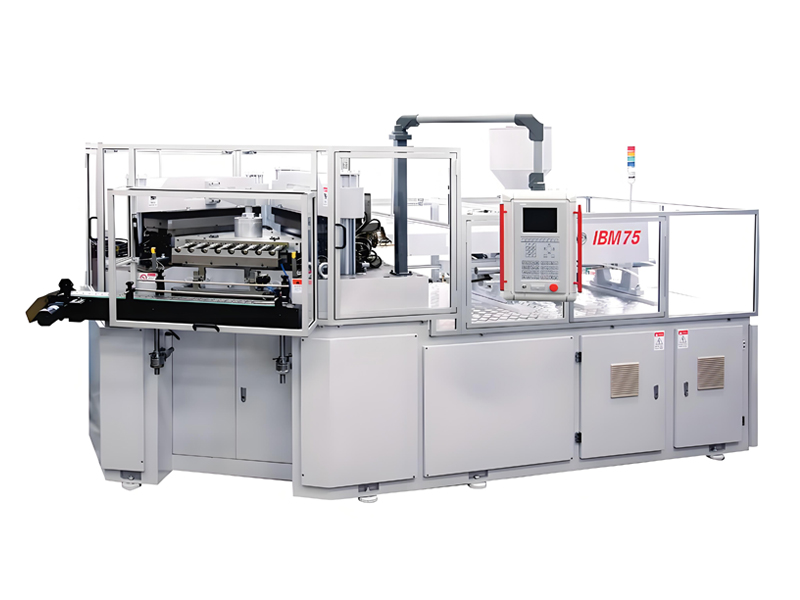
- So sánh với dòng IBM75
- Phân tích thời gian chu kỳ và tính toán công suất
- Khả năng tương thích vật liệu
- Các ngành ứng dụng và sản phẩm cuối
- Từ nhu cầu đến khuyến nghị cấu hình
- Sản xuất tuân thủ cho dược phẩm và mỹ phẩm
- Giải pháp khuôn mẫu
- Lắp đặt, chạy thử và nghiệm thu (FAT/SAT)
- Lịch bảo trì và kiểm tra
- Chẩn đoán sự cố thường gặp
- So sánh lộ trình công nghệ
- Tính kinh tế và lợi nhuận
- Dịch vụ và hỗ trợ
- Câu hỏi thường gặp
- Kết luận
Giới thiệu: Aibim và nền tảng Hybrid IBM55
Aibim, a Wanplas factory, is a specialized manufacturer of injection blow molding machines with more than 12 years of experience building plastic machinery and two decades of accumulated know-how in the injection blow molding (IBM) process. Based in Zhangjiagang and operating its own CNC machining center, Aibim ships to more than 40 countries and runs a new production facility purchased in 2022 with an annual capacity of over 100 complete lines. The company’s product focus is narrow and deep: three-station, one-step injection blow molding machines that convert plastic resin directly into finished, flash-free bottles in a single continuous cycle.
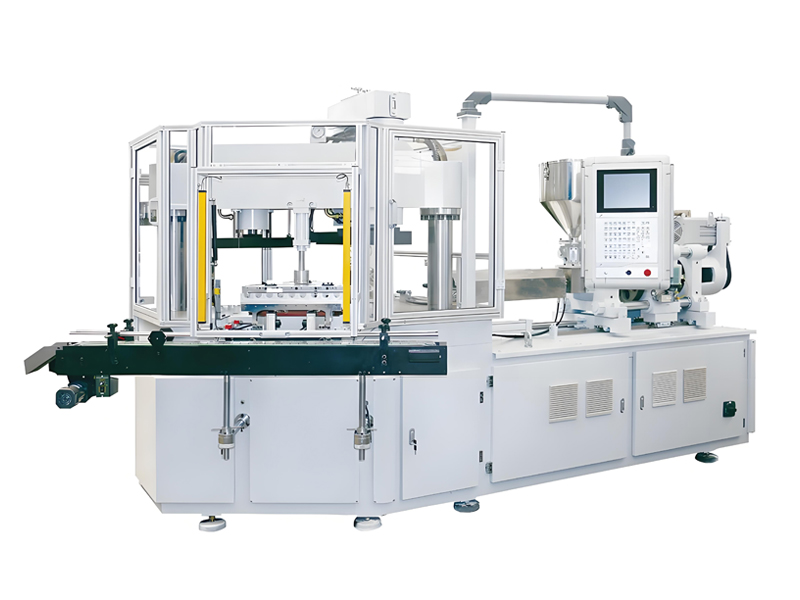
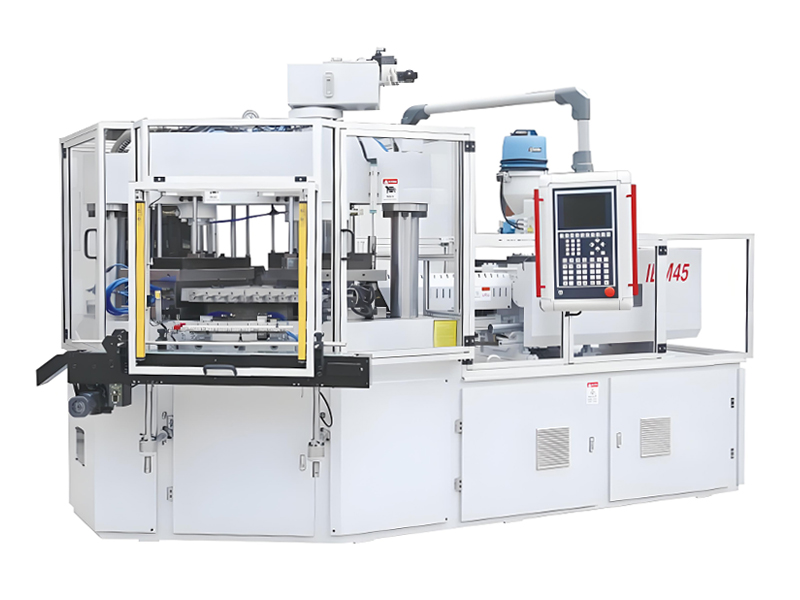
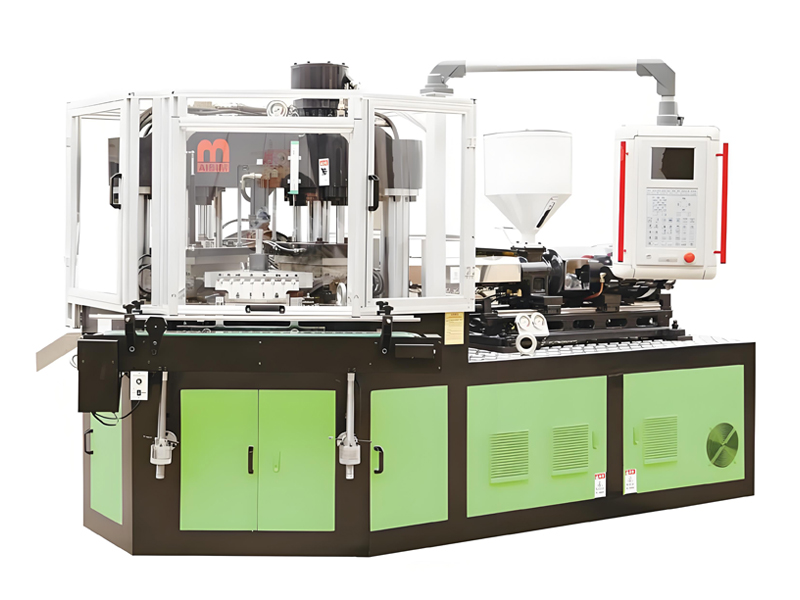
This article is a single-machine technical deep-dive on the Máy phun ép bằng điện hybrid IBM55, the model built for high-precision small bottle production from 3 ml to 300 ml. Where the broader Aibim range covers containers from 3 ml up to 1000 ml, the IBM55 Hybrid is tuned specifically for the demanding low-volume, high-cavity, tight-tolerance segment: eye-drop bottles, oral-liquid vials, reagent tubes, essential-oil and perfume flacons, sample vials, and small lotion or emulsion bottles. The “Hybrid Electric” designation means the machine pairs a servo-driven variable-displacement pump hydraulic system with electrically optimized plasticizing and injection control, delivering the rigidity of hydraulics where it matters and the precision and efficiency of servo control where it pays back.
Two engineering facts frame everything that follows. First, Aibim cites a minimum energy saving of 35 percent versus conventional hydraulic designs, an outcome of its PREFILL technology and variable-displacement pump pressurizing architecture. Second, the machine is CE certified, with a stripper station protected by a long-distance digital laser sensor and a light curtain for personnel safety. Throughout this article we explain how the hybrid architecture delivers on those claims, and where the real precision value is created in the 3–300 ml window.
Whether you run a pharmaceutical packaging line that needs validated, low-particulate output, or a cosmetic brand that needs consistent neck threads and crystal-clear walls, the IBM55 Hybrid is designed around one goal: repeatable, clean, small-bottle production with the lowest practical energy and labor footprint. The sections below cover drive architecture, station mechanics, precision technique, specifications, capacity math, materials, applications, compliance, tooling, commissioning, maintenance, troubleshooting, competitive fit, and economics.
Kiến trúc dẫn động điện lai
The hybrid drive is the single most important differentiator of the IBM55, and understanding it is the key to understanding the machine’s energy, precision, and noise profile. A true hybrid does not simply bolt a servo motor onto an old hydraulic circuit. It re-partitions the work: high-force, low-frequency motions stay on hydraulics for rigidity and safety, while high-frequency, precision-critical motions move to servo-controlled, on-demand power.
Bơm Biến thiên Truyền động Servo so với Bơm Cố định và Van Tràn
Conventional full-hydraulic IBM machines use a fixed-displacement pump running at constant speed, dumping excess flow across a relief valve whenever the system demand is below pump capacity. That bypassed oil is not free: it is heated, filtered, cooled, and pumped again, continuously. The IBM55 Hybrid replaces this with a servo motor driving a variable-displacement pump. The controller commands the servo to spin only as fast as the current phase requires, and the pump swashplate trims displacement to match the instantaneous flow demand. This is on-demand flow: when the clamp is idle during the blow phase, the pump output falls toward zero rather than circulating through relief.
Operationally, the difference shows up as lower average motor speed, lower flow to tank, and far less heat generated inside the circuit. The hydraulic power unit behaves like a load-following supply instead of a always-on generator. Aibim’s PREFILL technology complements this by pre-charging the clamp cylinder rapidly during the closing stroke, so the high-flow demand is met without oversizing the pump, after which the variable-displacement pump holds tonnage with minimal flow. The net effect is a hydraulic system that is quieter, cooler, and smaller in installed power than an equivalent fixed-pump design.
So sánh mức tiêu thụ năng lượng
Đo so với mức cơ sở thủy lực hoàn toàn có lực kẹp và sản lượng tương đương, IBM55 Hybrid thường giảm tiêu thụ năng lượng tổng thể từ 30 đến 50 phần trăm, với mức sàn được Aibim ghi chép là 35 phần trăm. Khoản tiết kiệm không phải là một con số duy nhất mà là một chồng các hiệu ứng, mỗi hiệu ứng đều có thể xác minh trên sàn xưởng:
- Tiêu thụ không tải và chờ: Vì lưu lượng theo nhu cầu, các giai đoạn chờ và nhu cầu thấp tiêu thụ một phần nhỏ công suất chờ của bơm cố định. Năng lượng thủy lực chờ có thể giảm hơn một nửa.
- Nhiệt độ dầu: Nhiệt độ vận hành dầu thủy lực thường giảm từ dải 50-58 °C trên dây chuyền thông thường xuống dải 40-48 °C trên máy lai, mức giảm bảo vệ phớt, duy trì độ nhớt và giảm tải làm mát.
- Nước làm mát: Với ít nhiệt cần thải hơn, tiêu thụ nước làm mát của nhà máy cho bộ nguồn giảm, hạ cả mức sử dụng tiện ích và tải trên máy làm lạnh trung tâm.
- Tuổi thọ dầu: Nhiệt độ dầu thấp hơn và ổn định hơn làm chậm quá trình oxy hóa và kéo dài tuổi thọ chất lỏng, giảm tần suất thay và lượng dầu thải.
- Nhu cầu đỉnh: Vì servo tránh được dòng xung và tốc độ vượt liên tục của bơm cố định, nhà máy thấy mức kéo điện đỉnh nhẹ hơn, điều quan trọng ở nơi áp dụng phí nhu cầu.
Tất cả các con số năng lượng trong bài viết này chỉ được biểu thị bằng phần trăm và đại lượng vật lý. Không sử dụng số tiền tệ; lợi thế chi phí được đánh giá thông qua các chỉ số năng lượng, tỷ lệ sản phẩm đạt và chỉ số chi phí chuyển đổi được mô tả trong phần kinh tế.
Độ lặp lại và độ chính xác
Năng lượng chỉ là một nửa câu chuyện; kiến trúc lai giành được vị trí của nó trong các dây chuyền dược phẩm và mỹ phẩm vì nó thắt chặt độ lặp lại quy trình. Ba cơ chế quan trọng:
- Ổn định thời gian chu kỳ: Điều khiển servo giữ biến động chu kỳ trong khoảng ±1 phần trăm, để thiết bị chiết rót và kiểm tra hạ nguồn thấy một dòng ổn định thay vì dòng xung.
- Vòng kín áp suất phun: Giai đoạn phun chạy dưới điều khiển áp suất vòng kín thay vì dòng hở, giữ cho trọng lượng ống phôi nhất quán từ lần phun này sang lần phun khác.
- Giữ áp phân đoạn: Biên dạng giữ áp (packing) được chia thành các phân đoạn, cho phép người vận hành điều chỉnh áp suất giữ áp so với áp suất khoang khuôn trong suốt cửa sổ làm mát thay vì áp dụng một mức giữ áp phẳng duy nhất.
- Dung sai khối lượng chai: Với quá trình định lượng và giữ áp ổn định, khối lượng chai thành phẩm thường duy trì trong khoảng ±1 phần trăm giữa các sản phẩm, trực tiếp giảm lượng nhựa sử dụng và cải thiện độ ổn định thể tích chiết rót.
Đây chính là độ chính xác khiến máy phù hợp cho các chai siêu nhỏ 3–15 ml, nơi sự thay đổi trọng lượng một phần trăm đều có thể nhận thấy cả về chi phí lẫn hành vi chiết rót. Sự kết hợp giữa thủy lực theo nhu cầu và phun vòng kín biến “đủ tốt” thành “đã được xác nhận”.
Giá trị về tiếng ồn và phòng sạch
Tiếng ồn is rarely the headline reason a buyer chooses a machine, but in a cleanroom or a shared production hall it becomes a compliance and comfort issue. Fixed-pump hydraulics produce a steady broadband whine plus relief-valve chatter; the IBM55 Hybrid, by trimming pump speed to demand, typically reduces operating noise by several decibels A-weighted, commonly landing in a lower dB(A) band than an equivalent full-hydraulic unit. Lower noise improves the human environment at the operator station and reduces the acoustic isolation burden when the machine is placed inside a controlled clean area. Combined with the cooler oil and smaller cooling load, the hybrid is materially easier to site within pharmaceutical and cosmetic clean production zones.
Ranh giới giữa thủy lực và điện
A well-designed hybrid draws a clear line. Clamping uses hydraulics on purpose: the mold must be held rigid under injection and blow pressure, and hydraulic clamp gives the low-pressure mold-protection and high-tonnage hold that small, delicate cores and neck inserts need. Plasticizing and injection move toward servo control because that is where speed, pressure, and position precision convert directly into bottle quality. The blow and transfer motions are engineered for smooth, controlled indexing rather than raw force. The result is a machine that keeps the safety and rigidity of hydraulics while capturing most of the efficiency and repeatability gain normally associated with all-electric systems, at a lower total cost than a fully electric press of equal capability.
Cấu trúc ba trạm và độ chính xác chỉ mục
Ép phun blow molding is defined by its three-station, one-step layout. The IBM55 rotates a central transfer system through injection, blow, and ejection without the parison ever leaving the core rod. This structural choice is the root of IBM’s signature advantages: no flash at the parting line, an integral neck finish, and consistent wall distribution.
Trình tự phun, thổi, đẩy sản phẩm
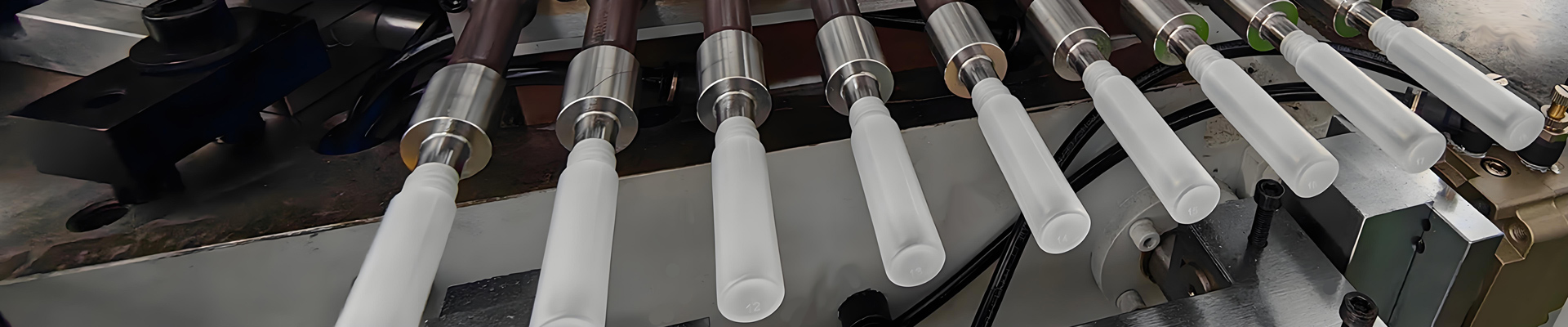
At the first station, the injection unit plasticizes resin and injects it onto the heated core rod to form a parison — a hollow tube of molten polymer sized to the final bottle. At the second station, the parison-carrying core rod indexes into the blow cavity, where conditioned air expands the parison against the cooled mold wall to set the bottle shape and surface. At the third station, the finished bottle is stripped from the core rod and discharged. Because the parison is molded onto the core rod rather than extruded and cut, the neck is created by the injection mold, which is why IBM neck finishes are dimensionally tight and flash-free by design.
Độ lặp lại của cơ cấu quay trục lõi
The heart of quality in this layout is the transfer index. Each core rod must return to the same position in the injection, blow, and ejection stations within tight limits, shot after shot, for the life of the tool. The IBM55 platform is built around a rigid rotating platen and a precision index mechanism so that core rod repeat positioning stays within the small tolerance window the neck and body demand. Poor indexing shows up as neck eccentricity, wall variation between cavities, and intermittent hang-up at strip. Aibim’s single-crossbeam, double-pole clamping framework enlarges the mold-setting space and keeps the station geometry stable, which protects index accuracy under continuous running. Index repeatability is maintained through periodic lubrication of the transfer mechanism, verification of the indexing cam or servo, and inspection of core rod wear.
Kiểm soát nhiệt độ trục lõi
The core rod is both a molding surface and a heat exchanger. It must be hot enough to keep the injected parison soft for the brief transfer to the blow station, yet cool enough that the finished bottle releases cleanly at ejection. In practice the core rod runs warmer than the blow cavity wall, with a controlled temperature difference commonly in the 20–60 °C range depending on material and bottle geometry. Stable core rod temperature is what prevents sticking, neck deformation, and inconsistent wall thickness. The IBM55 supports dedicated core rod cooling and temperature zoning so that each rod is held at its process setpoint; this is especially important in high-cavity layouts where a single hot rod can spoil an entire shot.
Các thách thức và giải pháp độ chính xác trong dải 3–300 ml
Phân khúc 3–300 ml là nơi đúc thổi phun vượt trội so với các quy trình thay thế, nhưng cũng là nơi kỷ luật quy trình quan trọng nhất. Chai nhỏ khuếch đại mọi sai sót: sai lệch cổ chai 0,1 mm chỉ là sai số làm tròn trên chai 1 lít nhưng lại là nắp bị loại trên lọ 5 ml.
Ép phun vi lượng cho các chi tiết 3–15 ml
At the low end of the range, the mass of polymer in a single parison is tiny. Metering that small a shot repeatably demands fine screw control. Key techniques on the IBM55 include a small minimum screw stroke so the machine is not trying to meter a pea-sized shot with a barrel built for much more, a reliable non-return valve (check ring) that prevents backflow during hold, controlled residual (cushion) melt so each shot starts from the same condition, and injection speed profiling that slows the fill as the parison approaches full to avoid flash and jetting. For 3–15 ml parts, cavity count rises (often 16–24 cavities) to keep the per-station shot meaningful while the individual bottle stays minute. The payback is uniform micro-bottles with stable weight and clean necks.
Độ chính xác cổ chai và tạo hình không ba via
The neck is the functional interface of every bottle: it carries the thread or snap, the sealing land, and often a tamper band. IBM creates the neck by injection, so its thread completeness, land flatness, and diameter are set by steel, not by a secondary trimming operation. On the IBM55, neck outer diameter is typically held within ±0.05–0.1 mm and perpendicularity (verticality) is controlled by rigid core rod guidance. Because there is no bimodal parting line across the neck, the bottle is flash-free by process — a structural advantage over extrusion blow molding, which must trim a parison tail. Flash-free necks mean no secondary deflashing, lower particulate generation, and immediate compatibility with standard caps and droppers.
Độ đồng đều độ dày thành
Wall uniformity drives both appearance and performance. Too thin and the bottle collapses or leaks; too thick and you waste resin and extend cooling. Uniformity starts with parison design and is finished by the blow step. The IBM55 works with blow-up ratios in the practical 2:1 to 4:1 range, blow air pressure around 0.4–0.8 MPa, and a tuned blow delay so the parison is at the right temperature when air enters. Core rod and cavity geometry are matched so the parison contacts the wall evenly; air delay and exhaust are set so no zone is starved or over-blown. The result is balanced wall distribution from shoulder to base, which matters for drop resistance and for clear cosmetic bottles where thick-and-thin streaks are visible.
Cân bằng khuôn nhiều lòng
At 8–24 cavities, balance is the difference between a profitable line and a troubleshooting marathon. Fill imbalance above a few percent means some cavities short-weight while others flash, and the spread grows with cavity count. The IBM55 addresses balance through a thermally zoned manifold, symmetric runner geometry, and validated flow distribution. Two shop-floor methods confirm balance: the short-shot method, where a partially filled shot reveals which cavities fill last, and the weigh method, where finished bottles from each cavity are weighed to quantify the spread. A well-tuned IBM55 layout keeps cavity-to-cavity fill imbalance below 3 percent, which is the threshold at which downstream filling and inspection stay simple.
Thông số kỹ thuật chính của IBM55
The figures in the table below are typical/indicative values for the IBM55 Hybrid platform. The source profile confirms the model name, the 3 ml to 300 ml volume range stated in the article title, the material list, the PREFILL hybrid hydraulic architecture, and a minimum 35 percent energy saving. Specific numeric ratings (clamping force, shot size, screw diameter, and so on) are not published in the profile and are presented here as reasonable industry-typical values for the platform class; final specifications are confirmed at quotation.
| Parameter | IBM55 Hybrid (typical / indicative) | Reference basis |
|---|---|---|
| Clamping force | 550 kN (≈55 ton) | Model designation, typical class |
| Shot size (theoretical) | 250 g | Typical for class |
| Screw diameter | 40 mm | Typical for class |
| Screw L/D ratio | 20:1 | Typical for class |
| Container volume range | 3–300 ml | Article title / product definition |
| Mold stations | 3 (injection / blow / ejection) | Three-station one-step IBM |
| Cavity number | 8–24 | Typical for 3–300 ml segment |
| Dry cycle (index) time | 3.5 s | Typical for class |
| Installed power | 38 kW | Typical for class |
| Machine dimensions (L×W×H) | 3500 × 1500 × 2200 mm | Typical for class |
| Trọng lượng máy | 6500 kg | Typical for class |
| Drive architecture | Hybrid electric, servo variable-displacement pump | Profile: PREFILL + variable-displacement pump |
| Năng lượng saving vs full hydraulic | ≥35% (minimum, per Aibim) | Profile claim |
| Processable materials | PE (HDPE/LDPE/LLDPE), PP, PS, ABS, SAN, TPU, PC, PCTG | Profile material list |
| Safety / certification | CE; digital laser sensor at stripper; light curtain | Profile claim |
So sánh với dòng IBM75
To help buyers choose between the small-bottle specialist and the larger sibling, the table below places the IBM55 Hybrid next to the IBM75, a real model in the same Aibim series. The IBM75 is positioned for bigger containers and higher per-station output, while the IBM55 stays focused on the 3–300 ml precision window. As with the IBM55, numeric ratings for the IBM75 are presented as typical/indicative values because the profile lists the model name but not its detailed ratings.
| Parameter | IBM55 Hybrid (typical) | IBM75 (typical / indicative) |
|---|---|---|
| Clamping force | 550 kN (≈55 ton) | 750 kN (≈75 ton) |
| Shot size (theoretical) | 250 g | 400 g |
| Screw diameter | 40 mm | 45 mm |
| Screw L/D ratio | 20:1 | 20:1 |
| Container volume range | 3–300 ml | 50–750 ml (typical; up to 1000 ml class) |
| Mold stations | 3 | 3 |
| Cavity number | 8–24 | 12–32 |
| Dry cycle (index) time | 3.5 s | 4.0 s |
| Installed power | 38 kW | 52 kW |
| Machine dimensions (L×W×H) | 3500 × 1500 × 2200 mm | 4200 × 1700 × 2400 mm |
| Trọng lượng máy | 6500 kg | 9000 kg |
| Best-fit application | Micro to small precision bottles, 3–300 ml | Mid-size bottles and higher cavitation |
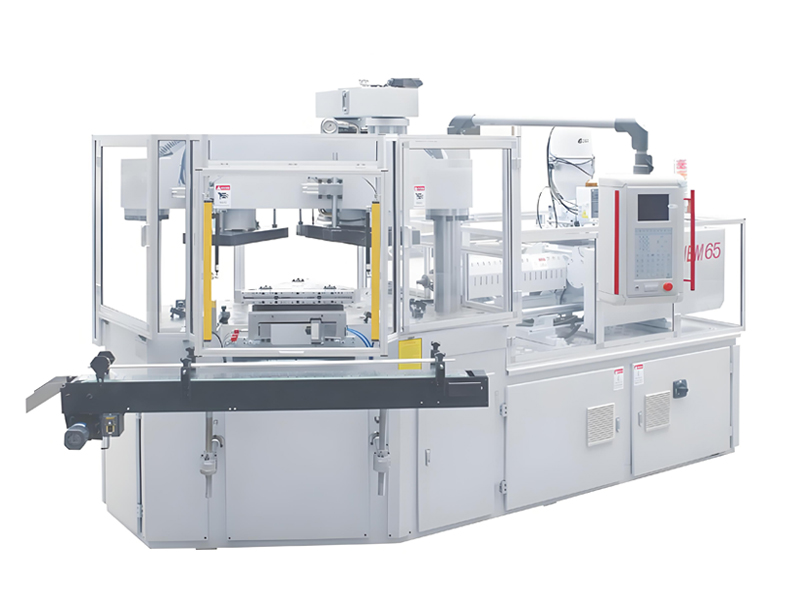
Đối với các dự án nằm giữa hai loại, dòng sản phẩm của Aibim cũng bao gồm IBM65, mang lại một lộ trình phân cấp từ cửa sổ chính xác nhỏ lên đến các bao bì lớn hơn mà không rời khỏi cùng nền tảng ba trạm, một bước và triết lý điều khiển.
Phân tích thời gian chu kỳ và tính toán công suất
Capacity on an IBM machine is governed by the index cycle and the cavity count, because each index produces a full set of bottles equal to the cavity number. A practical capacity estimate uses: pieces per hour = cavities × 3600 ÷ cycle time (seconds). The table below shows typical relationships for the 3–300 ml window on the IBM55 Hybrid. Numbers are indicative and assume stable cooling and a clean process; actual output depends on bottle geometry, material, and cavitation.
| Volume segment | Typical cycle time (s) | Cavities | Capacity (pcs/h, indicative) | Năng lượng (kWh per 1000 pcs, indicative) |
|---|---|---|---|---|
| 3–15 ml (micro) | 8 | 24 | 10,800 | 2.1 |
| 10–30 ml (vial) | 9 | 20 | 8,000 | 2.9 |
| 30–100 ml | 10 | 16 | 5,760 | 4.0 |
| 100–300 ml | 14 | 12 | 3,090 | 7.4 |
To read the table: a 5 ml eye-drop bottle at 24 cavities and an 8-second index yields roughly 10,800 bottles per hour. Năng lượng per 1000 pieces rises as bottles get larger because more resin must be plasticized and cooled, but the hybrid drivetrain keeps the absolute number well below a comparable full-hydraulic line. When planning a line, always add changeover, minor stoppage, and maintenance allowances; a realistic operating utilization of 80–90 percent is a sound planning assumption.
Khả năng tương thích vật liệu
The IBM55 processes a broad resin set, making it suitable across pharmaceutical, cosmetic, food, and laboratory consumable applications. The table below pairs each material with practical processing temperature, typical shrinkage, drying guidance, and representative end products. Temperatures for PP, HDPE, PETG, and PC follow the standard windows for these resins; shrinkage and drying are typical ranges that shift with grade and additive package.
| Material | Processing temp (°C) | Shrinkage (%) | Drying requirement | Typical application |
|---|---|---|---|---|
| PP (random copolymer, medical) | 200–240 | 1.5–2.0 | Generally not required; 80 °C optional | Eye-drop, oral-liquid bottles |
| HDPE | 180–220 | 2.0–2.5 | Not required | Milk vials, cosmetic jars |
| LDPE / LLDPE | 170–210 | 1.5–2.5 | Not required | Squeeze bottles, soft tubes |
| PETG | 220–250 | 0.4–0.7 | 65 °C / 4 h dehumidifying | Mỹ phẩm, display bottles |
| PS | 190–230 | 0.4–0.7 | 70 °C / 2 h | Lab vials, sampling bottles |
| SAN | 210–250 | 0.4–0.7 | 80 °C / 3 h | Clear cosmetic bottles |
| PC | 270–300 | 0.5–0.7 | 120 °C / 4 h dehumidifying | Premium medical, cosmetic |
| TPU | 190–220 | 1.0–1.8 | 80 °C / 3 h | Soft-touch droppers, flex bottles |
| PCTG | 230–260 | 0.4–0.7 | 65 °C / 4 h dehumidifying | Premium cosmetic flacons |
| COC / COP | 240–280 | 0.5–0.7 | 90 °C / 3 h | Diagnostic, pharmaceutical vials |
Material selection drives both machine setup and compliance pathway. Medical PP random copolymer is the workhorse for pharmacopoeia contact; PETG and PCTG deliver clarity for cosmetic and premium lines; PC and COC/COP serve high-clarity or high-barrier medical needs. Drying discipline is non-negotiable for the hygroscopic grades (PETG, PC, SAN, COC/COP) because moisture turns into splay, haze, and weakened necks.
Các ngành ứng dụng và sản phẩm cuối
Máy ép phun thổi của Aibim phục vụ các thị trường dược phẩm, thực phẩm, đồ uống và mỹ phẩm. Trong trọng tâm 3–300 ml của IBM55, các sản phẩm cuối cụ thể là:
- Dược phẩm: chai thuốc nhỏ mắt trong dải 5–15 ml, chai dung dịch uống trong dải 10–30 ml, chai thuốc thử liều đơn và lọ mẫu chẩn đoán, nơi độ chính xác cổ chai và sản xuất sạch là bắt buộc.
- Vật tư tiêu hao phòng thí nghiệm: ống thuốc thử, lọ mẫu và chai thử nghiệm đòi hỏi độ khớp cổ chai chặt cho nắp và vòng đệm, cùng mức tạo hạt thấp.
- Mỹ phẩm: chai tinh dầu, lọ nước hoa và chai serum hoặc nhũ tương trong dải 30–200 ml nơi độ trong suốt của thành và chất lượng ren quyết định sức hấp dẫn trên kệ.
- Thực phẩm và đồ uống: chai mini hương liệu và gia vị, ống nhỏ giọt định lượng và mẫu dầu ăn đặc biệt nơi yêu cầu tuân thủ tiếp xúc thực phẩm và cổ chai không rò rỉ.
- Hóa chất gia dụng: chai sữa dưỡng thể và nhũ tương cỡ du lịch, định dạng gói dùng một lần trong chai, và các gói mini khuyến mãi.
Vì cổ chai được đúc, không phải cắt gọt, mọi sản phẩm trong số này rời khỏi máy đã sẵn sàng để đóng nắp, dán nhãn và chiết rót mà không cần bước gỡ ba via. Chính tính năng đơn lẻ đó là lý do IBM thống trị các định dạng chai dược phẩm và mỹ phẩm nhỏ.
Từ nhu cầu đến khuyến nghị cấu hình
The table below maps a representative set of customer requirements to a concrete IBM55 (or sibling) configuration. Volume, monthly output, material, and required cleanliness drive the model choice, cavity count, and option list. Figures are planning guidance; final cavitation is validated during trial and tooling design.
| Requirement (volume / monthly / material / clean class) | Recommended model | Cavities | Key options |
|---|---|---|---|
| 5–15 ml eye drops / 3M / PP / ISO 8 | IBM55 Hybrid | 16–24 | Core rod temp control, cleanroom kit, hopper dryer |
| 10–30 ml oral liquid / 5M / PP / ISO 8 | IBM55 Hybrid | 12–20 | Cleanroom kit, in-line inspection, recipe management |
| 5–20 ml reagent vials / 4M / PS / ISO 8 | IBM55 Hybrid | 16–24 | Drying, core rod zoning, color sorter interface |
| 30–200 ml lotion / 2M / HDPE or PETG / general | IBM55 Hybrid | 8–16 | Surface polish, striped or clear option |
| 10–30 ml essential oil / 1M / PETG / general | IBM55 Hybrid | 8–12 | High-polish cavity, low-haze setup |
| 50–300 ml cosmetic / 1.5M / PETG or PC / ISO 8 | IBM75 | 12–24 | Cleanroom kit, drying, multi-zone hot runner |
Sản xuất tuân thủ cho dược phẩm và mỹ phẩm
Các chai nhỏ dùng cho dược phẩm và mỹ phẩm hiếm khi chỉ là bao bì; chúng là một phần của hệ thống tiếp xúc đã được xác nhận. IBM55 Hybrid có thể được chỉ định cho sản xuất có kiểm soát thông qua sự kết hợp các biện pháp về môi trường và phía máy:
- Môi trường sạch: Bố trí bên trong phòng sạch Class 100000 (ISO 8), hoặc tủ thổi khí tầng (laminar-flow hood) cục bộ phía trên khu vực đẩy và thu gom chai, với áp suất dương so với các khu vực xung quanh để ngăn bụi lọt vào.
- Khí tiện ích sạch: Khí nén không dầu cho thổi và sử dụng phụ trợ, để không có sol khí dầu đến bên trong chai hoặc khu vực sạch.
- Bề mặt máy vệ sinh: Tấm chắn thép không gỉ và hình học dễ làm sạch chống cặn bám và đơn giản hóa việc vệ sinh giữa các chiến dịch.
- Tuân thủ vật liệu và tiếp xúc: Lựa chọn nhựa phù hợp với các khung quy định tiếp xúc thực phẩm và y tế bao gồm FDA, EU 10/2011, GB 4806, và đối với cấp y tế là USP Class VI và ISO 10993 khi áp dụng.
- Căn chỉnh hệ thống chất lượng: Bao bì chính cho dược phẩm có thể được tham chiếu theo ISO 15378, mở rộng ISO 9001 với các kỳ vọng GMP cho vật liệu bao bì.
- Truy xuất nguồn gốc: Lưu trữ và truy xuất công thức (bộ thông số), quản lý quyền vận hành viên và ghi dữ liệu quy trình để mỗi lô sản xuất có thể được tái tạo và kiểm toán.
These measures are configuration and facility choices layered on the base machine; none change the fundamental three-station process, which is already flash-free and low-particulate by design. The SD-card parameter storage on Aibim machines supports recipe portability and repeat setups across multiple lines.
Giải pháp khuôn mẫu
Khuôn là nơi quyết định chất lượng chai và tốc độ chuyển đổi. IBM55 làm việc với khuôn nhiều khoang được xây dựng quanh khái niệm trục lõi ba trạm:
- Bố trí nhiều khoang: Số khoang được chọn để cân bằng lượng phun mỗi trạm với chu kỳ mục tiêu; dải 8–24 khoang là điển hình cho cửa sổ 3–300 ml.
- Đầu nóng / ống góp: Một ống góp phân vùng nhiệt cấp liệu đều cho các trạm phun, là nền tảng của mục tiêu cân bằng điền đầy dưới 3 phần trăm.
- Làm nguội trục lõi: Các kênh làm nguội chuyên dụng giữ mỗi trục lõi ở điểm đặt, bảo vệ hình dạng cổ và khả năng nhả sản phẩm.
- Thoát khí và đánh bóng: Thoát khí (venting) đúng cách và độ bóng bề mặt cao ngăn cháy, khí kẹt và thành mờ, đặc biệt trong các cấp mỹ phẩm trong suốt.
- Tuổi thọ khuôn: Khuôn được bảo trì tốt chạy đến hàng triệu chu kỳ; tuổi thọ phụ thuộc vào độ mài mòn của nhựa, bảo trì và cách xử lý.
- Thay nhanh (SMED): Thiết kế thay khuôn nhanh và giao diện chuẩn hóa nhắm mục tiêu cửa sổ chuyển đổi ngắn, giảm thời gian dừng máy khi chuyển định dạng chai.
- Quản lý thư viện khuôn: Lưu trữ thông số, hồ sơ bảo trì và lịch sử cho từng khuôn hỗ trợ khởi động lặp lại và tân trang theo kế hoạch.
Aibim vận hành trung tâm CNC riêng, hỗ trợ gia công chính xác nội bộ các bộ phận máy và linh kiện liên quan đến khuôn mẫu, rút ngắn thời gian giao hàng và giữ hình dạng nhất quán trên các khuôn dự phòng và sản xuất.
Lắp đặt, chạy thử và nghiệm thu (FAT/SAT)
Một trình tự chạy thử nghiệm thu có kỷ luật giảm rủi ro khi khởi động và mang lại cho cả hai bên một mốc chuẩn được lập tài liệu. IBM55 thường được kiểm chứng theo các giai đoạn tăng dần, từ không tải đến sản xuất đầy khoang bền vững:
| Stage | Criterion | Kontaktujte násance judgment |
|---|---|---|
| No-load run | 30 min continuous, no alarm, low noise and temperature rise | Pass if clean run, stable hydraulics |
| Single cavity | 200 shots, stable weight and dimensions | Weight capability (Cpk) ≥ 1.33 |
| Full cavitation | 2 h continuous at target cavities | Cavity fill balance < 3% |
| 8 h stability | Continuous production, monitored | Cycle variance ±1%, yield ≥ 98% |
| Final inspection | Sampled bottle measurement | Neck dimension ±0.05–0.1 mm, no flash |
Utilities planning matters before the machine arrives: a level foundation within specified tolerance, clean and dry compressed air at the required pressure and volume, cooling water at a stable temperature and flow, and an electrical supply sized to the installed power with appropriate kVA headroom. Factory Kontaktujte násance Test (FAT) is performed at Aibim before shipment; Site Kontaktujte násance Test (SAT) confirms the same behavior in the customer plant after installation and commissioning.
Lịch bảo trì và kiểm tra
Máy lai đền đáp việc bảo trì kỷ luật vì lợi thế của chúng phụ thuộc vào dầu sạch và điều khiển ổn định. Một lịch trình thực tế cho IBM55:
| Interval | Key tasks |
|---|---|
| Daily | Check oil level and temperature; verify safety light curtain and laser sensor; clear ejection area; confirm no abnormal noise or leak |
| Weekly | Inspect core rods for wear or coating loss; verify indexing lubrication; check heating bands and thermocouples; review cycle and weight trends |
| Monthly | Sample and assess hydraulic oil cleanliness (target ISO 4406 class per specification); inspect and replace filter elements as needed; check non-return valve and screw wear |
| Quarterly | Full lubrication of transfer and clamp linkages; calibrate pressure and temperature sensors; verify safety circuit function; review mold condition and planned maintenance |
Độ sạch của dầu là yếu tố thầm lặng quyết định độ tin cậy của máy hybrid. Theo dõi chất lỏng theo mã độ sạch ISO 4406 và thay phần tử lọc trước khi đạt giới hạn giúp bơm lưu lượng biến thiên và các van tỷ lệ luôn khỏe mạnh, từ đó bảo vệ độ chính xác mà máy được mua vì nó.
Chẩn đoán sự cố thường gặp
Ngay cả một dây chuyền vận hành tốt thỉnh thoảng cũng trôi. Bảng dưới đây ghép các triệu chứng phổ biến với nguyên nhân gốc khả dĩ và hành động đầu tiên, đóng khung là hiện tượng → nguyên nhân gốc → hành động.
| Phenomenon | Root cause | Action |
|---|---|---|
| Bottle weight drift | Non-return valve wear, unstable cushion, temperature shift | Check check ring, stabilize barrel and core rod temp, verify metering |
| Neck flash | Excess injection pressure, worn neck insert, low clamp | Reduce pack pressure, inspect neck steel, confirm tonnage |
| Neck whitening / stress | Over-high injection speed or hold, cold core rod | Slow fill, raise core rod temp within window, review profile |
| Core rod sticking | Core rod too hot, contamination, poor release | Adjust core rod cooling, clean, check resin and additive |
| Wall eccentricity | Index repeatability loss, parison asymmetry | Verify indexing, balance manifold, inspect core rod alignment |
| Poor clarity / haze | Moisture in hygroscopic resin, trapped gas | Improve drying, add venting, lower melt temperature slightly |
| Cycle time instability | Oil temperature rise, sensor drift, utility fluctuation | Check cooling, recalibrate sensors, stabilize air and power |
So sánh lộ trình công nghệ
Chọn IBM là một quyết định về quy trình. Bảng dưới đây so sánh IBM55 Hybrid với một máy IBM thủy lực toàn phần thông thường, đúc thổi đùn (EBM) và đúc thổi kéo phun hai bước (ISBM). Không sử dụng tên thương hiệu; đây là công nghệ đối đầu công nghệ.
| Criterion | IBM55 Hybrid (this machine) | Conventional full-hydraulic IBM | Extrusion blow molding (EBM) | Two-step ISBM |
|---|---|---|---|---|
| Neck precision | Ép phun-molded, flash-free, ±0.05–0.1 mm | Ép phun-molded, flash-free | Cut parison tail, needs trimming | Ép phun-molded preform neck |
| Wall uniformity | Good, 2:1–4:1 blow-up | Good | Variable, parison control needed | Very good with orientation |
| Năng lượng | 30–50% below full hydraulic (≥35% per Aibim) | Baseline | Lower machine cost, higher per-bottle energy varies | Higher, two machines plus reheater |
| Best volume | 3–300 ml precision | Small to mid | Mid to large, also irregular shapes | Mostly PET, mid volumes |
| Clean production | Flash-free, low particulate, cleanroom-ready | Flash-free | Trim waste, more particulates | Two-stage handling, more transfer |
| Material range | PP/PE/PS/ABS/SAN/TPU/PC/PCTG | Same broad range | PE-heavy, broad polyolefins | PET-dominant, some PP |
| Capital cost | Medium-High | Medium | Low-Medium | High |
Đối với các chai nhỏ, độ chính xác cao, không ba via bằng PP, PE và các cấp độ vô định hình trong suốt, IBM — và đặc biệt là biến thể hybrid — là sự phù hợp mạnh nhất. EBM thắng ở các hình dạng rất lớn hoặc không đều và chi phí khởi điểm thấp hơn; ISBM hai bước thắng ở nơi yêu cầu định hướng PET và khả năng chống carbonat hóa.
Tính kinh tế và lợi nhuận
Phần này chỉ đánh giá chi phí thông qua các chỉ số, tỷ lệ phần trăm và số lượng vật lý, không bao giờ bằng tiền tệ. Đường cơ sở cho chỉ số chi phí chuyển đổi được đặt ở 100 điểm cho một máy IBM thủy lực toàn phần thông thường có sản lượng tương đương.
- Chỉ số năng lượng đơn vị: IBM55 Hybrid thường nằm trong dải 60–70 so với mốc 100, phản ánh mức giảm năng lượng 30–50 phần trăm.
- Hiệu quả thiết bị tổng thể (OEE): Một cụm máy vận hành tốt đạt 80–90 phần trăm, được hỗ trợ bởi độ ổn định chu kỳ ±1 phần trăm và tỷ lệ đạt cao.
- Tỷ lệ đạt: Tỷ lệ chai tốt bền vững từ 98 phần trăm trở lên là khả thi với số khoang cân bằng và quy trình được kiểm soát.
- Thời gian chuyển đổi: khuôn theo định hướng SMED và giao diện chuẩn hóa nhắm mục tiêu chuyển đổi trong dải 1,5–3 giờ, bảo vệ mức sử dụng trên các dây chuyền nhiều SKU.
- Chỉ số chi phí chuyển đổi: Bao gồm năng lượng, hao hụt nhựa, lao động và bảo trì, máy lai thường đạt trong dải 70–85 so với mốc 100.
- Thời gian hoàn vốn: Đối với các dây chuyền chạy nhiều ca với chi phí năng lượng cao hoặc yêu cầu phòng sạch nghiêm ngặt, khoản đầu tư tăng thêm so với bộ nguồn toàn thủy lực thường được thu hồi trong khoảng 12–36 tháng, tùy thuộc vào mức sử dụng và giá năng lượng địa phương.
Trường hợp kinh tế trở nên mạnh hơn ở những nơi chi phí năng lượng, tải làm mát phòng sạch hoặc hiệu quả nhân công chiếm một phần đáng kể trong tổng chi phí. Vì máy cũng giảm thất thoát nhựa thông qua kiểm soát trọng lượng chặt chẽ hơn, một phần lợi nhuận đến từ tiết kiệm vật liệu chứ không chỉ từ năng lượng.
Dịch vụ và hỗ trợ
Aibim, với tư cách là nhà máy của Wanplas, hỗ trợ IBM55 bằng các cam kết dịch vụ chung của tập đoàn. Mô hình hỗ trợ bao phủ toàn bộ vòng đời của dây chuyền:
- Thử nghiệm trước khi giao hàng: Mỗi máy được vận hành và thử nghiệm tại nhà máy, bao gồm thử khuôn và sản xuất thử, để khách hàng nhận được một mốc khởi động đã được kiểm chứng và lập tài liệu thay vì một chiếc máy trần.
- Lắp đặt và chạy thử: Các kỹ sư hỗ trợ lắp đặt tại chỗ, kết nối tiện ích và SAT để xác nhận hành vi FAT tại nhà máy của khách hàng.
- Chính sách phụ tùng miễn phí: 500 USD phụ tùng miễn phí mỗi năm theo chính sách của tập đoàn Wanplas, bổ sung cho việc thay thế bảo hành các linh kiện hư hỏng.
- Đào tạo: Đào tạo vận hành viên và bảo trì khuôn bao gồm vận hành, quản lý công thức, vệ sinh và kiểm tra định kỳ để đội ngũ khách hàng làm chủ quy trình.
- Vận hành và bảo trì từ xa: Hệ thống điều khiển hỗ trợ giám sát và chẩn đoán từ xa, cho phép kỹ sư nhà máy xem xét dữ liệu quy trình và hướng dẫn khắc phục không chậm trễ.
- Nhà máy mở cửa: Aibim chào đón khách hàng đến thăm cơ sở Zhangjiagang, bao gồm trung tâm CNC và khu vực thử nghiệm, như một phần của chính sách nhà máy mở cửa Wanplas.
Các cam kết này áp dụng trên toàn bộ dòng sản phẩm Aibim và phản ánh các lời hứa của tập đoàn thương hiệu Wanplas về phụ tùng miễn phí, bảo đảm vận chuyển, bảo đảm công suất sản xuất và tiêu chuẩn chất lượng.
Câu hỏi thường gặp
IBM55 Hybrid được thiết kế cho dải dung tích nào?
IBM55 Hybrid được thiết kế cho các chai chính xác nhỏ từ 3 ml đến 300 ml. Cửa sổ này bao phủ các lọ thuốc nhỏ mắt và chất lỏng uống ở đầu thấp và các flacon kem dưỡng, nhũ tương và mỹ phẩm ở đầu cao. Đối với các bao bì lớn hơn, IBM75 trong cùng dòng mở rộng công suất lên trên.
Truyền động lai thực sự tiết kiệm bao nhiêu năng lượng?
Against a full-hydraulic IBM of equal output, the hybrid reduces total energy consumption by 30 to 50 percent, with Aibim documenting a minimum saving of 35 percent. The saving comes from a servo-driven variable-displacement pump that delivers flow on demand instead of continuously bypassing oil through relief, plus the PREFILL rapid clamp pre-charge.
Tại sao chai IBM không có ba via ở phần cổ?
In injection blow molding the neck is created by injection onto the core rod, so its thread and land are defined by steel rather than by cutting a parison. There is no parting line across the neck and no tail to trim, which is why IBM bottles are flash-free by process and ready for capping without deflashing.
Máy IBM55 có thể gia công những vật liệu nào?
Máy xử lý PE (HDPE, LDPE, LLDPE), PP, PS, ABS, SAN, TPU, PC và PCTG. Mỗi loại có cửa sổ nhiệt độ, co rút và sấy riêng; các cấp hút ẩm như PETG, PC, SAN và COC/COP yêu cầu sấy hút ẩm đúng cách trước khi sản xuất.
Độ cân bằng khoang được kiểm chứng như thế nào trên khuôn nhiều khoang?
Hai phương pháp thực tế được sử dụng: phương pháp mũi phun ngắn, trong đó một mũi phun được điền một phần tiết lộ thứ tự điền đầy trên các khoang, và phương pháp cân, trong đó các chai thành phẩm từ mỗi khoang được cân để định lượng độ phân tán. Một bố trí IBM55 được hiệu chỉnh tốt giữ sự mất cân bằng điền đầy giữa các khoang dưới 3 phần trăm.
Cần cấu hình phòng sạch nào cho chai dược phẩm?
Small pharma bottles are typically produced inside a Class 100000 (ISO 8) cleanroom or under a laminar-flow hood at the ejection zone, with positive pressure, oil-free compressed air, stainless-steel guarding, and recipe-managed traceability. Material selection then aligns with FDA, EU 10/2011, GB 4806, USP Class VI, ISO 10993, and ISO 15378 as applicable.
Quá trình vận hành thử và nghiệm thu mất bao lâu?
Commissioning runs from no-load verification through single-cavity, full-cavitation, and an 8-hour stability run, with acceptance judged on cycle variance, fill balance, yield, and neck dimensions. With utilities prepared in advance, a structured FAT and SAT can be completed within a short on-site window, after which the line enters routine production.
Chính sách phụ tùng miễn phí 500 USD bao gồm những gì?
Theo chính sách của tập đoàn Wanplas, khách hàng nhận được phụ tùng miễn phí 500 USD mỗi năm, bổ sung cho việc thay thế theo bảo hành các linh kiện bị hư hỏng. Đây là một cam kết thương hiệu dùng chung trên toàn mạng lưới Aibim và Wanplas, nhằm giữ cho việc thay thế vật tư tiêu hao và phụ tùng mòn thường xuyên đơn giản và có thể dự đoán được.
Kết luận
Máy ép phun thổi điện lai IBM55 is a focused answer to a focused problem: producing 3–300 ml bottles with injection-grade neck precision, flash-free walls, and validated repeatability, while cutting energy and cooling load through a servo-driven hybrid hydraulic architecture. Its three-station, one-step process, tight core-rod indexing, and balanced high-cavity manifolds make it the right platform for pharmaceutical vials, cosmetic flacons, laboratory consumables, and small food and daily-chemical bottles.
Backed by Aibim’s two decades of injection blow molding experience, its own CNC center, shipment to more than 40 countries, and the shared Wanplas service promises — including pre-shipment trial production, installation and commissioning, USD 500 free parts per year, training, remote support, and open-factory visits — the IBM55 Hybrid is built to run as a dependable production asset rather than a one-time purchase.
If your project involves small precision bottles in the 3–300 ml range and you want to discuss cavity count, material choice, cleanroom configuration, or a trial run on your own resin and bottle design, Aibim welcomes your specifications for a tailored configuration proposal and an invitation to visit the factory for a live demonstration.