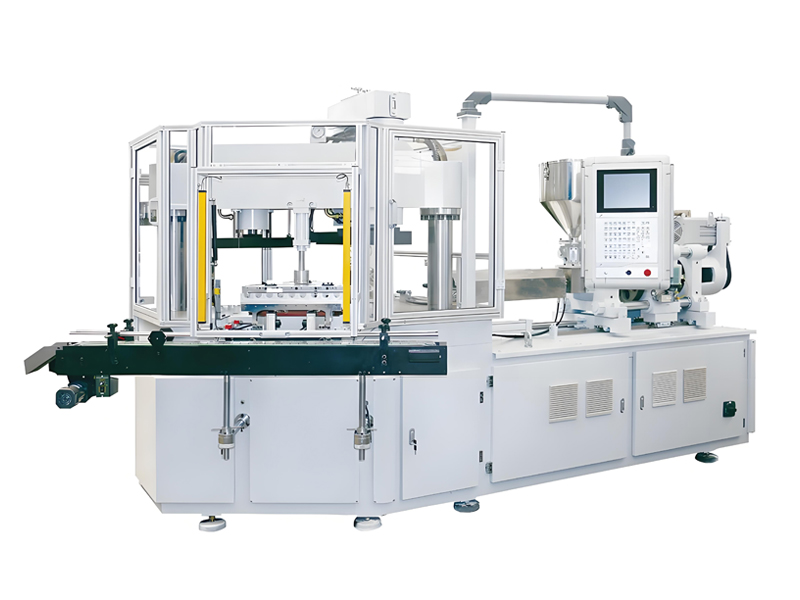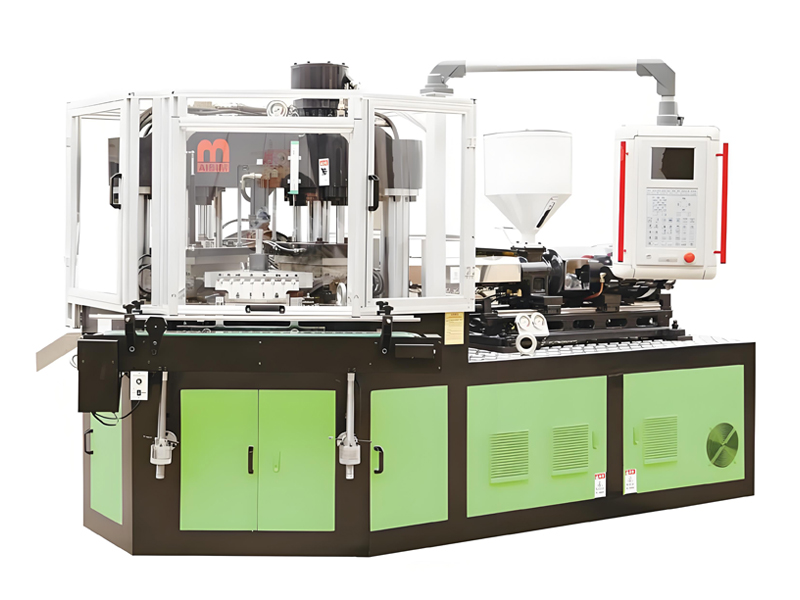
A custom turnkey IBM production line is the fastest route from a bottle drawing on paper to a validated, running cell on your factory floor. Instead of sourcing an injection blow molding machine, a multi-cavity mold, deflashing equipment, leak-test stations and conveying separately, a turnkey package bundles every element into one engineered, commissioned and documented solution. For brands that need bottles with tight neck tolerances, no flash and a consistent wall distribution, injection blow molding (IBM) is often the most reliable route, and a tailored line makes that technology fit the product rather than forcing the product to fit a standard machine.
Aibim is a Wanplas factory with more than 12 years of experience in plastic machine manufacturing and two decades focused specifically on injection blow molding. The company runs its own CNC center for machine and mold parts, operates a new factory purchased in 2022, and ships more than 100 lines per year to over 40 countries. Aibim’s product range spans from 3 ml pharmaceutical vials to 1000 ml personal-care bottles, built on the IBM75, IBM65 and IBM55 Hybrid Electric platforms. This article explains what a custom turnkey IBM line includes, how the three-station process works, how mold design and automation are tailored to your bottle, and how the project is delivered and validated.
Dây chuyền sản xuất IBM chìa khóa trao tay theo yêu cầu mang lại điều gì
A turnkey IBM line is defined less by a single machine and more by the promise that the supplier delivers a working production cell, not a pile of hardware. The word “turnkey” means the buyer can hand over a bottle specification and receive, at the end, a cell that molds, finishes, tests and conveys bottles to the next process with minimal additional engineering. The scope of a custom turnkey IBM project therefore extends well beyond the injection blow molding machine itself.
At the center sits the injection blow molding machine, but surrounding it the turnkey scope typically includes the dedicated mold set engineered for your exact bottle geometry, the neck and gate handling that removes the small injection tail, inline leak-test stations, a conveyor or robotic take-out loop, vision inspection, cooling and material handling, and the control architecture that ties the stations together. On top of the hardware, the package covers factory layout design, installation and commissioning, operator training, and the documentation required for validation. The buyer is left with a cell that simply needs resin, utilities and an operator.
Một dây chuyền IBM chìa khóa trao tay tùy chỉnh không phải là một máy với các tùy chọn được lắp thêm. Nó là một ô sản xuất được thiết kế kỹ thuật, nơi khuôn, máy, khâu hoàn thiện và khâu kiểm tra được xác định cùng nhau để chai ra đúng chuẩn ở cuối dây chuyền, chứ không phải đúng chuẩn ở cuối bước đúc.
The advantage of tailoring the whole line is consistency. When the mold, the parison transfer timing and the blow pressure are tuned as one system, the result is a bottle with a tightly controlled neck finish, uniform wall thickness and no flash to trim. For pharmaceutical, cosmetic and food applications where the neck must seal precisely against a closure or a dropper, that level of control is the reason brands choose IBM over other hollow-molding routes. The table below maps each turnkey element to the problem it solves.
Phạm vi chìa khóa trao tay so với mua máy riêng lẻ
| Turnkey element | What it does | Why it matters for your bottle |
|---|---|---|
| Ép phun blow molding machine | Injects parison, transfers, blows and ejects in three stations | Core process that defines neck accuracy and wall distribution |
| Dedicated multi-cavity mold | Forms neck, parison and bottle in matched cavities | Geometry, cavity count and output are set by your product |
| Tail and flash separation | Automatic removal at stripper station | Eliminates manual trimming and contamination risk |
| Inline leak-test station | Pressure or vacuum decay check per bottle | Rejects weak bottles before they leave the cell |
| Conveyor and take-out | Transfers bottles between stations | Keeps the cell compact and continuous |
| Vision inspection | Checks finish, color and defects | Documented quality for regulated markets |
| Layout, install, commissioning | Delivered as a running cell | Shortens time from order to validated output |
Quy trình IBM một bước ba trạm
Ép phun blow molding is a one-step, three-station process that converts plastic resin into a finished hollow bottle without an intermediate reheating stage. Understanding the three stations is essential because the layout of a turnkey line is built directly around them. Aibim machines use a rotating or indexing three-station platen that carries the core rod through injection, blow and ejection in a continuous cycle.
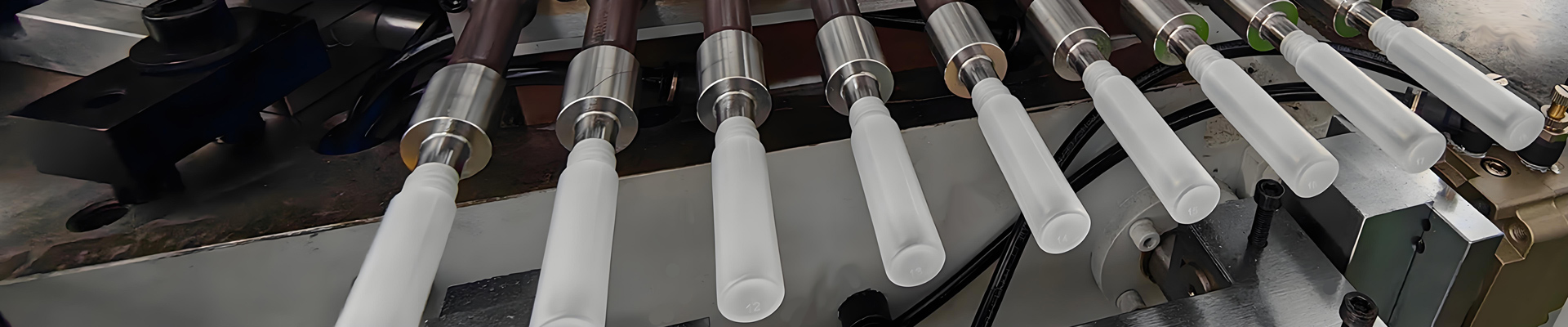
The first station is injection. Melt is plasticized in the barrel by the screw, then injected into the neck and parison cavity around a core rod. The neck finish, including threads, is already molded to near-final tolerance here, which is the defining advantage of IBM over extrusion blow molding. The second station is blow. The hot parison on its core rod indexes to the blow cavity, where compressed air expands the parison against the cooled bottle mold wall, setting the body shape and wall thickness. The third station is ejection and deflashing. The formed bottle, still on the core rod, indexes to the stripper station where it is released, the small injection gate tail is separated automatically, and the finished bottle drops to the conveyor.
Vì cổ chai được đúc phun thay vì cắt hoặc hàn, một chai IBM rời máy với bề mặt hoàn thiện không ba via và dạng ren chính xác. Thao tác sau khuôn duy nhất là tách phần đuôi cổng nhỏ, việc này xảy ra tự động tại trạm gỡ sản phẩm.
This one-step flow is why a turnkey IBM line can be so compact. There is no reheating oven, no separate preform handling, and no large trimming department. The three stations sit on a single machine frame, and the downstream equipment (leak-test, vision, packing) attaches to the outfeed conveyor. For a brand launching a new bottle, the one-step nature also reduces the number of process variables to tune, which shortens validation.
Bảng dưới đây so sánh IBM với các phương pháp tạo hình rỗng khác để người đọc có thể thấy dây chuyền IBM chìa khóa trao tay tùy chỉnh phù hợp ở đâu. Đây là so sánh công nghệ, không phải so sánh thương hiệu.
IBM so với các quy trình chai rỗng khác
| Attribute | Ép phun blow molding (IBM) | Extrusion blow molding (EBM) | Two-step stretch blow (ISBM) |
|---|---|---|---|
| Process steps | One-step, three-station | One-step, parison extruded | Two-step, preform then reheat |
| Neck finish quality | Excellent, flash-free threads | Good, requires neck trimming | Excellent, oriented neck |
| Flash and scrap | Minimal (gate tail only) | Higher (parting line flash) | Minimal |
| Typical volume range | 3 ml to 1000 ml | Up to large containers | Mostly 50 ml to several L |
| Best for | Pharma, cosmetic, food small bottles | Industrial, large, irregular shapes | Carbonated and water bottles |
Phân tích thông số kỹ thuật chai riêng của bạn
Before any steel is cut, a custom turnkey IBM line begins with a bottle specification. The more precisely the product is defined, the better the mold, machine size and automation can be matched. Aibim’s engineering team typically works from a drawing or a sample bottle and extracts the parameters that drive the line design.
The first parameter is finished volume and fill volume. IBM covers roughly 3 ml to 1000 ml, so the volume determines whether a small high-cavity layout or a larger low-cavity layout is appropriate. The second is neck finish: thread type, diameter, height and the presence of a tamper-evident band or a dropper seat. Because the neck is injection molded, its geometry must be built into the neck cavity with tight tolerance. The third is body shape and the required wall thickness, which governs blow air pressure and cooling. The fourth is resin, since each material has a different melt behavior and shrinkage. The fifth is decoration and downstream handling, which determine whether vision inspection or orientation stations are needed.
A useful way to think about the specification is to separate what the consumer sees from what the filling line demands. The consumer cares about shape, clarity and feel. The filling line cares about neck concentricity, torque consistency and leak integrity. A tailored IBM line is optimized for the second list, because that is where IBM wins. The table below lists the inputs Aibim requests at project kickoff.
Các yếu tố đầu vào thông số định hình dây chuyền
| Input | Example value | Drives |
|---|---|---|
| Finished volume | 15 ml dropper bottle | Cavity count, machine size |
| Neck finish | 18 mm tamper-evident | Neck cavity, closure match |
| Resin | PP or PETG | Barrel temperature, mold temp |
| Wall thickness | 0.8 mm typical | Blow pressure, cooling time |
| Required output | Per shift or per year | Cycle time, cavity count |
Thiết kế và chế tạo khuôn cho IBM
The mold is the heart of a custom turnkey IBM line, and it is built as three matched components rather than one block. The neck cavity molds the finish, the parison cavity (or parison cavity plus core rod) shapes the hollow tube, and the blow cavity forms the final bottle. These cavities are mounted on a rotating platen so the same core rod carries the parison from injection through blow to ejection. Getting the relationship between cavities right is what delivers a bottle with a precise neck and a uniform body wall.
Thermal design is the most important mold engineering task. The neck cavity must stay cool enough to set the threads quickly, while the parison cavity must hold the parison warm and uniform so it blows without thin spots. Aibim’s in-house CNC center machines these cavities to tight tolerances and can iterate on cooling-channel layout during development. Because the factory controls its own mold machining, lead time and revision cycles are shorter than when moldmaking is outsourced.
Cavity count is the key commercial lever. For small bottles such as 5 ml to 30 ml pharmaceutical vials, a turnkey line may run eight, ten or even more cavities on an IBM55 or IBM65, multiplying output without enlarging the machine. For a 500 ml to 1000 ml bottle, two or four cavities are more realistic because each cavity consumes more platen area and shot volume. The mold designer balances cavity count against the machine’s available clamping force, shot size and platen space to hit the target output.
Aibim vận hành trung tâm CNC của riêng mình cho các bộ phận máy và khuôn, điều đó có nghĩa là khoang cổ, khoang phôi và khoang thổi được gia công và xác nhận dưới một mái nhà. Sự tích hợp dọc đó là điều cho phép một khuôn tùy chỉnh chuyển từ bản vẽ sang mẫu thử theo một lịch trình có thể dự đoán được.
Deflashing is largely solved inside the mold system for IBM. The gate where the parison is injected leaves a small tail at the base of the neck or inside the finish. At the stripper station this tail is separated automatically as the bottle releases from the core rod, so there is no manual flash trimming department. For brands in pharmaceutical and food contact, removing a manual trimming step also removes a source of contamination and a worker-dependent quality variation. The table below summarizes the three cavity roles.
Ba bộ phận khuôn của IBM
| Mold component | Forms | Design focus |
|---|---|---|
| Neck cavity | Threads, finish, tamper band | Fast cooling, tight tolerance |
| Parison cavity | Hollow tube on core rod | Uniform wall, controlled temperature |
| Blow cavity | Final bottle body | Cooling channels, air path |
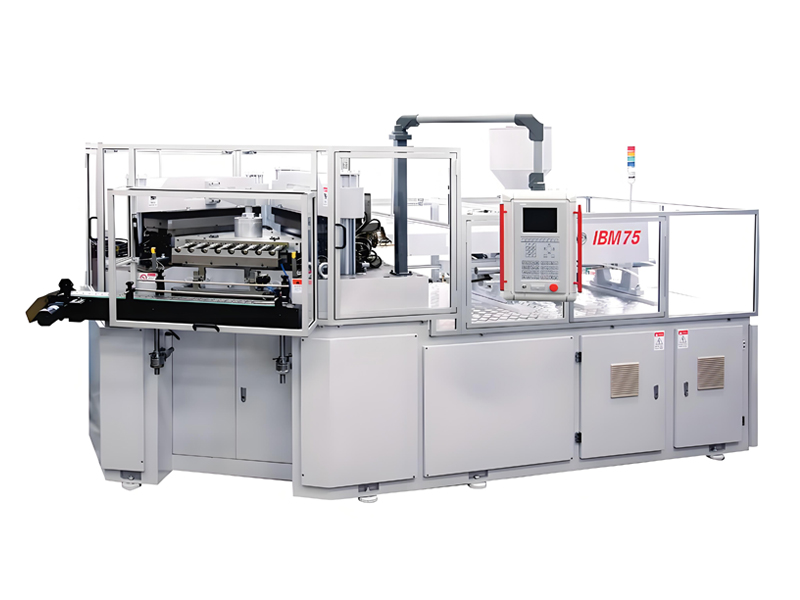
Mô-đun sản phẩm: Máy Aibim IBM75
The Aibim IBM75 is the largest machine in the IBM series and the natural choice for bottles near the top of the 3 ml to 1000 ml range. Its higher clamping force and enlarged mold-setting space support larger bottle bodies and fewer but bigger cavities, which is typical for wide-mouth personal-care jars, 500 ml to 1000 ml cosmetic or food bottles, and other formats where each cavity is physically large.
The IBM75 uses Aibim’s unique PREFILL technology and a variable displacement pump in the hydraulic system, which reduces energy draw during the clamping and holding phases. The single-crossbeam, double-pole clamping framework gives a stable, enlarged mold-setting area, and an SD card stores parameter recipes so a proven setup can be reloaded on another machine without re-tuning. The stripper station uses a long-distance digital laser sensor for mold safety and a light curtain for personal safety, supporting the CE-oriented safety design.
Bảng thông số kỹ thuật dưới đây liệt kê các thông số điển hình cho phân khúc IBM75. Các giá trị này phản ánh hạng mục máy và nên được xác nhận với báo giá cuối cùng cho một loại chai và số khoang cụ thể, vì thể tích phun và số khoang thay đổi cùng nhau.
Thông số kỹ thuật điển hình của Aibim IBM75
| Parameter | IBM75 | Notes |
|---|---|---|
| Clamping force | 75 ton | Single-crossbeam, double-pole frame |
| Ép phun screw diameter | 45 mm | Plasticizing in the barrel |
| Theoretical shot volume | approx. 250 cm³ | Sets max cavity count |
| Max bottle volume | 1000 ml | Largest in the IBM range |
| Mold platen size | approx. 420 × 420 mm | Enlarged mold-setting space |
| Plasticizing capacity | approx. 60 kg/h | Depends on resin |
| Installed power | approx. 22 kW | PREFILL hydraulic savings |
| Trọng lượng máy | approx. 4.5 t | Three-station frame |
Mô-đun sản phẩm: IBM65 và IBM55 Hybrid Electric
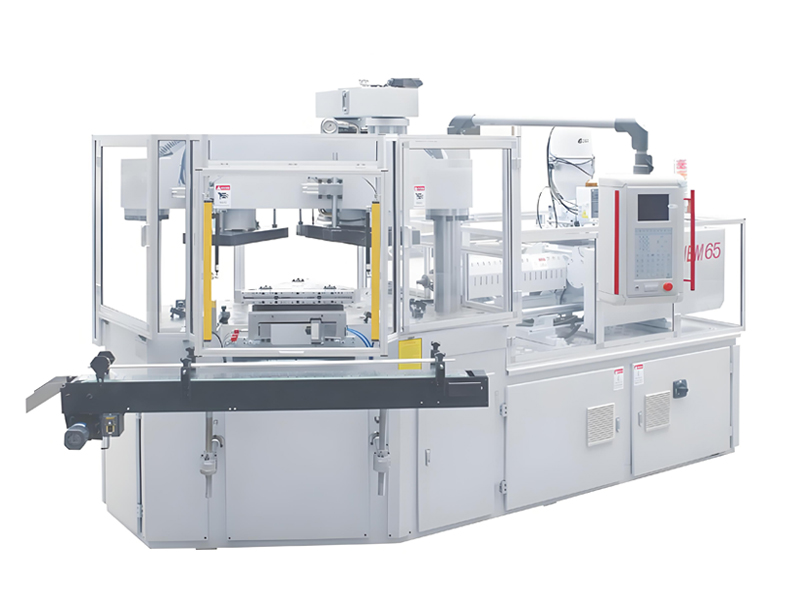
The IBM65 sits in the middle of the range and covers the majority of cosmetic and oral-care bottles from roughly 50 ml to 250 ml, while still reaching larger formats at lower cavity counts. It shares the same three-station architecture, PREFILL hydraulic technology and SD-card recipe storage as the IBM75, so a customer running both machines can transfer process knowledge between them.
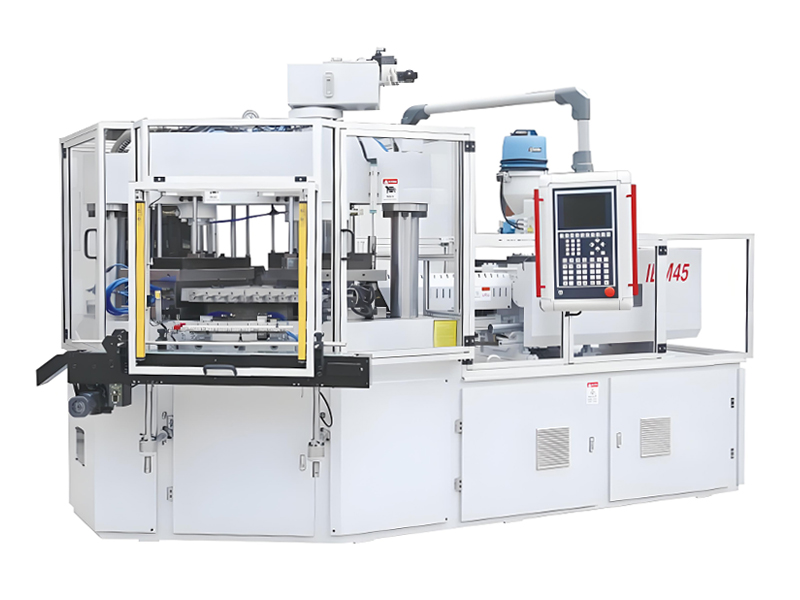
The IBM55 Hybrid Electric is the compact, energy-oriented member of the family. Aibim’s hybrid drive combines electric indexing and dosing with hydraulic clamping, delivering the brand’s stated minimum 35 percent energy saving compared with conventional hydraulic machines while keeping the clamping force needed for a stable neck. For small pharmaceutical vials, eye-care and perfume miniatures in the 3 ml to 50 ml range, the IBM55 supports high cavity counts and is the most economical platform per bottle.
Bảng dưới đây so sánh ba nền tảng Aibim để người mua có thể thấy kích thước máy ánh xạ với kích thước chai và chiến lược lòng khuôn như thế nào. Cả ba đều được xây dựng trên cùng nguyên tắc một bước, ba trạm và chia sẻ chính sách dịch vụ của tập đoàn Wanplas.
So sánh dòng máy Aibim IBM
| Parameter | IBM55 Hybrid | IBM65 | IBM75 |
|---|---|---|---|
| Clamping force | 55 ton | 65 ton | 75 ton |
| Screw diameter | 35 mm | 40 mm | 45 mm |
| Shot volume | approx. 150 cm³ | approx. 200 cm³ | approx. 250 cm³ |
| Max bottle volume | 250 ml | 500 ml | 1000 ml |
| Drive type | Hybrid electric | Hydraulic | Hydraulic |
| Năng lượng profile | Min. 35% saving | PREFILL savings | PREFILL savings |
| Typical cavity count | High (small vials) | Medium | Low (large bottles) |
Tích hợp dây chuyền: Ép phun, gỡ ba via và kiểm tra rò rỉ
The phrase “custom turnkey” earns its meaning at the integration stage, where molding, deflashing and leak-test are engineered as one continuous cell. On a standalone IBM machine the bottle drops onto a box. In a turnkey line the bottle drops onto a conveyor that carries it through finishing and testing before it is counted and packed. The integration is what converts a molding machine into a production line.
Deflashing in IBM is integrated by design. As described earlier, the small gate tail is removed automatically at the stripper station, so the bottle that leaves the machine is already finish-trimmed. The turnkey cell then routes bottles to the leak-test station without a manual handling break. Leak testing uses either a pressure decay method, where the bottle is sealed at the finish and charged with air while a sensor watches for pressure drop, or a vacuum decay method, where the bottle is placed under vacuum and the decay rate is measured. Either way, bottles that fail the threshold are diverted to a reject bin and never reach the good-bottle stream.
Tích hợp kiểm tra rò rỉ trực tuyến, thay vì như một cuộc kiểm toán ngoại tuyến riêng biệt, có nghĩa là mọi chai đều được kiểm tra, không chỉ một vài mẫu. Đối với các chai dược phẩm và tiếp xúc thực phẩm, nơi rò rỉ có nghĩa là hư hỏng sản phẩm hoặc mất liều, kiểm tra 100 phần trăm là một lợi thế thương mại và tuân thủ mạnh mẽ.
The layout of the integrated cell depends on throughput and floor space. A compact cell places the leak-test and vision stations directly on the outfeed conveyor within a few meters of the machine. A higher-throughput cell may use a small buffer conveyor and a rotary test wheel. Because Aibim controls both the machine and the downstream integration, the conveyor speed and the machine cycle are matched so bottles do not pile up or starve the test stations. The table below shows a typical integration chain.
Chuỗi tích hợp tế bào sản xuất chìa khóa trao tay điển hình
| Step | Action | Result |
|---|---|---|
| 1. Mold and blow | Three-station IBM cycle | Finished, flash-free bottle |
| 2. Strip and deflash | Automatic tail separation | No manual trimming |
| 3. Convey | Matched-speed belt | Continuous flow to test |
| 4. Leak-test | Pressure or vacuum decay | 100% integrity check |
| 5. Vision and count | Inspect and tally | Documented good output |
Tự động hóa và hệ thống phụ trợ
A custom turnkey IBM line is only as good as the automation that surrounds the machine. The goal is a cell that runs with one operator and minimal intervention, so the auxiliary systems are selected during the design phase rather than added later. Aibim’s automation scope covers take-out, conveying, inspection and data.
Robotic or pneumatic take-out transfers bottles from the stripper station to the conveyor without touching the finish, preserving neck cleanliness for pharmaceutical and food use. Downstream, a vision system checks for short shots, color variation, finish defects and presence of the tamper band. For bottles that feed a filling line, an orientation or puck-handling module can present them neck-up or neck-down consistently. On the data side, the machine’s PLC records cycle counts and rejects, and the SD-card recipe system lets a validated parameter set be carried to a second machine on a simple memory card.
Material handling is the other half of automation. A dehumidifying dryer and central feeding keep the resin at the correct moisture before it enters the barrel, which matters for materials such as PETG and PC that are sensitive to hydrolysis. A chiller stabilizes mold temperature so wall thickness and cycle time stay repeatable across a shift. Because these auxiliaries are specified together with the machine in a turnkey project, the buyer avoids the common problem of an under-sized dryer or chiller bottlenecking a perfectly good molding cell.
Việc chỉ định máy sấy, máy làm lạnh và băng tải là một phần của gói chìa khóa trao tay, thay vì mua chúng riêng lẻ, chính là điều ngăn ngừa một điểm nghẽn ẩn. Một máy làm lạnh thiếu công suất là lý do phổ biến nhất khiến một cụm IBM vốn có năng lực không thể giữ thời gian chu kỳ vào một buổi chiều nóng.
Lựa chọn vật liệu cho chai của bạn
Aibim’s IBM machines process a broad set of rigid and semi-rigid resins, and the material choice is a core input to the turnkey design because it changes barrel temperature, mold temperature, shrinkage and the required cooling time. The profile of processable materials is PE (including HDPE, LDPE and LLDPE), PP, PS, ABS, SAN, TPU, PC and PCTG.
PP and HDPE are workhorses for pharmaceutical and food bottles thanks to their chemical resistance and low cost. PETG and PC deliver clarity for cosmetic and premium formats but need careful drying. SAN and ABS bring rigidity and gloss for personal-care and tablet packaging. TPU is used where a soft-touch or flexible bottle is wanted. Each resin has a different melt flow behavior, so the screw and barrel heating profile, the parison temperature and the blow air are tuned per material during commissioning.
The table below maps common bottle applications to the resin typically chosen and the property that drives the choice. These materials can be validated against FDA, EU 10/2011 and, where relevant, USP Class VI expectations for food and pharmaceutical contact, provided the grade is selected accordingly.
Lựa chọn vật liệu theo ứng dụng chai
| Application | Typical resin | Key property |
|---|---|---|
| Pharmaceutical vials | PP, HDPE | Chemical resistance, low extractables |
| Mỹ phẩm jars | PETG, PP | Clarity, surface gloss |
| Thực phẩm condiment bottles | PP, HDPE | Thực phẩm contact, barrier |
| Premium clear bottles | PC, PCTG | Transparency, impact strength |
| Rigid tablet packs | SAN, ABS | Dimensional stability |
Quy trình bàn giao dự án chìa khóa trao tay
Giao hàng là nơi một dự án chìa khóa trao tay khác biệt nhất so với việc mua một máy. Aibim cấu trúc dự án thành các giai đoạn rõ ràng để người mua luôn biết trạng thái và nhận được một ô sản xuất đang chạy, được ghi chép đầy đủ ở cuối. Quy trình làm việc bắt đầu với thông số kỹ thuật và kết thúc với các mẫu sản xuất đã được xác nhận.
Phase one is specification and quote, where the bottle drawing, resin, output target and site constraints are captured. Phase two is mold and machine design, including 3D layout of the cell and confirmation of cavity count. Phase three is manufacturing: the mold is cut in the in-house CNC center while the machine is built and wired. Phase four is integrated testing at the factory, where the machine runs with the real mold and the downstream stations so the buyer can witness output before shipment. Phase five is packing and shipping. Phase six is on-site installation and commissioning by Aibim engineers. Phase seven is validation support, where trial-run samples and parameter records are handed over for the buyer’s own quality documentation.
Aibim chế tạo hơn 100 dây chuyền mỗi năm và giao hàng đến hơn 40 quốc gia, do đó quy trình dự án có thể lặp lại thay vì ứng biến. Mỗi giai đoạn có một sản phẩm đầu ra xác định, điều này cho phép người mua lên kế hoạch không gian nhà máy, tiện ích và nhân sự trước khi máy đến.
Bảng dưới đây tóm tắt kế hoạch giai đoạn và sản phẩm bàn giao điển hình của người mua tại mỗi cổng. Thời lượng thay đổi theo độ phức tạp của khuôn, nhưng bản thân các cổng vẫn nhất quán giữa các dự án.
Kế hoạch giai đoạn giao hàng trọn gói
| Phase | Activity | Buyer deliverable |
|---|---|---|
| 1. Specify | Capture bottle, resin, output | Quotation and scope |
| 2. Design | Mold and cell layout | 3D layout approval |
| 3. Build | CNC mold, machine assembly | Progress updates |
| 4. Test | Integrated factory run | Witnessed samples |
| 5. Ship | Pack and export | Packing list |
| 6. Install | On-site commissioning | Running cell |
| 7. Validate | Trial runs, records | Validation dossier |
Thẩm định và tuân thủ chất lượng
For pharmaceutical and food customers, a turnkey line is only useful if it can be validated. Aibim supports this in two ways: by building machines to CE-oriented safety and construction requirements, and by delivering the process records a buyer needs to complete their own quality documentation. The machine’s safety design uses a long-distance digital laser sensor at the stripper station and a light curtain for personal protection, while the hydraulic and electrical build follow recognized industrial practice.
On the material side, the resins processed by Aibim IBM machines, such as PP, HDPE, PETG and PC, are available in grades that meet FDA and EU 10/2011 food-contact requirements, and in pharmaceutical grades that can be assessed against USP Class VI where the application demands it. The buyer selects the grade; Aibim tunes the process. The turnkey package then provides the evidence trail: commissioning reports, the SD-card parameter recipe, and trial-run samples for the buyer’s laboratory to test for extractables, leak integrity and dimensional conformance.
Documentation discipline is what separates a validated line from a merely working one. Aibim’s recipe management means the exact filling speeds, temperatures, pressures and cooling times used during the witnessed factory run can be reproduced on the buyer’s floor and on any sister machine, which is essential when a brand runs the same bottle in two plants. The table below lists the compliance elements typically addressed.
Các yếu tố tuân thủ và xác nhận
| Element | How it is addressed |
|---|---|
| Machine safety | Laser sensor, light curtain, CE-oriented build |
| Thực phẩm contact material | FDA, EU 10/2011 capable resin grades |
| Pharma contact | USP Class VI capable grades where required |
| Process records | SD-card recipe, commissioning report |
| 100% integrity | Inline leak-test with auto reject |
Bảng khuyến nghị lựa chọn
Choosing the right Aibim platform for a custom turnkey line starts from the bottle, not from the machine catalog. The table below translates common customer needs into a recommended model and cavity strategy. Because cavity count moves with bottle size, the recommendation pairs the machine with a realistic cavity range rather than a single number.
Từ nhu cầu khách hàng đến mẫu được khuyến nghị
| Customer need | Recommended model | Typical cavity count |
|---|---|---|
| 3-30 ml pharma vial, max output | IBM55 Hybrid Electric | 8 to 12+ |
| 30-100 ml cosmetic dropper | IBM65 | 6 to 10 |
| 100-250 ml personal-care bottle | IBM65 or IBM75 | 4 to 6 |
| 500 ml food or cosmetic bottle | IBM75 | 2 to 4 |
| 1000 ml wide-mouth jar | IBM75 | 2 |
| Năng lượng-critical small bottle | IBM55 Hybrid Electric | High |
Cân nhắc chi phí
Cost for a custom turnkey IBM line is best expressed in relative tiers rather than single numbers, because the final figure depends on cavity count, automation level and validation scope. The machine itself sits in a Medium to High tier relative to simpler blow-molding equipment, reflecting the precision of the injection-molded neck and the integrated finishing. The IBM55 Hybrid Electric carries a Premium energy profile that is offset over time by lower power consumption.
The mold is a separate, one-time investment that scales with cavity count: a high-cavity small-vial mold costs more in tooling but pays back through output, while a two-cavity large-jar mold is lower cost but slower per hour. Downstream automation, such as inline leak-test and vision, adds a Medium incremental cost that is usually justified by removing manual inspection labor and by the commercial value of 100 percent leak testing. Consumable cost is Low, dominated by resin and a small amount of gate-tail scrap.
Đối với các chai được quản lý, câu hỏi chi phí thực sự không phải là giá máy mà là chi phí của một chai không đạt tiêu chuẩn đến tay bệnh nhân hoặc lên kệ. Một ô IBM chìa khóa trao tay xây dựng tính toàn vẹn chống rò rỉ và tài liệu ngay từ đầu có xu hướng giảm tổng chi phí chất lượng ngay cả khi cấp độ thiết bị cao hơn.
Dịch vụ và hỗ trợ
A custom turnkey IBM line is a long-term asset, and Aibim backs it with the Wanplas group service policy. Every line ships with USD 500 free spare parts per year, so routine wear items such as seals, heater bands and sensors are covered without a separate purchase negotiation. Damaged parts within the warranty period are replaced free of charge, which protects the buyer during the early production ramp.
Engineers travel to the buyer’s site for installation and commissioning, then train the operator and maintenance team on running, cleaning and basic fault response. Because parameter recipes are stored on an SD card, a proven setting can be carried to a sister machine or reloaded after a changeover without re-engineering. Remote monitoring lets Aibim’s engineers review PLC data and respond to abnormal conditions, shortening downtime when a problem appears. Finally, the open-factory policy welcomes buyers to visit the Zhangjiagang facility, see the CNC center and witness a machine running before they commit.
Câu hỏi thường gặp
Dây chuyền sản xuất IBM chìa khóa trao tay tùy chỉnh bao gồm chính xác những gì?
A custom turnkey IBM production line bundles the injection blow molding machine, the dedicated multi-cavity mold set, deflashing and tail-separation modules, inline leak-test stations, conveyor and robotic take-out, vision inspection, cooling and material handling, plus layout design, installation, commissioning and validation into a single delivered package. The buyer receives a running cell rather than loose components, which removes the integration risk of sourcing each element separately.
Tại sao IBM cần ít công đoạn cắt gọt ba via hơn ép thổi đùn?
In injection blow molding the parison is injected inside a precisely machined neck cavity, so the bottle finishes with a clean, flash-free neck and no bottom weld line. The only scrap is the small injection gate tail, which is separated automatically at the stripper station. Extrusion blow molding by contrast produces a parison that requires trimming of flash at both the parting line and the neck, generating substantially more post-mold finishing work and a manual trimming step.
Kiểm tra rò rỉ được tích hợp vào dây chuyền như thế nào thay vì thực hiện ngoại tuyến?
Aibim integrates leak-test stations directly after the stripper station on the same conveyor loop. Bottles are clamped at the finish, pressurized with air or subjected to a vacuum decay check, and rejected automatically if the decay rate exceeds the set threshold. Integrating the test inline removes a separate handling step and keeps defective bottles from entering downstream packaging, giving every bottle a 100 percent integrity check.
Tôi nên chọn mẫu Aibim nào cho chai dược phẩm hoặc mỹ phẩm nhỏ?
For volumes up to roughly 50 ml with many cavities, the IBM55 Hybrid Electric is the efficient entry point, with its minimum 35 percent energy saving. For mid-range bottles from 50 ml to 250 ml, the IBM65 covers most cosmetic and oral-care formats. For larger formats up to 1000 ml such as wide-mouth jars or personal-care bottles, the IBM75 provides the clamping force and platen space required for fewer but larger cavities.
Dự án IBM chìa khóa trao tay mất bao lâu từ thông số kỹ thuật đến sản xuất đã thẩm định?
A typical single-machine turnkey project runs through mold design, machining in the in-house CNC center, machine build, integrated testing, packing and shipment, then on-site installation and commissioning, followed by validation runs. The calendar duration depends on mold complexity and cavity count, but the structured phase plan keeps the buyer informed at every gate rather than waiting for a single handover at the end, which reduces surprise delays.
Dây chuyền có thể được xác nhận cho tuân thủ dược phẩm và tiếp xúc thực phẩm không?
Yes. Aibim machines are built to CE-oriented safety requirements, and the materials processed, including PE, PP, PS, SAN, PC, PCTG and others, are selected to meet FDA, EU 10/2011 and, where applicable, USP Class VI expectations for food and pharmaceutical contact. The turnkey delivery includes documented commissioning, parameter recipes stored on SD card, and trial-run samples so the buyer can complete their own validation dossier with confidence.
Dây chuyền IBM chìa khóa trao tay đi kèm hỗ trợ sau bán hàng gì?
Every turnkey line ships with the Wanplas group policy of USD 500 free spare parts per year, warranty replacement of damaged parts, engineer on-site installation and commissioning, operator training, remote monitoring and open-factory visits. The shared recipe management via SD card also lets parameters be reproduced quickly across multiple machines, which is valuable for brands running the same bottle in more than one plant.
Kết luận
A custom turnkey IBM production line is the most direct way to turn a unique bottle design into a validated, automated cell. By engineering the mold, the machine, the deflashing, the leak-test and the conveying as one system, Aibim removes the integration risk that comes from buying those pieces separately, and delivers a cell that molds flash-free bottles with precisely controlled necks and 100 percent leak integrity.
As a Wanplas factory with more than 12 years in plastic machinery and two decades in injection blow molding, Aibim brings its own CNC center, a 2022-expanded plant and a product range from 3 ml to 1000 ml built on the IBM75, IBM65 and IBM55 Hybrid Electric platforms. Whether your bottle is a 5 ml pharmaceutical vial or a 1000 ml cosmetic jar, the turnkey route tailors the line to the product instead of forcing the product to fit a standard machine.
If you are planning a new bottle or moving an existing format to a more controlled process, send your bottle drawing, target resin and required output to Aibim’s engineering team. They will propose a tailored machine and mold configuration, invite you to witness a trial run at the factory, and support installation, commissioning and validation through to steady production. A factory visit and a sample trial are the best way to confirm the line fits your product before you commit.