- 1. Bir Kavanozu “Geniş Ağızlı” Yapan Nedir ve Kalıplanması Neden Zordur
- 2. Geniş Ağızlı Kavanozlar için IBM ve ISBM ve EBM
- 3. Altı Temel Zorluk ve Çözümleri
- 4. Geniş Ağızlı Kavanozlar için Malzeme Seçimi
- 5. Geniş Ağızlı IBM için Kalıp Tasarım İlkeleri
- 6. Kalite Denetimi ve Kabul Kriterleri
- 7. Geniş Ağızlı Kavanoz Üretimi için Aibim Makineleri
- 8. Uygulama Sektörleri ve Tipik Spesifikasyonlar
- 9. Gereksinimden Model Seçimine Rehber
- 10. Servis, Destek ve Nasıl Başlanır
- 11. Sıkça Sorulan Sorular
Bir Kavanozu “Geniş Ağızlı” Yapan Nedir ve Kalıplanması Neden Zordur
A wide mouth jar is defined by geometry, not by marketing language. In blow molding the controlling dimension is the neck-to-body diameter ratio, which is the finished neck opening diameter divided by the maximum body diameter of the container. A wide mouth jar carries a neck-to-body diameter ratio above 0.5, with the typical production window sitting between 0.55 and 0.85. By contrast a narrow neck bottle stays below 0.35, and many pharmaceutical dropper and beverage bottles sit well under 0.25. The moment the ratio climbs past 0.5 the part stops behaving like a bottle and starts behaving like a small open container, and that single change rewrites the way the parison must be formed, blown and ejected.
Wide mouth jars are produced across a broad range of opening sizes and volumes. The most common neck or finish diameters are 38 mm, 45 mm, 53 mm, 63 mm, 70 mm, 89 mm and 100 mm. Matching volumes usually run from 30 mL for sample and lab jars up to 1000 mL for food, confectionery and pet food containers. A 100 mm opening on a 1000 mL jar is at the upper edge of practical injection blow molding, while a 38 mm opening on a 120 mL jar is at the easy end of the range. The table below places these sizes on a single reference grid so the geometry is unambiguous before we discuss process behavior.
| Opening diameter (mm) | Typical volume range (mL) | Neck-to-body ratio | Common use |
|---|---|---|---|
| 38 | 30 – 250 | 0.55 – 0.70 | Sample jars, cosmetic cream cups, vitamin packs |
| 45 | 50 – 300 | 0.55 – 0.72 | Personal care, single-dose food |
| 53 | 100 – 400 | 0.58 – 0.75 | Kozmetik, pharmacy powder |
| 63 | 150 – 500 | 0.60 – 0.78 | Honey, sauce, supplement jars |
| 70 | 200 – 750 | 0.62 – 0.80 | Jam, nuts, body butter |
| 89 | 400 – 900 | 0.70 – 0.83 | Pet food, confectionery, lab storage |
| 100 | 500 – 1000 | 0.75 – 0.85 | Large food, protein, industrial samples |
Geniş ağızlı bir kavanozun dar boyunlu bir şişeden daha zor kalıplanmasının nedeni tek bir arıza değil, dört bağlantılı mekanik ve proses nedenidir. Bu dört nedeni anlamak, bu makalede daha sonra tartışılan her çözümün temelidir.
First cause: the blow-up ratio is locked down. In blow molding the blow-up ratio is the body diameter divided by the parison diameter at the point being blown. A narrow neck bottle is injected as a slim parison and blown outward many times, so the polymer stretches dramatically and fills the cavity. A wide mouth jar already starts with a parison that is nearly as wide as the final body, because the neck finish itself is wide. The available blow-up ratio collapses to roughly 2.0 to 3.5, sometimes less. With little stretch left, the polymer cannot redistribute itself to even out wall thickness, so the base and shoulder tend to stay thin while the body stays thick. This is the root of most wall balance complaints on wide mouth parts.
Second cause: the parison distribution is difficult to make uniform. Because the part is short and squat, the parison travels a short distance from the injection cavity to the blow cavity, but the cross-section changes are abrupt. The neck region must stay stiff and dimensionally exact, the shoulder must accept rapid expansion, and the base must fill without webbing. A uniform tubular parison that works for a tall bottle does not map onto a wide mouth jar, so the parison wall must be deliberately profiled along its length.
Third cause: the demolding path is obstructed. A narrow neck bottle is stripped off the core rod through a small opening, so the draft is gentle and the undercut risk is low. A wide mouth jar has a large opening and large side walls with threads or knurls, so the stripping travel is long and the friction against the core rod and cavity is high. The part wants to stick, gall, or stretch during ejection, and a single bad release can scar the sealing land.
Fourth cause: the neck lacks rigidity and deforms easily. The wide neck is both the largest opening and the most functionally critical surface. It carries the threads or snap feature, the sealing plane, and the torque load of the closure. Because the neck wall is necessarily thin relative to its diameter, it cools slowly and, if ejected while soft, relaxes into ovality or sink. A warped neck leaks, a low-torque neck cross-threads, and an out-of-round neck fails automated capping.
Geniş ağızlı bir kavanoz zordur; çünkü tek bir adım başarısız olur değil, şişirme oranı, parison profili, bırakma yolu ve boyun sertliği aynı anda birbirine karşı baskı yapar. Enjeksiyon şişirme kalıplama, dördü üzerinde aynı anda en fazla kontrolü veren süreçtir.
Aibim is a Wanplas factory with more than twelve years of experience building injection blow molding machines and molds, exporting to over forty countries, with its own CNC machining center and an annual capacity above one hundred lines per year. The wide mouth jar is one of the most demanding parts that an IBM line is asked to make, and the rest of this guide explains how to design the process, the mold and the material so the part consistently passes spec.
Geniş Ağızlı Kavanozlar için IBM ve ISBM ve EBM
Three blow molding routes can technically produce a wide mouth jar: injection blow molding (IBM), injection stretch blow molding (ISBM), and extrusion blow molding (EBM). They differ most at the neck finish, where the wide mouth jar lives or dies. The comparison below is a process-to-process benchmark, not a brand comparison, and it shows why IBM dominates precision wide mouth production.
| Attribute | Enjeksiyon Şişirme Kalıplama (IBM) | Enjeksiyon Stretch Şişirme Kalıplama (ISBM) | Extrusion Şişirme Kalıplama (EBM) |
|---|---|---|---|
| Neck finish precision | Plus or minus 0.05 mm, no flash, no trim | Plus or minus 0.10 mm, no flash | Plus or minus 0.30 mm, flash requires trim |
| Minimum practical neck-to-body ratio | 0.50 and up (best for wide mouth) | 0.45 and up | 0.30 and up (best for very wide, low-precision) |
| Wall thickness uniformity | Good, controllable by parison profile | Excellent, biaxial orientation | Fair, parison programming needed |
| Material adaptability | PE, PP, PS, SAN, PC, PCTG, TPU | PET, PETG, PEN, some PP | PE, PP, PVC, PC, TPU |
| Scrap rate | Low, below 5 percent | Low, below 5 percent | Medium, flash and trim 15 to 25 percent |
| Cycle time | Medium | Medium | Medium |
| Mold complexity | Medium | Medium to High | Low |
| Cost level | Medium | Medium to High | Low |
The decisive column for a wide mouth jar is neck finish precision. The neck is the opening through which the product is filled and the closure is applied, and on a wide mouth jar that opening can be 100 mm across. IBM forms the neck by injecting molten polymer into a precision neck ring, so the threads, the sealing land and the inside diameter are fixed by steel, not by a cut parison. That yields a finish held to roughly plus or minus 0.05 mm with no flash and no secondary trimming operation. ISBM is excellent for oriented PET and gives the best wall distribution, but its neck precision and its material set (driven by PET and PETG) make it a second choice for PP and PS food jars. EBM is the cheapest route and handles very large openings, but the flash line and the plus or minus 0.30 mm neck tolerance force a trimming step and a looser closure fit, which is unacceptable for many food, pharmaceutical and cosmetic jars.
Wanplas grup perspektifinden bakıldığında, bir proje dolum gibi eşleştirilmiş bir alt akış hattı veya tamamlayıcı bir ekstrüzyon prosesi gerektirdiğinde, bu yetenekler Wanplas adı altında sağlanır; böylece müşteri birbirinden kopuk birkaç satıcı yerine tek bir sorumlu tedarikçi elde eder.
Geniş ağızlı kavanoz neredeyse sıfır varyasyonla ve sonradan kırpma olmadan sızdırmalı, dişli ve kapaklı olmalıysa IBM'i seçin. Maksimum berraklık ve düşme direncine sahip yönlendirilmiş PET geniş ağızlı kavanozlar için ISBM'yi seçin. EBM'yi yalnızca açıklık çok büyük ve kapatma toleransı gevşek olduğunda seçin.
Altı Temel Zorluk ve Çözümleri
Aşağıdaki altı zorluk, geniş ağızlı kavanoz programlarında en sık karşılaşılanlardır. Her biri bir döngü olarak yazılmıştır: olgu, mekanizma, parametre veya yapı önlemi ve doğrulama yöntemi. Arızalı bir parçayı tahmin etmek yerine teşhis etmek için bu yapıyı atölyede kullanın.
Zorluk 1: Şişirme Oranı Sınırı Taban ve Omuz Duvarı Dengesizliğine Neden Olur
Olgu. Gövde duvarı tolerans içinde ölçülür, ancak taban düşme testinde delinecek kadar incedir ve omuz, boyuna geçişin yakınında lokal incelme gösterir. Parça, 1,2 m'lik bir düşmede veya bir üst yük testinde başarısız olana kadar iyi görünür.
Mechanism. The wide mouth geometry leaves only a 2.0 to 3.5 blow-up ratio. With little radial stretch available, the polymer cannot flow from the body into the base and shoulder during blowing. Where the parison was already thin, it stays thin; where it was thick, it stays thick. The classic symptom is a thick cylindrical body and a starved base.
Parameter and structure countermeasure. Profile the parison deliberately with a stepped core rod so the wall thickness tapers from the neck down to the base. A practical injection wall gradient runs from 1.5 mm at the neck region to 4.5 mm toward the base, putting more material where the blow-up ratio is lowest. Keep the blow-up ratio inside the 2.0 to 3.5 window by sizing the core rod diameter correctly, and apply a staged pre-blow: a low first pressure to seat the parison against the cavity, then a higher second pressure to complete the form. Avoid trying to compensate by raising blow pressure alone, which only bursts weak zones.
Verification method. Cut the jar at eight or more points (neck, shoulder, upper body, mid body, lower body, base radius, base center, side wall) and measure wall thickness. Confirm the thinnest point is above the drop-test minimum and that the ratio between the thickest and thinnest wall is inside the agreed spec. Re-run the drop test at 1.2 m full before releasing the setting.
Zorluk 2: Boyun Deformasyonu ve Ovalite
Belirti. Boyun açıklığı, çizimin izin verdiğinden daha fazla yuvarlaklıktan sapma ölçer veya sızdırmazlık yüzeyinde görünür bir çökme gösterir. Kapaklar çapraz dişlenir veya tork testinde sızdırır.
Mechanism. The wide neck wall is thin relative to its diameter and has a large surface area, so it cools more slowly than the body. If the part is stripped while the neck polymer is still soft, the land relaxes under its own weight and the clamping load, producing ovality and sink. Low crystallinity control in PP makes the effect worse because the amorphous skin is soft at higher temperatures.
Parameter and structure countermeasure. Give the neck ring its own independent cooling circuit so the neck can be brought to temperature faster than the body. Control neck crystallinity by holding the neck ring temperature in the correct band for the grade. Keep the demold temperature below 70 degrees C for polypropylene. Extend the residence time on the turret at the blow or cooling station so the neck sets before transfer. Add 0.2 to 0.5 mm to the neck wall thickness compared with a narrow neck design to raise its stiffness without changing the opening.
Verification method. Measure neck inside diameter at two perpendicular axes with a bore gauge and compute ovality as the difference. Run a torque test with the production closure at the specified application torque and confirm no cross-thread and no leak under the seal test. Check the sealing land with a flatness indicator referenced to the datum plane.
Zorluk 3: Zor Kalıptan Çıkarma ve Yüzey Çizilmesi
Belirti. Kavanoz gövdesinde veya boynunda dikey çizik izleri görülür veya çekirdek çubuğa yapışır ve çıkarma robotu parçayı kaçırır. Çevrim stabilitesi düşer ve hurda artar.
Mechanism. A wide mouth jar has a large internal surface dragged along the core rod during stripping, and the threads or knurls add local undercut. The release travel is long, so friction is high and any sticking point galls the surface. A 0.5 degree draft angle that works on a bottle is insufficient here.
Parameter and structure countermeasure. Increase the draft angle to 1 to 2 degrees, roughly double the bottle norm. Use a stripper air pulse with a timed sequence so a short burst of compressed air breaks the vacuum seal at the start of ejection. Add a mechanical stripper plate that pushes the jar uniformly off the core rod instead of relying on air alone. Polish the cavity and core rod to a surface finish of Ra 0.2 micrometer or better so the polymer does not grip. Use a release agent only when absolutely necessary and only in a controlled, documented dose, because excess agent blooms to the surface and spoils printing or labeling.
Doğrulama yöntemi. Sürekli bir çevrim bloğu çalıştırın ve yapışma veya çizilme olaylarını sayın. Çizgi ışığı altında iç duvarı çizgi izleri için inceleyin. Çıkarma robotunun, bloğun tamamında kaçırılan bir strok olmadan her parçayı aldığını doğrulayın.
Zorluk 4: Düşme Çatlamasıyla Omuz ve Köşe İncelmesi
Belirti. Kavanoz ilk muayeneden geçer ancak dolum, istifleme veya nakliye sırasında omuzda veya iç köşede çatlar. Arıza kaynağı ince, yüksek gerilimli bir köşedir.
Mekanizma. Keskin iç köşeler stresi yoğunlaştırır ve ince omuzlar darbe enerjisini ememez. Çekirdek çubuk çok soğuksa parison uyum sağlamadan donar; çok sıcaksa parison sarkar. Yanlış kalite, kullanım sıcaklığında düşük darbe mukavemeti verir.
Parameter and structure countermeasure. Run the core rod with zoned temperature control, typically 60 to 110 degrees C, so the parison stays formable long enough to fill the corners. Specify corner radii of R 2 mm or larger at every internal transition so stress does not concentrate. Choose a material with enough low-temperature impact, for example a polypropylene random co-polymer for improved toughness. Where the application allows, apply a short anneal step after molding to relax residual stress in the shoulder and corners.
Doğrulama yöntemi. Omuz ve köşeleri keserek yarıçapların çizime uyduğunu doğrulayın. Kavanozu anma hacmine kadar doldurup 1,2 m'den düşme testini gereken her darbe yönünde yapın ve pazar düşük sıcaklık performansı gerektiriyorsa soğuk koşullandırma döngüsünden sonra tekrarlayın.
Zorluk 5: Uzun Çevrim Süresi ve Düşük Çıktı
Belirti. Göz başına çevrim, ticari hedeften daha uzundur; bu nedenle tam göz sayısında bile yıllık çıktı iş planının gerisinde kalır.
Mekanizma. Geniş ağızlı bir kavanoz, aynı hacimdeki bir şişeden göz boşluğu başına daha fazla plaka alanı kaplar; bu nedenle göz boşluğu sayısı atış boyutuyla değil, plakayla sınırlanır. Soğutma yavaştır çünkü kalın boyun ve taban ısıyı tutar ve taret istasyonlar arasında hareket ederek boş zaman harcar.
Parameter and structure countermeasure. Select a multi-cavity configuration that fits the platen, accepting that wide mouth jars rarely reach the cavitation of narrow neck programs. Drop the cooling water temperature to 8 to 15 degrees C and densify the water channels so heat leaves the mold faster. Use a servo-driven turret to shorten the non-productive transfer time between stations. Optimize the dry cycle by tightening the clamp open, transfer and close sequence without sacrificing safety.
| Cycle phase | Typical time (s) | Optimization lever |
|---|---|---|
| Enjeksiyon and parison hold | 1.4 – 2.2 | Balance pack pressure, avoid over-pack |
| Transfer to blow station | 0.4 – 0.7 | Servo turret, shorten dead stroke |
| Blow and cooling | 2.0 – 4.0 | Water at 8 to 15 C, denser channels |
| Transfer to eject station | 0.4 – 0.7 | Servo turret timing |
| Demold and reset | 0.8 – 1.4 | Stripper plate, stripper air timing |
| Dry cycle total | 3.8 – 5.0 | Machine dependent |
Doğrulama yöntemi. Gerçek kalıplama çevrimini stabil bir üretim bloğu üzerinde zamanlayın ve her aşamayı yukarıdaki tabloyla karşılaştırın. Darboğazın transfer aşaması değil soğutma aşaması olduğunu doğrulayın; transfer baskınsa, kazanç daha soğuk sudan değil servo taretten gelir.
Zorluk 6: Sızdırmazlık Yüzeyi Düzlüğü ve Kapak Uyumu
Belirti. Kavanoz statik sızıntı testini geçer ancak termal çevrim, istifleme veya nakliye sonrasında sızdırır ya da kapak ağız çevresinde eşit olmayan tork uygular.
Mechanism. A wide mouth jar has a large sealing face, so a small absolute warp becomes a large leak path. Warp comes from uneven cooling across the wide land, from residual stress, and from a neck that was not fully set at demold. A mismatch between the thread form and the closure compounds the problem.
Parameter and structure countermeasure. Hold the seal face flatness to 0.15 mm or better by balancing the neck ring cooling and by gating the parison so the land fills symmetrically. Select the thread form to match the closure family: the 400, 415 and 425 series are the common continuous-thread finishes, and the choice sets the wall and torque behavior. For products needing a secondary barrier, design the land to accept an inner plug or an aluminum foil seal without distorting the plane. Validate the closure torque against the chosen finish so the cap seats uniformly.
Doğrulama yöntemi. Granit bir referans yüzeyinde komparatörle sızdırmazlık yüzeyi düzlüğünü ölçün. Doldurulmuş, kapaklı kavanozda vakum veya basınç tutma testi yapın, ardından bir termal çevrimden sonra tekrarlayın. Uygulama torkunun örneklenen her birimde kararlaştırılan aralıkta olduğunu doğrulayın.
Geniş Ağızlı Kavanozlar için Malzeme Seçimi
Material choice sets the ceiling on clarity, impact, temperature resistance and food contact compliance. The table below lists the materials that run on IBM and ISBM wide mouth programs with their processing window and compliance reference. Compliance names are given as plain text for verification against the official regulation text.
| Material | Melt temp (C) | Mold temp (C) | Demold temp (C) | Shrinkage (%) | Impact grade | Transparency | Gıda contact compliance |
|---|---|---|---|---|---|---|---|
| PP homo-polymer | 210 – 250 | 20 – 60 | < 70 | 1.5 – 2.0 | Medium | Opaque | FDA 21 CFR 177, EU 10/2011 |
| PP random co-polymer | 200 – 240 | 20 – 60 | < 70 | 1.4 – 1.9 | High | Opaque, slight clarity | FDA 21 CFR 177, EU 10/2011 |
| HDPE | 200 – 240 | 15 – 50 | < 65 | 1.5 – 2.5 | Medium-High | Opaque | FDA 21 CFR 177, EU 10/2011 |
| PS | 190 – 230 | 20 – 50 | < 60 | 0.4 – 0.7 | Low | High | FDA 21 CFR 177, EU 10/2011 |
| SAN | 220 – 260 | 50 – 80 | < 70 | 0.4 – 0.7 | Medium | High | FDA 21 CFR 177, EU 10/2011 |
| PET (ISBM) | 270 – 290 | 90 – 120 | < 90 | 0.2 – 0.5 | High | Very high | FDA 21 CFR 177, EU 10/2011 |
| PETG | 230 – 260 | 20 – 40 | < 65 | 0.3 – 0.6 | High | Very high | FDA 21 CFR 177, EU 10/2011 |
| PCTG | 240 – 270 | 30 – 60 | < 70 | 0.4 – 0.7 | Very high | Very high | FDA 21 CFR 177, EU 10/2011 |
| PC | 280 – 320 | 80 – 120 | < 100 | 0.5 – 0.7 | Very high | High | Check BPA compliance for baby-related items |
Polipropilen in homo-polymer or random co-polymer grade is the default for food jars such as jam, honey, nuts and confectionery because it resists heat, chemicals and grease while meeting food contact rules. The random co-polymer adds low-temperature impact, which helps jars that are filled hot or stored cold. HDPE serves pharmaceutical powder and tablet jars where squeezability and chemical resistance matter more than clarity. PS ve SAN give transparent display jars for cosmetics and hardware, though their impact is lower so the wall must be tuned for drop performance. PET and PETG through ISBM produce the clearest wide mouth jars with the best barrier, but they need the higher stretch ratios and the hotter mold that ISBM provides. PCTG and PC deliver top impact and clarity for demanding items; for any baby-related product the PC grade must be verified for BPA compliance before use.
Geniş Ağızlı IBM için Kalıp Tasarım İlkeleri
Dört zorluk nedeninin çelikte çözüldüğü yer kalıptır. Geniş ağızlı IBM kalıpları, şişe kalıplarından üç yapısal açıdan farklıdır: taret yerleşimi, boyun halkası yapısı ve çekirdek çubuk rijitliği.
Three-station and four-station turret layout. Aibim IBM machines use a three-station one-step process: injection, blow and ejection on a rotating turret. Some programs add a fourth station for extra cooling or in-mold labeling. A wide mouth mold occupies more platen area per cavity than a bottle mold, so the turret pitch and the platen size set the maximum cavity count directly. Plan the cavitation from the platen drawing, not from the shot size, because the wide body almost always runs out of platen before it runs out of polymer.
Neck ring split design and flash control. Because IBM injects the neck, the neck ring is a split steel insert that defines the finish. For a wide mouth jar the neck ring is large and must part cleanly without a flash line on the sealing land. Design the parting line away from the seal face, and hold the neck ring as a replaceable insert so wear does not force a full mold rebuild. Flash on the land is the fastest way to fail a closure leak test, so the neck ring fit is cut tighter than on a bottle mold.
Core rod length-to-diameter ratio and rigidity. The core rod forms the internal shape and carries the parison between stations. A wide mouth jar needs a large-diameter core rod, and a large-diameter rod is more prone to deflection than a slim bottle rod. Keep the rod aspect ratio conservative, support it at both ends where the machine allows, and specify a stiff, dimensionally stable grade so the inside diameter stays round across the run. A deflecting rod produces an out-of-round inside wall that no blow setting can fix.
Water channel layout and uniform temperature. Wide mouth jars need the neck cooled faster than the body, so the neck ring gets its own circuit while the body cavity gets another. Lay the channels to hold the mold temperature uniform within plus or minus 2 degrees C across the cavity face; a 5 degree C spread across a wide land is enough to warp the seal plane. Denser channels near the base and shoulder pull heat from the thick sections that otherwise dictate the cycle.
Mold material and maintenance. Use pre-hardened tool steel (P20-type) for the body and cavity where the loads are moderate, and stainless tool steel (420-type) for necks and cores that contact food-grade or corrosive compounds and need corrosion resistance with a polish-ready surface. The cavity and core rod are finished to Ra 0.2 micrometer or better for clean demolding. With routine cleaning, channel descaling and rod inspection, a well-built wide mouth IBM mold runs a long life; schedule a full refurbish at the cavitation and wear interval defined in the mold maintenance plan rather than waiting for a failure.
Kalite Muayenesi ve Kabul Kriterleri
Geniş ağızlı bir kavanoz, boyutsal, mekanik ve sızdırmazlık kriterlerine göre kabul edilir. Aşağıdaki tablo, her kontrolü limitine ve yöntemine eşleyen hazır bir kabul kontrol listesidir.
| Check | Chat on WhatsAppance limit | Method |
|---|---|---|
| Capacity | Plus or minus 2 percent of rated volume | Fill to overflow, weigh or measure |
| Neck inside diameter | Per drawing, plus or minus 0.05 mm | Bore gauge at two axes |
| Neck ovality | Below drawing max, typically < 0.10 mm | Two-axis bore gauge |
| Seal face flatness | 0.15 mm or better | Dial indicator on datum |
| Wall thickness distribution | Minimum at or above spec, 8 plus points | Section and micrometer |
| Vertical top load | Per rated stack load in newtons | Compression test at set speed |
| Drop test | No leak or break at 1.2 m, full | Drop on required orientations |
| Seal retention | Hold vacuum or pressure per spec | Vacuum or pressure chamber |
| Light transmittance and haze | Per clarity grade for transparent jars | Haze meter or spectro |
Capacity is confirmed by filling the jar to the overflow line and weighing the contents against the rated volume, with the tolerance held to plus or minus 2 percent so filling lines stay accurate. Neck inside diameter and ovality are checked at two perpendicular axes because a wide mouth jar fails capping the moment the opening goes out of round. Seal face flatness is the single most important number for leak performance and is held to 0.15 mm or better. Wall thickness is measured at no fewer than eight points so a thin base or shoulder cannot hide in a single reading. Top load in newtons confirms the jar survives pallet stacking, and the 1.2 m full drop test confirms field performance. Transparent jars are additionally checked for light transmittance and haze so the display appearance is controlled.
Geniş Ağızlı Kavanoz Üretimi için Aibim Makineleri
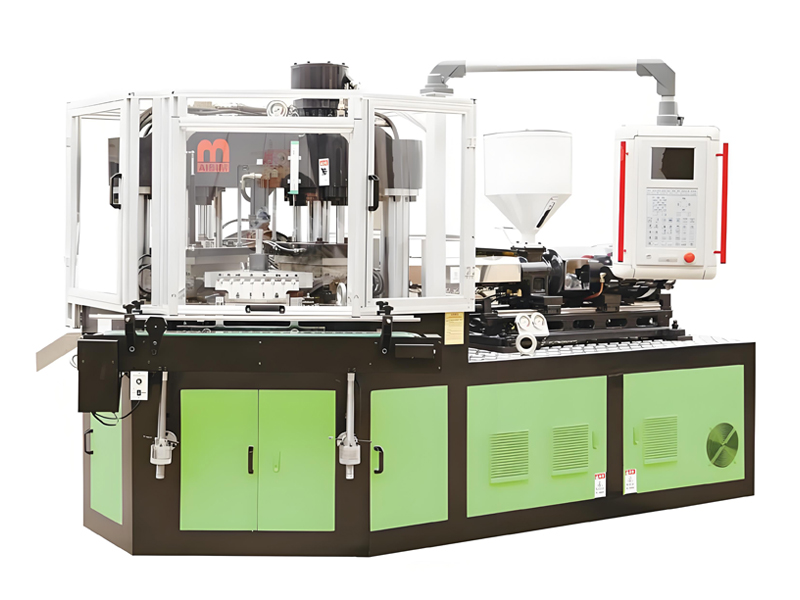
When the technical discussion reaches the question of which machine to run, Aibim offers a focused IBM lineup built for precision hollow parts including wide mouth jars. Two representative models are described below with specification tables that include the two numbers that matter most for this application: maximum bottle mouth diameter and maximum bottle volume.
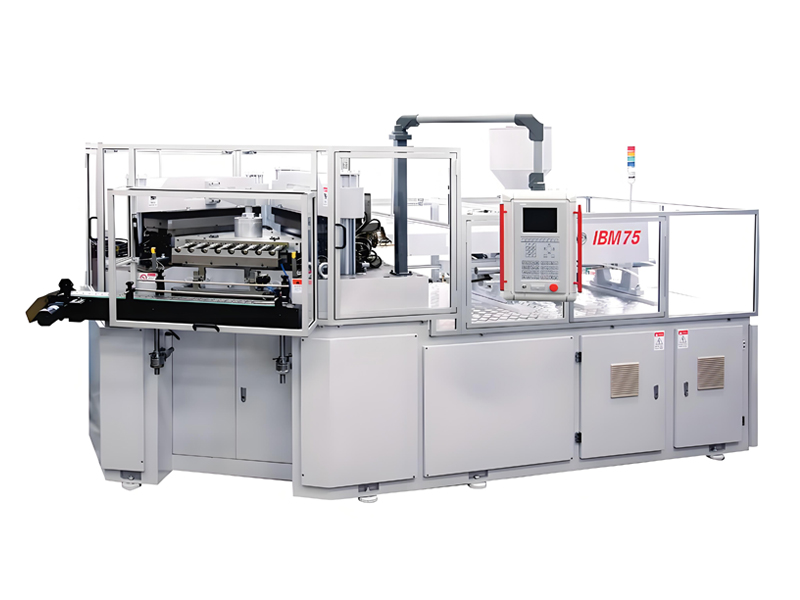
Aibim IBM75 Enjeksiyon Üfleme Kalıplama Makinesi
The IBM75 is the largest standard Aibim model and the natural choice for wide mouth jars up to 1000 mL and openings up to 120 mm. Its single-crossbeam, double-pole clamping framework enlarges the mold setting space, which is exactly what a wide mouth mold needs because the body footprint is large. The machine uses Aibim PREFILL technology with a variable displacement pump that cuts energy use by at least 35 percent compared with a conventional fixed-pump hydraulic unit.
| Specification | IBM75 value |
|---|---|
| Clamping force | 75 tf (750 kN) |
| Enjeksiyon capacity (shot) | 600 cm3 |
| Screw diameter | 45 mm |
| L/D ratio | 20:1 |
| Maximum cavities | Up to 8 for small parts; 2 to 4 for wide mouth jars |
| Maximum bottle mouth diameter | 120 mm |
| Maximum bottle volume | 1000 mL |
| Platen size | 520 x 520 mm |
| Installed power | 30 kW |
| Kuru döngü süresi | 4.5 s |
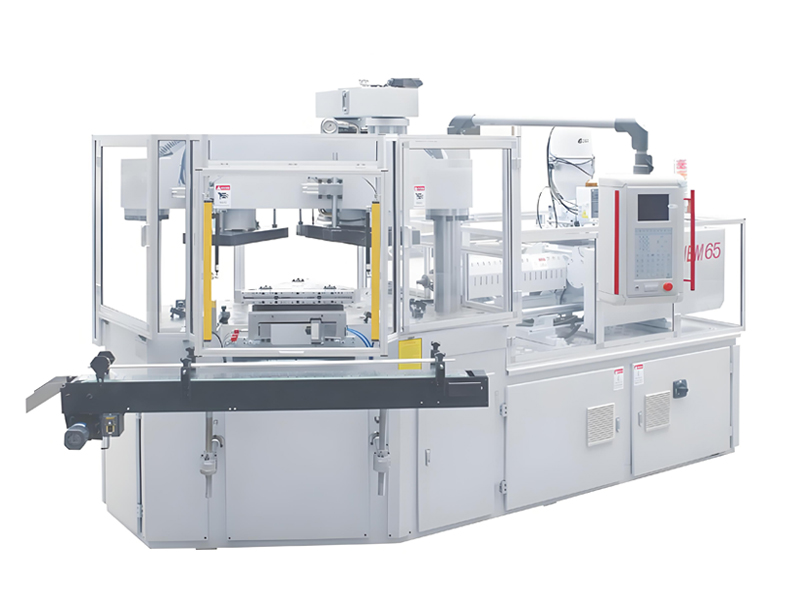
Aibim IBM65 Enjeksiyon Üfleme Kalıplama Makinesi
The IBM65 sits one step below the IBM75 and covers wide mouth jars up to 750 mL and openings up to 100 mm. It is the workhorse for food, cosmetic and pharmaceutical jars in the mid-volume band, with the same three-station one-step process and the same neck precision. Cavity count for a wide mouth jar is limited by platen space, so a 250 mL jar at 70 mm mouth can run four to six cavities while a 750 mL jar at 100 mm mouth runs two.
| Specification | IBM65 value |
|---|---|
| Clamping force | 65 tf (650 kN) |
| Enjeksiyon capacity (shot) | 450 cm3 |
| Screw diameter | 40 mm |
| L/D ratio | 20:1 |
| Maximum cavities | Up to 6 for small parts; 2 to 3 for wide mouth jars |
| Maximum bottle mouth diameter | 100 mm |
| Maximum bottle volume | 750 mL |
| Platen size | 460 x 460 mm |
| Installed power | 25 kW |
| Kuru döngü süresi | 4.0 s |
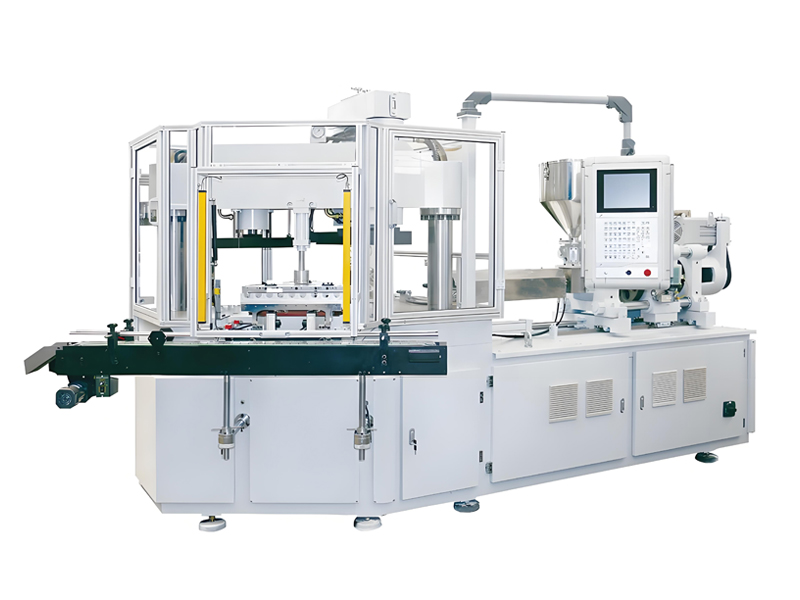
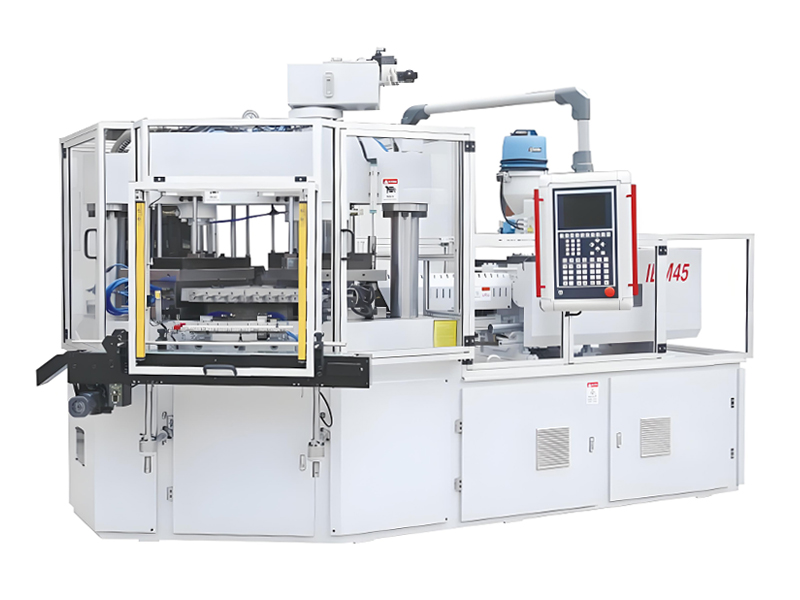
Aibim also offers the IBM55 Hybrid Electric model for smaller wide mouth jars up to 500 mL and openings up to 80 mm, where the electric clamp and servo plasticizing give the tightest energy and repeatability numbers for cleanroom and pharmaceutical use. All three models share the Aibim advantages: CE-certified safety with a stripper station laser sensor and light curtain, SD-card recipe storage that moves a proven setting from one machine to another, and the Wanplas group backing for service and spare parts.
Uygulama Sektörleri ve Tipik Şartnameler
IBM tarafından üretilen geniş ağızlı kavanozlar, açıklığın, sızdırmazlığın ve berraklığın hepsinin önemli olduğu endüstrilere hizmet eder. Aşağıdaki kombinasyonlar tipiktir, kapsamlı değildir ve her biri somut bir makine ve kalıp konfigürasyonu olarak teklif edilebilir.
Gıda. 63 ila 100 mm ağız açıklığına ve 250 ila 500 mL hacme sahip PP reçineden reçel ve bal kavanozları; 70 ila 89 mm ve 400 ila 750 mL PP fındık ve atıştırmalık kavanozları; 53 ila 63 mm ve 100 ila 250 mL PP rastgele kopolimer bebek gıdası kavanozları; 63 ila 89 mm ve 200 ila 500 mL PP veya ISBM ile şeffaf PETG şekerleme kavanozları.
Sağlık ve takviye. PP'den 53 ila 89 mm ve 200 ila 750 mL vitamin ve protein kavanozları; genellikle alüminyum folyo sızdırmazlık yüzeyi ve kurcalanmaya karşı korumalı kapakla.
Farmasötik. Boyun hassasiyetinin çocuklara karşı güvenli bir kapak ve nem emici tertibatı desteklediği HDPE veya PP'den 38 ila 63 mm ve 60 ila 300 mL tablet ve toz şişeleri.
Kozmetik. SAN veya PP'den 45 ila 70 mm ve 30 ila 200 mL krem kavanozları; PP'den 63 ila 89 mm ve 200 ila 500 mL vücut yağı ve losyon kavanozları; PP veya PETG'den 70 ila 100 mm ve 250 ila 500 mL maske kavanozları.
Günlük kimyasal. PP'den 70 ila 100 mm ve 400 ila 1000 mL çamaşır boncuk ve pod kavanozları; çocuklara karşı güvenli geniş kapak ve nem bariyeriyle tasarlanmıştır.
Evcil hayvan maması. PP'den 89 ila 100 mm ve 500 ila 1000 mL ıslak ve kuru evcil hayvan maması kavanozları; geniş ağız kepçelemeyi kolaylaştırır ve boyun hassasiyeti kapağı sızdırmaz tutar.
İşgücüatuvar ve numune. Berraklık ve kimyasal direncin her ikisinin de gerektiği PP, PS veya PCTG'den 38 ila 63 mm ve 30 ila 250 mL numune ve reaktif kavanozları.
İhtiyaçtan Modele Seçim Rehberi
Aşağıdaki tablo, bir müşteri gereksinimini önerilen bir Aibim modeline ve göz konfigürasyonuna eşler. Göz sayıları geniş ağızlı kalıplar için verilmiştir ve daha önce açıklanan plaka sınırlı yerleşimi varsayar; nihai göz sayısı kalıp tasarım aşamasında doğrulanır.
| Mouth diameter | Volume | Material | Annual output | Recommended model | Cavities | Key configuration |
|---|---|---|---|---|---|---|
| 38 – 45 mm | 30 – 150 mL | PP / PS | Low to medium | IBM55 Hybrid | 4 | Electric clamp, cleanroom option |
| 53 – 63 mm | 100 – 300 mL | PP / HDPE | Medium | IBM65 | 4 | Independent neck cooling |
| 63 – 70 mm | 200 – 500 mL | PP / PETG | Medium to high | IBM65 or IBM75 | 3 – 4 | Stepped core rod, stripper plate |
| 70 – 89 mm | 400 – 750 mL | PP | Medium to high | IBM75 | 2 – 3 | Dense cooling, servo turret |
| 89 – 100 mm | 500 – 1000 mL | PP | Medium | IBM75 | 2 | 120 mm max mouth, reinforced core rod |
| Up to 100 mm | 250 – 500 mL | PET / PETG (ISBM) | High | Wanplas ISBM line | Per project | Oriented clarity, barrier |
For projects that need an oriented PET or PETG wide mouth jar with maximum clarity and barrier, the Wanplas group supplies the matching ISBM line so the customer stays with one supplier and one service organization. For any configuration outside the table, Aibim engineers size the machine from the part drawing, the annual volume and the material data sheet rather than from a generic rule.
Servis, Destek ve Nasıl Başlanır
Geniş ağızlı kavanoz hattı satın almak, tek seferlik bir işlem değil, bir üretim ilişkisinin başlangıcıdır. Aibim, bir Wanplas fabrikası olarak her makineyi grubun ortak hizmet vaatleriyle destekler.
Sevkiyat öncesi fabrika testi. Her makine, mümkünse müşterinin kalıbıyla fabrika zemininde bir süreklilik ve performans testi çalıştırır; böylece hat Zhangjiagang'dan ayrılmadan önce kanıtlanır. Test, çevrim süresini, göz dengesini ve ilk parça boyutlarını kaydeder.
Kalıp denemesi ve ilk ürün muayenesi. Kalıp, gerçek makinede denenir ve çizime göre boyun çapı, ovalite, sızdırmazlık yüzeyi düzlüğü, et dağılımı ve düşme performansını kapsayan bir ilk ürün muayene raporu düzenlenir. Rapor imzalanana kadar parça serbest bırakılmaz.
Kurulum ve devreye alma. Mühendisler yerinde kurulum ve devreye almayı destekler, kanıtlanmış reçeteyi tesisin SD kartına aktarır ve yerel ekibi hattı çalıştırma, temizleme ve bakımını yapma konusunda eğitir.
Yedek parça politikası. Wanplas grubu, kapsanan makineler için her yıl 500 USD değerinde ücretsiz parça sağlar ve garanti içindeki hasarlı parçalar ücretsiz olarak değiştirilir. Bu, büyük bir bağlı envanter olmadan geniş ağızlı kavanoz hattının çalışmasını sağlar.
Eğitim ve uzaktan çalıştırma. Operatörler ve bakım personeli sahada eğitilir ve makine uzaktan izlemeyi destekler; böylece Aibim mühendisleri PLC verilerini okuyabilir ve bir saha ziyareti beklemeden anormal koşullara yanıt verebilir.
Açık fabrika. Müşteriler, üretimi denetlemek, deneme çalışmasını izlemek ve makine parçalarını üreten CNC merkezini incelemek için Aibim fabrikasını ziyaret edebilir.
If you are planning a wide mouth jar program, send your part drawing, target volume, material and annual output to Aibim. The engineering team will propose a machine model, a cavity layout and a process window, and invite you to the factory for a mold trial and a line audit before you commit. There is no substitute for seeing your jar come off the machine with the neck in tolerance and the seal flat.
Sıkça Sorulan Sorular
Hangi boyun-gövde çapı oranı geniş ağızlı bir kavanozu tanımlar?
Geniş ağızlı bir kavanoz, 0.5'in üzerinde, tipik olarak 0.55 ila 0.85 arasında bir boyun-gövde çap oranına sahiptir. Dar boyunlu şişeler 0.35'in altındadır. Oran ne kadar büyükse, açıklık tam gövde çapına o kadar yakındır; bu da şişirme mekaniğini değiştirir ve duvar dağılımını kontrol etmeyi zorlaştırır.
Geniş ağızlı kavanozlar için enjeksiyon şişirme kalıplama neden ekstrüzyon şişirme kalıplamaya tercih edilir?
IBM produces the neck finish by injection in a precision neck ring, so the opening is held to roughly plus or minus 0.05 mm with no flash and no post trim. For a wide mouth jar the opening is the critical sealing and filling surface, and IBM holds that surface to the tightest tolerance of the three processes.
Gıda temaslı geniş ağızlı kavanoz için hangi malzeme en iyisidir?
For most food jars such as jam, honey, nuts and confectionery, polypropylene in homo-polymer or random co-polymer grade is the first choice because of its heat resistance, chemical inertness and food contact compliance. Transparent display jars use PS, SAN or PETG, while HDPE serves pharmaceutical powder and tablet jars.
Tek bir IBM makinesinde geniş ağızlı kavanoz kalıbı kaç gözlü çalışabilir?
Cavity count is limited by platen area because a wide mouth jar occupies far more mold space than a narrow neck bottle of equal volume. On an Aibim IBM75 a 1000 mL jar up to 120 mm mouth may run two cavities, while a 250 mL jar at 70 mm mouth can run four to six cavities. Larger cavitation is possible only on smaller diameter parts.
Geniş ağızlı bir kavanoz boynunun ovalleşmesine veya deformasyonuna ne neden olur?
Ovalite, ince boyun duvarlarından, boyun halkasının yetersiz soğutulmasından ve polimer hâlâ yumuşakken kalıptan çıkarmadan kaynaklanır. Karşı önlemler, boyun halkasında bağımsız bir soğutma devresi, PP için kalıptan çıkarma sıcaklığını 70 santigrat derecenin altında tutmak ve boyun duvar kalınlığına 0,2 ila 0,5 mm eklemektir.
Geniş ağızlı kavanoz için en iyi şişirme oranı nedir?
Şişirme oranını 2,0 ila 3,5 aralığında tutun. Bunun üzerinde parison eşit şekilde gerilemez; omuz ve taban incelirken gövde kalın kalır. Kademeli bir çekirdek çubuk profili ve 1,5 ila 4,5 mm enjeksiyon duvar gradyanı, oranı güvenli pencerenin içinde tutmanıza olanak tanır.
Geniş ağızlı bir kavanozun kalite şartnamesini karşıladığını nasıl doğrularım?
Measure capacity at plus or minus 2 percent, neck inside diameter and ovality, seal face flatness at or below 0.15 mm, wall thickness at no fewer than eight points, top load in newtons, a 1.2 m full drop test, and seal retention under vacuum or pressure. Transparent jars also need light transmittance and haze checks.