- 1. อะไรที่ทำให้โหลเป็น “ปากกว้าง” และเหตุใดจึงขึ้นรูปได้ยาก
- 2. IBM เทียบกับ ISBM เทียบกับ EBM สำหรับขวดโหลปากกว้าง
- 3. ความท้าทายหลักหกประการและแนวทางแก้ไข
- 4. การเลือกวัสดุสำหรับขวดโหลปากกว้าง
- 5. หลักการออกแบบแม่พิมพ์สำหรับเครื่อง IBM ปากกว้าง
- 6. การตรวจสอบคุณภาพและเกณฑ์การยอมรับ
- 7. เครื่องจักร Aibim สำหรับการผลิตโหลปากกว้าง
- 8. อุตสาหกรรมที่นำไปใช้และข้อกำหนดทั่วไป
- 9. คู่มือการเลือกเครื่องรุ่นตามความต้องการ
- 10. การบริการ การสนับสนุน และวิธีเริ่มต้น
- 11. คำถามที่พบบ่อย
อะไรที่ทำให้โหลเป็น “ปากกว้าง” และเหตุใดจึงขึ้นรูปได้ยาก
A wide mouth jar is defined by geometry, not by marketing language. In blow molding the controlling dimension is the neck-to-body diameter ratio, which is the finished neck opening diameter divided by the maximum body diameter of the container. A wide mouth jar carries a neck-to-body diameter ratio above 0.5, with the typical production window sitting between 0.55 and 0.85. By contrast a narrow neck bottle stays below 0.35, and many pharmaceutical dropper and beverage bottles sit well under 0.25. The moment the ratio climbs past 0.5 the part stops behaving like a bottle and starts behaving like a small open container, and that single change rewrites the way the parison must be formed, blown and ejected.
Wide mouth jars are produced across a broad range of opening sizes and volumes. The most common neck or finish diameters are 38 mm, 45 mm, 53 mm, 63 mm, 70 mm, 89 mm and 100 mm. Matching volumes usually run from 30 mL for sample and lab jars up to 1000 mL for food, confectionery and pet food containers. A 100 mm opening on a 1000 mL jar is at the upper edge of practical injection blow molding, while a 38 mm opening on a 120 mL jar is at the easy end of the range. The table below places these sizes on a single reference grid so the geometry is unambiguous before we discuss process behavior.
| Opening diameter (mm) | Typical volume range (mL) | Neck-to-body ratio | Common use |
|---|---|---|---|
| 38 | 30 – 250 | 0.55 – 0.70 | Sample jars, cosmetic cream cups, vitamin packs |
| 45 | 50 – 300 | 0.55 – 0.72 | Personal care, single-dose food |
| 53 | 100 – 400 | 0.58 – 0.75 | เครื่องสำอาง, pharmacy powder |
| 63 | 150 – 500 | 0.60 – 0.78 | Honey, sauce, supplement jars |
| 70 | 200 – 750 | 0.62 – 0.80 | Jam, nuts, body butter |
| 89 | 400 – 900 | 0.70 – 0.83 | Pet food, confectionery, lab storage |
| 100 | 500 – 1000 | 0.75 – 0.85 | Large food, protein, industrial samples |
เหตุผลที่ขวดโหลปากกว้างขึ้นรูปยากกว่าขวดคอแคบไม่ใช่ความผิดเดียวแต่เป็นกลไกและสาเหตุกระบวนการที่เชื่อมโยงกันสี่ประการ การเข้าใจสาเหตุทั้งสี่นี้เป็นรากฐานของทุกโซลูชันที่กล่าวถึงในภายหลังในบทความนี้
First cause: the blow-up ratio is locked down. In blow molding the blow-up ratio is the body diameter divided by the parison diameter at the point being blown. A narrow neck bottle is injected as a slim parison and blown outward many times, so the polymer stretches dramatically and fills the cavity. A wide mouth jar already starts with a parison that is nearly as wide as the final body, because the neck finish itself is wide. The available blow-up ratio collapses to roughly 2.0 to 3.5, sometimes less. With little stretch left, the polymer cannot redistribute itself to even out wall thickness, so the base and shoulder tend to stay thin while the body stays thick. This is the root of most wall balance complaints on wide mouth parts.
Second cause: the parison distribution is difficult to make uniform. Because the part is short and squat, the parison travels a short distance from the injection cavity to the blow cavity, but the cross-section changes are abrupt. The neck region must stay stiff and dimensionally exact, the shoulder must accept rapid expansion, and the base must fill without webbing. A uniform tubular parison that works for a tall bottle does not map onto a wide mouth jar, so the parison wall must be deliberately profiled along its length.
Third cause: the demolding path is obstructed. A narrow neck bottle is stripped off the core rod through a small opening, so the draft is gentle and the undercut risk is low. A wide mouth jar has a large opening and large side walls with threads or knurls, so the stripping travel is long and the friction against the core rod and cavity is high. The part wants to stick, gall, or stretch during ejection, and a single bad release can scar the sealing land.
Fourth cause: the neck lacks rigidity and deforms easily. The wide neck is both the largest opening and the most functionally critical surface. It carries the threads or snap feature, the sealing plane, and the torque load of the closure. Because the neck wall is necessarily thin relative to its diameter, it cools slowly and, if ejected while soft, relaxes into ovality or sink. A warped neck leaks, a low-torque neck cross-threads, and an out-of-round neck fails automated capping.
ขวดปากกว้างยากไม่ใช่เพราะขั้นตอนใดขั้นตอนหนึ่งล้มเหลว แต่เพราะอัตราส่วนการเป่าขยาย โปรไฟล์พาริซอน เส้นทางการปลด และความแข็งของคอทั้งหมดดันกันในเวลาเดียวกัน การฉีดขึ้นรูปเป่าเป็นกระบวนการที่ให้การควบคุมมากที่สุดเหนือทั้งสี่อย่างในเวลาเดียวกัน
Aibim is a Wanplas factory with more than twelve years of experience building injection blow molding machines and molds, exporting to over forty countries, with its own CNC machining center and an annual capacity above one hundred lines per year. The wide mouth jar is one of the most demanding parts that an IBM line is asked to make, and the rest of this guide explains how to design the process, the mold and the material so the part consistently passes spec.
IBM เทียบกับ ISBM เทียบกับ EBM สำหรับขวดโหลปากกว้าง
Three blow molding routes can technically produce a wide mouth jar: injection blow molding (IBM), injection stretch blow molding (ISBM), and extrusion blow molding (EBM). They differ most at the neck finish, where the wide mouth jar lives or dies. The comparison below is a process-to-process benchmark, not a brand comparison, and it shows why IBM dominates precision wide mouth production.
| Attribute | การฉีด การเป่าขึ้นรูป (IBM) | การฉีด Stretch การเป่าขึ้นรูป (ISBM) | Extrusion การเป่าขึ้นรูป (EBM) |
|---|---|---|---|
| Neck finish precision | Plus or minus 0.05 mm, no flash, no trim | Plus or minus 0.10 mm, no flash | Plus or minus 0.30 mm, flash requires trim |
| Minimum practical neck-to-body ratio | 0.50 and up (best for wide mouth) | 0.45 and up | 0.30 and up (best for very wide, low-precision) |
| Wall thickness uniformity | Good, controllable by parison profile | Excellent, biaxial orientation | Fair, parison programming needed |
| Material adaptability | PE, PP, PS, SAN, PC, PCTG, TPU | PET, PETG, PEN, some PP | PE, PP, PVC, PC, TPU |
| Scrap rate | Low, below 5 percent | Low, below 5 percent | Medium, flash and trim 15 to 25 percent |
| Cycle time | Medium | Medium | Medium |
| Mold complexity | Medium | Medium to High | Low |
| Cost level | Medium | Medium to High | Low |
The decisive column for a wide mouth jar is neck finish precision. The neck is the opening through which the product is filled and the closure is applied, and on a wide mouth jar that opening can be 100 mm across. IBM forms the neck by injecting molten polymer into a precision neck ring, so the threads, the sealing land and the inside diameter are fixed by steel, not by a cut parison. That yields a finish held to roughly plus or minus 0.05 mm with no flash and no secondary trimming operation. ISBM is excellent for oriented PET and gives the best wall distribution, but its neck precision and its material set (driven by PET and PETG) make it a second choice for PP and PS food jars. EBM is the cheapest route and handles very large openings, but the flash line and the plus or minus 0.30 mm neck tolerance force a trimming step and a looser closure fit, which is unacceptable for many food, pharmaceutical and cosmetic jars.
จากมุมมองของกลุ่ม Wanplas เมื่อโครงการต้องการสายปลายน้ำที่เข้ากัน เช่น การเติมหรือกระบวนการอัดรีดเสริม ความสามารถเหล่านั้นถูกจัดหาภายใต้ชื่อ Wanplas เพื่อให้ลูกค้าได้ผู้จัดหาที่รับผิดชอบหนึ่งรายแทนผู้ขายหลายรายที่ไม่เชื่อมโยงกัน
เลือก IBM เมื่อขวดปากกว้างต้องซีล เกลียว และปิดฝาด้วยความผันแปรใกล้ศูนย์และไม่ต้องตัดแต่งหลังการผลิต เลือก ISBM สำหรับขวดปากกว้าง PET แบบยืดด้วยความใสสูงสุดและความทนทานต่อการตก เลือก EBM เฉพาะเมื่อช่องเปิดใหญ่มากและความคลาดเคลื่อนของฝาปิดหลวม
ความท้าทายหลักหกประการและแนวทางแก้ไข
ความท้าทายหกประการต่อไปนี้เป็นสิ่งที่พบได้บ่อยที่สุดในโปรแกรมขวดปากกว้าง แต่ละข้อเขียนเป็นวงรอบ: ปรากฏการณ์ กลไก มาตรการรับมือด้านพารามิเตอร์หรือโครงสร้าง และวิธีการตรวจสอบ ใช้โครงสร้างนี้บนพื้นที่โรงงานเพื่อวินิจฉัยชิ้นส่วนที่ล้มเหลวแทนการเดา
ความท้าทายที่ 1: ขีดจำกัดอัตราส่วนการเป่าทำให้ผนังฐานและไหล่ไม่สมดุล
ปรากฏการณ์ ผนังลำตัววัดได้ภายในค่าความคลาดเคลื่อนแต่ฐานบางพอที่จะทะลุในการทดสอบการตก และไหล่แสดงการบางเฉพาะจุดใกล้รอยต่อกับคอ ชิ้นส่วนดูดีจนกระทั่งล้มเหลวในการทดสอบการตก 1.2 ม. หรือการทดสอบแรงกดด้านบน
Mechanism. The wide mouth geometry leaves only a 2.0 to 3.5 blow-up ratio. With little radial stretch available, the polymer cannot flow from the body into the base and shoulder during blowing. Where the parison was already thin, it stays thin; where it was thick, it stays thick. The classic symptom is a thick cylindrical body and a starved base.
Parameter and structure countermeasure. Profile the parison deliberately with a stepped core rod so the wall thickness tapers from the neck down to the base. A practical injection wall gradient runs from 1.5 mm at the neck region to 4.5 mm toward the base, putting more material where the blow-up ratio is lowest. Keep the blow-up ratio inside the 2.0 to 3.5 window by sizing the core rod diameter correctly, and apply a staged pre-blow: a low first pressure to seat the parison against the cavity, then a higher second pressure to complete the form. Avoid trying to compensate by raising blow pressure alone, which only bursts weak zones.
Verification method. Cut the jar at eight or more points (neck, shoulder, upper body, mid body, lower body, base radius, base center, side wall) and measure wall thickness. Confirm the thinnest point is above the drop-test minimum and that the ratio between the thickest and thinnest wall is inside the agreed spec. Re-run the drop test at 1.2 m full before releasing the setting.
ความท้าทายที่ 2: การเสียรูปของคอขวดและความรี
ปรากฏการณ์ ช่องเปิดคอขวดวัดความเบี้ยวเกินกว่าที่แบบอนุญาต หรือแสดงรอยยุบที่มองเห็นได้บนขอบซีล ฝาไขเกลียวผิดหรือรั่วในการทดสอบแรงบิด
Mechanism. The wide neck wall is thin relative to its diameter and has a large surface area, so it cools more slowly than the body. If the part is stripped while the neck polymer is still soft, the land relaxes under its own weight and the clamping load, producing ovality and sink. Low crystallinity control in PP makes the effect worse because the amorphous skin is soft at higher temperatures.
Parameter and structure countermeasure. Give the neck ring its own independent cooling circuit so the neck can be brought to temperature faster than the body. Control neck crystallinity by holding the neck ring temperature in the correct band for the grade. Keep the demold temperature below 70 degrees C for polypropylene. Extend the residence time on the turret at the blow or cooling station so the neck sets before transfer. Add 0.2 to 0.5 mm to the neck wall thickness compared with a narrow neck design to raise its stiffness without changing the opening.
Verification method. Measure neck inside diameter at two perpendicular axes with a bore gauge and compute ovality as the difference. Run a torque test with the production closure at the specified application torque and confirm no cross-thread and no leak under the seal test. Check the sealing land with a flatness indicator referenced to the datum plane.
ความท้าทายที่ 3: การถอดชิ้นงานยากและรอยขีดข่วนบนพื้นผิว
ปรากฏการณ์ ขวดแสดงรอยขีดแนวตั้งบนตัวหรือคอขวด หรือติดบนแกนคอร์และหุ่นยนต์นำออกพลาดชิ้นส่วน ความเสถียรของวงจรลดลงและของเสียเพิ่มขึ้น
Mechanism. A wide mouth jar has a large internal surface dragged along the core rod during stripping, and the threads or knurls add local undercut. The release travel is long, so friction is high and any sticking point galls the surface. A 0.5 degree draft angle that works on a bottle is insufficient here.
Parameter and structure countermeasure. Increase the draft angle to 1 to 2 degrees, roughly double the bottle norm. Use a stripper air pulse with a timed sequence so a short burst of compressed air breaks the vacuum seal at the start of ejection. Add a mechanical stripper plate that pushes the jar uniformly off the core rod instead of relying on air alone. Polish the cavity and core rod to a surface finish of Ra 0.2 micrometer or better so the polymer does not grip. Use a release agent only when absolutely necessary and only in a controlled, documented dose, because excess agent blooms to the surface and spoils printing or labeling.
วิธีการตรวจสอบ วิ่งรอบต่อเนื่องเป็นบล็อกและนับเหตุการณ์การติดหรือการขีดข่วน ตรวจสอบผนังภายในภายใต้แสงเฉียงเพื่อหารอยขีด ตรวจสอบว่าหุ่นยนต์นำชิ้นส่วนหยิบทุกชิ้นส่วนทั่วทั้งบล็อกโดยไม่พลาดจังหวะ
ความท้าทายที่ 4: การบางของไหล่และมุมพร้อมการแตกเมื่อตกกระแทก
ปรากฏการณ์ ขวดผ่านการตรวจสอบเบื้องต้นแต่แตกที่บ่าไหล่หรือมุมภายในระหว่างการเติม การซ้อน หรือการขนส่ง ต้นกำเนิดความล้มเหลวคือมุมที่บางและรับความเค้นสูง
กลไก มุมภายในที่แหลมรวมความเค้น และไหล่บางไม่สามารถดูดซับพลังงานกระแทก หากแกนเย็นเกินไปพาริซอนจะแข็งก่อนที่จะเข้ารูป หากร้อนเกินไปพาริซอนจะย้อย เกรดที่ผิดให้ความแข็งแรงกระแทกต่ำที่อุณหภูมิการใช้งาน
Parameter and structure countermeasure. Run the core rod with zoned temperature control, typically 60 to 110 degrees C, so the parison stays formable long enough to fill the corners. Specify corner radii of R 2 mm or larger at every internal transition so stress does not concentrate. Choose a material with enough low-temperature impact, for example a polypropylene random co-polymer for improved toughness. Where the application allows, apply a short anneal step after molding to relax residual stress in the shoulder and corners.
วิธีการตรวจสอบ ตัดส่วนไหล่และมุมและยืนยันว่ารัศมีตรงตามแบบวาด ทดสอบการตกที่ 1.2 ม. โดยเติมโหลถึงปริมาตรที่กำหนด ในแต่ละทิศทางการกระแทกที่กำหนด และทำซ้ำหลังวงจรการปรับสภาพเย็นหากตลาดต้องการประสิทธิภาพอุณหภูมิต่ำ
ความท้าทายที่ 5: เวลารอบยาวและผลผลิตต่ำ
ปรากฏการณ์ วงจรต่อช่องแม่พิมพ์ยาวกว่าเป้าหมายเชิงพาณิชย์ ดังนั้นผลผลิตต่อปีจึงต่ำกว่าแผนธุรกิจแม้ใช้ช่องแม่พิมพ์เต็มจำนวน
กลไก ขวดปากกว้างใช้พื้นที่เพลเทนต่อช่องมากกว่าขวดที่มีปริมาตรเดียวกัน ดังนั้นจำนวนช่องถูกจำกัดโดยเพลเทน ไม่ใช่ขนาดช็อต การทำความเย็นช้าเพราะคอและฐานหนากักเก็บความร้อน และป้อมปืนใช้เวลาว่างเคลื่อนที่ระหว่างสถานี
Parameter and structure countermeasure. Select a multi-cavity configuration that fits the platen, accepting that wide mouth jars rarely reach the cavitation of narrow neck programs. Drop the cooling water temperature to 8 to 15 degrees C and densify the water channels so heat leaves the mold faster. Use a servo-driven turret to shorten the non-productive transfer time between stations. Optimize the dry cycle by tightening the clamp open, transfer and close sequence without sacrificing safety.
| Cycle phase | Typical time (s) | Optimization lever |
|---|---|---|
| การฉีด and parison hold | 1.4 – 2.2 | Balance pack pressure, avoid over-pack |
| Transfer to blow station | 0.4 – 0.7 | Servo turret, shorten dead stroke |
| Blow and cooling | 2.0 – 4.0 | Water at 8 to 15 C, denser channels |
| Transfer to eject station | 0.4 – 0.7 | Servo turret timing |
| Demold and reset | 0.8 – 1.4 | Stripper plate, stripper air timing |
| Dry cycle total | 3.8 – 5.0 | Machine dependent |
วิธีการตรวจสอบ จับเวลารอบการขึ้นรูปจริงในช่วงการผลิตที่เสถียรและเปรียบเทียบแต่ละเฟสกับตารางด้านบน ยืนยันว่าเฟสการระบายความร้อนไม่ใช่เฟสการถ่ายโอนเป็นคอขวด หากการถ่ายโอนครอบงำ กำไรจะมาจากแท่นหมุนเซอร์โวมากกว่าน้ำที่เย็นกว่า
ความท้าทายที่ 6: ความเรียบของผิวซีลและการเข้ากันของฝาปิด
ปรากฏการณ์ ขวดผ่านการทดสอบการรั่วแบบสถิตแต่รั่วหลังการหมุนเวียนความร้อน การซ้อน หรือการขนส่ง หรือฝาปิดใช้แรงบิดไม่สม่ำเสมอรอบขอบปาก
Mechanism. A wide mouth jar has a large sealing face, so a small absolute warp becomes a large leak path. Warp comes from uneven cooling across the wide land, from residual stress, and from a neck that was not fully set at demold. A mismatch between the thread form and the closure compounds the problem.
Parameter and structure countermeasure. Hold the seal face flatness to 0.15 mm or better by balancing the neck ring cooling and by gating the parison so the land fills symmetrically. Select the thread form to match the closure family: the 400, 415 and 425 series are the common continuous-thread finishes, and the choice sets the wall and torque behavior. For products needing a secondary barrier, design the land to accept an inner plug or an aluminum foil seal without distorting the plane. Validate the closure torque against the chosen finish so the cap seats uniformly.
วิธีการตรวจสอบ วัดความเรียบของพื้นผิวซีลด้วยไดอัลอินดิเคเตอร์บนฐานหินแกรนิต ทำการทดสอบการคงสุญญากาศหรือแรงดันบนขวดที่เติมและปิดฝาแล้ว จากนั้นทำซ้ำหลังวงจรความร้อน ยืนยันว่าแรงบิดการใช้งานอยู่ในช่วงที่ตกลงกันในทุกหน่วยที่สุ่มตัวอย่าง
การเลือกวัสดุสำหรับขวดโหลปากกว้าง
Material choice sets the ceiling on clarity, impact, temperature resistance and food contact compliance. The table below lists the materials that run on IBM and ISBM wide mouth programs with their processing window and compliance reference. Compliance names are given as plain text for verification against the official regulation text.
| Material | Melt temp (C) | Mold temp (C) | Demold temp (C) | Shrinkage (%) | Impact grade | Transparency | อาหาร contact compliance |
|---|---|---|---|---|---|---|---|
| PP homo-polymer | 210 – 250 | 20 – 60 | < 70 | 1.5 – 2.0 | Medium | Opaque | FDA 21 CFR 177, EU 10/2011 |
| PP random co-polymer | 200 – 240 | 20 – 60 | < 70 | 1.4 – 1.9 | High | Opaque, slight clarity | FDA 21 CFR 177, EU 10/2011 |
| HDPE | 200 – 240 | 15 – 50 | < 65 | 1.5 – 2.5 | Medium-High | Opaque | FDA 21 CFR 177, EU 10/2011 |
| PS | 190 – 230 | 20 – 50 | < 60 | 0.4 – 0.7 | Low | High | FDA 21 CFR 177, EU 10/2011 |
| SAN | 220 – 260 | 50 – 80 | < 70 | 0.4 – 0.7 | Medium | High | FDA 21 CFR 177, EU 10/2011 |
| PET (ISBM) | 270 – 290 | 90 – 120 | < 90 | 0.2 – 0.5 | High | Very high | FDA 21 CFR 177, EU 10/2011 |
| PETG | 230 – 260 | 20 – 40 | < 65 | 0.3 – 0.6 | High | Very high | FDA 21 CFR 177, EU 10/2011 |
| PCTG | 240 – 270 | 30 – 60 | < 70 | 0.4 – 0.7 | Very high | Very high | FDA 21 CFR 177, EU 10/2011 |
| PC | 280 – 320 | 80 – 120 | < 100 | 0.5 – 0.7 | Very high | High | Check BPA compliance for baby-related items |
โพลีโพรพิลีน in homo-polymer or random co-polymer grade is the default for food jars such as jam, honey, nuts and confectionery because it resists heat, chemicals and grease while meeting food contact rules. The random co-polymer adds low-temperature impact, which helps jars that are filled hot or stored cold. HDPE serves pharmaceutical powder and tablet jars where squeezability and chemical resistance matter more than clarity. PS และ SAN give transparent display jars for cosmetics and hardware, though their impact is lower so the wall must be tuned for drop performance. PET and PETG through ISBM produce the clearest wide mouth jars with the best barrier, but they need the higher stretch ratios and the hotter mold that ISBM provides. PCTG and PC deliver top impact and clarity for demanding items; for any baby-related product the PC grade must be verified for BPA compliance before use.
หลักการออกแบบแม่พิมพ์สำหรับเครื่อง IBM ปากกว้าง
แม่พิมพ์คือจุดที่สาเหตุความยากสี่ประการถูกแก้ไขด้วยเหล็ก แม่พิมพ์ปากกว้าง IBM แตกต่างจากแม่พิมพ์ขวดในสามด้านโครงสร้าง: การจัดวางป้อมหมุน โครงสร้างแหวนคอ และความแข็งของแกนคอร์
Three-station and four-station turret layout. Aibim IBM machines use a three-station one-step process: injection, blow and ejection on a rotating turret. Some programs add a fourth station for extra cooling or in-mold labeling. A wide mouth mold occupies more platen area per cavity than a bottle mold, so the turret pitch and the platen size set the maximum cavity count directly. Plan the cavitation from the platen drawing, not from the shot size, because the wide body almost always runs out of platen before it runs out of polymer.
Neck ring split design and flash control. Because IBM injects the neck, the neck ring is a split steel insert that defines the finish. For a wide mouth jar the neck ring is large and must part cleanly without a flash line on the sealing land. Design the parting line away from the seal face, and hold the neck ring as a replaceable insert so wear does not force a full mold rebuild. Flash on the land is the fastest way to fail a closure leak test, so the neck ring fit is cut tighter than on a bottle mold.
Core rod length-to-diameter ratio and rigidity. The core rod forms the internal shape and carries the parison between stations. A wide mouth jar needs a large-diameter core rod, and a large-diameter rod is more prone to deflection than a slim bottle rod. Keep the rod aspect ratio conservative, support it at both ends where the machine allows, and specify a stiff, dimensionally stable grade so the inside diameter stays round across the run. A deflecting rod produces an out-of-round inside wall that no blow setting can fix.
Water channel layout and uniform temperature. Wide mouth jars need the neck cooled faster than the body, so the neck ring gets its own circuit while the body cavity gets another. Lay the channels to hold the mold temperature uniform within plus or minus 2 degrees C across the cavity face; a 5 degree C spread across a wide land is enough to warp the seal plane. Denser channels near the base and shoulder pull heat from the thick sections that otherwise dictate the cycle.
Mold material and maintenance. Use pre-hardened tool steel (P20-type) for the body and cavity where the loads are moderate, and stainless tool steel (420-type) for necks and cores that contact food-grade or corrosive compounds and need corrosion resistance with a polish-ready surface. The cavity and core rod are finished to Ra 0.2 micrometer or better for clean demolding. With routine cleaning, channel descaling and rod inspection, a well-built wide mouth IBM mold runs a long life; schedule a full refurbish at the cavitation and wear interval defined in the mold maintenance plan rather than waiting for a failure.
การตรวจสอบคุณภาพและเกณฑ์การยอมรับ
ขวดปากกว้างได้รับการยอมรับตามเกณฑ์มิติ เชิงกล และการซีล ตารางด้านล่างเป็นรายการตรวจสอบการรับมอบที่พร้อมใช้ซึ่งจับคู่การตรวจแต่ละรายการกับขีดจำกัดและวิธีการ
| Check | ติดต่อ aibimance limit | Method |
|---|---|---|
| Capacity | Plus or minus 2 percent of rated volume | Fill to overflow, weigh or measure |
| Neck inside diameter | Per drawing, plus or minus 0.05 mm | Bore gauge at two axes |
| Neck ovality | Below drawing max, typically < 0.10 mm | Two-axis bore gauge |
| Seal face flatness | 0.15 mm or better | Dial indicator on datum |
| Wall thickness distribution | Minimum at or above spec, 8 plus points | Section and micrometer |
| Vertical top load | Per rated stack load in newtons | Compression test at set speed |
| Drop test | No leak or break at 1.2 m, full | Drop on required orientations |
| Seal retention | Hold vacuum or pressure per spec | Vacuum or pressure chamber |
| Light transmittance and haze | Per clarity grade for transparent jars | Haze meter or spectro |
Capacity is confirmed by filling the jar to the overflow line and weighing the contents against the rated volume, with the tolerance held to plus or minus 2 percent so filling lines stay accurate. Neck inside diameter and ovality are checked at two perpendicular axes because a wide mouth jar fails capping the moment the opening goes out of round. Seal face flatness is the single most important number for leak performance and is held to 0.15 mm or better. Wall thickness is measured at no fewer than eight points so a thin base or shoulder cannot hide in a single reading. Top load in newtons confirms the jar survives pallet stacking, and the 1.2 m full drop test confirms field performance. Transparent jars are additionally checked for light transmittance and haze so the display appearance is controlled.
เครื่องจักร Aibim สำหรับการผลิตโหลปากกว้าง
When the technical discussion reaches the question of which machine to run, Aibim offers a focused IBM lineup built for precision hollow parts including wide mouth jars. Two representative models are described below with specification tables that include the two numbers that matter most for this application: maximum bottle mouth diameter and maximum bottle volume.
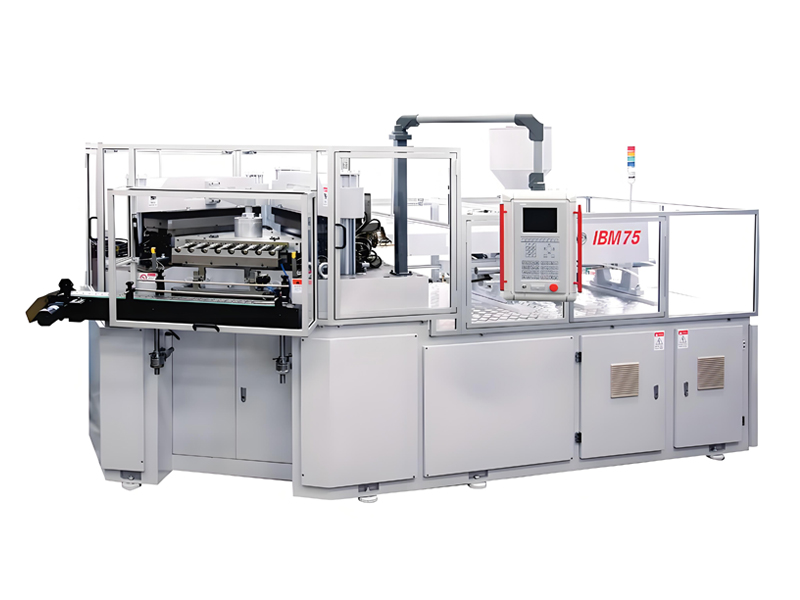
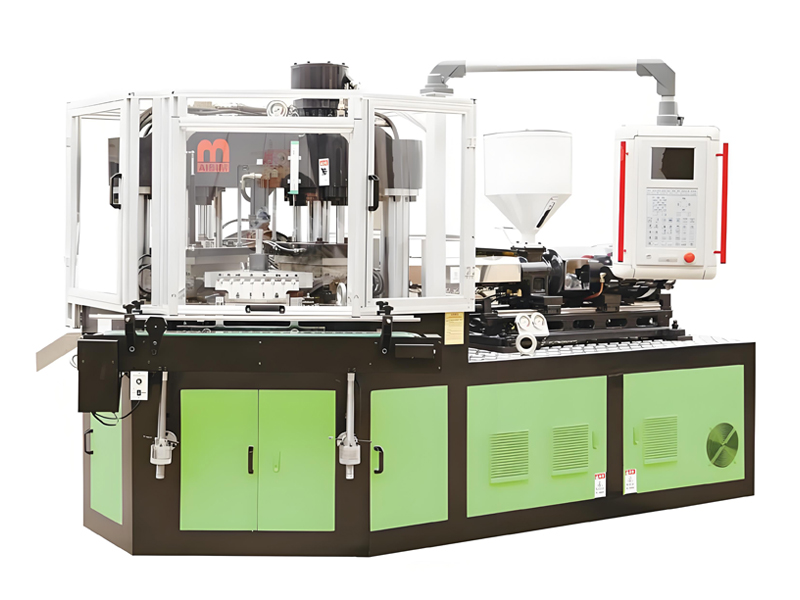
เครื่องฉีดขึ้นรูปเป่าขวด Aibim IBM75
The IBM75 is the largest standard Aibim model and the natural choice for wide mouth jars up to 1000 mL and openings up to 120 mm. Its single-crossbeam, double-pole clamping framework enlarges the mold setting space, which is exactly what a wide mouth mold needs because the body footprint is large. The machine uses Aibim PREFILL technology with a variable displacement pump that cuts energy use by at least 35 percent compared with a conventional fixed-pump hydraulic unit.
| Specification | IBM75 value |
|---|---|
| Clamping force | 75 tf (750 kN) |
| การฉีด capacity (shot) | 600 cm3 |
| Screw diameter | 45 mm |
| L/D ratio | 20:1 |
| Maximum cavities | Up to 8 for small parts; 2 to 4 for wide mouth jars |
| Maximum bottle mouth diameter | 120 mm |
| Maximum bottle volume | 1000 mL |
| Platen size | 520 x 520 mm |
| Installed power | 30 kW |
| เวลาในการหมุนแบบแห้ง | 4.5 s |
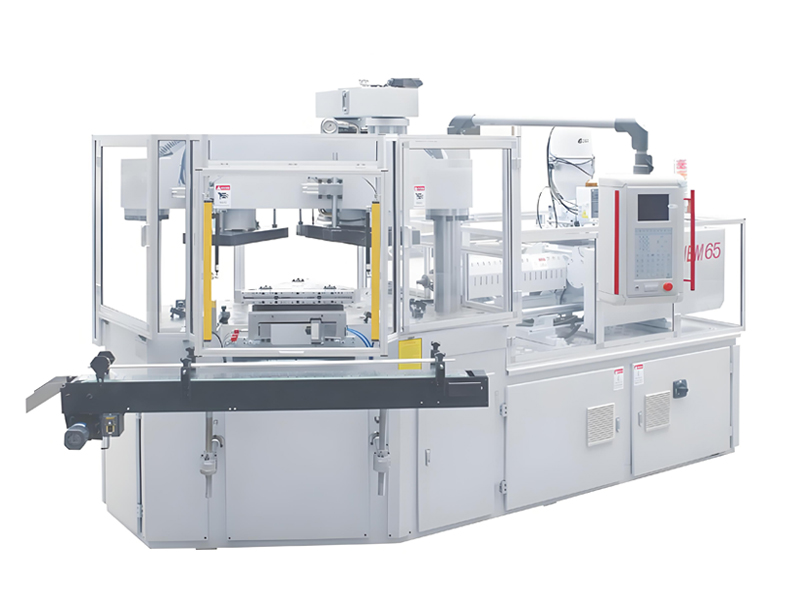
เครื่องฉีดขึ้นรูปเป่าขวด Aibim IBM65
The IBM65 sits one step below the IBM75 and covers wide mouth jars up to 750 mL and openings up to 100 mm. It is the workhorse for food, cosmetic and pharmaceutical jars in the mid-volume band, with the same three-station one-step process and the same neck precision. Cavity count for a wide mouth jar is limited by platen space, so a 250 mL jar at 70 mm mouth can run four to six cavities while a 750 mL jar at 100 mm mouth runs two.
| Specification | IBM65 value |
|---|---|
| Clamping force | 65 tf (650 kN) |
| การฉีด capacity (shot) | 450 cm3 |
| Screw diameter | 40 mm |
| L/D ratio | 20:1 |
| Maximum cavities | Up to 6 for small parts; 2 to 3 for wide mouth jars |
| Maximum bottle mouth diameter | 100 mm |
| Maximum bottle volume | 750 mL |
| Platen size | 460 x 460 mm |
| Installed power | 25 kW |
| เวลาในการหมุนแบบแห้ง | 4.0 s |
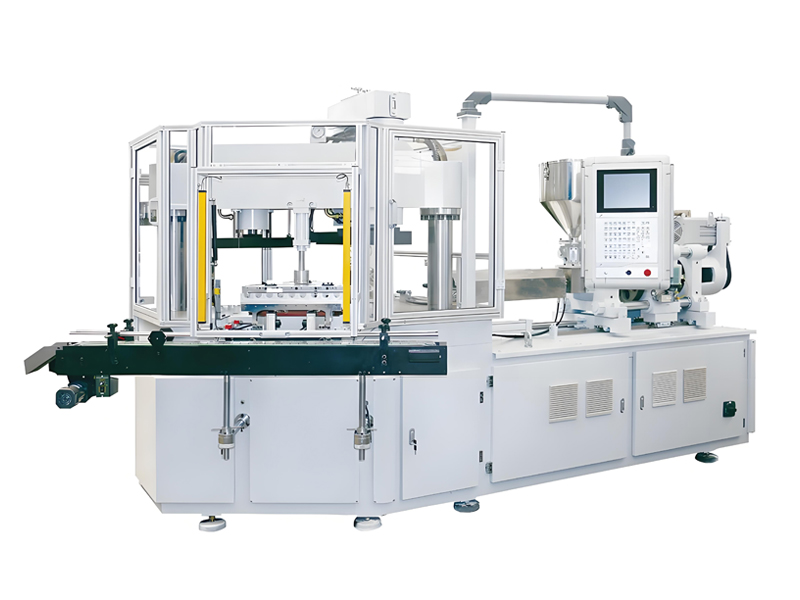
Aibim also offers the IBM55 Hybrid Electric model for smaller wide mouth jars up to 500 mL and openings up to 80 mm, where the electric clamp and servo plasticizing give the tightest energy and repeatability numbers for cleanroom and pharmaceutical use. All three models share the Aibim advantages: CE-certified safety with a stripper station laser sensor and light curtain, SD-card recipe storage that moves a proven setting from one machine to another, and the Wanplas group backing for service and spare parts.
อุตสาหกรรมที่ประยุกต์ใช้และข้อมูลจำเพาะทั่วไป
ขวดโหลปากกว้างที่ผลิตโดย IBM ให้บริการอุตสาหกรรมที่ช่องเปิด ซีล และความใสทั้งหมดมีความสำคัญ ชุดค่าผสมด้านล่างเป็นแบบทั่วไป ไม่ครบถ้วน และแต่ละชุดสามารถอ้างอิงเป็นเครื่องจักรและการกำหนดค่าแม่พิมพ์ที่เป็นรูปธรรมได้
อาหาร. ขวดแยมและน้ำผึ้งขนาดปาก 63 ถึง 100 มม. และ 250 ถึง 500 มล. ทำจาก PP; ขวดถั่วและขนมขบเคี้ยวขนาด 70 ถึง 89 มม. และ 400 ถึง 750 มล. ทำจาก PP; ขวดอาหารทารกขนาด 53 ถึง 63 มม. และ 100 ถึง 250 มล. ทำจาก PP random co-polymer; ขวดลูกกวาดขนาด 63 ถึง 89 มม. และ 200 ถึง 500 มล. ทำจาก PP หรือ PETG ใสผ่านกระบวนการ ISBM
สุขภาพและอาหารเสริม ขวดวิตามินและโปรตีนขนาด 53 ถึง 89 มม. และ 200 ถึง 750 มล. ทำจาก PP มักมีขอบซีลฟอยล์อะลูมิเนียมและฝาปิดแบบแสดงร่องรอยการงัดแงะ
ยา ขวดยาเม็ดและยาผงขนาด 38 ถึง 63 มม. และ 60 ถึง 300 มล. ทำจาก HDPE หรือ PP ซึ่งความแม่นยำของคอขวดรองรับฝาปิดกันเด็กเปิดและอุปกรณ์ดูดความชื้น
เครื่องสำอาง ขวดครีมขนาด 45 ถึง 70 มม. และ 30 ถึง 200 มล. ทำจาก SAN หรือ PP ขวดบอดี้บัตเตอร์และโลชันขนาด 63 ถึง 89 มม. และ 200 ถึง 500 มล. ทำจาก PP ขวดมาส์กขนาด 70 ถึง 100 มม. และ 250 ถึง 500 มล. ทำจาก PP หรือ PETG
เคมีภัณฑ์รายวัน ขวดเม็ดและแคปซูลซักผ้าขนาด 70 ถึง 100 มม. และ 400 ถึง 1000 มล. ทำจาก PP ออกแบบด้วยฝาปิดกว้างกันเด็กเปิดและชั้นกั้นความชื้น
อาหารสัตว์เลี้ยง ขวดอาหารเปียกและแห้งสำหรับสัตว์เลี้ยงขนาด 89 ถึง 100 มม. และ 500 ถึง 1000 มล. ทำจาก PP ซึ่งช่องเปิดกว้างช่วยให้ตักง่ายและความแม่นยำของคอขวดทำให้ฝาปิดสนิท
ห้องปฏิบัติการและตัวอย่าง ขวดตัวอย่างและขวดรีเอเจนต์ขนาด 38 ถึง 63 มม. และ 30 ถึง 250 มล. ทำจาก PP, PS หรือ PCTG ซึ่งต้องใช้ทั้งความใสและความทนทานต่อสารเคมี
คู่มือการเลือกรุ่นตามความต้องการ
ตารางด้านล่างจับคู่ความต้องการของลูกค้ากับรุ่น Aibim ที่แนะนำและการกำหนดค่าโพรง จำนวนโพรงระบุสำหรับแม่พิมพ์ปากกว้างและสมมติผังโรงงานที่จำกัดด้วยเพลทตามที่อธิบายไว้ก่อนหน้า จำนวนโพรงสุดท้ายได้รับการยืนยันในขั้นตอนการออกแบบแม่พิมพ์
| Mouth diameter | Volume | Material | Annual output | Recommended model | Cavities | Key configuration |
|---|---|---|---|---|---|---|
| 38 – 45 mm | 30 – 150 mL | PP / PS | Low to medium | IBM55 Hybrid | 4 | Electric clamp, cleanroom option |
| 53 – 63 mm | 100 – 300 mL | PP / HDPE | Medium | IBM65 | 4 | Independent neck cooling |
| 63 – 70 mm | 200 – 500 mL | PP / PETG | Medium to high | IBM65 or IBM75 | 3 – 4 | Stepped core rod, stripper plate |
| 70 – 89 mm | 400 – 750 mL | PP | Medium to high | IBM75 | 2 – 3 | Dense cooling, servo turret |
| 89 – 100 mm | 500 – 1000 mL | PP | Medium | IBM75 | 2 | 120 mm max mouth, reinforced core rod |
| Up to 100 mm | 250 – 500 mL | PET / PETG (ISBM) | High | Wanplas ISBM line | Per project | Oriented clarity, barrier |
For projects that need an oriented PET or PETG wide mouth jar with maximum clarity and barrier, the Wanplas group supplies the matching ISBM line so the customer stays with one supplier and one service organization. For any configuration outside the table, Aibim engineers size the machine from the part drawing, the annual volume and the material data sheet rather than from a generic rule.
บริการ การสนับสนุน และวิธีการเริ่มต้น
การซื้อสายการผลิตขวดปากกว้างคือจุดเริ่มต้นของความสัมพันธ์การผลิต ไม่ใช่ธุรกรรมครั้งเดียว Aibim ในฐานะโรงงานของ Wanplas สนับสนุนทุกเครื่องด้วยคำสัญญาบริการร่วมของกลุ่ม
การทดสอบจากโรงงานก่อนจัดส่ง เครื่องจักรแต่ละเครื่องผ่านการทดสอบความต่อเนื่องและประสิทธิภาพบนพื้นที่โรงงานด้วยแม่พิมพ์ของลูกค้าเมื่อมี เพื่อให้สายการผลิตได้รับการพิสูจน์ก่อนออกจากจางเจียกั่ง การทดสอบบันทึกรอบเวลา ความสมดุลของช่องพิมพ์ และขนาดชิ้นแรก
การทดลองแม่พิมพ์และการตรวจสอบชิ้นส่วนแรก แม่พิมพ์ถูกทดลองบนเครื่องจักรจริงและรายงานการตรวจสอบชิ้นส่วนแรกถูกออกตามแบบวาด ครอบคลุมเส้นผ่านศูนย์กลางคอ ความรี ความเรียบของพื้นผิวปิดผนึก การกระจายผนัง และประสิทธิภาพการตก ชิ้นส่วนจะไม่ถูกปล่อยจนกว่ารายงานจะถูกลงนาม
การติดตั้งและการทดสอบเดินเครื่อง วิศวกรสนับสนุนการติดตั้งและการทดสอบเดินเครื่องที่หน้างาน ถ่ายโอนสูตรที่พิสูจน์แล้วไปยังการ์ด SD ของโรงงาน และฝึกอบรมทีมงานในพื้นที่ให้เดินเครื่อง ทำความสะอาด และบำรุงรักษาสายการผลิต
นโยบายอะไหล่ กลุ่ม Wanplas ให้อะไหล่ฟรีมูลค่า USD 500 ทุกปีสำหรับเครื่องที่ครอบคลุม และชิ้นส่วนที่เสียหายภายในระยะเวลาการรับประกันถูกเปลี่ยนฟรี สิ่งนี้ทำให้สายการผลิตขวดโหลปากกว้างทำงานต่อไปโดยไม่ต้องมีสต็อกที่ผูกมัดจำนวนมาก
การฝึกอบรมและการทำงานระยะไกล ผู้ปฏิบัติงานและเจ้าหน้าที่บำรุงรักษาได้รับการฝึกอบรมที่หน้างาน และเครื่องรองรับการตรวจสอบระยะไกลเพื่อให้วิศวกรของ Aibim อ่านข้อมูล PLC และตอบสนองต่อสภาวะผิดปกติโดยไม่ต้องรอการเยี่ยมชมสถานที่
โรงงานเปิด ลูกค้ายินดีต้อนรับให้เยี่ยมชมโรงงาน Aibim เพื่อตรวจสอบการประกอบ ชมการทดลองเดินเครื่อง และตรวจสอบศูนย์ CNC ที่ผลิตชิ้นส่วนเครื่องจักร
If you are planning a wide mouth jar program, send your part drawing, target volume, material and annual output to Aibim. The engineering team will propose a machine model, a cavity layout and a process window, and invite you to the factory for a mold trial and a line audit before you commit. There is no substitute for seeing your jar come off the machine with the neck in tolerance and the seal flat.
คำถามที่พบบ่อย
อัตราส่วนเส้นผ่านศูนย์กลางคอต่อตัวที่กำหนดโหลปากกว้างคือเท่าใด?
ขวดปากกว้างมีอัตราส่วนเส้นผ่านศูนย์กลางคอต่อลำตัวสูงกว่า 0.5 โดยทั่วไป 0.55 ถึง 0.85 ขวดคอแคบอยู่ต่ำกว่า 0.35 ยิ่งอัตราส่วนใหญ่ ช่องเปิดยิ่งใกล้กับเส้นผ่านศูนย์กลางลำตัวเต็ม ซึ่งเปลี่ยนกลไกการเป่าและทำให้การกระจายผนังควบคุมยากขึ้น
ทำไมการฉีดขึ้นรูปเป่าจึงเป็นที่นิยมสำหรับโหลปากกว้างมากกว่าการอัดขึ้นรูปเป่า?
IBM produces the neck finish by injection in a precision neck ring, so the opening is held to roughly plus or minus 0.05 mm with no flash and no post trim. For a wide mouth jar the opening is the critical sealing and filling surface, and IBM holds that surface to the tightest tolerance of the three processes.
วัสดุใดดีที่สุดสำหรับโหลปากกว้างที่สัมผัสอาหาร?
For most food jars such as jam, honey, nuts and confectionery, polypropylene in homo-polymer or random co-polymer grade is the first choice because of its heat resistance, chemical inertness and food contact compliance. Transparent display jars use PS, SAN or PETG, while HDPE serves pharmaceutical powder and tablet jars.
แม่พิมพ์โหลปากกว้างสามารถวิ่งได้กี่โพรงในเครื่อง IBM เครื่องเดียว?
Cavity count is limited by platen area because a wide mouth jar occupies far more mold space than a narrow neck bottle of equal volume. On an Aibim IBM75 a 1000 mL jar up to 120 mm mouth may run two cavities, while a 250 mL jar at 70 mm mouth can run four to six cavities. Larger cavitation is possible only on smaller diameter parts.
อะไรทำให้คอโหลปากกว้างรีหรือเสียรูป?
ความรีเกิดจากผนังคอบาง การระบายความร้อนแหวนคอไม่เพียงพอ และการถอดแม่พิมพ์ในขณะที่โพลีเมอร์ยังอ่อน มาตรการรับมือคือวงจรระบายความร้อนอิสระบนแหวนคอ รักษาอุณหภูมิการถอดแม่พิมพ์ต่ำกว่า 70 องศาเซลเซียสสำหรับ PP และเพิ่มความหนาผนังคอ 0.2 ถึง 0.5 มม.
อัตราการเป่าขยายที่ดีที่สุดสำหรับโหลปากกว้างคือเท่าใด?
รักษาอัตราส่วนการเป่าขยายในช่วง 2.0 ถึง 3.5 เหนือกว่านั้นพาริซอนไม่สามารถยืดอย่างสม่ำเสมอ ดังนั้นไหล่และฐานบางลงในขณะที่ลำตัวยังหนา โปรไฟล์แกนคอร์แบบขั้นบันไดและความลาดผนังการฉีด 1.5 ถึง 4.5 มม. ช่วยให้คุณรักษาอัตราส่วนภายในหน้าต่างปลอดภัย
ฉันจะตรวจสอบได้อย่างไรว่าโหลปากกว้างตรงตามข้อกำหนดคุณภาพ?
Measure capacity at plus or minus 2 percent, neck inside diameter and ovality, seal face flatness at or below 0.15 mm, wall thickness at no fewer than eight points, top load in newtons, a 1.2 m full drop test, and seal retention under vacuum or pressure. Transparent jars also need light transmittance and haze checks.