- 1. Cosa rende un vasetto a “bocca larga” e perché è difficile da stampare
- 2. IBM vs ISBM vs EBM per barattoli a bocca larga
- 3. Sei sfide principali e le loro soluzioni
- 4. Selezione dei materiali per barattoli a bocca larga
- 5. Principi di progettazione dello stampo per IBM a bocca larga
- 6. Ispezione della qualità e criteri di accettazione
- 7. Macchine Aibim per la produzione di barattoli a bocca larga
- 8. Settori di applicazione e specifiche tipiche
- 9. Guida dalla necessità alla selezione del modello
- 10. Assistenza, supporto e come iniziare
- 11. Domande frequenti
Cosa rende un vasetto a “bocca larga” e perché è difficile da stampare
A wide mouth jar is defined by geometry, not by marketing language. In blow molding the controlling dimension is the neck-to-body diameter ratio, which is the finished neck opening diameter divided by the maximum body diameter of the container. A wide mouth jar carries a neck-to-body diameter ratio above 0.5, with the typical production window sitting between 0.55 and 0.85. By contrast a narrow neck bottle stays below 0.35, and many pharmaceutical dropper and beverage bottles sit well under 0.25. The moment the ratio climbs past 0.5 the part stops behaving like a bottle and starts behaving like a small open container, and that single change rewrites the way the parison must be formed, blown and ejected.
Wide mouth jars are produced across a broad range of opening sizes and volumes. The most common neck or finish diameters are 38 mm, 45 mm, 53 mm, 63 mm, 70 mm, 89 mm and 100 mm. Matching volumes usually run from 30 mL for sample and lab jars up to 1000 mL for food, confectionery and pet food containers. A 100 mm opening on a 1000 mL jar is at the upper edge of practical injection blow molding, while a 38 mm opening on a 120 mL jar is at the easy end of the range. The table below places these sizes on a single reference grid so the geometry is unambiguous before we discuss process behavior.
| Opening diameter (mm) | Typical volume range (mL) | Neck-to-body ratio | Common use |
|---|---|---|---|
| 38 | 30 – 250 | 0.55 – 0.70 | Sample jars, cosmetic cream cups, vitamin packs |
| 45 | 50 – 300 | 0.55 – 0.72 | Personal care, single-dose food |
| 53 | 100 – 400 | 0.58 – 0.75 | Cosmetico, pharmacy powder |
| 63 | 150 – 500 | 0.60 – 0.78 | Honey, sauce, supplement jars |
| 70 | 200 – 750 | 0.62 – 0.80 | Jam, nuts, body butter |
| 89 | 400 – 900 | 0.70 – 0.83 | Pet food, confectionery, lab storage |
| 100 | 500 – 1000 | 0.75 – 0.85 | Large food, protein, industrial samples |
Il motivo per cui un barattolo a bocca larga è più difficile da stampare rispetto a una bottiglia a collo stretto non è un singolo difetto ma quattro cause meccaniche e di processo accoppiate. Comprendere queste quattro cause è il fondamento di ogni soluzione discussa più avanti in questo articolo.
First cause: the blow-up ratio is locked down. In blow molding the blow-up ratio is the body diameter divided by the parison diameter at the point being blown. A narrow neck bottle is injected as a slim parison and blown outward many times, so the polymer stretches dramatically and fills the cavity. A wide mouth jar already starts with a parison that is nearly as wide as the final body, because the neck finish itself is wide. The available blow-up ratio collapses to roughly 2.0 to 3.5, sometimes less. With little stretch left, the polymer cannot redistribute itself to even out wall thickness, so the base and shoulder tend to stay thin while the body stays thick. This is the root of most wall balance complaints on wide mouth parts.
Second cause: the parison distribution is difficult to make uniform. Because the part is short and squat, the parison travels a short distance from the injection cavity to the blow cavity, but the cross-section changes are abrupt. The neck region must stay stiff and dimensionally exact, the shoulder must accept rapid expansion, and the base must fill without webbing. A uniform tubular parison that works for a tall bottle does not map onto a wide mouth jar, so the parison wall must be deliberately profiled along its length.
Third cause: the demolding path is obstructed. A narrow neck bottle is stripped off the core rod through a small opening, so the draft is gentle and the undercut risk is low. A wide mouth jar has a large opening and large side walls with threads or knurls, so the stripping travel is long and the friction against the core rod and cavity is high. The part wants to stick, gall, or stretch during ejection, and a single bad release can scar the sealing land.
Fourth cause: the neck lacks rigidity and deforms easily. The wide neck is both the largest opening and the most functionally critical surface. It carries the threads or snap feature, the sealing plane, and the torque load of the closure. Because the neck wall is necessarily thin relative to its diameter, it cools slowly and, if ejected while soft, relaxes into ovality or sink. A warped neck leaks, a low-torque neck cross-threads, and an out-of-round neck fails automated capping.
Un barattolo a bocca larga è difficile non perché un singolo passaggio fallisce, ma perché il rapporto di soffiaggio, il profilo della parison, il percorso di rilascio e la rigidità del collo si contrastano tutti contemporaneamente. Lo stampaggio a iniezione e soffiaggio è il processo che offre il massimo controllo su tutti e quattro allo stesso tempo.
Aibim is a Wanplas factory with more than twelve years of experience building injection blow molding machines and molds, exporting to over forty countries, with its own CNC machining center and an annual capacity above one hundred lines per year. The wide mouth jar is one of the most demanding parts that an IBM line is asked to make, and the rest of this guide explains how to design the process, the mold and the material so the part consistently passes spec.
IBM contro ISBM contro EBM per barattoli a bocca larga
Three blow molding routes can technically produce a wide mouth jar: injection blow molding (IBM), injection stretch blow molding (ISBM), and extrusion blow molding (EBM). They differ most at the neck finish, where the wide mouth jar lives or dies. The comparison below is a process-to-process benchmark, not a brand comparison, and it shows why IBM dominates precision wide mouth production.
| Attribute | Iniezione Stampaggio a soffiaggio (IBM) | Iniezione Stretch Stampaggio a soffiaggio (ISBM) | Extrusion Stampaggio a soffiaggio (EBM) |
|---|---|---|---|
| Neck finish precision | Plus or minus 0.05 mm, no flash, no trim | Plus or minus 0.10 mm, no flash | Plus or minus 0.30 mm, flash requires trim |
| Minimum practical neck-to-body ratio | 0.50 and up (best for wide mouth) | 0.45 and up | 0.30 and up (best for very wide, low-precision) |
| Wall thickness uniformity | Good, controllable by parison profile | Excellent, biaxial orientation | Fair, parison programming needed |
| Material adaptability | PE, PP, PS, SAN, PC, PCTG, TPU | PET, PETG, PEN, some PP | PE, PP, PVC, PC, TPU |
| Scrap rate | Low, below 5 percent | Low, below 5 percent | Medium, flash and trim 15 to 25 percent |
| Cycle time | Medium | Medium | Medium |
| Mold complexity | Medium | Medium to High | Low |
| Cost level | Medium | Medium to High | Low |
The decisive column for a wide mouth jar is neck finish precision. The neck is the opening through which the product is filled and the closure is applied, and on a wide mouth jar that opening can be 100 mm across. IBM forms the neck by injecting molten polymer into a precision neck ring, so the threads, the sealing land and the inside diameter are fixed by steel, not by a cut parison. That yields a finish held to roughly plus or minus 0.05 mm with no flash and no secondary trimming operation. ISBM is excellent for oriented PET and gives the best wall distribution, but its neck precision and its material set (driven by PET and PETG) make it a second choice for PP and PS food jars. EBM is the cheapest route and handles very large openings, but the flash line and the plus or minus 0.30 mm neck tolerance force a trimming step and a looser closure fit, which is unacceptable for many food, pharmaceutical and cosmetic jars.
Da una prospettiva del gruppo Wanplas, quando un progetto necessita di una linea a valle abbinata come il riempimento o un processo di estrusione complementare, quelle capacità sono fornite sotto il nome Wanplas così il cliente ottiene un unico fornitore responsabile piuttosto che diversi venditori scollegati.
Scegliere IBM quando il barattolo a bocca larga deve sigillare, filettare e tappare con variazione quasi nulla e senza rifinitura posteriore. Scegliere ISBM per barattoli a bocca larga in PET orientato con massima trasparenza e resistenza alla caduta. Scegliere EBM solo quando l'apertura è molto grande e la tolleranza della chiusura è ampia.
Sei sfide principali e le loro soluzioni
Le seguenti sei sfide sono quelle incontrate più spesso nei programmi di barattoli a bocca larga. Ciascuna è scritta come un ciclo: fenomeno, meccanismo, contromisura di parametro o struttura e metodo di verifica. Usate questa struttura in officina per diagnosticare un pezzo difettoso invece di tirare a indovinare.
Sfida 1: il limite del rapporto di soffiaggio causa squilibrio della parete di base e spalla
Fenomeno. La parete del corpo rientra nella tolleranza ma la base è abbastanza sottile da perforarsi al test di caduta, e la spalla mostra un assottigliamento locale vicino alla transizione al collo. Il pezzo sembra a posto finché non fallisce un test di caduta da 1,2 m o un test di carico verticale.
Mechanism. The wide mouth geometry leaves only a 2.0 to 3.5 blow-up ratio. With little radial stretch available, the polymer cannot flow from the body into the base and shoulder during blowing. Where the parison was already thin, it stays thin; where it was thick, it stays thick. The classic symptom is a thick cylindrical body and a starved base.
Parameter and structure countermeasure. Profile the parison deliberately with a stepped core rod so the wall thickness tapers from the neck down to the base. A practical injection wall gradient runs from 1.5 mm at the neck region to 4.5 mm toward the base, putting more material where the blow-up ratio is lowest. Keep the blow-up ratio inside the 2.0 to 3.5 window by sizing the core rod diameter correctly, and apply a staged pre-blow: a low first pressure to seat the parison against the cavity, then a higher second pressure to complete the form. Avoid trying to compensate by raising blow pressure alone, which only bursts weak zones.
Verification method. Cut the jar at eight or more points (neck, shoulder, upper body, mid body, lower body, base radius, base center, side wall) and measure wall thickness. Confirm the thinnest point is above the drop-test minimum and that the ratio between the thickest and thinnest wall is inside the agreed spec. Re-run the drop test at 1.2 m full before releasing the setting.
Sfida 2: deformazione del collo e ovalità
Fenomeno. L'apertura del collo risulta fuori tondo oltre quanto consentito dal disegno, oppure mostra un avvallamento visibile sull'anello di tenuta. I tappi si incrociano nella filettatura o perdono al test di coppia.
Mechanism. The wide neck wall is thin relative to its diameter and has a large surface area, so it cools more slowly than the body. If the part is stripped while the neck polymer is still soft, the land relaxes under its own weight and the clamping load, producing ovality and sink. Low crystallinity control in PP makes the effect worse because the amorphous skin is soft at higher temperatures.
Parameter and structure countermeasure. Give the neck ring its own independent cooling circuit so the neck can be brought to temperature faster than the body. Control neck crystallinity by holding the neck ring temperature in the correct band for the grade. Keep the demold temperature below 70 degrees C for polypropylene. Extend the residence time on the turret at the blow or cooling station so the neck sets before transfer. Add 0.2 to 0.5 mm to the neck wall thickness compared with a narrow neck design to raise its stiffness without changing the opening.
Verification method. Measure neck inside diameter at two perpendicular axes with a bore gauge and compute ovality as the difference. Run a torque test with the production closure at the specified application torque and confirm no cross-thread and no leak under the seal test. Check the sealing land with a flatness indicator referenced to the datum plane.
Sfida 3: Sformatura difficile e graffi superficiali
Fenomeno. Il barattolo mostra segni verticali sul corpo o sul collo, oppure si attacca all'anima e il robot di prelievo manca il pezzo. La stabilità del ciclo cala e gli scarti aumentano.
Mechanism. A wide mouth jar has a large internal surface dragged along the core rod during stripping, and the threads or knurls add local undercut. The release travel is long, so friction is high and any sticking point galls the surface. A 0.5 degree draft angle that works on a bottle is insufficient here.
Parameter and structure countermeasure. Increase the draft angle to 1 to 2 degrees, roughly double the bottle norm. Use a stripper air pulse with a timed sequence so a short burst of compressed air breaks the vacuum seal at the start of ejection. Add a mechanical stripper plate that pushes the jar uniformly off the core rod instead of relying on air alone. Polish the cavity and core rod to a surface finish of Ra 0.2 micrometer or better so the polymer does not grip. Use a release agent only when absolutely necessary and only in a controlled, documented dose, because excess agent blooms to the surface and spoils printing or labeling.
Metodo di verifica. Eseguite un blocco continuo di cicli e contate gli eventi di adesione o graffiatura. Ispezionate la parete interna con luce radente per individuare linee di graffio. Confermate che il robot di estrazione prelevi ogni pezzo nell'intero blocco senza una corsa mancata.
Sfida 4: assottigliamento di spalla e angoli con rottura da caduta
Fenomeno. Il vasetto supera l'ispezione iniziale ma si crepa alla spalla o in un angolo interno durante il riempimento, l'impilamento o il trasporto. L'origine del guasto è un angolo sottile e altamente sollecitato.
Meccanismo. Gli angoli interni taglienti concentrano lo stress e le spalle sottili non possono assorbire l'energia d'impatto. Se l'asta centrale è troppo fredda, la parison congela prima di conformarsi; se troppo calda, la parison si affloscia. Il grado sbagliato dà una bassa resistenza all'impatto alla temperatura d'uso.
Parameter and structure countermeasure. Run the core rod with zoned temperature control, typically 60 to 110 degrees C, so the parison stays formable long enough to fill the corners. Specify corner radii of R 2 mm or larger at every internal transition so stress does not concentrate. Choose a material with enough low-temperature impact, for example a polypropylene random co-polymer for improved toughness. Where the application allows, apply a short anneal step after molding to relax residual stress in the shoulder and corners.
Metodo di verifica. Sezionate la spalla e gli angoli e confermate che i raggi rispettino il disegno. Eseguite il test di caduta a 1,2 m con il barattolo riempito al volume nominale, su ciascuna delle orientazioni di impatto richieste, e ripetete dopo un ciclo di condizionamento a freddo se il mercato richiede prestazioni a bassa temperatura.
Sfida 5: tempo di ciclo lungo e bassa produzione
Fenomeno. Il ciclo per cavità è più lungo dell'obiettivo commerciale, quindi la produzione annua non raggiunge il piano aziendale anche a piena cavitazione.
Meccanismo. Un barattolo a bocca larga occupa più area di piastra per cavità di una bottiglia dello stesso volume, quindi il numero di cavità è limitato dalla piastra, non dalla dimensione dello shot. Il raffreddamento è lento perché il collo spesso e la base trattengono il calore, e la torretta trascorre tempo vuoto muovendosi tra le stazioni.
Parameter and structure countermeasure. Select a multi-cavity configuration that fits the platen, accepting that wide mouth jars rarely reach the cavitation of narrow neck programs. Drop the cooling water temperature to 8 to 15 degrees C and densify the water channels so heat leaves the mold faster. Use a servo-driven turret to shorten the non-productive transfer time between stations. Optimize the dry cycle by tightening the clamp open, transfer and close sequence without sacrificing safety.
| Cycle phase | Typical time (s) | Optimization lever |
|---|---|---|
| Iniezione and parison hold | 1.4 – 2.2 | Balance pack pressure, avoid over-pack |
| Transfer to blow station | 0.4 – 0.7 | Servo turret, shorten dead stroke |
| Blow and cooling | 2.0 – 4.0 | Water at 8 to 15 C, denser channels |
| Transfer to eject station | 0.4 – 0.7 | Servo turret timing |
| Demold and reset | 0.8 – 1.4 | Stripper plate, stripper air timing |
| Dry cycle total | 3.8 – 5.0 | Machine dependent |
Metodo di verifica. Cronometrate il ciclo di stampaggio effettivo su un blocco di produzione stabile e confrontate ogni fase con la tabella precedente. Confermate che il collo di bottiglia sia la fase di raffreddamento, non quella di trasferimento; se domina il trasferimento, il guadagno deriva dalla torretta servo piuttosto che da acqua più fredda.
Sfida 6: planarità della superficie di tenuta e accoppiamento della chiusura
Fenomeno. Il barattolo supera il test di tenuta statico ma perde dopo cicli termici, impilamento o spedizione, oppure la chiusura applica una coppia non uniforme attorno al bordo.
Mechanism. A wide mouth jar has a large sealing face, so a small absolute warp becomes a large leak path. Warp comes from uneven cooling across the wide land, from residual stress, and from a neck that was not fully set at demold. A mismatch between the thread form and the closure compounds the problem.
Parameter and structure countermeasure. Hold the seal face flatness to 0.15 mm or better by balancing the neck ring cooling and by gating the parison so the land fills symmetrically. Select the thread form to match the closure family: the 400, 415 and 425 series are the common continuous-thread finishes, and the choice sets the wall and torque behavior. For products needing a secondary barrier, design the land to accept an inner plug or an aluminum foil seal without distorting the plane. Validate the closure torque against the chosen finish so the cap seats uniformly.
Metodo di verifica. Misurare la planarità della superficie di tenuta con un comparatore a quadrante su un riferimento in granito. Eseguire un test di ritenzione del vuoto o della pressione sul barattolo riempito e tappato, poi ripetere dopo un ciclo termico. Confermare che la coppia di applicazione rientri nell'intervallo concordato su ogni unità campionata.
Selezione dei materiali per barattoli a bocca larga
Material choice sets the ceiling on clarity, impact, temperature resistance and food contact compliance. The table below lists the materials that run on IBM and ISBM wide mouth programs with their processing window and compliance reference. Compliance names are given as plain text for verification against the official regulation text.
| Material | Melt temp (C) | Mold temp (C) | Demold temp (C) | Shrinkage (%) | Impact grade | Transparency | Alimentare contact compliance |
|---|---|---|---|---|---|---|---|
| PP homo-polymer | 210 – 250 | 20 – 60 | < 70 | 1.5 – 2.0 | Medium | Opaque | FDA 21 CFR 177, EU 10/2011 |
| PP random co-polymer | 200 – 240 | 20 – 60 | < 70 | 1.4 – 1.9 | High | Opaque, slight clarity | FDA 21 CFR 177, EU 10/2011 |
| HDPE | 200 – 240 | 15 – 50 | < 65 | 1.5 – 2.5 | Medium-High | Opaque | FDA 21 CFR 177, EU 10/2011 |
| PS | 190 – 230 | 20 – 50 | < 60 | 0.4 – 0.7 | Low | High | FDA 21 CFR 177, EU 10/2011 |
| SAN | 220 – 260 | 50 – 80 | < 70 | 0.4 – 0.7 | Medium | High | FDA 21 CFR 177, EU 10/2011 |
| PET (ISBM) | 270 – 290 | 90 – 120 | < 90 | 0.2 – 0.5 | High | Very high | FDA 21 CFR 177, EU 10/2011 |
| PETG | 230 – 260 | 20 – 40 | < 65 | 0.3 – 0.6 | High | Very high | FDA 21 CFR 177, EU 10/2011 |
| PCTG | 240 – 270 | 30 – 60 | < 70 | 0.4 – 0.7 | Very high | Very high | FDA 21 CFR 177, EU 10/2011 |
| PC | 280 – 320 | 80 – 120 | < 100 | 0.5 – 0.7 | Very high | High | Check BPA compliance for baby-related items |
Polipropilene in homo-polymer or random co-polymer grade is the default for food jars such as jam, honey, nuts and confectionery because it resists heat, chemicals and grease while meeting food contact rules. The random co-polymer adds low-temperature impact, which helps jars that are filled hot or stored cold. HDPE serves pharmaceutical powder and tablet jars where squeezability and chemical resistance matter more than clarity. PS e SAN give transparent display jars for cosmetics and hardware, though their impact is lower so the wall must be tuned for drop performance. PET and PETG through ISBM produce the clearest wide mouth jars with the best barrier, but they need the higher stretch ratios and the hotter mold that ISBM provides. PCTG and PC deliver top impact and clarity for demanding items; for any baby-related product the PC grade must be verified for BPA compliance before use.
Principi di progettazione degli stampi per IBM a bocca larga
Lo stampo è il punto in cui le quattro cause di difficoltà vengono risolte nell'acciaio. Gli stampi IBM a bocca larga differiscono dagli stampi per bottiglie in tre modi strutturali: disposizione della torretta, costruzione dell'anello del collo e rigidità dell'anima.
Three-station and four-station turret layout. Aibim IBM machines use a three-station one-step process: injection, blow and ejection on a rotating turret. Some programs add a fourth station for extra cooling or in-mold labeling. A wide mouth mold occupies more platen area per cavity than a bottle mold, so the turret pitch and the platen size set the maximum cavity count directly. Plan the cavitation from the platen drawing, not from the shot size, because the wide body almost always runs out of platen before it runs out of polymer.
Neck ring split design and flash control. Because IBM injects the neck, the neck ring is a split steel insert that defines the finish. For a wide mouth jar the neck ring is large and must part cleanly without a flash line on the sealing land. Design the parting line away from the seal face, and hold the neck ring as a replaceable insert so wear does not force a full mold rebuild. Flash on the land is the fastest way to fail a closure leak test, so the neck ring fit is cut tighter than on a bottle mold.
Core rod length-to-diameter ratio and rigidity. The core rod forms the internal shape and carries the parison between stations. A wide mouth jar needs a large-diameter core rod, and a large-diameter rod is more prone to deflection than a slim bottle rod. Keep the rod aspect ratio conservative, support it at both ends where the machine allows, and specify a stiff, dimensionally stable grade so the inside diameter stays round across the run. A deflecting rod produces an out-of-round inside wall that no blow setting can fix.
Water channel layout and uniform temperature. Wide mouth jars need the neck cooled faster than the body, so the neck ring gets its own circuit while the body cavity gets another. Lay the channels to hold the mold temperature uniform within plus or minus 2 degrees C across the cavity face; a 5 degree C spread across a wide land is enough to warp the seal plane. Denser channels near the base and shoulder pull heat from the thick sections that otherwise dictate the cycle.
Mold material and maintenance. Use pre-hardened tool steel (P20-type) for the body and cavity where the loads are moderate, and stainless tool steel (420-type) for necks and cores that contact food-grade or corrosive compounds and need corrosion resistance with a polish-ready surface. The cavity and core rod are finished to Ra 0.2 micrometer or better for clean demolding. With routine cleaning, channel descaling and rod inspection, a well-built wide mouth IBM mold runs a long life; schedule a full refurbish at the cavitation and wear interval defined in the mold maintenance plan rather than waiting for a failure.
Ispezione di qualità e criteri di accettazione
Un barattolo a bocca larga è accettato in base a criteri dimensionali, meccanici e di tenuta. La tabella seguente è una checklist di accettazione pronta che associa ogni controllo al suo limite e al suo metodo.
| Check | Contact aibimance limit | Method |
|---|---|---|
| Capacity | Plus or minus 2 percent of rated volume | Fill to overflow, weigh or measure |
| Neck inside diameter | Per drawing, plus or minus 0.05 mm | Bore gauge at two axes |
| Neck ovality | Below drawing max, typically < 0.10 mm | Two-axis bore gauge |
| Seal face flatness | 0.15 mm or better | Dial indicator on datum |
| Wall thickness distribution | Minimum at or above spec, 8 plus points | Section and micrometer |
| Vertical top load | Per rated stack load in newtons | Compression test at set speed |
| Drop test | No leak or break at 1.2 m, full | Drop on required orientations |
| Seal retention | Hold vacuum or pressure per spec | Vacuum or pressure chamber |
| Light transmittance and haze | Per clarity grade for transparent jars | Haze meter or spectro |
Capacity is confirmed by filling the jar to the overflow line and weighing the contents against the rated volume, with the tolerance held to plus or minus 2 percent so filling lines stay accurate. Neck inside diameter and ovality are checked at two perpendicular axes because a wide mouth jar fails capping the moment the opening goes out of round. Seal face flatness is the single most important number for leak performance and is held to 0.15 mm or better. Wall thickness is measured at no fewer than eight points so a thin base or shoulder cannot hide in a single reading. Top load in newtons confirms the jar survives pallet stacking, and the 1.2 m full drop test confirms field performance. Transparent jars are additionally checked for light transmittance and haze so the display appearance is controlled.
Macchine Aibim per la produzione di barattoli a bocca larga
When the technical discussion reaches the question of which machine to run, Aibim offers a focused IBM lineup built for precision hollow parts including wide mouth jars. Two representative models are described below with specification tables that include the two numbers that matter most for this application: maximum bottle mouth diameter and maximum bottle volume.
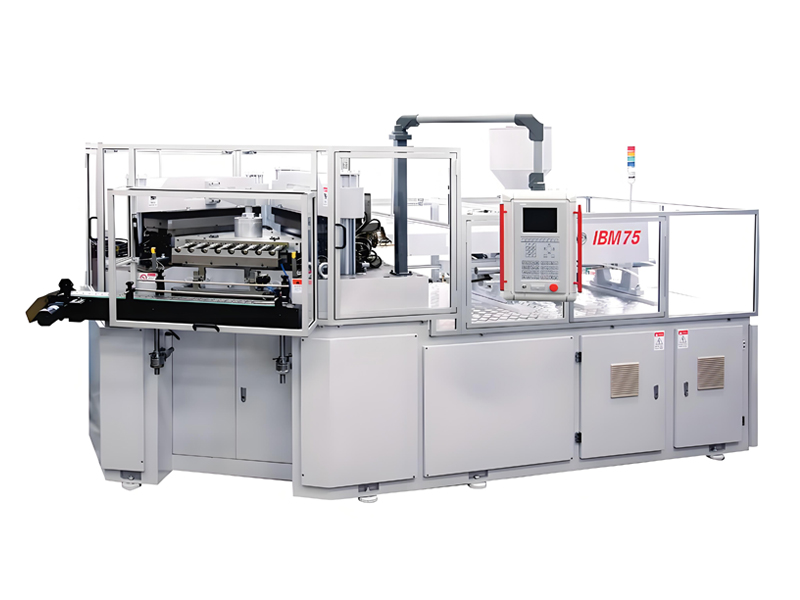
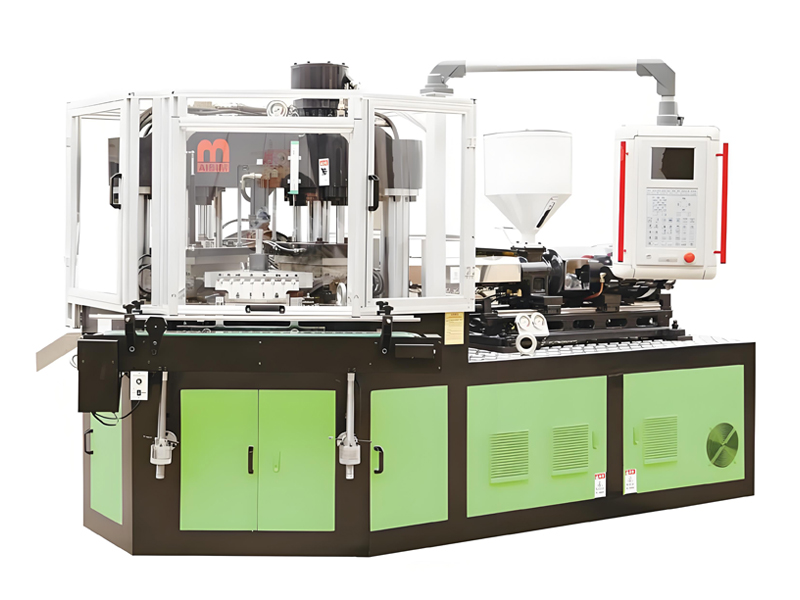
Macchina per stampaggio a iniezione e soffiaggio Aibim IBM75
The IBM75 is the largest standard Aibim model and the natural choice for wide mouth jars up to 1000 mL and openings up to 120 mm. Its single-crossbeam, double-pole clamping framework enlarges the mold setting space, which is exactly what a wide mouth mold needs because the body footprint is large. The machine uses Aibim PREFILL technology with a variable displacement pump that cuts energy use by at least 35 percent compared with a conventional fixed-pump hydraulic unit.
| Specification | IBM75 value |
|---|---|
| Clamping force | 75 tf (750 kN) |
| Iniezione capacity (shot) | 600 cm3 |
| Screw diameter | 45 mm |
| L/D ratio | 20:1 |
| Maximum cavities | Up to 8 for small parts; 2 to 4 for wide mouth jars |
| Maximum bottle mouth diameter | 120 mm |
| Maximum bottle volume | 1000 mL |
| Platen size | 520 x 520 mm |
| Installed power | 30 kW |
| Tempo di ciclo a secco | 4.5 s |
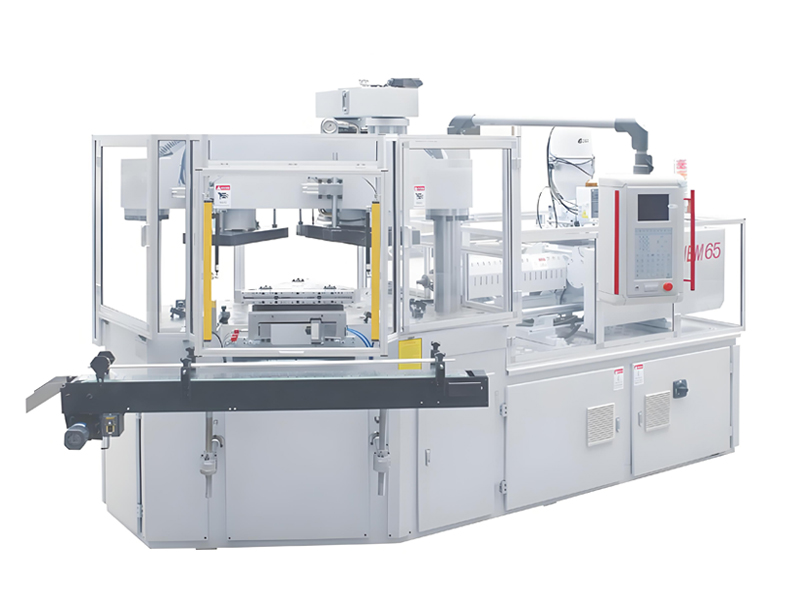
Macchina per stampaggio a iniezione e soffiaggio Aibim IBM65
The IBM65 sits one step below the IBM75 and covers wide mouth jars up to 750 mL and openings up to 100 mm. It is the workhorse for food, cosmetic and pharmaceutical jars in the mid-volume band, with the same three-station one-step process and the same neck precision. Cavity count for a wide mouth jar is limited by platen space, so a 250 mL jar at 70 mm mouth can run four to six cavities while a 750 mL jar at 100 mm mouth runs two.
| Specification | IBM65 value |
|---|---|
| Clamping force | 65 tf (650 kN) |
| Iniezione capacity (shot) | 450 cm3 |
| Screw diameter | 40 mm |
| L/D ratio | 20:1 |
| Maximum cavities | Up to 6 for small parts; 2 to 3 for wide mouth jars |
| Maximum bottle mouth diameter | 100 mm |
| Maximum bottle volume | 750 mL |
| Platen size | 460 x 460 mm |
| Installed power | 25 kW |
| Tempo di ciclo a secco | 4.0 s |
Aibim also offers the IBM55 Hybrid Electric model for smaller wide mouth jars up to 500 mL and openings up to 80 mm, where the electric clamp and servo plasticizing give the tightest energy and repeatability numbers for cleanroom and pharmaceutical use. All three models share the Aibim advantages: CE-certified safety with a stripper station laser sensor and light curtain, SD-card recipe storage that moves a proven setting from one machine to another, and the Wanplas group backing for service and spare parts.
Settori applicativi e specifiche tipiche
I vasetti a bocca larga realizzati con IBM servono settori in cui l'apertura, la tenuta e la trasparenza contano tutte. Le combinazioni di seguito sono tipiche, non esaustive, e ciascuna può essere quotata come configurazione concreta di macchina e stampo.
Alimentare. Barattoli per marmellata e miele con apertura da 63 a 100 mm e da 250 a 500 mL in PP; barattoli per noci e snack da 70 a 89 mm e da 400 a 750 mL in PP; barattoli per alimenti per lattanti da 53 a 63 mm e da 100 a 250 mL in copolimero casuale PP; barattoli per dolciumi da 63 a 89 mm e da 200 a 500 mL in PP o PETG trasparente tramite ISBM.
Salute e integratori. Barattoli per vitamine e proteine da 53 a 89 mm e da 200 a 750 mL in PP, spesso con anello di saldatura in foglio di alluminio e chiusura a prova di manomissione.
Farmaceutico. Bottiglie per compresse e polveri da 38 a 63 mm e da 60 a 300 mL in HDPE o PP, dove la precisione del collo supporta una chiusura a prova di bambino e un inserto essiccante.
Cosmeticoo. Vasetti per creme da 45 a 70 mm e da 30 a 200 mL in SAN o PP; vasetti per burro corpo e lozioni da 63 a 89 mm e da 200 a 500 mL in PP; vasetti per maschere da 70 a 100 mm e da 250 a 500 mL in PP o PETG.
Chimica quotidiana. Barattoli per perle e capsule per lavanderia da 70 a 100 mm e da 400 a 1000 mL in PP, progettati con una chiusura larga a prova di bambino e una barriera all'umidità.
Alimenti per animali. Barattoli per alimenti umidi e secchi per animali da 89 a 100 mm e da 500 a 1000 mL in PP, dove l'apertura larga facilita il prelievo e la precisione del collo mantiene il coperchio sigillato.
Manodoperaatorio e campioni. Barattoli per campioni e reagenti da 38 a 63 mm e da 30 a 250 mL in PP, PS o PCTG, dove sono richiesti sia chiarezza che resistenza chimica.
Guida alla selezione dal requisito al modello
La tabella seguente mappa un requisito del cliente su un modello Aibim consigliato e una configurazione delle cavità. I numeri delle cavità sono indicati per stampi a bocca larga e presuppongono il layout limitato dalla piastra descritto in precedenza; la cavitazione finale viene confermata in fase di progettazione dello stampo.
| Mouth diameter | Volume | Material | Annual output | Recommended model | Cavities | Key configuration |
|---|---|---|---|---|---|---|
| 38 – 45 mm | 30 – 150 mL | PP / PS | Low to medium | IBM55 Hybrid | 4 | Electric clamp, cleanroom option |
| 53 – 63 mm | 100 – 300 mL | PP / HDPE | Medium | IBM65 | 4 | Independent neck cooling |
| 63 – 70 mm | 200 – 500 mL | PP / PETG | Medium to high | IBM65 or IBM75 | 3 – 4 | Stepped core rod, stripper plate |
| 70 – 89 mm | 400 – 750 mL | PP | Medium to high | IBM75 | 2 – 3 | Dense cooling, servo turret |
| 89 – 100 mm | 500 – 1000 mL | PP | Medium | IBM75 | 2 | 120 mm max mouth, reinforced core rod |
| Up to 100 mm | 250 – 500 mL | PET / PETG (ISBM) | High | Wanplas ISBM line | Per project | Oriented clarity, barrier |
For projects that need an oriented PET or PETG wide mouth jar with maximum clarity and barrier, the Wanplas group supplies the matching ISBM line so the customer stays with one supplier and one service organization. For any configuration outside the table, Aibim engineers size the machine from the part drawing, the annual volume and the material data sheet rather than from a generic rule.
Assistenza, supporto e come iniziare
L'acquisto di una linea per vasetti a bocca larga è l'inizio di un rapporto produttivo, non una transazione una tantum. Aibim, in quanto stabilimento Wanplas, supporta ogni macchina con le promesse di servizio condivise del gruppo.
Test in fabbrica prima della spedizione. Ogni macchina esegue un test di continuità e prestazioni sul piano di fabbrica con lo stampo del cliente dove disponibile, così la linea è collaudata prima di lasciare Zhangjiagang. Il test registra il tempo di ciclo, il bilanciamento delle cavità e le dimensioni del primo pezzo.
Prova stampo e ispezione del primo articolo. Lo stampo viene provato sulla macchina reale e viene emesso un rapporto di ispezione del primo articolo rispetto al disegno, che copre diametro del collo, ovalità, planarità della superficie di tenuta, distribuzione della parete e prestazioni di caduta. Il pezzo non viene rilasciato finché il rapporto non è firmato.
Installazione e messa in servizio. Gli ingegneri supportano l'installazione e la messa in servizio in loco, trasferiscono la ricetta collaudata sulla scheda SD dello stabilimento e formano il team locale per far funzionare, pulire e mantenere la linea.
Politica dei ricambi. Il gruppo Wanplas fornisce 500 USD di parti gratuite ogni anno per le macchine coperte e le parti danneggiate in garanzia vengono sostituite gratuitamente. Questo mantiene operativa una linea di barattoli a bocca larga senza un grande inventario immobilizzato.
Formazione e funzionamento remoto. Operatori e personale di manutenzione vengono formati sul posto e la macchina supporta il monitoraggio remoto, così che gli ingegneri Aibim possano leggere i dati PLC e rispondere a condizioni anomale senza attendere una visita in loco.
Fabbrica aperta. I clienti sono invitati a visitare la fabbrica Aibim per verificare la costruzione, assistere a una prova di funzionamento e visitare il centro CNC che produce i componenti delle macchine.
If you are planning a wide mouth jar program, send your part drawing, target volume, material and annual output to Aibim. The engineering team will propose a machine model, a cavity layout and a process window, and invite you to the factory for a mold trial and a line audit before you commit. There is no substitute for seeing your jar come off the machine with the neck in tolerance and the seal flat.
Domande frequenti
Quale rapporto tra diametro del collo e del corpo definisce un vasetto a bocca larga?
Un barattolo a bocca larga ha un rapporto diametro collo-corpo superiore a 0,5, tipicamente da 0,55 a 0,85. Le bottiglie a collo stretto stanno sotto 0,35. Più grande è il rapporto, più l'apertura è vicina al diametro pieno del corpo, il che cambia la meccanica del soffiaggio e rende la distribuzione della parete più difficile da controllare.
Perché lo stampaggio a iniezione-soffiaggio è preferito per i barattoli a bocca larga rispetto allo stampaggio a estrusione-soffiaggio?
IBM produces the neck finish by injection in a precision neck ring, so the opening is held to roughly plus or minus 0.05 mm with no flash and no post trim. For a wide mouth jar the opening is the critical sealing and filling surface, and IBM holds that surface to the tightest tolerance of the three processes.
Quale materiale è migliore per un vasetto a bocca larga a contatto con gli alimenti?
For most food jars such as jam, honey, nuts and confectionery, polypropylene in homo-polymer or random co-polymer grade is the first choice because of its heat resistance, chemical inertness and food contact compliance. Transparent display jars use PS, SAN or PETG, while HDPE serves pharmaceutical powder and tablet jars.
Quante cavità può gestire uno stampo per barattoli a bocca larga in una macchina IBM?
Cavity count is limited by platen area because a wide mouth jar occupies far more mold space than a narrow neck bottle of equal volume. On an Aibim IBM75 a 1000 mL jar up to 120 mm mouth may run two cavities, while a 250 mL jar at 70 mm mouth can run four to six cavities. Larger cavitation is possible only on smaller diameter parts.
Cosa causa l'ovalizzazione o la deformazione del collo di un vasetto a bocca larga?
L'ovalità deriva da pareti del collo sottili, raffreddamento insufficiente dell'anello del collo e sformatura mentre il polimero è ancora morbido. Le contromisure sono un circuito di raffreddamento indipendente sull'anello del collo, il mantenimento della temperatura di sformatura sotto i 70 gradi C per il PP e l'aggiunta di 0,2-0,5 mm allo spessore della parete del collo.
Qual è il miglior rapporto di soffiaggio per un vasetto a bocca larga?
Mantenere il rapporto di soffiaggio nell'intervallo 2,0-3,5. Oltre questo la parison non può stirare in modo uniforme, quindi spalla e base si assottigliano mentre il corpo rimane spesso. Un profilo a gradini dell'asta centrale e un gradiente di parete di iniezione da 1,5 a 4,5 mm consentono di mantenere il rapporto entro la finestra sicura.
Come verifico che un vasetto a bocca larga soddisfi le sue specifiche di qualità?
Measure capacity at plus or minus 2 percent, neck inside diameter and ovality, seal face flatness at or below 0.15 mm, wall thickness at no fewer than eight points, top load in newtons, a 1.2 m full drop test, and seal retention under vacuum or pressure. Transparent jars also need light transmittance and haze checks.