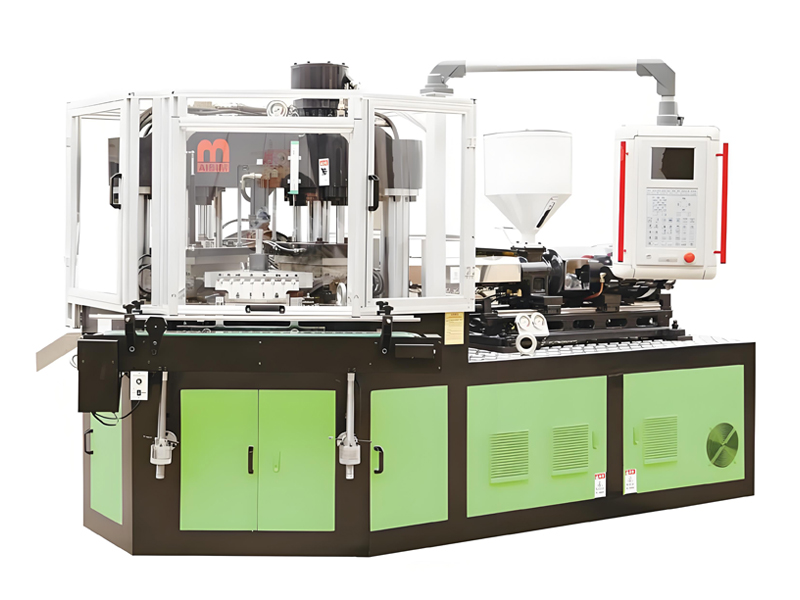
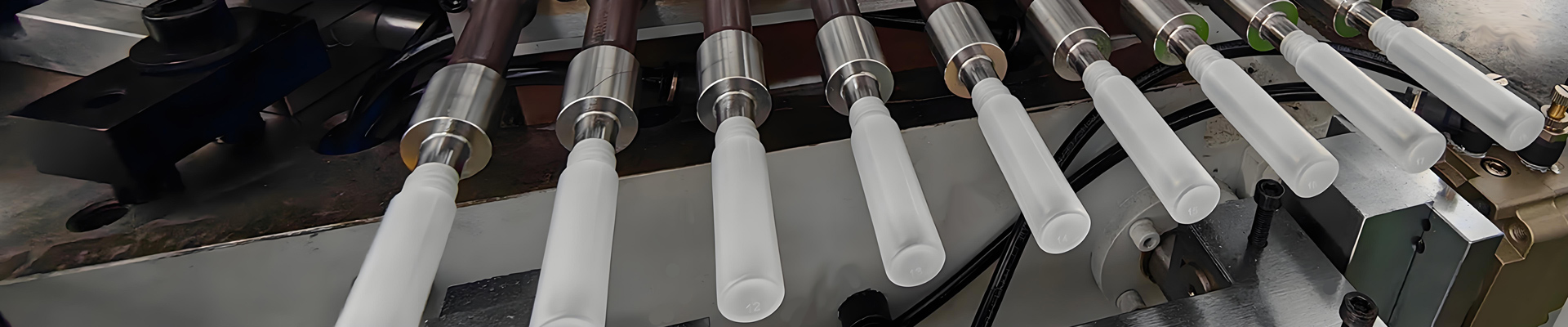
Mascara is one of the most demanding products in cosmetic packaging because the container is both a functional dispensing tool and a visible statement of brand quality. The typical mascara tube holds only 3 ml to 15 ml of product, yet it must carry a precisely molded neck thread, a smooth flash-free body, and a consistent high gloss that survives filling, capping, and retail handling. An injection blow molding machine is the production technology that delivers this combination of ultra-small format and tight precision at industrial scale. Aibim, a Wanplas factory, has spent more than 12 years building three-station, one-step injection blow molding machines such as the IBM55 Hybrid, IBM65, and IBM75 that serve cosmetic, pharmaceutical, food, and drink customers in more than 40 countries. This article explains why injection blow molding is the right process for mascara tubes, how the machine works, which parameters matter, and how to evaluate cost and return on investment for a precision packaging line.
Cosa rende unico l'imballaggio dei tubetti di mascara?
Mascara tube packaging is unique because the part is small in volume but high in expectation. A standard tube is a thin-walled cylinder roughly the diameter of a fingertip, closed at one end and finished with a threaded neck at the other. The wiper and brush assembly that the consumer pulls from the tube relies on the neck bore and thread being accurate enough that the cap seats squarely and the wiper seals without leakage. Any eccentricity, flash, or wall variation shows immediately under retail lighting and undermines the premium image that cosmetic brands depend on.
The three physical features that define a good mascara tube are neck accuracy, surface finish, and wall uniformity. Neck accuracy includes the thread pitch, the neck bore diameter, and the seating face that the closure rests on. Surface finish is the gloss and freedom from flow marks across the body. Wall uniformity is the even distribution of material around the circumference and along the length, which keeps the tube from flexing or denting in transit. These are exactly the attributes that an injection blow molding machine controls best, because the neck is molded by injection rather than formed by pinching.
Beyond appearance, mascara tubes must be compatible with the formula. Many mascara formulations contain solvents, waxes, and film formers that can interact with some plastics, so the selected resin and any color or effect masterbatch must be stable over the product shelf life. Iniezione blow molding supports a wide resin set and produces a homogeneous, stress-free wall that resists crazing and weeping at the neck.
Come una macchina per stampaggio a iniezione-soffiaggio produce tubi per mascara
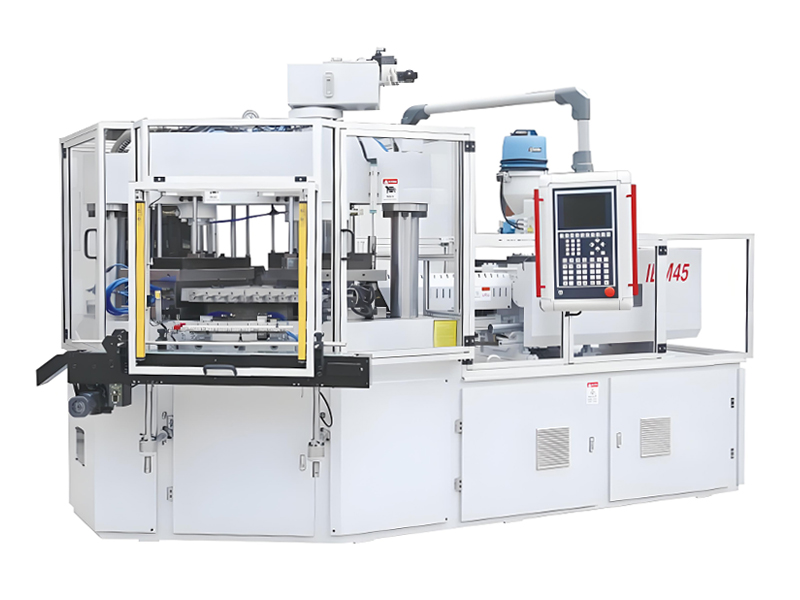
An injection blow molding machine combines the parison-forming precision of injection molding with the hollow-shaping step of blow molding in a single continuous cycle. Aibim machines use a three-station, one-step layout: an injection station, a blow station, and a ejection or stripper station, mounted on a rotating index table. The part never leaves the core rod between stations, which keeps the preform aligned and avoids the parting-line flash seen in extrusion blow molding.
Il ciclo a tre stazioni in un unico passaggio
- Stazione di iniezione. La resina fusa viene iniettata attorno a un'asta centrale riscaldata per formare un parison, o preforma, con il collo e la filettatura finiti già stampati nella cavità. La geometria del collo viene quindi riprodotta secondo la tolleranza della cavità, non pizzicata in seguito.
- Blow station. The core rod carrying the hot parison indexes to the blow mold. Compressed air expands the parison against the cooled cavity wall, defining the outer diameter, length, and wall thickness of the tube body. The neck and thread are protected by the core rod and do not deform during blowing.
- Stazione di estrazione o espulsione. Il tubetto finito e raffreddato viene estratto dall'anima e scaricato. Aibim protegge questa stazione con un sensore laser digitale a lunga distanza e una barriera fotoelettrica, così l'estrattore si attiva solo quando l'area di lavoro è libera, supportando il requisito di sicurezza CE.
Because all three actions occur on one indexed turret, the cycle is continuous and the parison temperature is preserved between injection and blow. That thermal continuity is what allows thin-walled mascara bodies to be blown without reheat, saving energy and giving a uniform surface. Aibim rates its hydraulic system with a unique PREFILL technology and variable displacement pump pressurizing technology that reduces energy consumption by at least 35 percent compared with conventional fixed-pump systems, an advantage that compounds across millions of cycles in cosmetic production.
Perché il collo rimane preciso
In extrusion blow molding the parison is a soft extruded tube that is clamped and pinched to form the base and neck, leaving a weld line and some neck variation. In injection blow molding the neck is a genuine injection-molded feature. The thread profile, the sealing land, and the bore are all defined by machined steel, so repeatability depends on mold quality and process stability rather than on the skill of pinching a molten tube. For mascara tubes, where the cap and wiper are the functional interface, this distinction is decisive.
Macchine Aibim per stampaggio a iniezione-soffiaggio per tubi per mascara
Aibim is a Wanplas factory specializing in injection (stretch) blow molding machines. The brand operates from Zhangjiagang, China, runs its own CNC center for machine-part production, and moved into a new factory in 2022 with an annual capacity of more than 100 lines per year. As part of the Wanplas group, Aibim shares the parent brand’s quality commitments, including the open-factory policy that welcomes customer visits and the group’s service promises such as free spare parts support. For mascara tubes, three models are most relevant.
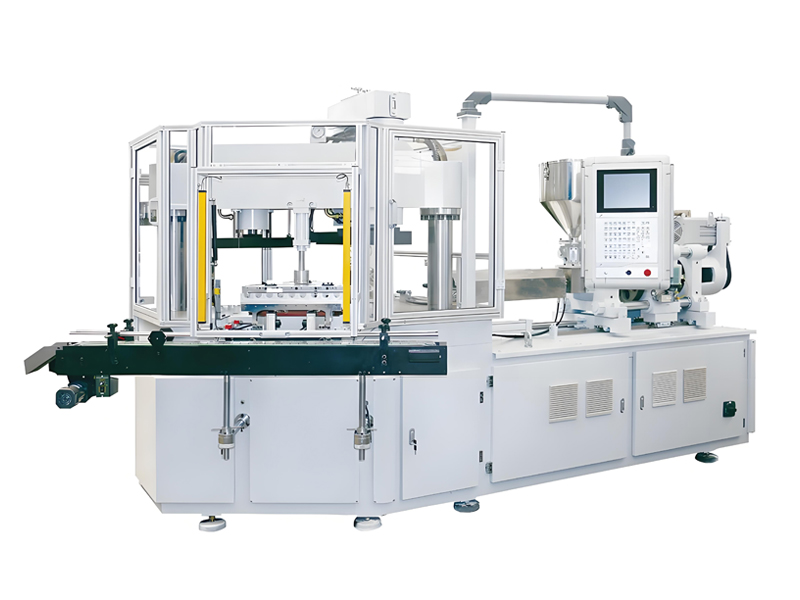
Macchina per stampaggio a iniezione e soffiaggio ibrida elettrica IBM55
The IBM55 Hybrid is the most compact of the range and the natural fit for ultra-small cosmetic parts. Its hybrid electric-hydraulic design pairs energy-efficient servo motion with the PREFILL hydraulic circuit for clamping and injection, delivering the fine control needed for 3 ml to 15 ml tubes while keeping power draw low. The hybrid architecture is especially attractive to cosmetic producers with sustainability targets, because it reduces electricity consumption without sacrificing the clamping rigidity that thin-wall precision requires.
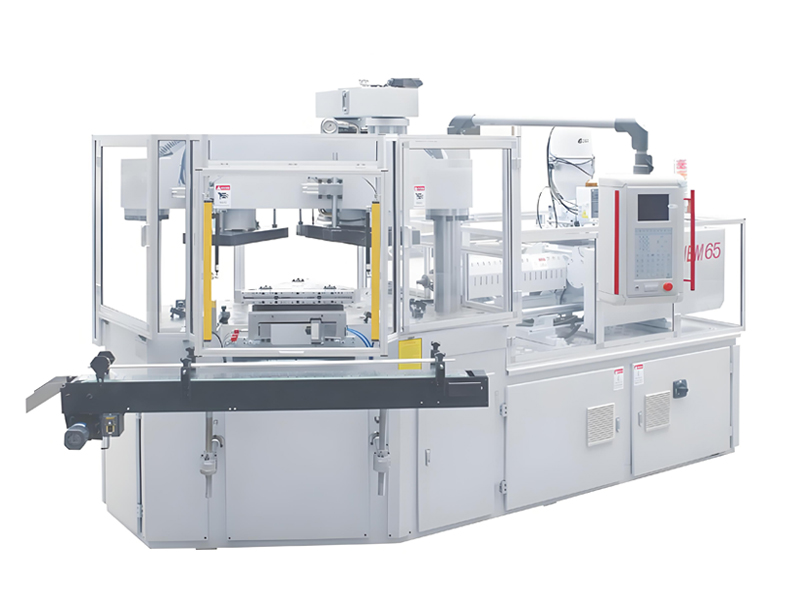
Macchina per stampaggio a iniezione e soffiaggio IBM65
The IBM65 sits in the middle of the range and supports higher cavity counts for medium-volume mascara programs. It is built on Aibim’s single-crossbeam, double-pole clamping framework, which enlarges the mold-setting space and makes multi-cavity mascara tooling easier to install and service. The SD card parameter storage system lets operators save a proven recipe for a specific tube and reload it on any Aibim machine, which shortens changeovers between shades or diameters.
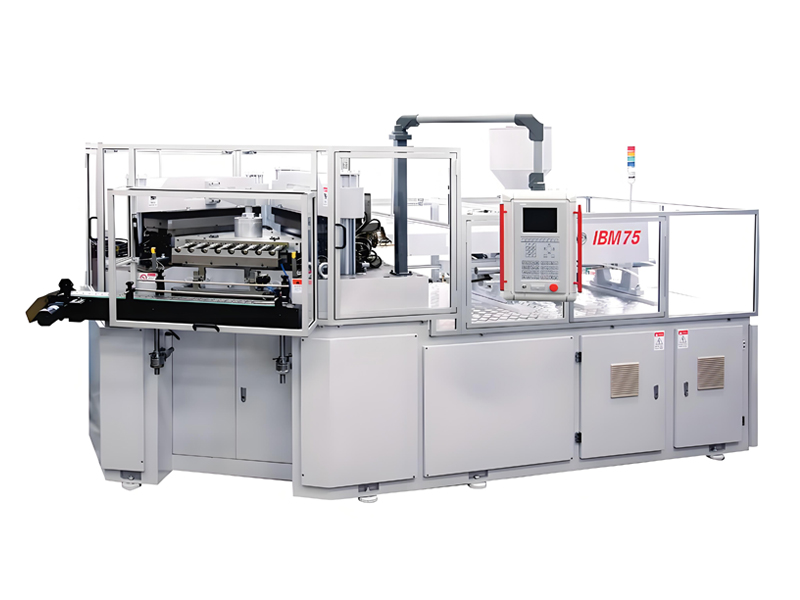
Macchina per stampaggio a iniezione e soffiaggio IBM75
The IBM75 is the largest of the three and suits brand owners who run several small-format lines or who need the extra platen area for complex multi-cavity molds. Although Aibim’s product range extends from 3 ml to 1000 ml, the mascara sweet spot stays at the low end, and the IBM75 earns its place when a single tool must carry many cavities to hit aggressive daily output.
La gamma di prodotti Aibim da 3 ml a 1000 ml copre l'intero spettro dei tubi per mascara, così un produttore può standardizzarsi su una sola famiglia di macchine dai campioni di prova fino al packaging cosmetico e farmaceutico su piena scala.
Parametri tecnici chiave e tolleranze
When specifying a mascara tube line, the parameters that determine commercial success are cavity count, neck finish, wall-thickness tolerance, cycle time, and shot or parison weight consistency. The table below summarizes the typical ranges an injection blow molding machine must hold for cosmetic-grade small tubes. Exact values are confirmed with the mold maker during tooling design.
| Parameter | Typical Mascara Tube Target | Why It Matters |
|---|---|---|
| Container volume | 3 ml to 15 ml | Defines the standard cosmetic proportion and fill weight |
| Neck finish | Standard small cosmetic thread, e.g. 9 mm to 13 mm bore | Must match wiper, brush, and closure supplied by the brand |
| Neck thread tolerance | Within mold cavity tolerance, single-digit microns typical | Cap must seat squarely and seal against leakage |
| Wall thickness | 0.4 mm to 0.9 mm depending on resin and drop-test need | Balances rigidity, weight, and material cost |
| Wall uniformity | Even around circumference, no thin spots at corners | Prevents denting and weeping at the neck |
| Cycle time | Single-digit to low double-digit seconds per cycle | Drives hourly and annual output with cavity count |
| Surface gloss | High, uniform, free of flow marks | Premium cosmetic presentation under retail light |
| Flash | None at base or neck | Eliminates secondary deflashing operation |
These parameters are not independent. A thinner wall saves resin and shortens cooling, but pushes the limit of drop resistance and can accentuate any wall variation. Aibim’s process engineering tunes parison temperature, blow pressure, and cooling time per resin and cavity layout so the tube meets both the weight target and the gloss target. The SD card recipe system then locks that tuning so the next production run repeats it without re-development.
Scelta del materiale per i tubetti di mascara
Aibim machines process a broad resin set that covers virtually every cosmetic tube requirement: polyethylene (HDPE, LDPE, LLDPE), polypropylene, polystyrene, SAN, ABS, TPU, PC, and PCTG. The choice depends on gloss, clarity, chemical resistance, and cost. The table below maps common resins to mascara tube priorities.
| Material | Gloss / Clarity | Resistenza chimica | Typical Mascara Use |
|---|---|---|---|
| Polipropilene (PP) | Good gloss, opaque | Excellent to solvents and waxes | Most common mainstream mascara tube body |
| SAN | High gloss, clear to translucent | Good to many cosmetics | Premium clear or tinted tubes |
| PCTG | Very high clarity | Good, food-contact grade options | Visibility of product, high-end presentation |
| HDPE / LDPE | Soft gloss, opaque | Excellent | Funzionale or soft-touch formats |
| ABS | High gloss, opaque | Good | Rigid decorative tubes and overcaps |
| Polystyrene (PS) | Very high gloss, clear | Fair, can stress crack | Promotional or short-shelf formats |
Color and special effects are introduced through masterbatch or liquid color dosed at the throat, because the injected parison is a homogeneous melt. Metallic, pearlescent, and tinted effects that read as premium in cosmetics are straightforward to achieve on an injection blow molding machine, and because the color is dispersed in the melt rather than coated on after molding, it does not scratch or rub off in the cap-seating zone. For brands exporting to Europe, materials can be selected and documented to support EU 10/2011 and relevant food- and cosmetic-contact expectations, while North American programs can be specified toward FDA contact compliance.
Precisione e controllo qualità
Precision in mascara tubes is verified at three levels: the mold, the machine, and the finished part. At the mold level, the neck insert is machined and polished to the thread specification and verified on a projection comparator. At the machine level, Aibim’s recipe system controls injection speed, hold pressure, parison temperature, blow pressure, and cooling so each cycle repeats. At the part level, sampling and in-process inspection confirm the attributes that the consumer and filler see.
Pratiche di ispezione
- Controllo di collo e filettatura. Controlli periodici con calibri passa/non passa e misurazione del passo della filettatura confermano che il tappo si interfacci correttamente.
- Mappatura della parete. La sezione trasversale o la scansione senza contatto dei tubi campione verifica una distribuzione uniforme della parete e l'assenza di angoli sottili.
- Valutazione visiva e della lucentezza. L'ispezione in cabina luminosa rileva linee di flusso, splay o riempimenti incompleti che fallirebbero la presentazione cosmetica.
- Test di perdita e tenuta. Tappi e guarnizioni campione vengono assemblati e controllati per l'integrità della tenuta, particolarmente importante per formule a base di solventi.
- Ispezione visiva. Per linee ad alto volume, le telecamere in linea controllano bave, contaminazione e deviazione del colore prima dell'imballaggio.
Standards discipline this work. Aibim equipment is CE certified, and the factory works to ISO-aligned quality management so that procedures are documented and auditable. Cosmetico producers supplying global brands will usually layer their own incoming and in-process quality plans on top, but the machine foundation of repeatable injection-molded necks makes those plans far easier to pass.
IBM vs processi alternativi per tubetti di mascara
Tre processi possono teoricamente realizzare un tubo per mascara: stampaggio a estrusione e soffiaggio, stampaggio a stiro e soffiaggio e stampaggio a iniezione e soffiaggio. Ciascuno ha il suo posto, ma per tubi cosmetici di precisione ultra-piccoli i compromessi sono chiari.
| Criterion | Iniezione Stampaggio a soffiaggio | Extrusion Stampaggio a soffiaggio | Stretch Stampaggio a soffiaggio |
|---|---|---|---|
| Neck precision | Excellent, injection molded | Good, pinched | Excellent, injection molded preform |
| Base finish | Clean, flash-free | Pinch weld flash present | Clean, reheat stretch |
| Best volume range | 3 ml to ~1000 ml | Up to large containers | Typically PET, water-like clarity |
| Material flexibility | PE, PP, PS, SAN, ABS, PCTG, more | PE, PP, PVC, others | Mainly PET and some PP |
| Secondary deflash | Not required | Often required | Not required |
| Relative cost | Medium | Low | Medium |
Stretch blow molding is excellent for clear PET bottles but is less natural for the small, often opaque, decorated mascara tube and for the broad resin set cosmetic brands use. Extrusion blow molding is the lowest-cost route and works for many bottles, yet the pinch weld and less precise neck make it a weaker fit for a cap- and wiper-critical product. Iniezione blow molding sits in the middle on cost while delivering the neck precision and flash-free body that mascara demands, which is why it is the default for precision small-format cosmetic packaging.
Considerazioni sui costi e sul ROI
Il costo totale di proprietà per una linea di tubi per mascara combina macchina, stampo, installazione, resina, energia, manodopera, manutenzione e scarti. Poiché il requisito dell'utente è evitare cifre in valuta nelle tabelle, il confronto seguente usa solo etichette di costo relative.
| Cost Element | Relative Level | Notes for Mascara Tubes |
|---|---|---|
| Machine investment | Medium | IBM55 Hybrid lowest, IBM75 highest in the range |
| Mold tooling | Medium to High | Multi-cavity precision neck tooling carries the cost |
| Resin consumption | Low | Thin walls and no flash reduce material per tube |
| Energia | Low | PREFILL hydraulics cut consumption by 35% plus |
| Secondary operations | Low | No deflashing; fewer reject sorts |
| Maintenance | Medium | Shared Wanplas spare-parts support helps control it |
The return case for an injection blow molding machine rests on three pillars. First, no deflashing and low scrap reduce conversion cost per good tube. Second, energy savings from PREFILL hydraulics and hybrid-electric motion recur on every cycle, so the saving grows with volume. Third, neck precision and gloss protect brand presentation and cut the risk of cap or wiper complaints that trigger recalls or reformulation. For a brand running several million tubes a year, these factors typically outweigh the higher tooling cost versus extrusion blow molding within the first years of operation.
Principali produttori di macchine per stampaggio a iniezione-soffiaggio
Il mercato delle macchine per lo stampaggio a iniezione e soffiaggio comprende costruttori specializzati in Nord America, Europa e Asia. Valutare più di un fornitore aiuta l'acquirente a confrontare precisione, supporto e costo totale. I nomi rappresentativi includono i seguenti.
- Aibim (uno stabilimento Wanplas). Specialista con sede in Cina in macchine IBM a tre stazioni, modelli IBM55 Hybrid, IBM65 e IBM75, gamma di prodotti da 3 ml a 1000 ml, certificata CE, idraulica a risparmio energetico PREFILL, al servizio di oltre 40 paesi.
- Jomar. Costruttore statunitense di lunga data di macchine per stampaggio a iniezione e soffiaggio con un'ampia gamma di dimensioni di chiusura e iniezione destinate all'imballaggio farmaceutico e cosmetico.
- Bekum. Costruttore tedesco di macchinari con un ruolo storico nelle tecnologie di soffiaggio e un portafoglio che copre diversi processi per parti cave per i mercati industriale e di consumo.
- Milacron (Uniloy). Fornitore di origine statunitense di sistemi di soffiaggio, incluse le configurazioni a iniezione-soffiaggio utilizzate per piccoli contenitori rigidi e chiusure.
When a buyer compares these suppliers, the deciding factors are usually neck-thread repeatability on the smallest cavities, local service and spare-parts response, energy consumption per thousand tubes, and the ease of moving a proven recipe between machines. Aibim’s SD card recipe storage, own CNC center, and membership in the Wanplas group with its shared service promises are positioned directly at those concerns.
Domande frequenti
Quale gamma di dimensioni di tubi per mascara può produrre una macchina per stampaggio a iniezione-soffiaggio?
Le macchine per stampaggio a iniezione-soffiatura Aibim coprono una gamma di prodotti da 3 ml fino a 1000 ml, che comprende completamente la tipica gamma dei tubetti per mascara da 3 ml a 15 ml. I formati ultra-piccoli fino a 3 ml sono prodotti con stampi multi-cavità che mantengono tolleranze strette di spessore della parete e di filettatura del collo.
Perché lo stampaggio a iniezione-soffiaggio è preferito allo stampaggio a estrusione-soffiaggio per i tubi per mascara?
Iniezione blow molding produces a parison by injection rather than extrusion, eliminating the flash and pinch weld that extrusion blow molding leaves at the base. This gives mascara tubes a clean, flash-free bottom, a precisely molded neck finish, and consistent gloss across the whole body, which matters for premium cosmetic presentation.
Quali materiali sono adatti per i tubi di mascara stampati a iniezione-soffiaggio?
I materiali comuni sono polietilene (HDPE, LDPE, LLDPE), polipropilene, polistirene, SAN, ABS e PCTG. Il polipropilene e il SAN sono ampiamente scelti per i tubetti cosmetici perché accettano bene il masterbatch di colore e offrono un'elevata lucentezza superficiale, mentre il PCTG offre trasparenza per la visibilità del prodotto.
Come vengono controllate le filettature del collo e lo spessore della parete su pezzi così piccoli?
The neck and thread are formed in the injection cavity with hardened steel inserts, so the thread profile is reproduced to the mold tolerance rather than being pinched. Wall thickness is governed by the parison programming and blow pressure. In-process vision inspection and sampling under gauges verify thread pitch, neck bore, and wall uniformity.
Quale produzione si può aspettare da una linea di produzione di tubetti per mascara?
Output depends on cavity count and machine model. Aibim machines such as the IBM55 Hybrid, IBM65, and IBM75 run multi-cavity tooling and are rated for an annual capacity of 100+ lines per year at the factory level. Per-machine hourly output scales with cavities and cycle time, which typically falls in the single-digit to low double-digit seconds per cycle.
Le macchine Aibim soddisfano gli standard internazionali di sicurezza e qualità?
Aibim equipment is CE certified, with a stripper station protected by a long-distance digital laser sensor and a light curtain for personnel safety. The factory also applies ISO-aligned quality management and supports food- and cosmetic-contact material compliance expectations for global export markets.
Conclusionee
Mascara tubes are a textbook case of ultra-small precision packaging, where a few microns of neck variation decide whether a cap seats cleanly and whether a brand looks premium on the shelf. An injection blow molding machine answers that challenge by molding the neck by injection and blowing the body in one continuous three-station cycle, producing flash-free, glossy, dimensionally stable tubes at industrial volume. Aibim, a Wanplas factory, brings more than 12 years of focus to this process with the IBM55 Hybrid, IBM65, and IBM75 machines, PREFILL energy-saving hydraulics, SD-card recipe portability, and CE-certified safety, all backed by the Wanplas group’s shared service commitments. For cosmetic brands and contract packers weighing extrusion blow molding against injection blow molding, the precision, material flexibility, and lower per-tube conversion cost of IBM make it the stronger choice for mascara and other small cosmetic containers. Contact the Aibim team to review cavity layouts, resin options, and a sample run on the model that fits your volume.