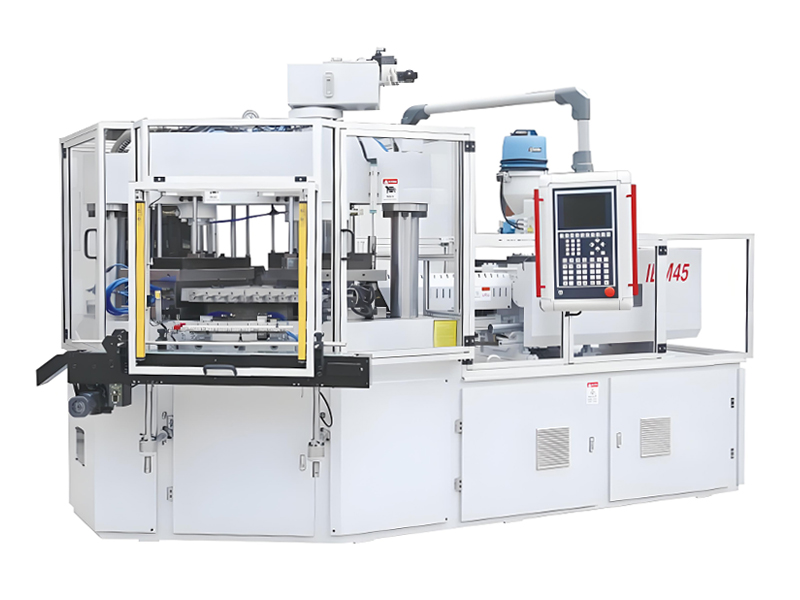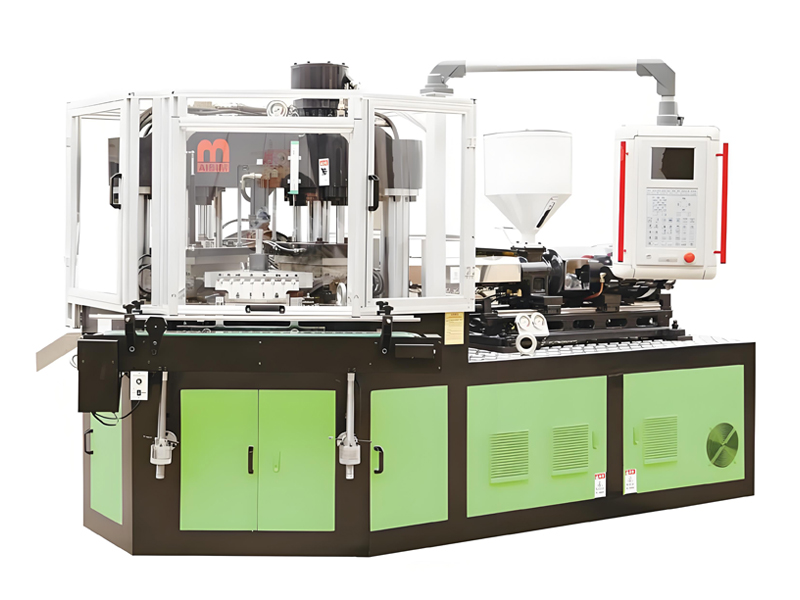
Aibim, a Wanplas factory with more than 12 years of experience in plastic machinery manufacturing, builds three-station, one-step injection blow molding (IBM) machines for containers from 3 ml to 1000 ml. Aibim runs its own CNC machining center for machine parts, moved into a newly purchased factory in 2022, and holds an annual production capacity of more than 100 machines. Many buyers focus on the machine specification alone, yet the workshop around the machine decides whether that specification is actually delivered every shift. This guide explains the power, space, cooling, compressed-air, and environmental standards an IBM workshop must meet, and it gives a practical pre-installation checklist you can apply before the machine arrives.
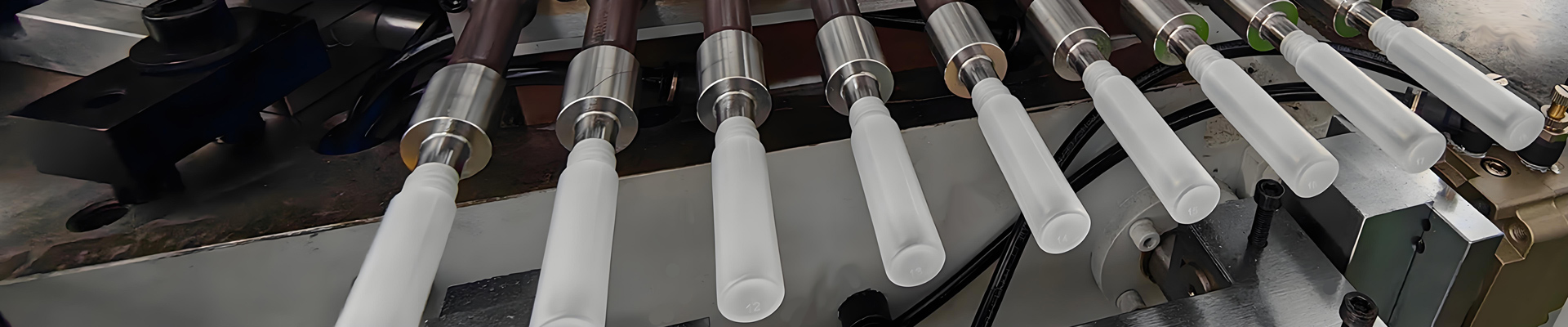
Injection blow molding is a one-step process: the resin is plasticized in the barrel, injected to form a parison in the injection cavity, transferred to the blow station, and expanded against the blow mold, then ejected. Because the parison and bottle are handled in a closed, oriented system, IBM naturally produces bottles with a consistent neck finish and no flash, which is why it suits pharmaceutical, oral-liquid, eye-drop, cosmetic, and health-supplement containers. The trade-off is that the process depends on stable utilities. A voltage dip, a warm cooling supply, or oily compressed air can quietly erode output and quality. The sections below turn those risks into concrete workshop requirements.
This article is written for plant engineers, project managers, and procurement teams who are laying out a new IBM line or upgrading an existing one. It is deliberately focused on the workshop shell, the utilities, and the conditions to verify before start-up. It does not cover mold design or operator training systems in depth; those are addressed in Aibim’s separate turnkey program. By the end you will have the data to size your electrical supply, reserve the right floor area, specify the chiller and air system, and define the cleanliness level your product legally and commercially requires.
Why Workshop Planning Decides IBM Machine Performance
Aibim IBM machines are precise, repeatable systems, but they are only as stable as the environment they sit in. The three-station index table, the servo or hybrid drive, and the mold-temperature balance all assume a steady supply of electricity, cooling water, and clean compressed air. When any of those drift, the symptoms look like machine faults when they are really workshop faults.
Consider cycle consistency. The injection station must hold a tight melt and cavity temperature window to form a uniform parison. If the cooling water creeps from 12 to 20 degrees Celsius because the chiller is undersized, the mold-temperature circuit cannot hold setpoint, the parison cools unevenly, and wall thickness variation grows. The operator then slows the cycle to compensate, and rated output drops. None of this appears as a broken part; it appears as lost bottles per hour.
Consider electrical stability. The servo and variable-displacement hydraulic system react to voltage. Aibim’s PREFILL technology and variable-displacement pump pressurizing method keep the actual running power well below the installed rating, but the drives still need a clean three-phase supply. Harmonics from other shop loads, unbalanced phases, or a weak neutral can trip protective devices or corrupt the PLC logic. A small uninterruptible power supply at the control cabinet removes that risk for a modest cost.
Consider cleanliness. An IBM bottle for eye drops leaves the blow mold as a finished, sealed-neck container. If the surrounding air carries oil mist, fibers, or high particle counts, those contaminants land on the neck and shoulder exactly where the cap must seal. The workshop cleanliness grade is therefore not a nice-to-have for regulated products; it is part of the product specification. The later sections quantify what grade maps to which industry.
Workshop conditions are not overhead cost around the machine. They are the invisible half of the machine specification, and they determine whether the rated output, neck accuracy, and container cleanliness are actually achieved on the factory floor.
Power Supply System: Voltage, Load, and Transformer Sizing
The electrical supply is the first item to lock down, because it dictates the transformer, the cable, and the protection devices, and those are hard to change after the slab is poured. Aibim builds IBM machines to match the local grid, so the discussion starts with the standard you need.
Common voltage standards and how Aibim handles them
Most Aibim IBM machines ship for three-phase 380 to 415 V at 50 Hz, which covers China, most of Asia, the Middle East, and parts of Europe. The same machine platform can be rewound and re-controlled for 220 to 240 V or 480 V at 60 Hz for the Americas, and for 200 V at 60 Hz for Japan. Confirm the regional standard at order time so the motor terminals, contactors, and the transformer in the control cabinet are correct. A mismatch is not a field fix.
| Grid standard | Voltage | Frequency | Phase | Typical regions |
|---|---|---|---|---|
| Default Aibim build | 380 to 415 V | 50 Hz | 3-phase | China, Asia, Middle East, parts of Europe |
| Americas low-voltage | 220 to 240 V | 60 Hz | 3-phase | Parts of North and South America |
| Americas high-power | 480 V | 60 Hz | 3-phase | North America heavy supply |
| Japan | 200 V | 60 Hz | 3-phase | Japan |
Installed power versus actual running power
The nameplate installed power is the worst-case sum of every motor and heater at full draw. In practice the IBM process never draws all of that at once. The servo or hybrid drive accelerates the index table and clamp only when needed, and the PREFILL hydraulic system only pumps the flow the stroke demands. The actual running power therefore sits at roughly 55 to 75 percent of installed power during normal production. For planning, size the supply on installed power plus the ancillaries, but expect the meter to read lower in steady state.
Transformer capacity and the simultaneity factor
A single machine is rarely the only load. Around an IBM line you also run a chiller, a mold-temperature controller, a compressed-air compressor, a resin dryer, conveyors, and the workshop air conditioning. These do not all peak together, so a simultaneity factor of 0.7 to 0.85 is realistic for the supporting utilities. The transformer capacity is then estimated as:
Transformer kVA ≈ (machine installed power + ancillary installed power) × simultaneity factor ÷ power factor
With a power factor around 0.85 and a simultaneity factor near 0.8, a single IBM75 plus its chiller and dryer typically needs a transformer in the 80 to 100 kVA band, while a six-machine pharmaceutical line with redundant air and cooling can reach 250 kVA or more. Always confirm the final figure against Aibim’s confirmed machine rating and your local ancillary choices.
Cable, protection, grounding, and power quality
Select the incoming cable cross-section from the continuous running current with a margin for starting inrush, not from the nameplate alone. The main breaker should be coordinated so it trips on a fault but rides through the brief servo acceleration current. A residual-current device protects personnel on the control and auxiliary circuits. The grounding electrode resistance should be 4 ohms or lower, and the supply voltage should stay within plus or minus 10 percent of nominal; beyond that, drives derate or fault.
Two power-quality issues deserve attention in a shared plant. First, harmonics from variable-frequency drives elsewhere in the building can distort the supply; a line reactor or a harmonic filter at the IBM incoming panel reduces this. Second, three-phase imbalance above a few percent heats motors and skews the drive bus; balance the loads across phases during layout. Finally, place a small UPS or a regulated power module on the PLC and HMI supply so a momentary sag during a nearby start-up does not reset the controller and scrap a parison.
Workshop Area and Machine Layout
Floor space is the second fixed decision. The machine footprint is only the beginning; the real area is the footprint plus the clearance you need to load molds, service the injection unit, remove bottles, and move material. Undersize this and every maintenance task becomes a bottleneck.
Clearance and aisle rules
Reserve at least 800 to 1200 mm of clear space on the non-opening sides of the machine for service and ventilation, and at least 1500 mm on the mold-opening side so the take-out robot, conveyor, or operator can work and so a mold can be slid out onto a trolley. The rear of the injection unit needs room to pull the screw and barrel for cleaning. Pedestrian aisles should be 1200 mm or wider, and forklift aisles 2500 mm or wider so pallets of resin and finished cartons move without squeezing past the machine.
Supporting zones
An IBM cell is more than the machine. Plan a mold storage and maintenance area close to the line but clear of traffic, a raw-material zone with the dryer and loader, a finished-goods and short-term buffer area, and a small quality-control station for wall-thickness and leak checks. Keeping these zones adjacent but separated reduces both walking time and cross-contamination of the bottle neck area.
Multi-machine layout and area ranges
When you run several machines, the per-machine area drops because aisles and support zones are shared, but you still need machine-to-machine spacing for service and heat removal. The table below gives practical workshop area ranges for common configurations, including all the zones above.
| Configuration | Machines | Recommended workshop area | Layout note |
|---|---|---|---|
| Pilot or trial line | 1 | 40 to 60 m² | Machine plus mold rack, one material pallet, small buffer |
| Small production cell | 3 | 120 to 180 m² | Shared aisle, central QC and material zone |
| Dedicated production line | 6 | 240 to 360 m² | Two rows with central service corridor, separate clean buffer |
Arrange multiple machines in two parallel rows facing a central service corridor when the count reaches six. This keeps utilities runs short, gives each machine a 1500 mm service side, and lets one technician walk the line without crossing forklift paths. Leave the corridor free of stored material; material and finished goods belong in their own zones at the line ends.
Floor, Foundation, and Vibration Control
The floor carries the machine weight and must stay flat and stable through years of indexing cycles. A weak or uneven slab causes the tie-bar alignment to drift and the index table to lose repeatability, which shows up as intermittent flash or parison mis-transfer.
Slab thickness, grade, and flatness
Use a reinforced concrete slab with a thickness and reinforcement grade specified by a structural engineer for the local soil. For the machine weights in this article a standard industrial slab of 150 to 200 mm with mesh and doweled joints is typical, but the engineer should confirm. The finished surface should be flat within a few millimeters over the machine footprint so shimming is minimal. The floor must be oil-resistant and slip-resistant, because hydraulic lines and barrel zones can weep, and operators walk the line with full resin bags.
Bearing capacity and anchoring
The machine weight is about 6.8 to 9.8 tons depending on model, spread over the base so the contact pressure is in the range of 10 to 14 kPa for a normal reinforced slab. If your soil or slab is marginal, thicken the local pad under each machine. Most Aibim IBM machines are stabilized with leveling feet and can run without permanent anchor bolts for straightforward installations, but anchor bolts are recommended where the floor is soft, where the machine sits on an upper level, or where local code requires seismic restraint. Discuss anchoring with Aibim when you share the workshop drawings.
Vibration and isolation
The IBM process is low-vibration compared with high-tonnage presses, yet the index table and clamp still transmit pulses. If the machine sits near precision measurement equipment or on a flexible upper floor, place elastomer or spring isolation pads under the feet to protect both the machine and the neighbor. Keep the machine away from heavy stamping or grinding nearby that shares the same slab, because transmitted vibration degrades parison transfer accuracy over time.
Ceiling Height and Lifting for Installation
Ceiling height is easy to forget and expensive to fix. The machine height is only part of the story; the hopper, the vacuum loader, and the lifting path add the rest.
Clear internal height
Plan a clear internal height that exceeds the machine height plus the hopper and loader, which usually means about 3.2 to 3.6 meters from finished floor to the lowest obstruction. If you run a central feeding system with silos above the line, add the silo and pipe height. Do not let ductwork, sprinkler branches, or lighting sit so low that the loader cannot be removed for service.
Lifting and access path
Provide a hoist or an overhead crane sized for the machine weight, or at minimum a mobile gantry rated for it, so the machine and heavy molds can be set and later removed. The door and the approach corridor from the truck to the machine position must clear the crate width and height; for a 3.6 m long machine the door should be at least 2.4 m wide and 2.8 m high, and the path must turn without a tight radius that traps the crate. Map the unloading, lifting, and final set points on the workshop drawing before the delivery date.
Cooling System: Chiller, Water Quality, and Mold Temperature
Cooling is the utility most often undersized, and it is the one that most directly limits cycle speed. An IBM machine rejects heat from the hydraulic oil, the mold-temperature circuits, and the barrel and plasticizing zones. Cool all three well and the machine holds setpoint and runs fast.
Chiller capacity and supply temperature
Size the chiller from total heat rejection, which is roughly the actual running power plus a margin for the dryer and ancillaries. Aibim specifies a cooling-water flow per model, from about 18 L/min on the IBM55 Hybrid to about 30 L/min on the IBM75, at a supply temperature of 8 to 15 degrees Celsius. Use the lower end of that range for high-cycle pharmaceutical work and the upper end for general daily-chemical production. Always insulate the supply and return lines so the set temperature reaches the mold rather than the surrounding air.
Water quality
Closed-loop cooling water should be controlled for pH, hardness, and conductivity to protect the mold channels and the chiller heat exchanger. A practical window is pH 7.0 to 8.5, low hardness to limit scaling, and controlled conductivity to limit corrosion. Treat and filter the loop, and test it periodically; a fouled mold channel is a slow, invisible cycle-killer. For open cooling towers, use biocide and side-stream filtration and keep the tower away from the air intake of the clean zone.
Mold temperature and freeze protection
The injection and blow molds are held on their own temperature loops, often with separate zones for the core and cavity. A dedicated mold-temperature controller per machine, or a zoned central unit, keeps each cavity within its narrow window. In cold climates, drain or glycol-treat the loop and insulate the pipes so a weekend shutdown does not burst a line. Keep the chiller and the mold-temperature unit in a ventilated plant area, not inside the clean zone, to avoid dumping their heat into the controlled environment.
Compressed Air: Pressure, Purity, and Distribution
The blow function is the one place an IBM machine needs compressed air, and for regulated products the air purity is part of the bottle’s cleanliness. Treat the air system as a product-contact utility, not a convenience.
Pressure and consumption
The blow function normally needs 0.6 to 1.0 MPa, with most Aibim configurations designed around 0.8 MPa. Pneumatic consumption is modest, about 0.4 to 0.6 cubic meters per minute depending on model, because the parison is already formed and only needs expansion. Size the compressor with a receiver tank so pressure stays steady through the blow stroke; a receiver of roughly 0.4 to 1.0 cubic meters is typical depending on the number of machines sharing the ring.
Purity for pharmaceutical and food contact
For pharmaceutical, oral-liquid, and food-contact bottles the air must be oil-free, dried to a dew point of minus 20 to minus 40 degrees Celsius, and filtered to an oil content near 0.01 milligrams per cubic meter, which is the medical-grade threshold. An oil-free compressor is the safe choice here, because even a trace of lubricant aerosol lands on the bottle neck and defeats the clean process. The distribution ring should use corrosion-resistant pipe with a falling slope and drain legs, and the pressure drop from the receiver to the last machine should stay small so every cavity sees the same blow pressure.
When an oil-free compressor is mandatory
The judgment rule is simple: if the bottle touches a regulated product, specify oil-free air. For purely non-contact daily-chemical packs made in a general workshop, a quality filtered lubricated compressor may be acceptable, but many plants standardize on oil-free to keep one air spec across all lines. Aibim can advise the grade that matches your product and market; the safest path is to plan oil-free from the start.
Environmental Temperature, Humidity, and Cleanliness
The air around the machine does two jobs: it protects the operator and the electronics, and for regulated products it protects the bottle. The standard you need depends on what you fill.
Temperature and humidity baseline
Keep the workshop at 18 to 28 degrees Celsius and relative humidity at 45 to 65 percent. This band protects the PLC and drives, keeps the resin dryer efficient, and limits static that attracts dust to the bottle shoulder. Outside this band, the hydraulic oil viscosity shifts, the dryer works harder, and condensation risk on cold mold surfaces rises.
Cleanliness grades by industry
For cosmetic vials and daily-chemical small packs, a general, well-ventilated, and regularly cleaned workshop is usually enough. For pharmaceutical bottles, eye-drop vials, and oral-liquid bottles in regulated markets, plan a controlled environment aligned with ISO 14644 Class 8 thinking and a Grade D clean-area concept. That means positive pressure of about 5 to 10 Pa relative to surrounding spaces, a defined number of air changes per hour, and filtration through pre, fine, and high-efficiency stages. The bottle-forming and ejection area is kept cleaner than the general corridor, with separate gowning and buffer rooms so people and material enter through filtered transitions rather than straight from the plant.
Cleanliness is graded by product, not by machine. An IBM75 can run in a general workshop for shampoo packs or inside a Grade D clean area for eye drops. The workshop grade is a property of the bottle’s end use, and it should be fixed before the slab is poured.
The relative investment for the environment rises from general ventilation through filtered clean zones to full Grade D clean-area construction with air handling and monitoring. Treat it as Low for general daily-chemical work, Medium for a filtered and temperature-controlled room, High for an ISO Class 8 style clean zone, Very High for a Grade D clean area with air handling and monitoring, and Premium for redundant systems with full environmental qualification. Choose the lowest grade that satisfies your market and product, then hold it with discipline.
Ventilation, Heat Removal, and Noise Control
The machine and its ancillaries reject heat that the cooling loop does not capture. That heat becomes an air-conditioning load, and if ignored it pushes the room above the 28 degree ceiling.
Heat load and air conditioning
Estimate the room cooling load from the machine running power plus the chiller and compressor reject plus solar and people loads. A single IBM line can reject several kilowatts into the room even after the closed cooling loop carries the mold and oil heat away, because the dryer, the control cabinet, and the hydraulic losses all land in the air. Provide general ventilation with filtered make-up air, and add local exhaust at the dryer and the resin feed if dust or odor is present. In a clean zone, the air-handling unit does this work as part of the cleanliness design.
Noise
Aibim IBM machines are relatively quiet because the hybrid and servo systems replace much of the hydraulic pump noise, and the process has no high-pressure parison burst. Typical operating noise is below 80 dB(A) at the operator position. If the line sits in a shared or office-adjacent space, enclose the compressor and the chiller remotely and use acoustic screens around the plant room; the machine itself rarely needs screening.
Raw Material Handling and Warehousing
Resin quality and its storage feed directly into bottle clarity and neck cleanliness. The workshop plan should separate dry, clean resin from the process dust and the finished goods.
Feeding, drying, and central systems
Two feeding styles are common. A single machine can use its own hopper loader and dryer beside the injection unit, which is simple and flexible. Several machines can share a central feeding system with a silo and distributed dryers, which saves floor space and standardizes moisture control. For hygroscopic resins the dryer must reach the resin’s target moisture before the barrel, because the IBM parison is thin and intolerant of steam bubbles that become silver streaks.
Storage discipline
Keep resin off the floor on pallets, in a dry area away from the loading dock where humidity enters, and protected from pests and direct sunlight. Use first-in-first-out rotation so older lots run first and lot traceability stays clean, which matters for pharmaceutical and food-contact documentation. Separate approved resin from holds and rejects, and keep the layout tidy so the neck-finishing area is never downwind of an open resin bag.
Safety and Fire Protection
Safety is built into the machine and into the room. Aibim machines follow CE-aligned guarding with an interlocked safety door, a light curtain at the operator side, and a long-distance digital laser sensor at the stripper station to confirm the mold is clear before the next index. The workshop must match that discipline.
Machine and personnel safety
Wire a clearly marked emergency stop within reach of the operator and at the main panel. Keep the safety door interlock and the light curtain functional and never bypass them for production speed. Guard the index table and the ejector with fixed fencing so hands cannot enter the moving zone. Train every operator on the lockout-tagout sequence before any barrel pull or mold change, and post the procedure at the line.
Fire, escape, and hazardous storage
Divide the workshop into fire compartments sized to the local code, place the correct class and count of extinguishers on mapped points, and keep escape routes lit and unobstructed at all times. Store purge material, lubricants, and cleaning solvents in a dedicated, ventilated cabinet away from the electrical panel and the resin. Keep the main electrical switch accessible and labeled, and rehearse the evacuation plan with the line team so a real alarm is routine rather than confusing.
Aibim IBM Machine Series and Workshop-Relevant Specs
The Aibim range covers three models, each a three-station, one-step IBM machine with the PREFILL hydraulic system and CE-aligned safety. The figures below are typical engineering reference values for workshop planning; the confirmed figures are provided by Aibim against your final configuration and mold. They are listed because these are the numbers your electrician, your civil engineer, and your chiller supplier actually need.
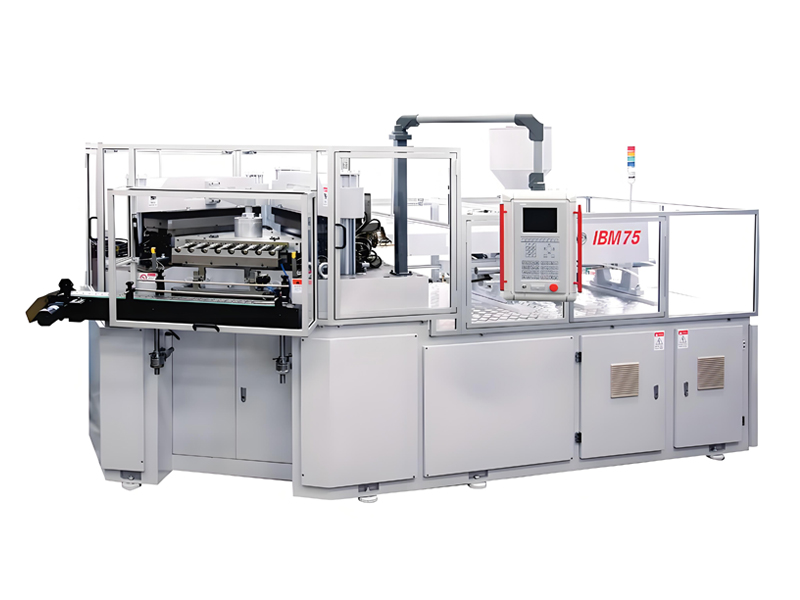
IBM75 injection blow molding machine
The IBM75 is the largest of the three and suits containers from about 50 to 1000 ml, including health-supplement bottles and larger daily-chemical packs. It carries the highest clamping force and the widest mold window in the range.
| Parameter | IBM75 (reference) |
|---|---|
| Clamping force | 75 ton class (about 750 kN) |
| Container range | 50 to 1000 ml |
| Installed power | about 32 kW |
| Actual running power | about 20 kW |
| Dimensions (L × W × H) | 3600 × 1850 × 2200 mm |
| Machine weight | about 9800 kg |
| Floor load requirement | about 14 kPa |
| Cooling water flow | about 30 L/min |
| Cooling water temperature | 8 to 15 °C |
| Compressed air consumption | about 0.6 m³/min |
| Compressed air pressure | 0.8 MPa |
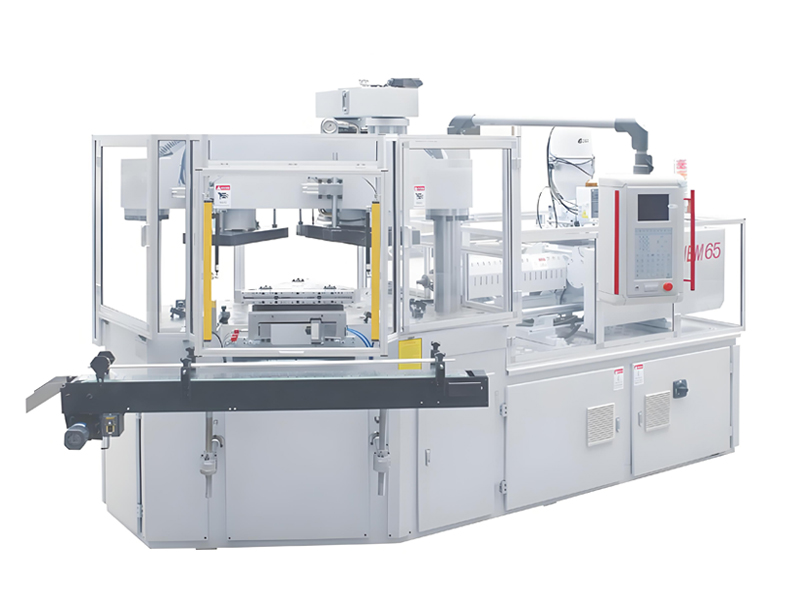
IBM65 injection blow molding machine
The IBM65 fits containers from about 10 to 500 ml and is a common choice for oral-liquid, pharmaceutical, and cosmetic bottles where the volume is mid-range. It balances footprint and output for a compact cell.
| Parameter | IBM65 (reference) |
|---|---|
| Clamping force | 65 ton class (about 650 kN) |
| Container range | 10 to 500 ml |
| Installed power | about 26 kW |
| Actual running power | about 16 kW |
| Dimensions (L × W × H) | 3300 × 1650 × 2100 mm |
| Machine weight | about 8200 kg |
| Floor load requirement | about 12 kPa |
| Cooling water flow | about 24 L/min |
| Cooling water temperature | 8 to 15 °C |
| Compressed air consumption | about 0.5 m³/min |
| Compressed air pressure | 0.8 MPa |
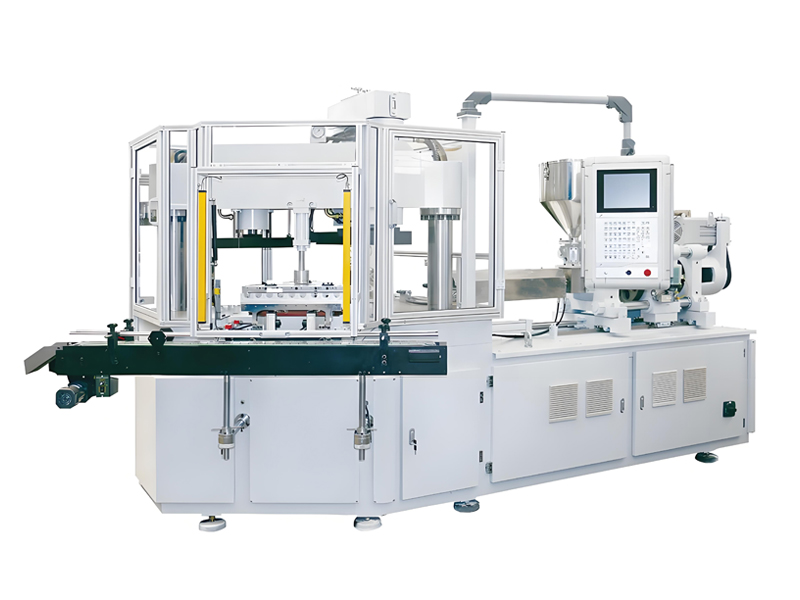
IBM55 hybrid electric injection blow molding machine
The IBM55 hybrid electric is the most compact and the most energy-efficient of the range, suited to small containers from 3 to 250 ml such as eye-drop vials and miniature cosmetic vials. The hybrid drive pairs electric indexing and clamp motion with a PREFILL hydraulic core, which is why its actual running power is the lowest in the lineup.
| Parameter | IBM55 Hybrid (reference) |
|---|---|
| Clamping force | 55 ton class (about 550 kN) |
| Container range | 3 to 250 ml |
| Installed power | about 22 kW |
| Actual running power | about 12 kW |
| Dimensions (L × W × H) | 3000 × 1500 × 2000 mm |
| Machine weight | about 6800 kg |
| Floor load requirement | about 10 kPa |
| Cooling water flow | about 18 L/min |
| Cooling water temperature | 8 to 15 °C |
| Compressed air consumption | about 0.4 m³/min |
| Compressed air pressure | 0.8 MPa |
All three share the same three-station, one-step principle and the same utility pattern; they differ in clamping force, container range, and the floor and power they require. For matched auxiliary equipment such as chillers and mold-temperature controllers, Wanplas can supply coordinated units so the whole cell is specified from one source and the cooling and air numbers above are met consistently.
Application Industries and Their Cleanliness Levels
The end product decides the workshop grade, so it is worth mapping the common IBM applications to the environment they need. Aibim IBM machines serve pharmaceutical, food and drink, and cosmetic markets, and the container size spans 3 ml to 1000 ml.
Pharmaceutical and medical
Pharmaceutical bottles, oral-liquid bottles, and eye-drop vials are the strictest case. Eye-drop vials in the 3 to 30 ml range are typically run on the IBM55 Hybrid inside a Grade D clean area with oil-free air and filtered make-up air, because the drop must stay sterile at the neck. Oral-liquid and general pharmaceutical bottles in the 30 to 150 ml range are usually run on the IBM65 under the same cleanliness thinking. The neck finish from IBM is precise and flash-free, which helps the cap seal, but the surrounding air must not contaminate that finish.
Cosmetic and personal care
Cosmetic vials and small personal-care jars from about 10 to 100 ml are run on the IBM55 or IBM65. Cosmetic plants often choose a filtered, temperature-controlled room rather than a full Grade D clean area, because the product is not sterile but the brand still demands a clean, glossy shoulder with no particles. The IBM process suits this well because the bottle is handled in an oriented, enclosed transfer rather than dropped on a belt.
Health supplement and daily chemical
Health-supplement bottles from about 100 to 1000 ml are a natural fit for the IBM75, often in a general but tidy workshop with good ventilation. Daily-chemical small packs such as shampoo and lotion sample bottles are similar: the grade is general, the priority is output and neck consistency, and the air system can be a quality filtered compressor rather than oil-free medical-grade. The difference between these industries is therefore not the machine but the cleanliness discipline around it.
Requirement to Model and Workshop Configuration Table
The table below links a typical requirement to a recommended Aibim model, the machine count, the cleanliness grade, and the resulting workshop area, power, cooling, and air configuration. Use it as a starting layout, then refine the numbers with Aibim against your confirmed machine ratings and local ancillaries.
| Requirement scenario | Recommended model | Units | Cleanliness grade | Workshop area | Power supply | Cooling and air |
|---|---|---|---|---|---|---|
| Eye-drop vials 3 to 30 ml, high volume | IBM55 Hybrid | 6 | ISO Class 8 / Grade D | 300 to 360 m² | 250 kVA transformer | 2 chillers about 20 kW; 2 oil-free receivers about 1 m³ at 0.8 MPa |
| Oral-liquid and pharma bottles 30 to 150 ml | IBM65 | 3 | ISO Class 8 / Grade D | 150 to 180 m² | 160 kVA transformer | 1 chiller about 25 kW; 1 oil-free receiver about 0.6 m³ |
| Cosmetic vials 10 to 100 ml | IBM65 / IBM55 | 3 | Filtered, temp-controlled | 120 to 160 m² | 125 kVA transformer | 1 chiller about 20 kW; 1 receiver about 0.6 m³ |
| Daily-chemical small packs 50 to 500 ml | IBM75 | 1 to 3 | General ventilation | 60 to 160 m² | 80 to 160 kVA | 1 chiller 15 to 30 kW; receiver about 0.6 m³ |
| Health-supplement bottles 100 to 1000 ml | IBM75 | 3 | General, Grade D optional | 150 to 180 m² | 160 kVA transformer | 1 chiller about 30 kW; receiver about 0.6 m³ |
This table intentionally separates the machine choice from the workshop grade. Two plants making the same bottle on the same IBM65 can need very different areas and air specs because one ships to a regulated market and the other does not. Set the grade from the product, then size the room and utilities to that grade.
Pre-Installation Checklist Before First Start-Up
The single most useful document for a smooth commissioning is a pre-installation checklist completed before the truck arrives. Aibim reviews your workshop drawings against this checklist, and the Yes-No columns below are the ones to verify on site. Resolve every No before start-up; a missing ground or a weak chiller turns a one-day commissioning into a two-week delay.
| Category | Check item | Target | Yes / No |
|---|---|---|---|
| Electrical | Correct regional voltage and frequency supplied | 380 to 415 V 50 Hz or as ordered | |
| Electrical | Transformer and cable sized for installed plus ancillaries | Per Aibim confirmed rating | |
| Electrical | Ground resistance measured | 4 ohms or below | |
| Electrical | UPS on PLC and HMI supply | Fitted | |
| Water | Chiller capacity matches total heat rejection | 8 to 15 °C supply | |
| Water | Flow per machine available at the inlet | 18 to 30 L/min per model | |
| Water | Loop water quality controlled | pH 7.0 to 8.5, low hardness | |
| Air | Blow pressure at the ring | 0.8 MPa stable | |
| Air | Purity for product contact | Oil-free, dew point minus 20 to minus 40 °C, 0.01 mg/m³ oil | |
| Floor | Slab strength and flatness | 10 to 14 kPa, flat surface | |
| Floor | Oil-resistant, slip-resistant finish | Confirmed | |
| Space | Side and mold-opening clearance | 800 to 1200 mm sides, 1500 mm opening | |
| Space | Clear ceiling height and lifting path | 3.2 to 3.6 m, hoist or crane sized | |
| Environment | Temperature and humidity | 18 to 28 °C, 45 to 65 percent RH | |
| Environment | Cleanliness grade built where required | ISO Class 8 / Grade D if regulated | |
| Personnel | Trained operator and lockout knowledge | Training completed | |
| Personnel | Emergency stop and escape route verified | Marked and clear |
Hand the completed checklist to Aibim before shipment. It shortens installation and commissioning, prevents the common surprises, and gives both sides a signed baseline of what the workshop promised to deliver.
Service and Support for a Smooth Commissioning
Aibim, as a Wanplas factory, backs the machine with the group’s shared service commitments so the workshop plan above is matched by support after delivery. The goal is that the line reaches rated output quickly and stays there.
Before and during delivery
Every machine is tested before shipment so the utilities and the process are verified at the factory, not discovered at your site. Aibim reviews your workshop drawings and the pre-installation checklist, then dispatches engineers for installation and commissioning on site. Because Aibim runs its own CNC machining center, critical parts are made and matched in-house, which shortens lead time and keeps the spare-part fit precise.
Spare parts, training, and remote support
The Wanplas group policy supplies USD 500 free parts every year, and warranty covers defective parts within the agreed period. Aibim trains your operators and maintenance staff on the line, the mold change, and the lockout procedure, and offers remote monitoring of the PLC so faults can be analyzed from the factory without a long on-site wait. The open-factory policy welcomes you to visit the 2022 plant, see the CNC center, and inspect the workshop-standard machines before you commit.
The pre-start workshop review
As part of commissioning, Aibim conducts a pre-start workshop condition review using the same seven categories in the checklist above: electrical, water, air, floor, space, environment, and personnel. This is the moment to catch a borderline ground, a slightly small chiller, or a missing oil-free air spec before production begins. Treat it as the final gate between a delivered machine and a running line.
Frequently Asked Questions
What power supply does an Aibim IBM machine require?
Most Aibim IBM machines are built for three-phase 380 to 415 V at 50 Hz, which is the default for China, much of Asia, and parts of Europe. The machines can also be configured for 220 to 240 V or 480 V at 60 Hz for the Americas and for 200 V at 60 Hz for Japan. The installed power ranges from about 22 kW on the IBM55 Hybrid up to about 32 kW on the IBM75, while the actual running load sits at roughly 55 to 75 percent of installed power because servo drives and the PREFILL hydraulic system do not draw full current continuously.
How much floor space do I need for one IBM machine?
A single IBM machine needs about 40 to 60 square meters of workshop area when you include the machine footprint, operator and maintenance clearance of at least 800 to 1200 mm on the sides and 1500 mm at the mold-opening side, plus space for a small mold rack, a raw-material pallet, and finished-goods staging. Three machines typically need 120 to 180 square meters, and a six-machine line needs roughly 240 to 360 square meters once you add aisles, quality control, and buffer storage.
Do IBM bottles require a cleanroom?
It depends on the end use. Cosmetic vials and daily-chemical small packs can be made in a general, well-ventilated workshop. Pharmaceutical bottles, eye-drop vials, and oral-liquid bottles for regulated markets usually require a controlled environment aligned with ISO 14644 Class 8 thinking and a Grade D clean-area concept, with positive pressure of about 5 to 10 Pa, controlled temperature and humidity, and filtered air. Aibim can advise the grade that matches your product and market.
What compressed air pressure and quality does the blow function need?
The blow function on an IBM machine normally needs 0.6 to 1.0 MPa, with most Aibim configurations designed around 0.8 MPa. Pneumatic consumption is modest, about 0.4 to 0.6 cubic meters per minute depending on model. For pharmaceutical and food-contact products the air should be oil-free, dried to a dew point of minus 20 to minus 40 degrees Celsius, and filtered to an oil content near 0.01 milligrams per cubic meter, which is the medical-grade threshold.
Why is a PREFILL hydraulic system relevant to my workshop power plan?
Aibim uses a PREFILL technology and variable-displacement pump pressurizing method in the hydraulic circuit. This means the pump only delivers the flow the process needs at each moment, so the actual running power stays well below the installed rating. That lowers the transformer and cable size you must provision and reduces heat rejected into the workshop, which in turn reduces the air-conditioning load.
Can Aibim help verify my workshop before I take delivery?
Yes. Aibim runs a pre-installation checklist covering power, water, air, floor, space, environment, and personnel, and reviews your workshop drawings before shipment. The factory also performs testing before delivery, provides installation and commissioning, supplies USD 500 free parts every year, trains operators, offers remote monitoring of the PLC, and welcomes an open-factory visit so you can inspect the workshop-standard machines directly.
What cooling capacity should I plan for an IBM line?
Cooling serves the hydraulic oil, the mold-temperature circuits, and the barrel and plasticizing zones. Aibim specifies cooling-water flow per model, from about 18 L/min on the IBM55 Hybrid to about 30 L/min on the IBM75, at a supply temperature of 8 to 15 degrees Celsius. Size the chiller from the total heat rejection, which is roughly the running power plus a margin for the dryer and ancillaries, and always insulate the supply and return lines to protect the set temperature.
What floor strength and ceiling height does an IBM machine need?
The machine weight is about 6.8 to 9.8 tons depending on model, spread over a footprint so the floor loading is in the range of 10 to 14 kPa for a standard reinforced concrete slab. The floor should be flat, oil-resistant, and slip-resistant. The clear internal height should exceed the machine height plus the hopper and loader, usually about 3.2 to 3.6 meters, with a lifting device such as a hoist or overhead crane sized for the machine weight to handle unloading and mold changes.
Conclusion
Aibim, a Wanplas factory with more than 12 years of plastic machinery experience, its own CNC machining center, a 2022 new plant, and an annual capacity above 100 machines, builds three-station, one-step IBM machines for containers from 3 ml to 1000 ml. The machine is only half of the result; the workshop around it decides whether the rated output, the precise neck finish, and the required cleanliness are actually achieved. This guide has covered the power supply from voltage standard to transformer sizing, the floor area and layout from single cell to six-machine line, the floor and foundation, the ceiling and lifting, the cooling and compressed-air systems, the temperature and cleanliness grades by industry, ventilation and noise, material handling, and safety, closing with the model and configuration table, the pre-installation checklist, and the service that backs it all.
If you are planning a new IBM line or upgrading an existing one, send Aibim your workshop drawings and your target products. The engineering team will review the layout, confirm the model choice between the IBM75, IBM65, and IBM55 Hybrid, and return a utility and workshop configuration proposal covering power, cooling, air, floor, and cleanliness so your line starts up fast and stays stable. Aibim welcomes a visit to the factory to walk through the machines and the standards described here before you place the order.