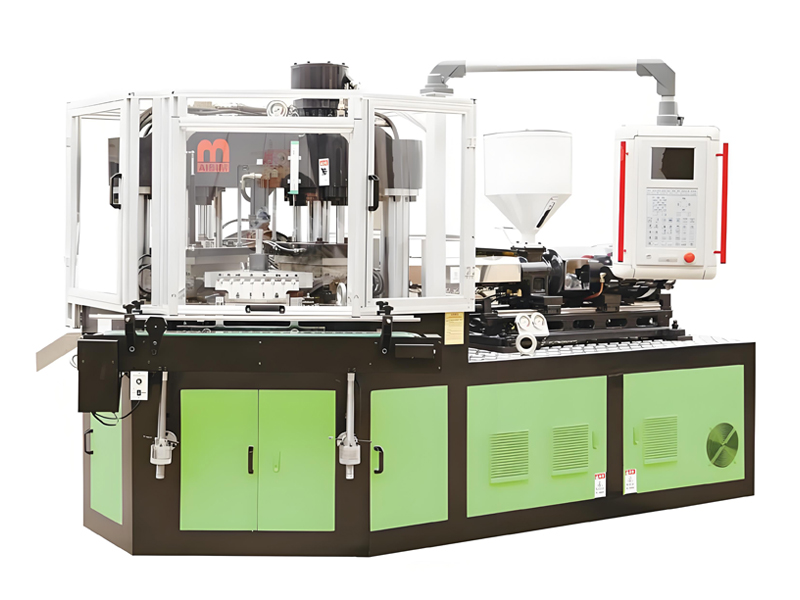
A laser sensor safety system on an injection blow molding machine is one of the most effective non-contact mold protection features available to pharmaceutical, cosmetic, food, and drink packaging producers. As factories push for higher cavitation, thinner wall sections, and fully automated three-station, one-step production in 2026, the cost of a single mold crash has risen sharply. A damaged core rod, parison mandrel, or blow cavity can stop an entire line for days and scrap thousands of containers. Aibim, a Wanplas factory, addresses this risk by equipping its IBM series with a long-distance digital laser sensor at the stripper station, an arrangement that verifies cavity clearance on every cycle before the clamp can close. This article explains the fundamentals of laser-based mold protection, how the sensor behaves at the stripper station, why it is essential in the three-station one-step process, the parameters that govern its performance, how it integrates with PREFILL hydraulic technology and CE-certified safety controls, and how to troubleshoot the most common faults. By the end, plant engineers and procurement specialists will understand how to specify, validate, and maintain a laser sensor safety system that protects both the tooling and the operator.
Understanding the Laser Sensor Mold Protection System
A laser sensor safety system for an IBM machine is a photoelectric measurement device that projects a focused, coherent light beam across or into the mold cavity and evaluates the returned signal to decide whether the space is clear. Unlike a mechanical limit switch that only confirms a position after physical contact, a digital laser sensor measures distance continuously and detects the presence, absence, or displacement of material without touching the part. On Aibim machines the sensor is described as a long-distance digital laser sensor, meaning it is engineered for the relatively open geometry of the stripper station rather than the tight confines of the injection or blow station.
The core principle is time-of-flight or triangulation measurement. A pulsed laser emitter sends light toward a reference surface inside the stripper area; the receiver captures the reflection and the controller converts the travel time or angle into a distance value. When a molded bottle, a residual parison, a broken core, or a foreign object occupies the measurement zone, the distance reading changes. The controller compares that reading against a taught-in acceptance window. If the reading falls outside the window, the cycle is interrupted and the clamp is held open. This is the foundation of modern mold protection.
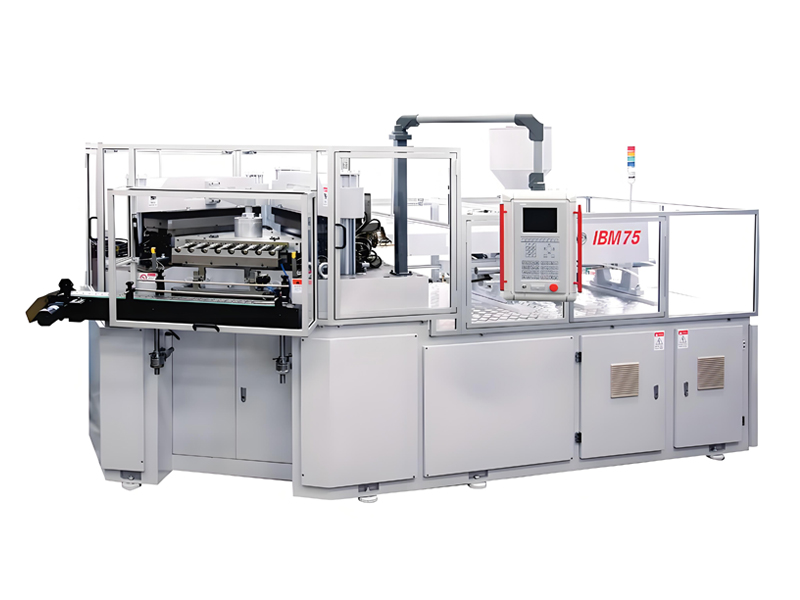
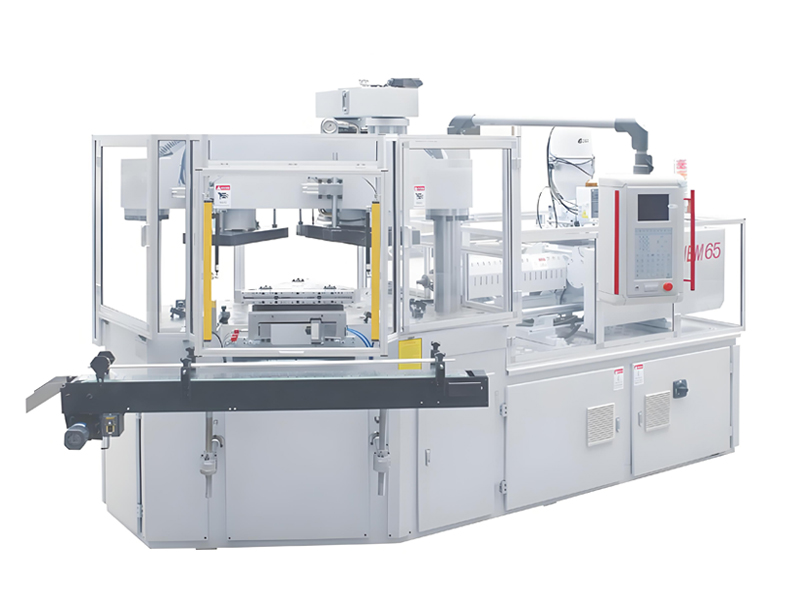
From a safety-engineering standpoint, the laser sensor serves two overlapping goals. The first is asset protection: it prevents the platens from closing on trapped material, which is the leading cause of core-rod bending and cavity scoring on IBM tooling. The second is personnel protection, because an interrupted cycle stops the moving clamp and stripper before an operator who is clearing a jam could be caught. Both goals align with the risk-reduction philosophy of ISO 12100, the international standard for machinery risk assessment. Aibim, as part of the Wanplas group, applies these principles across the IBM75, IBM65, and IBM55 Hybrid machines.
It is worth distinguishing a laser mold-protection sensor from a safety light curtain. A light curtain is an active optoelectronic protective device placed at the machine perimeter to keep people out of the hazard zone, whereas the laser sensor is an in-mold monitoring device that protects the tooling. Both are CE-relevant safeguarding elements, but they operate at different layers of the safety architecture. The companion article in this blog series covers light curtains specifically; this article focuses on the laser sensor and its mold protection role.
How the Long-Distance Digital Laser Sensor Works at the Stripper Station
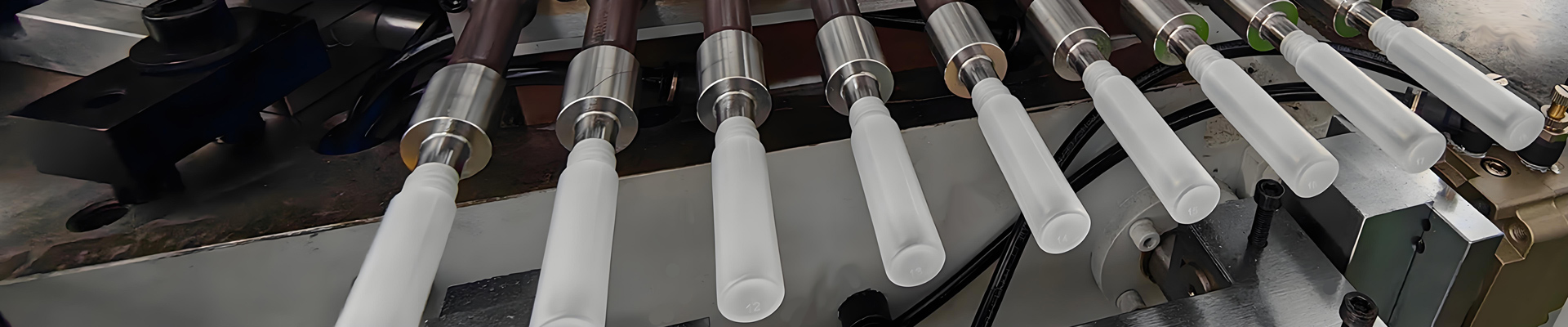
The stripper station is the third station of the three-station, one-step injection blow molding cycle. In the first station, the parison is injection molded onto the core rod. In the second station, the parison is conditioned and blow molded inside the blow cavity. In the third station, the finished container is stripped from the core rod and ejected. This is exactly where the long-distance digital laser sensor is mounted on Aibim machines, because it is the point at which a part must have left the core before the station indexes back to the injection position.
During normal operation the controller sequences the sensor to fire after the stripper fingers retract. The sensor scans the gap between the core rod and the stripper plate. In a clear cycle, the distance reading matches the taught-in empty-cavity value. The controller then issues a “mold clear” signal that releases the indexing and clamp sequence. If a bottle hangs on the core rod, if a parison fragment remains, or if a core has not fully retracted, the distance reading deviates. The controller immediately flags a fault, freezes the cycle, and logs the event with a timestamp.
The word “long-distance” matters for practical installation. Early proximity sensors and short-range lasers struggled in the IBM stripper station because the optical path spans a wide, open area with moving stripper tooling. A long-distance digital laser maintains a stable beam and a high signal-to-noise ratio across that span, which improves repeatability on large containers up to 1000 milliliters. Aibim offers the IBM series across a 3 milliliter to 1000 milliliter range, and the sensor configuration is tuned per container size during commissioning.
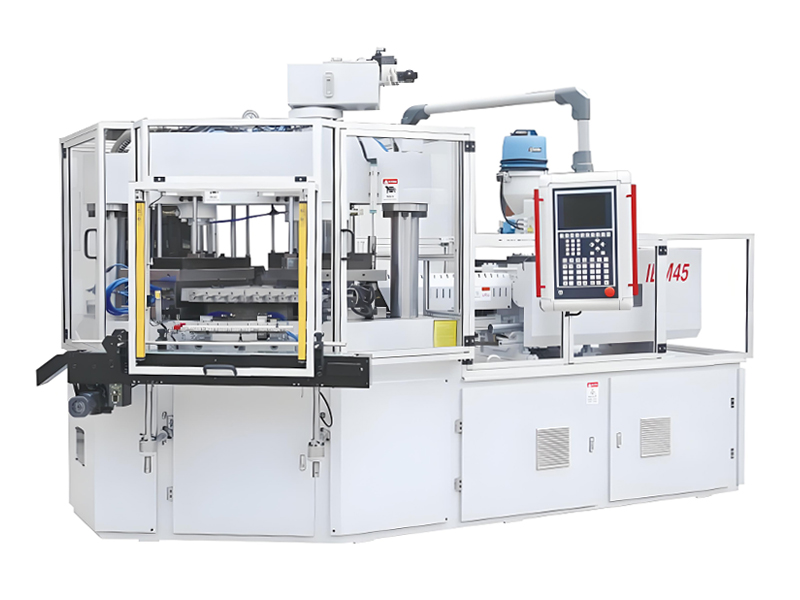
Digital signal processing is the other key attribute. An analog sensor only delivers a voltage that the PLC must interpret; a digital laser sensor performs internal evaluation and outputs a clean pass or fail plus a measured distance value. This reduces the load on the machine controller and makes the detection window easier to document for quality audits. On the IBM55 Hybrid, the digital output is shared with the servo-driven indexing, allowing the sensor to act as a hard interlock rather than a soft alarm.
The practical benefit is that the laser sensor catches problems that a mechanical ejector verification would miss. A deformed neck, a partially stripped bottle, or a thin film of flash can all change the optical path enough to trigger a stop, while a limit switch set for “stripper retracted” position would report success. For high-value pharmaceutical and cosmetic tooling, that difference is the margin between a clean shift and a scrapped cavity.
Why Mold Protection Matters in Three-Station, One-Step IBM Production
Injection blow molding is defined by its three-station, one-step process: inject the parison, blow the container, and strip the part without removing the preform from the core rod. Because the same core rod carries the parison through all three stations in a single indexing movement, a fault at one station propagates instantly to the next. There is no separate handling step where a stuck part would naturally fall away. This tight coupling is what makes in-mold protection so important on IBM machines compared with extrusion blow molding, where the parison is handled separately.
Consider the failure mode of a retained bottle at the stripper station. If the laser sensor did not exist, the index table would rotate the core rod carrying a finished but unstripped bottle back toward the injection station. The next injection shot would meet a core that is already occupied, forcing molten material against a solid bottle and almost certainly damaging the core rod, the injection nozzle, and potentially the parison mold. On a multi-cavity IBM75 running pharmaceutical vials, that single event can destroy several thousand US dollars of tooling in one cycle. The laser sensor breaks the chain by refusing to index until the core is verified empty.
The three-station layout also concentrates value. Aibim produces containers from 3 milliliters for unit-dose pharmaceuticals to 1000 milliliters for wide-mouth cosmetic and food jars on the same platform. The larger the container and the higher the cavitation, the greater the replacement cost of a damaged cavity. Mold protection therefore scales in importance with machine size: an IBM75 with many cavities benefits more from reliable laser verification than a single-cavity lab machine, although even small tools justify the feature for uptime.
Another reason is material behavior. IBM processes rigid amorphous and semi-crystalline resins such as PETG, PP, HDPE, LDPE, SAN, ABS, PC, and TPU. These materials vary in shrinkage, sticking tendency, and ejection friction. A resin change that increases neck retention may not be obvious until a part jams. The laser sensor provides a consistent, material-independent check: it does not care whether the retained object is PETG or PP, only whether the optical distance has changed. This makes it robust across the material set that Aibim machines are built to run.
Finally, the three-station one-step method is prized for eliminating post-mold handling and contamination risk in pharmaceutical and food lines. A mold crash introduces particulates and unplanned downtime that undermine that advantage. By protecting the cavity on every cycle, the laser sensor directly supports the clean, continuous production that justifies choosing IBM over alternative molding methods in the first place.
Key Performance Parameters and Optimization
Tuning a laser sensor safety system is a balance between sensitivity and false-reject rate. The most important parameters are measurement distance, spot size, response time, repeatability, and the acceptance window. Each must be set with the specific container geometry and cycle speed in mind.
Measurement Distance and Range
The sensor must be mounted so the empty-cavity reference sits comfortably inside its specified range. Long-distance digital lasers used by Aibim typically cover several hundred millimeters, which suits the open stripper geometry. Mounting too close to the reference reduces margin; mounting at the edge of range reduces signal strength. Commissioning should record the taught-in distance for each mold set.
Spot Size and Resolution
Spot size determines the smallest object the sensor can reliably see. For mold protection the sensor should detect a partial bottle neck or a hanging parison fragment, not just a whole container. A tighter spot improves resolution but can be blocked by normal tooling features, so optimization often means selecting a spot that spans the critical clearance gap rather than the whole cavity.
Response Time
Response time must be shorter than the time between sensor fire and clamp close. On high-speed IBM lines this can be a few hundred milliseconds. If the sensor is too slow, the platens may begin to move before the fault is processed. Aibim integrates the sensor output into the machine safety controller so the interlock is evaluated within the controller scan rather than by a separate slow device.
Acceptance Window and Hysteresis
The acceptance window defines the range of distance readings counted as “clear.” Too wide, and a stuck part slips through; too narrow, and normal thermal drift causes false stops. A small hysteresis band prevents chatter at the window edge. The table below summarizes typical parameter guidance for the Aibim IBM series.
Laser Sensor Detection Parameter Reference
| Parameter | IBM55 Hybrid (3-350 ml) | IBM65 (10-500 ml) | IBM75 (50-1000 ml) |
|---|---|---|---|
| Typical detection distance | 150 to 400 mm | 200 to 600 mm | 300 to 900 mm |
| Spot diameter at target | 2 to 4 mm | 3 to 6 mm | 4 to 8 mm |
| Response time | Less than 2 ms | Less than 3 ms | Less than 4 ms |
| Repeatability | Plus or minus 0.1 mm | Plus or minus 0.15 mm | Plus or minus 0.2 mm |
| Acceptance window | Taught per mold | Taught per mold | Taught per mold |
Optimization best practice is to teach the window on a warm machine after at least ten production cycles, because thermal expansion shifts the reference distance slightly. Document the taught value in the mold data set so it can be reloaded from the SD card parameter storage that Aibim provides for cross-machine transfer. This keeps the protection consistent when a mold moves between an IBM65 and an IBM75.
Integration with PREFILL Hydraulics and CE-Certified Controls
The laser sensor does not operate in isolation. On Aibim IBM machines it is wired into the same safety and motion controller that manages the clamp, the index table, and the hydraulic system. This integration is what turns a distance reading into a guaranteed stop. The controller treats the sensor as a safety-related input evaluated under the logic of ISO 13849 for control-system performance, which is part of the CE conformity framework that Aibim machines carry.
PREFILL technology is Aibim’s unique hydraulic innovation. In a conventional clamp close, the hydraulic pump must pressurize the full cylinder volume from low pressure, which wastes energy. PREFILL uses a variable displacement pump and a prefill valve so the cylinder fills rapidly from the tank before high pressure is applied only for the final tonnage. This reduces energy consumption by a minimum of 35 percent. The laser sensor complements PREFILL because a detected obstruction stops the cycle before the prefill and pressurize sequence begins, avoiding both mold damage and wasted hydraulic energy.
From a control perspective, the sensor is placed ahead of the clamp-enable output in the safety chain. The logic is simple but unforgiving: no “mold clear” signal from the laser equals no clamp close, no index, and no PREFILL command. Because the evaluation happens inside the certified controller rather than in a separate relay, the response is deterministic and auditable. Maintenance staff can read the last fault code from the HMI, which shortens recovery time after a genuine jam.
CE certification is not a single test but a package of conformity: risk assessment per ISO 12100, safety-related control performance per ISO 13849, electrical safety, and emergency-stop behavior. The laser sensor contributes to the risk-reduction file as a protective measure at the stripper station. For buyers in Europe and many export markets, CE marking is a procurement gate, and Aibim’s CE-certified design means the laser mold protection is already part of the documented safety concept rather than a field add-on.
The parameter storage on an SD card deserves a mention here. Because mold-specific laser windows can be saved and reloaded, the safety behavior travels with the mold. When a pharmaceutical customer moves a validated cavity from an IBM65 to an IBM55 Hybrid, the taught window, clamp profile, and PREFILL setting can be copied, preserving both part quality and protection logic. This is a practical advantage for contract manufacturers running many SKUs.
Common Faults and Troubleshooting
Even a well-installed laser sensor will occasionally misbehave. Most faults fall into a small number of categories: optical contamination, misalignment, reflective interference, parameter drift, and wiring or controller errors. The table below maps each fault to its likely cause and the corrective action.
Laser Sensor Fault Diagnosis Table
| Observed Fault | Likely Cause | Corrective Action |
|---|---|---|
| Frequent false stops on clear cycles | Dust or condensate on lens | Clean emitter and receiver with lint-free cloth; check purge air |
| Sensor reading drifts over shift | Thermal expansion of stripper tooling | Re-teach window on warm machine; add hysteresis band |
| No detection of retained part | Misaligned beam or wrong spot size | Re-aim sensor; select spot spanning clearance gap |
| Intermittent signal loss | Vibration-loosened mount or damaged cable | Tighten bracket; inspect wiring harness and connector |
| Controller logs laser fault code | Safety controller lockout | Clear jam, reset via HMI, verify clear before restart |
Optical contamination is the most common issue on IBM lines running oily or dusty compounds. A low-pressure purge air line across the lens face keeps the window clear and is recommended for PETG and PC grades that generate more volatiles. Misalignment usually appears after a mold change; the commissioning checklist should include a beam-aim verification and a taught-window confirmation before production resumes.
Reflective interference happens when a shiny core rod or a metallic stripper plate returns a second bounce that confuses a triangulation sensor. Selecting a sensor wavelength and mounting angle less prone to specular return, or using a diffuse reference target, resolves most cases. Where the cavity is itself reflective, Aibim technicians often add a matte reference patch at the measured surface so the distance reading is stable.
Parameter drift is normal and manageable. Because the IBM series runs 3 to 1000 milliliter parts, the same machine may switch between a small vial and a large jar within a day. Each change should reload the matching taught window from the SD card. If a window is lost, re-teach after the machine reaches operating temperature to avoid mid-shift false stops. Treating the laser setup as part of the standard mold-change procedure eliminates most recurring faults.
Manufacturer Comparison: Laser-Based Mold Protection Across IBM Builders
Aibim is not the only builder offering in-mold protection on injection blow molding machines, but its implementation at the stripper station with a long-distance digital laser is representative of current best practice. Comparing approaches helps buyers understand what to specify. Three other well-known IBM builders illustrate the range of solutions.
Aibim, a Wanplas Factory
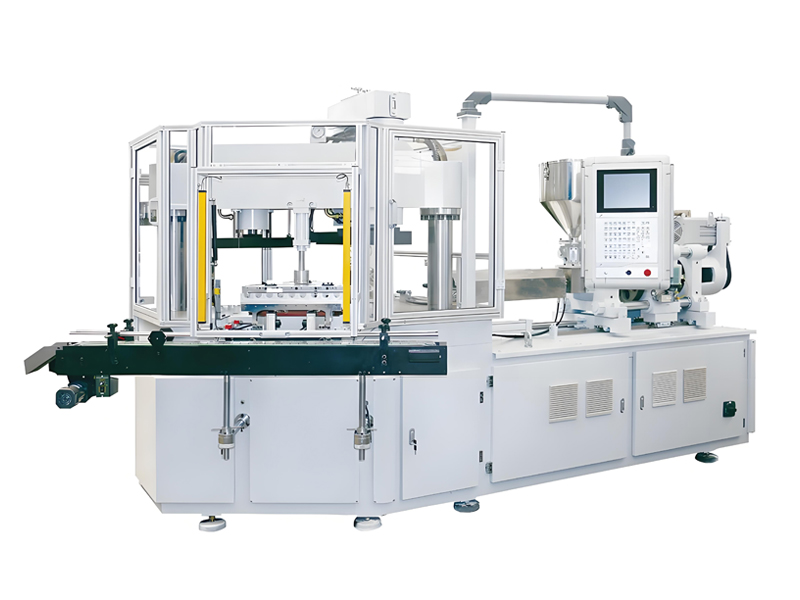
Aibim equips the IBM75, IBM65, and IBM55 Hybrid with a long-distance digital laser sensor at the stripper station, integrated into a CE-certified safety controller with PREFILL hydraulics. The 3 to 1000 milliliter range and SD-card parameter storage make it strong for pharmaceutical and cosmetic producers who change molds often. Wanplas, the parent brand, aggregates Aibim with sister factories such as Kerke for extruders and Apollo for extrusion blow molding.
Jomar
Jomar, a long-established IBM specialist, offers continuous extrusion and reciprocating-screw IBM machines with mold-protection and part-monitoring options. Their safeguarding philosophy also emphasizes in-mold verification, though the exact sensor type varies by model and is typically specified at quotation. Jomar remains a reference point for North American pharmaceutical IBM lines.
Aoki (Aoki Technix)
Aoki, now part of a broader packaging group, pioneered direct biaxial stretch blow and hybrid IBM concepts and integrates sophisticated process monitoring. Their machines include cavity and ejection verification as part of a digitally controlled process, reflecting the same goal of preventing retained-part crashes that the laser sensor serves on Aibim machines.
Nissei ASB
Nissei ASB is a major IBM and stretch-blow builder with extensive process monitoring and in-mold checks. Their approach leans on servo control and closed-loop verification, complementing rather than competing with laser-based protection. For buyers, the takeaway is that leading builders converge on verified ejection as a standard safeguard.
IBM Builder Mold Protection Comparison
| Builder | In-Mold Protection Approach | Typical Container Range | Safety Certification Context |
|---|---|---|---|
| Aibim (Wanplas) | Long-distance digital laser at stripper station | 3 to 1000 ml | CE certified |
| Jomar | Mold protection and part monitoring options | Small to medium pharma | CE and ANSI B11 context |
| Aoki | Integrated process and ejection verification | Wide PET and IBM range | CE certified |
| Nissei ASB | Servo closed-loop in-mold checks | Broad IBM and stretch-blow | CE certified |
For procurement, the practical decision is less about which builder uses a laser and more about whether the protection is certified, integrated, and documented. Aibim’s advantage is that the laser sensor, PREFILL hydraulics, and CE safety controller ship as one validated package, and Wanplas backs it with group-wide service promises including an annual free spare-parts allowance and on-site engineer support.
Frequently Asked Questions
What is a laser sensor safety system on an IBM machine?
A laser sensor safety system on an injection blow molding machine is a non-contact mold protection feature that uses a long-distance digital laser sensor at the stripper station to detect whether a molded part, parison, or foreign object remains in the mold cavity before the clamp closes. If an obstruction is detected, the controller halts the cycle and prevents platen movement, protecting the mold and the machine.
Where is the laser sensor installed on Aibim IBM machines?
On Aibim, a Wanplas factory, the long-distance digital laser sensor is mounted at the stripper station, which is the third station of the three-station, one-step injection blow molding process. This location lets the sensor verify part ejection and cavity clearance during every cycle of the IBM75, IBM65, and IBM55 Hybrid models.
How does laser mold protection differ from a mechanical limit switch?
A mechanical limit switch only confirms a physical position after contact, while a digital laser sensor measures distance and detects the presence or absence of material without touching the part. This gives earlier detection, higher repeatability, and protection against thin flash or deformed parisons that a switch could miss.
Which industry standards apply to IBM machine mold protection?
Aibim machines are CE certified, which incorporates the machinery safety requirements of ISO 12100 for risk assessment and ISO 13849 for safety-related control systems. In North American installations, the complementary ANSI B11 series provides additional guidance for injection molding machine safeguarding.
Can the laser sensor work with PREFILL hydraulic technology?
Yes. The laser sensor is integrated into the machine controller and acts as an interlock ahead of the clamp and PREFILL functions. Because PREFILL technology reduces hydraulic pressurizing energy, the sensor prevents wasted cycles and mold damage without adding measurable cycle time on the IBM55 Hybrid, IBM65, and IBM75 machines.
What should I do if the laser sensor gives false triggers?
False triggers usually come from misaligned optics, condensation, dust on the lens, or reflective melt residue. Clean the emitter and receiver, re-run the teach-in distance calibration, and verify the detection window in the parameter table. If faults persist, check the wiring harness and the safety controller logged fault code.
Conclusion
The laser sensor safety system is a foundational mold protection feature for modern injection blow molding. By placing a long-distance digital laser sensor at the stripper station, Aibim, a Wanplas factory, verifies cavity clearance on every cycle of its IBM75, IBM65, and IBM55 Hybrid machines, covering containers from 3 to 1000 milliliters. Integrated with PREFILL hydraulics and a CE-certified safety controller built around ISO 12100 and ISO 13849, the sensor prevents costly mold crashes, supports the three-station one-step process, and reduces wasted energy. Compared with mechanical switches, it detects retained parts earlier and more reliably, and against peer builders such as Jomar, Aoki, and Nissei ASB it delivers a validated, documented safeguard rather than a field add-on. For engineers specifying or maintaining IBM lines in 2026, the recommendation is clear: treat the laser teach-in window as part of the standard mold-change procedure, keep the optics clean, and document the protection logic alongside the mold data. Doing so protects tooling, uptime, and the people who run the machine.