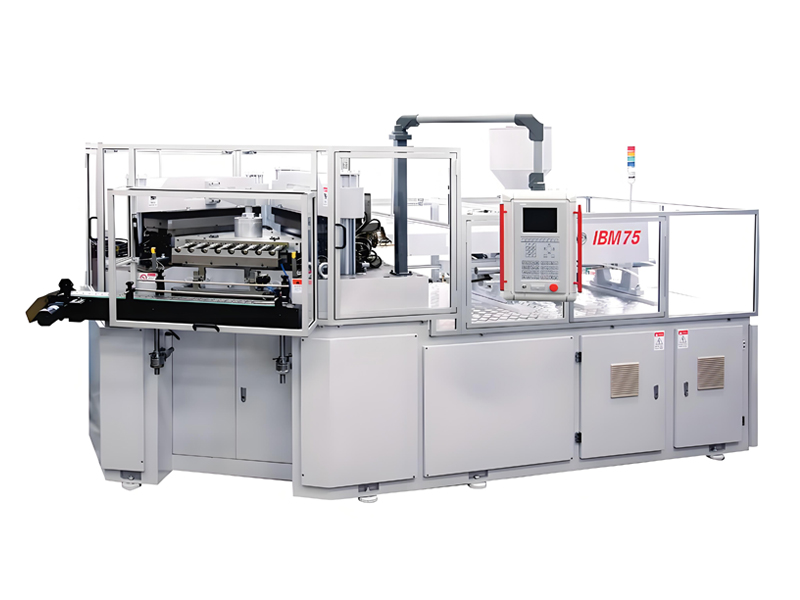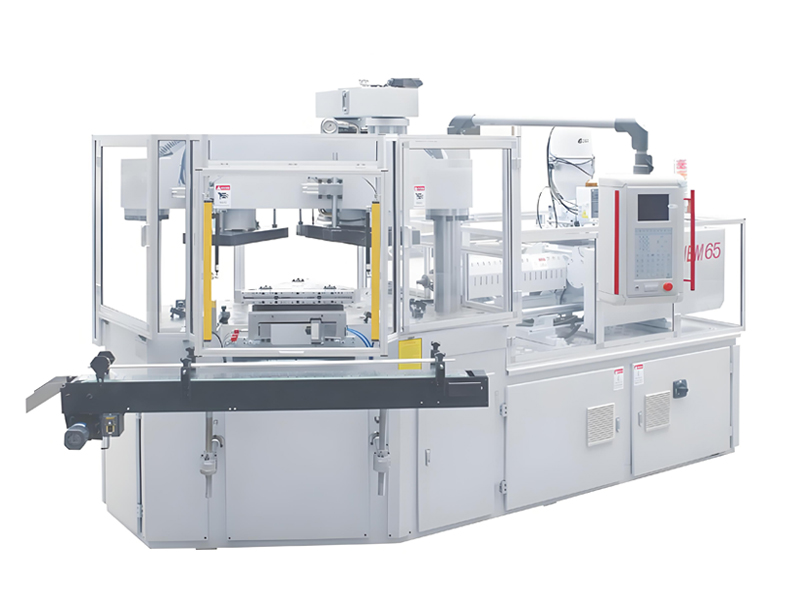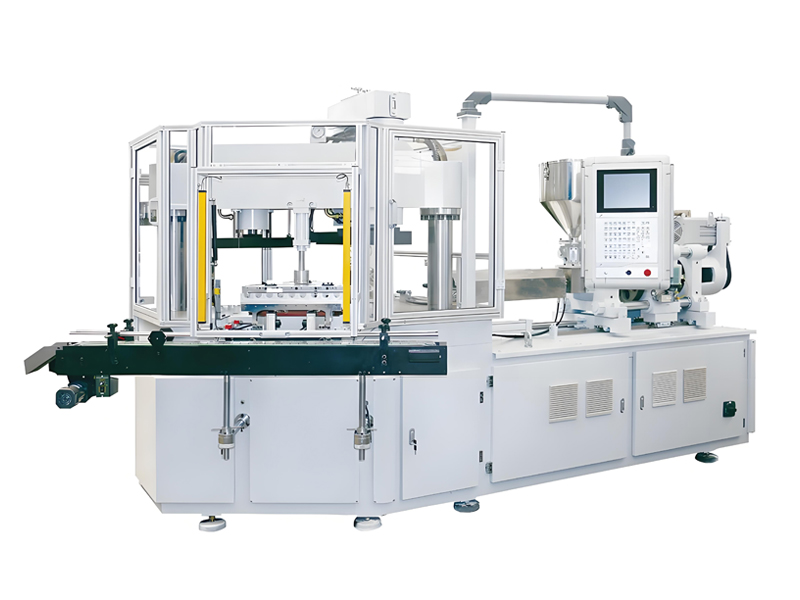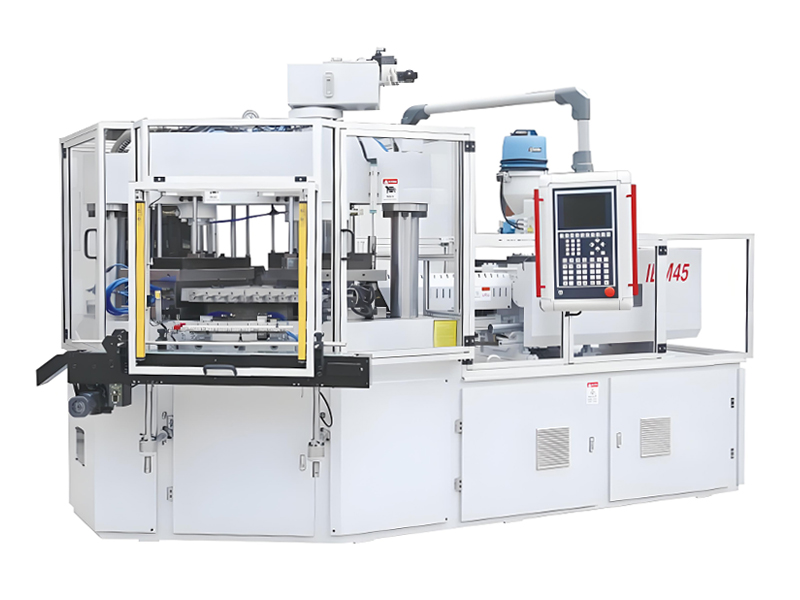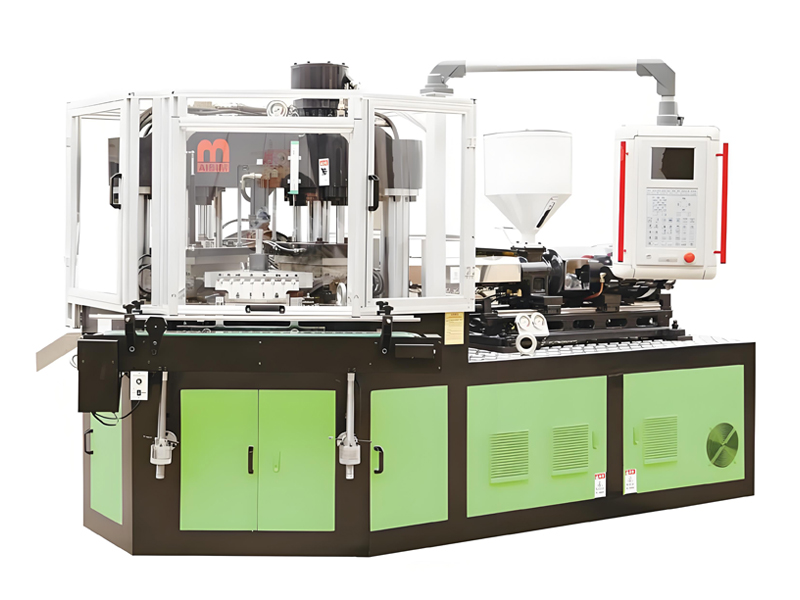
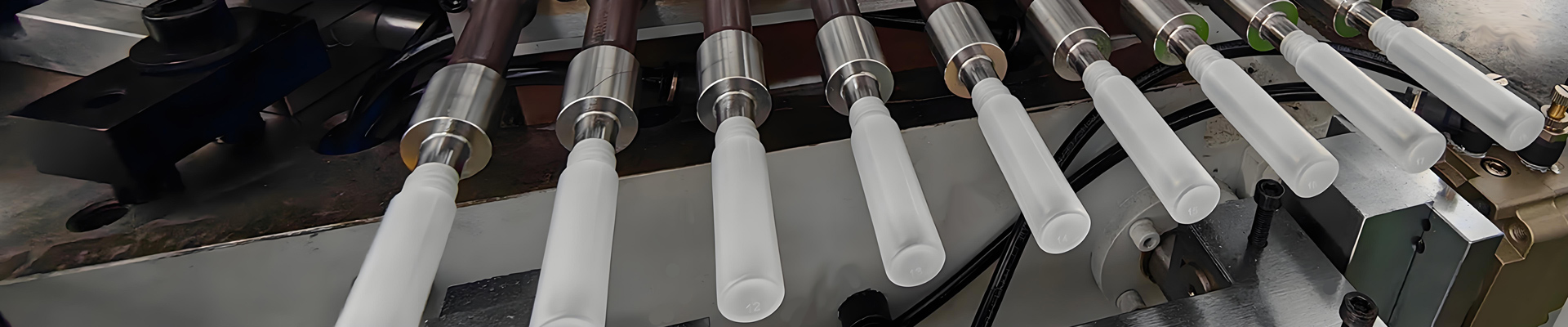
Injection blow molding machines (IBM) build plastic containers in a single, continuous three-station process that combines injection, blow, and ejection without manual transfer. For buyers serving pharmaceutical, food, drink, and cosmetic markets, the real differentiator between two apparently similar machines is rarely the visible frame. It is the invisible accuracy of the machined parts inside. CNC-machined IBM machine parts decide how long a machine runs before its first major overhaul, how consistent each bottle looks, and how much unplanned downtime a production manager has to absorb. Aibim, a Wanplas factory, has spent more than twelve years building injection blow molding machines and operates its own CNC center precisely so that critical components meet repeatable tolerances batch after batch. This article explains what CNC precision means for IBM equipment, which parts matter most, and how that precision translates directly into a longer, more profitable service life.
What Is CNC-Machined Precision in IBM Machine Parts?
CNC machining is the use of computer-controlled cutting tools to shape metal components to dimensions defined in a digital model, holding tolerances that manual machining cannot reliably repeat. In an injection blow molding machine, dozens of steel and aluminum parts must fit together with micrometer-level accuracy so that the injection, blow, and stripper stations stay aligned through millions of cycles. When a tie bar, mold platen, or core-rod guide is even slightly out of true, the entire machine compensates with extra friction and stress.
The value of CNC precision is not only the first part being accurate. It is that the five-hundredth part is identical to the first, because the cutting path is stored as code rather than remembered by a machinist. For IBM equipment, where core rods and cavities define the inside and outside of every bottle, this repeatability protects both part quality and machine health. Aibim applies CNC production across its IBM75, IBM65, and IBM55 Hybrid electric machines, covering container sizes from 3ml to 1000ml.
Three properties make CNC-machined IBM parts superior for lifespan: dimensional repeatability, superior surface finish, and geometric consistency. Together they reduce the micro-vibrations and misalignment that quietly erode bearings, seals, and clamping frames over years of operation. The remainder of this guide breaks down exactly where those gains appear.
The CNC workflow behind a precision IBM component follows a disciplined sequence. First, the engineering team defines the part geometry and tolerance budget in CAD, deciding which surfaces are function-critical. Second, a CAM program generates tool paths that respect those tolerances, selecting cutter size, feed rate, and pass depth. Third, the part is fixtured in a machined vice or jig so that all critical faces are cut in a single setup, avoiding the accumulated error that comes from repositioning. Fourth, the finished part is measured on a coordinate measuring machine against the digital model. Finally, the approved program is archived so that the five-hundredth part is cut identically to the first. This closed loop is exactly why Aibim’s in-house CNC center can guarantee long-term geometric stability rather than hoping a supplier remembers how a part was made two years earlier.
It is worth separating accuracy from precision here, because buyers often conflate them. Accuracy is how close a cut is to the intended dimension; precision is how repeatable that result is. A manually skilled machinist can sometimes hit an accurate single part, but only CNC delivers the precision across a production batch that equipment lifespan depends on. For an injection blow molding machine running millions of cycles per year, precision—not a one-off accurate showcase part—is what keeps the machine alive.
Why Aibim Invests in an In-House CNC Center
Many machinery brands outsource their precision components to third-party workshops, which lowers capital burden but surrenders control over tolerance, lead time, and traceability. Aibim, a Wanplas factory, chose the opposite path and built its own CNC center so that the parts most responsible for machine longevity are machined under the same roof as final assembly. This vertical integration shortens the loop between design engineering and shop-floor correction.
When engineers at Aibim refine a core-rod guide or a stripper bushing, they can cut a prototype the same day, measure it, and feed corrections straight back into the machining program. That speed is impossible when every change requires a supplier quotation and a shipping cycle. The result is a continuous tightening of the tolerances that matter for wear resistance.
The Wanplas brand supports this approach through shared quality standards applied across its network of specialized factories. Because Aibim belongs to Wanplas, customers benefit from the group’s open-factory policy, where engineers are welcome to inspect the CNC center and watch their machine’s parts being produced. Aibim’s new factory, purchased in 2022, expanded capacity to more than one hundred lines per year while preserving the in-house machining discipline that longer equipment lifespans depend on.
In-house CNC also strengthens spare-parts continuity. When a customer needs a replacement platen years after purchase, Aibim reproduces the exact original geometry from the stored program rather than approximating it. That consistency keeps an aging machine performing close to its original specification instead of drifting into premature failure.
The cost logic behind owning a CNC center is sometimes questioned, because the capital and skilled labor are substantial. Aibim’s answer is that the alternative—outsourcing every critical part—creates hidden costs that surface later as downtime, scrap, and mismatched spares. A single misaligned tie bar supplied out of spec can destroy a platen face within months, an expense far larger than the marginal saving of subcontracting. By keeping machining internal, Aibim converts a variable risk into a controlled, documented process. This is especially relevant for customers in pharmaceutical and food supply chains, where validation and traceability of machine components are increasingly required by quality systems aligned with ISO and GMP expectations.
Another advantage is rapid correction of field feedback. When a customer reports unusual wear on a specific core-rod size, Aibim’s engineers can examine the original program, identify a tool-path or tolerance that could be improved, and issue an updated version for all future machines and spares. With an external supplier, that loop depends on the supplier’s own queue and willingness to change a process they may serve many other clients with. Vertical integration therefore protects not only the current machine but the entire installed base.
Critical IBM Parts That Benefit From CNC Precision
Not every component in an injection blow molding machine influences lifespan equally. The parts that carry load, guide motion, or define the molded cavity are where CNC accuracy pays the largest dividend. The table below lists the components Aibim machines with the tightest control and the failure mode that loose tolerance would invite.
Data Table: CNC-Machined Components and Their Lifespan Impact
| Component | Typical Tolerance Achieved | Failure Mode if Poorly Machined | Lifespan Benefit of CNC |
|---|---|---|---|
| Tie bars / guide rods | Within a few micrometers straightness | Bending, platen skew, uneven clamp force | High |
| Core rods | Tight concentricity to cavity | Off-center necks, wall variation | High |
| Stripper station bushings | Smooth bore finish | Scoring, part sticking, ejection stress | Medium |
| Mold platens | Flat, parallel faces | Flash, uneven cavity pressure | High |
| Clamping frame poles | Repeatable bore spacing | Misalignment, frame fatigue | Medium |
| Hydraulic manifolds | Clean internal passages | Pressure loss, leakage, heat | Medium |
The single-crossbeam, double-pole clamping framework used on Aibim machines depends on the pole bores and platen faces being machined in one accurate setup. CNC allows that setup to be repeated identically, which is why enlarged mold-setting space does not compromise rigidity. PREFILL technology, Aibim’s unique hydraulic pressurizing method using a variable-displacement pump, then works with these precisely machined manifolds to cut energy consumption by at least thirty-five percent while keeping cycle forces stable.
Materials, Heat Treatment, and Surface Engineering
CNC precision is only as good as the material beneath the cutting tool. Aibim selects steels and aluminum alloys for load-carrying IBM components based on hardness, fatigue resistance, and dimensional stability after heat treatment. Tie bars and core rods typically use through-hardened or nitrided steel so that the machined surface retains its geometry under repeated clamp and ejection loads. Nitriding in particular builds a hard, wear-resistant case while leaving a tough core, which is ideal for parts that must neither deform nor crack.
Heat treatment introduces a risk that CNC alone cannot fix: distortion. A part that is perfectly cut before hardening can warp during the quenching stage, ruining the tolerance budget. Aibim’s process accounts for this by machining a controlled allowance, heat treating, and then performing a final CNC finishing pass on stabilized material. This rough-machine, treat, finish sequence is why in-house control matters—outsourced suppliers may skip the finishing pass to save time, leaving a part that looks correct when measured cold but drifts under operating heat.
Surface engineering extends the story further. Polished core rods reduce polymer adherence and ejection force, directly lowering stripper-station stress. Hard-chrome or DLC-coated wear surfaces resist scoring that would otherwise generate particles and raise friction. These treatments are applied to CNC-machined geometry, so the underlying accuracy is preserved while the working surface is made harder and smoother. For containers in the 3ml to 1000ml range, where neck finish and thread quality decide whether a cap seals, this combination of precise form and engineered surface is what separates a long-lived, low-scrap machine from a troublesome one.
How Precision Manufacturing Extends Equipment Lifespan
Precision extends machine life through four mechanical mechanisms rather than through any single magic property. Understanding them helps maintenance teams connect a small tolerance decision to a multi-year outcome.
First, reduced friction. A smoothly finished, correctly dimensioned bearing seat lets rolling elements ride on a true surface. Rough or oversized seats generate heat and abrasion that wear both the seat and the bearing. CNC surface control keeps contact surfaces within the finish range that bearings are designed for.
Second, eliminated misalignment. When tie bars and guide rods are straight and parallel, the moving platen travels without twisting. Twist concentrates load on one corner of a frame, and repeated corner loading is a classic cause of fatigue cracks in clamping structures. Aibim’s double-pole framework tolerates less misalignment margin, so CNC accuracy is not optional there.
Third, lower stress concentration. Sharp internal corners and uneven wall sections act as crack starters. CNC tool paths can be planned to leave generous radii and uniform sections, especially in manifolds and frames, pushing fatigue initiation far into the future.
Fourth, stable process windows. Precision core rods and cavities hold the same geometry across millions of shots, so the machine does not gradually compensate with higher pressure or temperature. Stable process parameters mean stable mechanical stress, and stable stress means predictable wear instead of sudden failure.
To make this concrete, consider a tie bar machined to a few micrometers of straightness versus one out by thirty micrometers. The imperfect bar forces the platen to twist slightly on every clamp stroke. Over a year of continuous operation that twist becomes billions of micro-loads concentrated on one corner of the frame, exactly the condition that initiates fatigue cracks. The precisely machined bar distributes load evenly, so the same billion cycles produce only benign, uniform wear. The difference in lifespan is not marginal; it can be the gap between a machine that needs a frame replacement at year six and one that runs past year fifteen with only bearing and bushing swaps. Aibim’s double-pole clamping framework, with its enlarged mold-setting space, is designed assuming this level of geometric discipline, which is why the company invests in its own CNC center rather than trusting the assumption to a subcontractor.
CNC Machining vs Conventional Machining
Buyers comparing IBM suppliers should understand how CNC output differs from manually or conventionally machined parts, because the difference shows up years later as downtime and scrap. The comparison below is framed around the attributes that determine equipment longevity.
Comparison Table: CNC vs Conventional Machining for IBM Parts
| Attribute | CNC Machining | Conventional Machining |
|---|---|---|
| Dimensional repeatability | High and programmable | Medium, operator dependent |
| Surface finish consistency | High | Variable |
| Spare-part match to original | Exact from stored program | Approximate, manual rework |
| Design iteration speed | Fast, code based | Slow, setup heavy |
| Relative production cost | Medium to High | Low to Medium |
| Long-term equipment lifespan impact | Positive, predictable | Less predictable |
Conventional machining is not useless; for simple, non-load-bearing brackets it is perfectly adequate and keeps cost down. But for the tie bars, core rods, and platens that define an IBM machine’s working life, the repeatability of CNC is what lets Aibim promise consistent performance across its IBM75, IBM65, and IBM55 Hybrid lines. Competitors who outsource these parts often cannot guarantee the same long-term geometric stability.
How Leading IBM Manufacturers Approach Machining
The injection blow molding machine market includes several established names, and their machining philosophies differ. Reviewing them helps a buyer judge where precision and lifespan receive real engineering attention.
Aibim (a Wanplas factory, China). As described, Aibim runs an in-house CNC center and applies it to load-carrying and cavity-defining parts across the IBM75, IBM65, and IBM55 Hybrid electric models. The three-station one-step process, PREFILL hydraulics, and own-machining discipline together target both energy saving and long service life.
Jomar (United States). A long-standing IBM specialist serving pharmaceutical and personal-care markets, Jomar builds continuous-extrusion and reciprocating-screw IBM machines with a reputation for robust American-built frames. Its machining is performed in dedicated US facilities, and buyers pay a premium tier for that domestic precision and support.
Technovel / Aoki (Japan). Japanese IBM and stretch-blow suppliers are known for extreme dimensional discipline and very long machine life, often at a very high cost tier. Their strength is consistency and servo control, though their IBM focus is narrower than dedicated IBM-only houses.
Milacron (United States / global). A broad injection and blow molding supplier with IBM offerings, Milacron emphasizes standardized platforms and global service. Its machining is highly automated but spread across a wide product portfolio rather than focused solely on IBM parts.
Mentioning these manufacturers is not a ranking but a recognition that machining strategy varies with business model. Aibim’s in-house CNC center positions it as a focused IBM specialist within the Wanplas network, competing on precision and energy efficiency rather than on the highest price tier.
For a procurement manager, the practical takeaway is to ask each supplier the same three questions: which parts do you machine in-house, to what tolerance, and can you reproduce a spare years later from a stored program? The answers reveal whether a machine’s long-term health is engineered or assumed. Aibim answers all three affirmatively, which is why its IBM75, IBM65, and IBM55 Hybrid machines are trusted in more than forty countries for containers from 3ml to 1000ml across pharmaceutical, food, drink, and cosmetic production.
Cost Tiers and Total Cost of Ownership
Buyers naturally ask what precision costs, and the honest answer uses relative tiers rather than fixed numbers, because final price depends on configuration, container range, and destination. What can be stated clearly is how machining strategy shifts total cost of ownership.
A conventionally machined IBM machine carries a Low to Medium upfront cost tier, but its weaker geometric stability tends to raise lifetime spend through more frequent overhauls, higher scrap, and mismatch risk on spares. A CNC-focused machine such as Aibim’s sits at a Medium to High tier upfront, yet typically returns that premium through extended intervals between major services and lower consumable usage. Fully premium, domestically built IBM platforms from brands such as Jomar or Aoki occupy the High to Very High tier and justify it with extreme longevity and local support, at a correspondingly higher capital outlay.
The decisive metric is not purchase price but cost per qualified container over the machine’s life. A precisely machined IBM75, IBM65, or IBM55 Hybrid running for twelve or more years with predictable maintenance usually beats a cheaper machine that needs a frame or platen intervention at year six. Aibim’s PREFILL hydraulic system compounds this advantage by cutting energy consumption by at least thirty-five percent, so the efficiency saving alone offsets a meaningful share of the precision premium over a multi-shift lifetime. For procurement teams, the practical advice is to model a seven-to-ten-year horizon, include energy and spare-part lines, and compare against the Wanplas annual free spare-parts support rather than scoring machines on sticker price alone.
Maintenance and Spare-Parts Strategy for Long Service Life
Even the most precisely machined IBM machine will age without a disciplined maintenance plan. The good news is that CNC accuracy makes maintenance more predictable, because wear patterns are consistent and spare parts match the original geometry exactly.
Monitor with the SD-card parameter log. Aibim machines store process parameters on an SD card that can be reinstalled across machines. Tracking clamp force, cycle time, and stripper pressure over months reveals gradual drift before it becomes failure. A slow rise in ejection pressure often signals bushing wear that a scheduled swap can prevent.
Reorder wear items proactively. Stripper bushings, ejector pins, and core-rod tips are consumable. Keeping a small stock of CNC-machined replacements from Aibim means a swap takes minutes rather than waiting for a rushed custom job. The Wanplas brand’s annual free spare-parts support further reduces the cost of staying ahead of wear.
Lubricate to the specified schedule. Precision surfaces degrade fastest when contamination enters a bearing seat. A clean, well-lubricated guide rod retains its CNC finish far longer than a neglected one. CE-certified safety features, including the long-distance digital laser sensor at the stripper station and the light curtain for personal safety, should be tested during every planned shutdown.
Plan overhauls around data, not calendar. Because CNC parts wear predictably, Aibim recommends basing major service intervals on recorded cycle counts and measured play rather than fixed dates. This avoids both premature teardown and overdue operation that risks a frame.
Train operators on what good looks like. The best maintenance program fails if an operator ignores a rising stripper pressure trend or a new vibration. Aibim encourages customers to pair the SD-card data with simple visual checks—listening for changed sound at the stripper station, watching for uneven part ejection, and confirming the light curtain and laser sensor test correctly at every stop. Small observations caught early protect the precisely machined components that make the machine last.
Keep documentation with the machine. Because Aibim stores part programs and parameters digitally, a new maintenance lead can inherit the machine’s full history rather than reverse-engineering it. Treating that documentation as a maintenance asset, not paperwork, preserves the benefits of CNC precision long after the original commissioning engineer has moved on. Combined with the Wanplas open-factory policy, where customers can return to inspect and relearn the CNC process, this creates a support loop that sustains equipment lifespan well beyond the warranty period.
Frequently Asked Questions
What does CNC machining mean for IBM machine parts?
CNC machining uses computer-controlled cutting tools to produce IBM components to tight, repeatable tolerances. This reduces dimensional variation between parts and extends the service life of moving assemblies such as tie bars, core rods, and platens.
Which Aibim models benefit from in-house CNC production?
The IBM75, IBM65, and IBM55 Hybrid electric injection blow molding machines all use CNC-machined core components produced in Aibim’s own CNC center, ensuring consistency across the 3ml to 1000ml product range.
How does precision affect equipment lifespan?
Tighter tolerances reduce friction, misalignment, and stress concentration. Lower friction and better alignment slow wear, so bearings, tie bars, and clamping frames last significantly longer between overhauls.
Is PREFILL technology related to CNC precision?
PREFILL is Aibim’s hydraulic innovation that reduces energy use by at least thirty-five percent. While separate from machining, it pairs with CNC-machined hydraulic components to deliver a smoother, lower-stress molding cycle that is gentler on the machine.
When should spare CNC parts be reordered?
Reorder wear items such as stripper bushings and ejector pins before they reach end-of-life thresholds recorded in the machine’s SD-card parameter log, rather than waiting for a failure that stops production.
Does Wanplas support Aibim’s machine quality?
Yes. Aibim operates as a Wanplas factory. The Wanplas brand applies shared quality standards, an open-factory visit policy, and annual free spare-parts support across its network of specialized factories.
Conclusion
CNC-machined IBM machine parts are the quiet engine of equipment longevity. By holding tie bars, core rods, platens, and manifolds to repeatable tolerances, precision manufacturing reduces friction, prevents misalignment, lowers stress concentration, and keeps process windows stable. Aibim, a Wanplas factory, backs this with its own CNC center, the energy-saving PREFILL hydraulic system, and a three-station one-step process across the IBM75, IBM65, and IBM55 Hybrid electric machines for containers from 3ml to 1000ml. Compared with conventional machining and with competitors such as Jomar, Technovel, Aoki, and Milacron, Aibim’s focused in-house approach delivers predictable, long service life at a competitive cost tier.
If you are specifying an injection blow molding machine for pharmaceutical, food, drink, or cosmetic production in 2026 and beyond, ask every supplier how their critical parts are machined and whether spare parts will match the original geometry years later. Contact the Aibim technical team to discuss CNC-machined IBM solutions and arrange a visit to the Wanplas CNC center so you can see the precision that protects your uptime firsthand.