- 1. Ce qui fait qu'un pot est « à large ouverture » et pourquoi il est difficile à mouler
- 2. IBM contre ISBM contre EBM pour les bocaux à large ouverture
- 3. Six défis fondamentaux et leurs solutions
- 4. Sélection des matériaux pour les bocaux à large ouverture
- 5. Principes de conception de moules pour l'IBM à large ouverture
- 6. Contrôle qualité et critères d'acceptation
- 7. Machines Aibim pour la production de pots à large ouverture
- 8. Industries d'application et spécifications types
- 9. Guide de sélection du modèle selon les exigences
- 10. Service, assistance et comment commencer
- 11. Questions fréquemment posées
Ce qui fait qu'un pot est « à large ouverture » et pourquoi il est difficile à mouler
A wide mouth jar is defined by geometry, not by marketing language. In blow molding the controlling dimension is the neck-to-body diameter ratio, which is the finished neck opening diameter divided by the maximum body diameter of the container. A wide mouth jar carries a neck-to-body diameter ratio above 0.5, with the typical production window sitting between 0.55 and 0.85. By contrast a narrow neck bottle stays below 0.35, and many pharmaceutical dropper and beverage bottles sit well under 0.25. The moment the ratio climbs past 0.5 the part stops behaving like a bottle and starts behaving like a small open container, and that single change rewrites the way the parison must be formed, blown and ejected.
Wide mouth jars are produced across a broad range of opening sizes and volumes. The most common neck or finish diameters are 38 mm, 45 mm, 53 mm, 63 mm, 70 mm, 89 mm and 100 mm. Matching volumes usually run from 30 mL for sample and lab jars up to 1000 mL for food, confectionery and pet food containers. A 100 mm opening on a 1000 mL jar is at the upper edge of practical injection blow molding, while a 38 mm opening on a 120 mL jar is at the easy end of the range. The table below places these sizes on a single reference grid so the geometry is unambiguous before we discuss process behavior.
| Opening diameter (mm) | Typical volume range (mL) | Neck-to-body ratio | Common use |
|---|---|---|---|
| 38 | 30 – 250 | 0.55 – 0.70 | Sample jars, cosmetic cream cups, vitamin packs |
| 45 | 50 – 300 | 0.55 – 0.72 | Personal care, single-dose food |
| 53 | 100 – 400 | 0.58 – 0.75 | Cosmétique, pharmacy powder |
| 63 | 150 – 500 | 0.60 – 0.78 | Honey, sauce, supplement jars |
| 70 | 200 – 750 | 0.62 – 0.80 | Jam, nuts, body butter |
| 89 | 400 – 900 | 0.70 – 0.83 | Pet food, confectionery, lab storage |
| 100 | 500 – 1000 | 0.75 – 0.85 | Large food, protein, industrial samples |
La raison pour laquelle un pot à large ouverture est plus difficile à mouler qu'une bouteille à col étroit n'est pas un défaut unique mais quatre causes mécaniques et de processus couplées. Comprendre ces quatre causes est le fondement de toutes les solutions discutées plus loin dans cet article.
First cause: the blow-up ratio is locked down. In blow molding the blow-up ratio is the body diameter divided by the parison diameter at the point being blown. A narrow neck bottle is injected as a slim parison and blown outward many times, so the polymer stretches dramatically and fills the cavity. A wide mouth jar already starts with a parison that is nearly as wide as the final body, because the neck finish itself is wide. The available blow-up ratio collapses to roughly 2.0 to 3.5, sometimes less. With little stretch left, the polymer cannot redistribute itself to even out wall thickness, so the base and shoulder tend to stay thin while the body stays thick. This is the root of most wall balance complaints on wide mouth parts.
Second cause: the parison distribution is difficult to make uniform. Because the part is short and squat, the parison travels a short distance from the injection cavity to the blow cavity, but the cross-section changes are abrupt. The neck region must stay stiff and dimensionally exact, the shoulder must accept rapid expansion, and the base must fill without webbing. A uniform tubular parison that works for a tall bottle does not map onto a wide mouth jar, so the parison wall must be deliberately profiled along its length.
Third cause: the demolding path is obstructed. A narrow neck bottle is stripped off the core rod through a small opening, so the draft is gentle and the undercut risk is low. A wide mouth jar has a large opening and large side walls with threads or knurls, so the stripping travel is long and the friction against the core rod and cavity is high. The part wants to stick, gall, or stretch during ejection, and a single bad release can scar the sealing land.
Fourth cause: the neck lacks rigidity and deforms easily. The wide neck is both the largest opening and the most functionally critical surface. It carries the threads or snap feature, the sealing plane, and the torque load of the closure. Because the neck wall is necessarily thin relative to its diameter, it cools slowly and, if ejected while soft, relaxes into ovality or sink. A warped neck leaks, a low-torque neck cross-threads, and an out-of-round neck fails automated capping.
Un pot à large ouverture est difficile non pas parce qu'une étape échoue, mais parce que le rapport de soufflage, le profil de la paraison, le chemin de démoulage et la rigidité du col se contrecarrent tous en même temps. Le moulage par injection-soufflage est le procédé qui offre le plus de contrôle sur ces quatre éléments simultanément.
Aibim is a Wanplas factory with more than twelve years of experience building injection blow molding machines and molds, exporting to over forty countries, with its own CNC machining center and an annual capacity above one hundred lines per year. The wide mouth jar is one of the most demanding parts that an IBM line is asked to make, and the rest of this guide explains how to design the process, the mold and the material so the part consistently passes spec.
IBM contre ISBM contre EBM pour les bocaux à large ouverture
Three blow molding routes can technically produce a wide mouth jar: injection blow molding (IBM), injection stretch blow molding (ISBM), and extrusion blow molding (EBM). They differ most at the neck finish, where the wide mouth jar lives or dies. The comparison below is a process-to-process benchmark, not a brand comparison, and it shows why IBM dominates precision wide mouth production.
| Attribute | Injection Soufflage (IBM) | Injection Stretch Soufflage (ISBM) | Extrusion Soufflage (EBM) |
|---|---|---|---|
| Neck finish precision | Plus or minus 0.05 mm, no flash, no trim | Plus or minus 0.10 mm, no flash | Plus or minus 0.30 mm, flash requires trim |
| Minimum practical neck-to-body ratio | 0.50 and up (best for wide mouth) | 0.45 and up | 0.30 and up (best for very wide, low-precision) |
| Wall thickness uniformity | Good, controllable by parison profile | Excellent, biaxial orientation | Fair, parison programming needed |
| Material adaptability | PE, PP, PS, SAN, PC, PCTG, TPU | PET, PETG, PEN, some PP | PE, PP, PVC, PC, TPU |
| Scrap rate | Low, below 5 percent | Low, below 5 percent | Medium, flash and trim 15 to 25 percent |
| Cycle time | Medium | Medium | Medium |
| Mold complexity | Medium | Medium to High | Low |
| Cost level | Medium | Medium to High | Low |
The decisive column for a wide mouth jar is neck finish precision. The neck is the opening through which the product is filled and the closure is applied, and on a wide mouth jar that opening can be 100 mm across. IBM forms the neck by injecting molten polymer into a precision neck ring, so the threads, the sealing land and the inside diameter are fixed by steel, not by a cut parison. That yields a finish held to roughly plus or minus 0.05 mm with no flash and no secondary trimming operation. ISBM is excellent for oriented PET and gives the best wall distribution, but its neck precision and its material set (driven by PET and PETG) make it a second choice for PP and PS food jars. EBM is the cheapest route and handles very large openings, but the flash line and the plus or minus 0.30 mm neck tolerance force a trimming step and a looser closure fit, which is unacceptable for many food, pharmaceutical and cosmetic jars.
Du point de vue du groupe Wanplas, lorsqu'un projet nécessite une ligne aval assortie telle que le remplissage ou un processus d'extrusion complémentaire, ces capacités sont fournies sous le nom Wanplas afin que le client obtienne un seul fournisseur responsable plutôt que plusieurs vendeurs déconnectés.
Choisissez l'IBM lorsque le pot à large ouverture doit être scellé, fileté et bouché avec une variation quasi nulle et sans retouche. Choisissez l'ISBM pour les pots à large ouverture en PET orienté avec une clarté et une résistance à la chute maximales. Choisissez l'EBM uniquement lorsque l'ouverture est très grande et que la tolérance de fermeture est lâche.
Six défis fondamentaux et leurs solutions
Les six défis suivants sont ceux rencontrés le plus souvent sur les programmes de pots à large ouverture. Chacun est rédigé sous forme de boucle : phénomène, mécanisme, contre-mesure de paramètre ou de structure, et méthode de vérification. Utilisez cette structure sur le terrain pour diagnostiquer une pièce défaillante au lieu de deviner.
Défi 1 : la limite du taux de soufflage provoque un déséquilibre de paroi entre le fond et l'épaule
Phénomène. La paroi du corps mesure dans la tolérance mais la base est assez fine pour se percer lors du test de chute, et l'épaule montre un amincissement local près de la transition vers le col. La pièce semble correcte jusqu'à ce qu'elle échoue à une chute de 1,2 m ou à un test de charge verticale.
Mechanism. The wide mouth geometry leaves only a 2.0 to 3.5 blow-up ratio. With little radial stretch available, the polymer cannot flow from the body into the base and shoulder during blowing. Where the parison was already thin, it stays thin; where it was thick, it stays thick. The classic symptom is a thick cylindrical body and a starved base.
Parameter and structure countermeasure. Profile the parison deliberately with a stepped core rod so the wall thickness tapers from the neck down to the base. A practical injection wall gradient runs from 1.5 mm at the neck region to 4.5 mm toward the base, putting more material where the blow-up ratio is lowest. Keep the blow-up ratio inside the 2.0 to 3.5 window by sizing the core rod diameter correctly, and apply a staged pre-blow: a low first pressure to seat the parison against the cavity, then a higher second pressure to complete the form. Avoid trying to compensate by raising blow pressure alone, which only bursts weak zones.
Verification method. Cut the jar at eight or more points (neck, shoulder, upper body, mid body, lower body, base radius, base center, side wall) and measure wall thickness. Confirm the thinnest point is above the drop-test minimum and that the ratio between the thickest and thinnest wall is inside the agreed spec. Re-run the drop test at 1.2 m full before releasing the setting.
Défi 2 : Déformation du goulot et ovalité
Phénomène. L'ouverture du goulot mesure un défaut de circularité supérieur à ce que permet le dessin, ou présente un retrait visible sur la zone de scellage. Les bouchons se croisent ou fuient au test de couple.
Mechanism. The wide neck wall is thin relative to its diameter and has a large surface area, so it cools more slowly than the body. If the part is stripped while the neck polymer is still soft, the land relaxes under its own weight and the clamping load, producing ovality and sink. Low crystallinity control in PP makes the effect worse because the amorphous skin is soft at higher temperatures.
Parameter and structure countermeasure. Give the neck ring its own independent cooling circuit so the neck can be brought to temperature faster than the body. Control neck crystallinity by holding the neck ring temperature in the correct band for the grade. Keep the demold temperature below 70 degrees C for polypropylene. Extend the residence time on the turret at the blow or cooling station so the neck sets before transfer. Add 0.2 to 0.5 mm to the neck wall thickness compared with a narrow neck design to raise its stiffness without changing the opening.
Verification method. Measure neck inside diameter at two perpendicular axes with a bore gauge and compute ovality as the difference. Run a torque test with the production closure at the specified application torque and confirm no cross-thread and no leak under the seal test. Check the sealing land with a flatness indicator referenced to the datum plane.
Défi 3 : Démoulage difficile et rayures de surface
Phénomène. Le pot présente des marques de rayure verticales sur le corps ou le goulot, ou il colle sur la tige noyau et le robot de sortie manque la pièce. La stabilité du cycle chute et les rebuts augmentent.
Mechanism. A wide mouth jar has a large internal surface dragged along the core rod during stripping, and the threads or knurls add local undercut. The release travel is long, so friction is high and any sticking point galls the surface. A 0.5 degree draft angle that works on a bottle is insufficient here.
Parameter and structure countermeasure. Increase the draft angle to 1 to 2 degrees, roughly double the bottle norm. Use a stripper air pulse with a timed sequence so a short burst of compressed air breaks the vacuum seal at the start of ejection. Add a mechanical stripper plate that pushes the jar uniformly off the core rod instead of relying on air alone. Polish the cavity and core rod to a surface finish of Ra 0.2 micrometer or better so the polymer does not grip. Use a release agent only when absolutely necessary and only in a controlled, documented dose, because excess agent blooms to the surface and spoils printing or labeling.
Méthode de vérification. Exécutez un bloc continu de cycles et comptez les événements de collage ou de rayure. Inspectez la paroi interne sous une lumière rasante pour détecter les rayures. Confirmez que le robot de prélèvement saisit chaque pièce sur tout le bloc sans cycle manqué.
Défi 4 : amincissement de l'épaule et des coins avec fissuration à la chute
Phénomène. Le pot réussit l'inspection initiale mais se fissure à l'épaule ou à un coin interne pendant le remplissage, l'empilage ou le transport. L'origine de la défaillance est un coin mince et fortement contraint.
Mécanisme. Les angles internes vifs concentrent les contraintes, et les épaules minces ne peuvent pas absorber l'énergie d'impact. Si la tige centrale est trop froide, la paraison gèle avant de se conformer ; si elle est trop chaude, la paraison s'affaisse. La mauvaise qualité donne une faible résistance aux chocs à la température d'utilisation.
Parameter and structure countermeasure. Run the core rod with zoned temperature control, typically 60 to 110 degrees C, so the parison stays formable long enough to fill the corners. Specify corner radii of R 2 mm or larger at every internal transition so stress does not concentrate. Choose a material with enough low-temperature impact, for example a polypropylene random co-polymer for improved toughness. Where the application allows, apply a short anneal step after molding to relax residual stress in the shoulder and corners.
Méthode de vérification. Sectionnez l’épaulement et les coins et confirmez que les rayons correspondent au dessin. Effectuez le test de chute à 1,2 m avec le pot rempli au volume nominal, sur chacune des orientations d’impact requises, et répétez après un cycle de conditionnement à froid si le marché exige des performances à basse température.
Défi 5 : Temps de cycle long et faible rendement
Phénomène. Le cycle par cavité est plus long que l'objectif commercial, de sorte que la production annuelle n'atteint pas le plan d'affaires même à pleine cavitation.
Mécanisme. Un pot à large ouverture occupe plus de surface de plateau par cavité qu'une bouteille de même volume, de sorte que le nombre de cavités est plafonné par le plateau, et non par la taille d'injection. Le refroidissement est lent car le col et la base épais retiennent la chaleur, et la tourelle passe du temps vide à se déplacer entre les stations.
Parameter and structure countermeasure. Select a multi-cavity configuration that fits the platen, accepting that wide mouth jars rarely reach the cavitation of narrow neck programs. Drop the cooling water temperature to 8 to 15 degrees C and densify the water channels so heat leaves the mold faster. Use a servo-driven turret to shorten the non-productive transfer time between stations. Optimize the dry cycle by tightening the clamp open, transfer and close sequence without sacrificing safety.
| Cycle phase | Typical time (s) | Optimization lever |
|---|---|---|
| Injection and parison hold | 1.4 – 2.2 | Balance pack pressure, avoid over-pack |
| Transfer to blow station | 0.4 – 0.7 | Servo turret, shorten dead stroke |
| Blow and cooling | 2.0 – 4.0 | Water at 8 to 15 C, denser channels |
| Transfer to eject station | 0.4 – 0.7 | Servo turret timing |
| Demold and reset | 0.8 – 1.4 | Stripper plate, stripper air timing |
| Dry cycle total | 3.8 – 5.0 | Machine dependent |
Méthode de vérification. Chronométrez le cycle de moulage réel sur un bloc de production stable et comparez chaque phase avec le tableau ci-dessus. Confirmez que la phase de refroidissement, et non la phase de transfert, est le goulot d’étranglement ; si le transfert domine, le gain vient de la tourelle à servocommande plutôt que d’une eau plus froide.
Défi 6 : Planéité de la face d'étanchéité et ajustement du bouchon
Phénomène. Le pot réussit un test d'étanchéité statique mais fuit après un cyclage thermique, un empilage ou un transport, ou la fermeture applique un couple inégal autour du bord.
Mechanism. A wide mouth jar has a large sealing face, so a small absolute warp becomes a large leak path. Warp comes from uneven cooling across the wide land, from residual stress, and from a neck that was not fully set at demold. A mismatch between the thread form and the closure compounds the problem.
Parameter and structure countermeasure. Hold the seal face flatness to 0.15 mm or better by balancing the neck ring cooling and by gating the parison so the land fills symmetrically. Select the thread form to match the closure family: the 400, 415 and 425 series are the common continuous-thread finishes, and the choice sets the wall and torque behavior. For products needing a secondary barrier, design the land to accept an inner plug or an aluminum foil seal without distorting the plane. Validate the closure torque against the chosen finish so the cap seats uniformly.
Méthode de vérification. Mesurez la planéité de la face d'étanchéité avec un comparateur à cadran sur une référence en granit. Effectuez un test de maintien du vide ou de la pression sur le pot rempli et bouché, puis répétez après un cycle thermique. Confirmez que le couple d'application se situe dans la plage convenue sur chaque unité échantillonnée.
Sélection des matériaux pour les bocaux à large ouverture
Material choice sets the ceiling on clarity, impact, temperature resistance and food contact compliance. The table below lists the materials that run on IBM and ISBM wide mouth programs with their processing window and compliance reference. Compliance names are given as plain text for verification against the official regulation text.
| Material | Melt temp (C) | Mold temp (C) | Demold temp (C) | Shrinkage (%) | Impact grade | Transparency | Alimentation contact compliance |
|---|---|---|---|---|---|---|---|
| PP homo-polymer | 210 – 250 | 20 – 60 | < 70 | 1.5 – 2.0 | Medium | Opaque | FDA 21 CFR 177, EU 10/2011 |
| PP random co-polymer | 200 – 240 | 20 – 60 | < 70 | 1.4 – 1.9 | High | Opaque, slight clarity | FDA 21 CFR 177, EU 10/2011 |
| HDPE | 200 – 240 | 15 – 50 | < 65 | 1.5 – 2.5 | Medium-High | Opaque | FDA 21 CFR 177, EU 10/2011 |
| PS | 190 – 230 | 20 – 50 | < 60 | 0.4 – 0.7 | Low | High | FDA 21 CFR 177, EU 10/2011 |
| SAN | 220 – 260 | 50 – 80 | < 70 | 0.4 – 0.7 | Medium | High | FDA 21 CFR 177, EU 10/2011 |
| PET (ISBM) | 270 – 290 | 90 – 120 | < 90 | 0.2 – 0.5 | High | Very high | FDA 21 CFR 177, EU 10/2011 |
| PETG | 230 – 260 | 20 – 40 | < 65 | 0.3 – 0.6 | High | Very high | FDA 21 CFR 177, EU 10/2011 |
| PCTG | 240 – 270 | 30 – 60 | < 70 | 0.4 – 0.7 | Very high | Very high | FDA 21 CFR 177, EU 10/2011 |
| PC | 280 – 320 | 80 – 120 | < 100 | 0.5 – 0.7 | Very high | High | Check BPA compliance for baby-related items |
Polypropylène in homo-polymer or random co-polymer grade is the default for food jars such as jam, honey, nuts and confectionery because it resists heat, chemicals and grease while meeting food contact rules. The random co-polymer adds low-temperature impact, which helps jars that are filled hot or stored cold. HDPE serves pharmaceutical powder and tablet jars where squeezability and chemical resistance matter more than clarity. PS et SAN give transparent display jars for cosmetics and hardware, though their impact is lower so the wall must be tuned for drop performance. PET and PETG through ISBM produce the clearest wide mouth jars with the best barrier, but they need the higher stretch ratios and the hotter mold that ISBM provides. PCTG and PC deliver top impact and clarity for demanding items; for any baby-related product the PC grade must be verified for BPA compliance before use.
Principes de conception du moule pour l'IBM à large ouverture
C'est dans le moule que les quatre causes de difficulté sont résolues dans l'acier. Les moules IBM à large ouverture diffèrent des moules de bouteilles de trois manières structurelles : la disposition de la tourelle, la construction de la bague de col et la rigidité de la tige noyau.
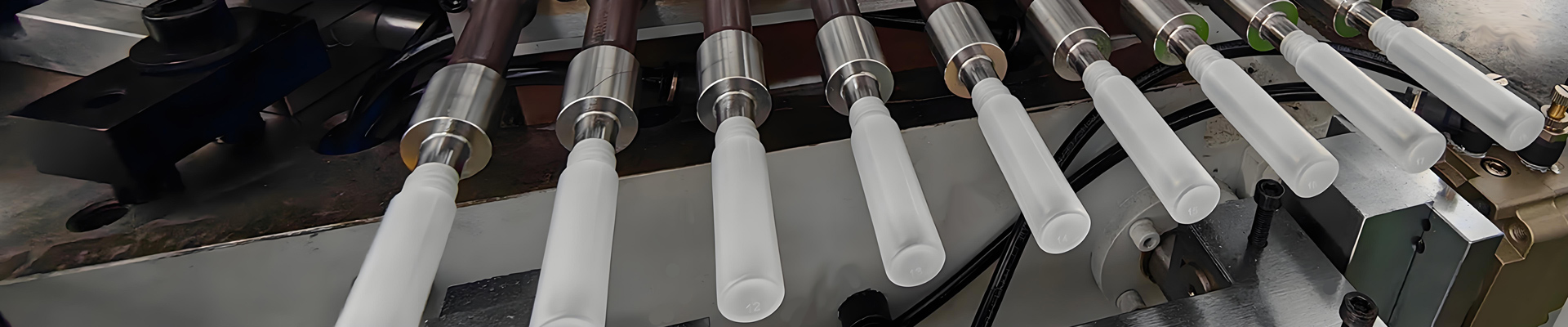
Three-station and four-station turret layout. Aibim IBM machines use a three-station one-step process: injection, blow and ejection on a rotating turret. Some programs add a fourth station for extra cooling or in-mold labeling. A wide mouth mold occupies more platen area per cavity than a bottle mold, so the turret pitch and the platen size set the maximum cavity count directly. Plan the cavitation from the platen drawing, not from the shot size, because the wide body almost always runs out of platen before it runs out of polymer.
Neck ring split design and flash control. Because IBM injects the neck, the neck ring is a split steel insert that defines the finish. For a wide mouth jar the neck ring is large and must part cleanly without a flash line on the sealing land. Design the parting line away from the seal face, and hold the neck ring as a replaceable insert so wear does not force a full mold rebuild. Flash on the land is the fastest way to fail a closure leak test, so the neck ring fit is cut tighter than on a bottle mold.
Core rod length-to-diameter ratio and rigidity. The core rod forms the internal shape and carries the parison between stations. A wide mouth jar needs a large-diameter core rod, and a large-diameter rod is more prone to deflection than a slim bottle rod. Keep the rod aspect ratio conservative, support it at both ends where the machine allows, and specify a stiff, dimensionally stable grade so the inside diameter stays round across the run. A deflecting rod produces an out-of-round inside wall that no blow setting can fix.
Water channel layout and uniform temperature. Wide mouth jars need the neck cooled faster than the body, so the neck ring gets its own circuit while the body cavity gets another. Lay the channels to hold the mold temperature uniform within plus or minus 2 degrees C across the cavity face; a 5 degree C spread across a wide land is enough to warp the seal plane. Denser channels near the base and shoulder pull heat from the thick sections that otherwise dictate the cycle.
Mold material and maintenance. Use pre-hardened tool steel (P20-type) for the body and cavity where the loads are moderate, and stainless tool steel (420-type) for necks and cores that contact food-grade or corrosive compounds and need corrosion resistance with a polish-ready surface. The cavity and core rod are finished to Ra 0.2 micrometer or better for clean demolding. With routine cleaning, channel descaling and rod inspection, a well-built wide mouth IBM mold runs a long life; schedule a full refurbish at the cavitation and wear interval defined in the mold maintenance plan rather than waiting for a failure.
Inspection qualité et critères d'acceptation
Un pot à large ouverture est accepté selon des critères dimensionnels, mécaniques et d'étanchéité. Le tableau ci-dessous est une liste de contrôle d'acceptation prête qui associe chaque contrôle à sa limite et sa méthode.
| Check | Contactez aibimance limit | Method |
|---|---|---|
| Capacity | Plus or minus 2 percent of rated volume | Fill to overflow, weigh or measure |
| Neck inside diameter | Per drawing, plus or minus 0.05 mm | Bore gauge at two axes |
| Neck ovality | Below drawing max, typically < 0.10 mm | Two-axis bore gauge |
| Seal face flatness | 0.15 mm or better | Dial indicator on datum |
| Wall thickness distribution | Minimum at or above spec, 8 plus points | Section and micrometer |
| Vertical top load | Per rated stack load in newtons | Compression test at set speed |
| Drop test | No leak or break at 1.2 m, full | Drop on required orientations |
| Seal retention | Hold vacuum or pressure per spec | Vacuum or pressure chamber |
| Light transmittance and haze | Per clarity grade for transparent jars | Haze meter or spectro |
Capacity is confirmed by filling the jar to the overflow line and weighing the contents against the rated volume, with the tolerance held to plus or minus 2 percent so filling lines stay accurate. Neck inside diameter and ovality are checked at two perpendicular axes because a wide mouth jar fails capping the moment the opening goes out of round. Seal face flatness is the single most important number for leak performance and is held to 0.15 mm or better. Wall thickness is measured at no fewer than eight points so a thin base or shoulder cannot hide in a single reading. Top load in newtons confirms the jar survives pallet stacking, and the 1.2 m full drop test confirms field performance. Transparent jars are additionally checked for light transmittance and haze so the display appearance is controlled.
Machines Aibim pour la production de pots à large ouverture
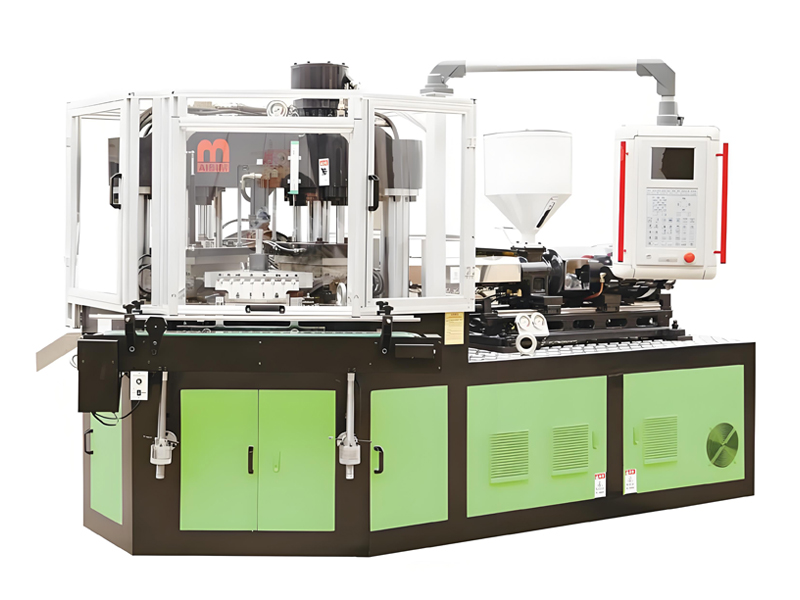
When the technical discussion reaches the question of which machine to run, Aibim offers a focused IBM lineup built for precision hollow parts including wide mouth jars. Two representative models are described below with specification tables that include the two numbers that matter most for this application: maximum bottle mouth diameter and maximum bottle volume.
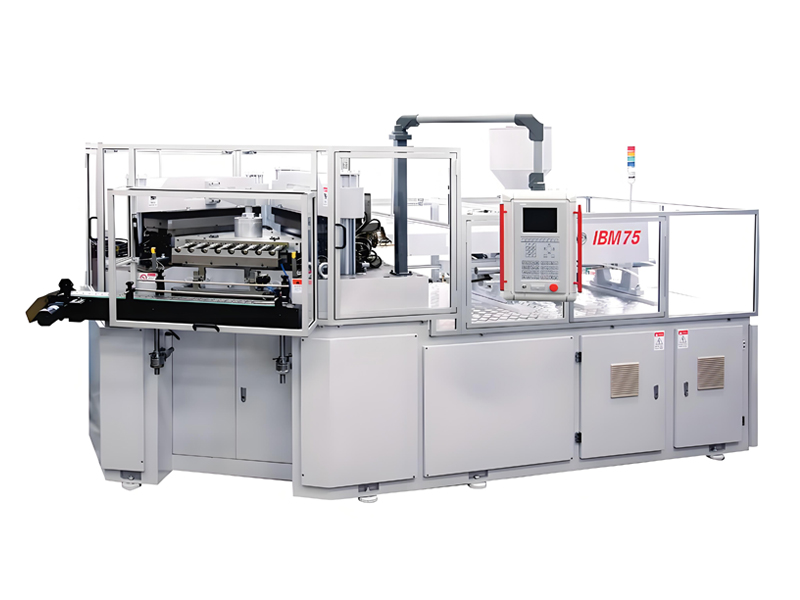
Machine de moulage par injection-soufflage Aibim IBM75
The IBM75 is the largest standard Aibim model and the natural choice for wide mouth jars up to 1000 mL and openings up to 120 mm. Its single-crossbeam, double-pole clamping framework enlarges the mold setting space, which is exactly what a wide mouth mold needs because the body footprint is large. The machine uses Aibim PREFILL technology with a variable displacement pump that cuts energy use by at least 35 percent compared with a conventional fixed-pump hydraulic unit.
| Specification | IBM75 value |
|---|---|
| Clamping force | 75 tf (750 kN) |
| Injection capacity (shot) | 600 cm3 |
| Screw diameter | 45 mm |
| L/D ratio | 20:1 |
| Maximum cavities | Up to 8 for small parts; 2 to 4 for wide mouth jars |
| Maximum bottle mouth diameter | 120 mm |
| Maximum bottle volume | 1000 mL |
| Platen size | 520 x 520 mm |
| Installed power | 30 kW |
| Temps de cycle en mode sec | 4.5 s |
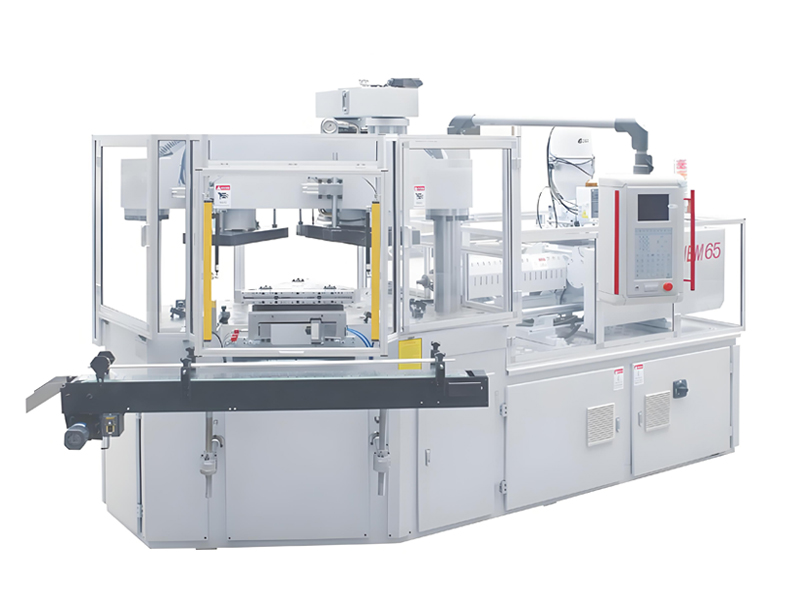
Machine de moulage par injection-soufflage Aibim IBM65
The IBM65 sits one step below the IBM75 and covers wide mouth jars up to 750 mL and openings up to 100 mm. It is the workhorse for food, cosmetic and pharmaceutical jars in the mid-volume band, with the same three-station one-step process and the same neck precision. Cavity count for a wide mouth jar is limited by platen space, so a 250 mL jar at 70 mm mouth can run four to six cavities while a 750 mL jar at 100 mm mouth runs two.
| Specification | IBM65 value |
|---|---|
| Clamping force | 65 tf (650 kN) |
| Injection capacity (shot) | 450 cm3 |
| Screw diameter | 40 mm |
| L/D ratio | 20:1 |
| Maximum cavities | Up to 6 for small parts; 2 to 3 for wide mouth jars |
| Maximum bottle mouth diameter | 100 mm |
| Maximum bottle volume | 750 mL |
| Platen size | 460 x 460 mm |
| Installed power | 25 kW |
| Temps de cycle en mode sec | 4.0 s |
Aibim also offers the IBM55 Hybrid Electric model for smaller wide mouth jars up to 500 mL and openings up to 80 mm, where the electric clamp and servo plasticizing give the tightest energy and repeatability numbers for cleanroom and pharmaceutical use. All three models share the Aibim advantages: CE-certified safety with a stripper station laser sensor and light curtain, SD-card recipe storage that moves a proven setting from one machine to another, and the Wanplas group backing for service and spare parts.
Industries d'application et spécifications types
Les pots à large ouverture fabriqués par IBM servent des industries où l'ouverture, l'étanchéité et la clarté comptent toutes. Les combinaisons ci-dessous sont typiques, non exhaustives, et chacune peut être chiffrée comme une configuration concrète de machine et de moule.
Alimentation. Pots de confiture et de miel avec ouverture de 63 à 100 mm et 250 à 500 mL en PP ; pots de noix et de snacks de 70 à 89 mm et 400 à 750 mL en PP ; pots d'aliments pour bébés de 53 à 63 mm et 100 à 250 mL en copolymère aléatoire PP ; pots de confiserie de 63 à 89 mm et 200 à 500 mL en PP ou PETG transparent via ISBM.
Santé et compléments. Pots de vitamines et protéines de 53 à 89 mm et 200 à 750 mL en PP, souvent avec une zone de scellage en feuille d'aluminium et une fermeture inviolable.
Pharmaceutique. Flacons de comprimés et de poudre de 38 à 63 mm et 60 à 300 mL en HDPE ou PP, où la précision du goulot supporte une fermeture de sécurité enfant et un accessoire dessiccant.
Cosmétique. Pots de crème de 45 à 70 mm et 30 à 200 mL en SAN ou PP ; pots de beurre corporel et de lotion de 63 à 89 mm et 200 à 500 mL en PP ; pots de masque de 70 à 100 mm et 250 à 500 mL en PP ou PETG.
Chimie quotidienne. Pots de perles et dosettes de lessive de 70 à 100 mm et 400 à 1000 mL en PP, conçus avec une large fermeture de sécurité enfant et une barrière d'humidité.
Alimentation animale. Pots d'aliments humides et secs pour animaux de 89 à 100 mm et 500 à 1000 mL en PP, où la large ouverture facilite le prélèvement et la précision du goulot maintient le couvercle fermé.
Main-d'œuvreatoire et échantillons. Pots d'échantillons et de réactifs de 38 à 63 mm et 30 à 250 mL en PP, PS ou PCTG, où la clarté et la résistance chimique sont toutes deux requises.
Guide de sélection du modèle selon les exigences
Le tableau ci-dessous fait correspondre une exigence client à un modèle Aibim recommandé et à une configuration de cavités. Les nombres de cavités sont donnés pour les moules à large ouverture et supposent l'agencement limité par le plateau décrit plus haut ; la cavitation finale est confirmée au stade de la conception du moule.
| Mouth diameter | Volume | Material | Annual output | Recommended model | Cavities | Key configuration |
|---|---|---|---|---|---|---|
| 38 – 45 mm | 30 – 150 mL | PP / PS | Low to medium | IBM55 Hybrid | 4 | Electric clamp, cleanroom option |
| 53 – 63 mm | 100 – 300 mL | PP / HDPE | Medium | IBM65 | 4 | Independent neck cooling |
| 63 – 70 mm | 200 – 500 mL | PP / PETG | Medium to high | IBM65 or IBM75 | 3 – 4 | Stepped core rod, stripper plate |
| 70 – 89 mm | 400 – 750 mL | PP | Medium to high | IBM75 | 2 – 3 | Dense cooling, servo turret |
| 89 – 100 mm | 500 – 1000 mL | PP | Medium | IBM75 | 2 | 120 mm max mouth, reinforced core rod |
| Up to 100 mm | 250 – 500 mL | PET / PETG (ISBM) | High | Wanplas ISBM line | Per project | Oriented clarity, barrier |
For projects that need an oriented PET or PETG wide mouth jar with maximum clarity and barrier, the Wanplas group supplies the matching ISBM line so the customer stays with one supplier and one service organization. For any configuration outside the table, Aibim engineers size the machine from the part drawing, the annual volume and the material data sheet rather than from a generic rule.
Service, support et comment démarrer
Acheter une ligne de pots à large ouverture est le début d'une relation de production, pas une transaction ponctuelle. Aibim, en tant qu'usine Wanplas, soutient chaque machine avec les promesses de service partagées du groupe.
Essais en usine avant expédition. Chaque machine subit un test de continuité et de performance sur le sol de l'usine avec le moule du client lorsqu'il est disponible, afin que la ligne soit éprouvée avant de quitter Zhangjiagang. Le test enregistre le temps de cycle, l'équilibre des cavités et les dimensions de la première pièce.
Essai du moule et inspection du premier article. Le moule est essayé sur la machine réelle et un rapport d'inspection du premier article est émis par rapport au dessin, couvrant le diamètre du col, l'ovalité, la planéité de la face d'étanchéité, la distribution des parois et les performances de chute. La pièce n'est pas libérée tant que le rapport n'est pas signé.
Installation et mise en service. Les ingénieurs accompagnent l'installation et la mise en service sur site, transfèrent la recette éprouvée sur la carte SD de l'usine et forment l'équipe locale à faire fonctionner, nettoyer et entretenir la ligne.
Politique de pièces de rechange. Le groupe Wanplas fournit chaque année 500 USD de pièces gratuites pour les machines couvertes, et les pièces endommagées sous garantie sont remplacées gratuitement. Cela maintient une ligne de pots à large ouverture en fonctionnement sans un stock important immobilisé.
Formation et exploitation à distance. Les opérateurs et le personnel de maintenance sont formés sur le terrain, et la machine prend en charge la surveillance à distance afin que les ingénieurs Aibim puissent lire les données de l'API et réagir aux conditions anormales sans attendre une visite sur site.
Usine ouverte. Les clients sont invités à visiter l'usine Aibim pour auditer la fabrication, regarder un essai et examiner le centre CNC qui produit les pièces de la machine.
If you are planning a wide mouth jar program, send your part drawing, target volume, material and annual output to Aibim. The engineering team will propose a machine model, a cavity layout and a process window, and invite you to the factory for a mold trial and a line audit before you commit. There is no substitute for seeing your jar come off the machine with the neck in tolerance and the seal flat.
Questions fréquemment posées
Quel rapport diamètre du goulot/corps définit un pot à large ouverture ?
Un pot à large ouverture a un rapport diamètre du col sur diamètre du corps supérieur à 0,5, généralement de 0,55 à 0,85. Les bouteilles à col étroit se situent en dessous de 0,35. Plus le rapport est grand, plus l'ouverture est proche du diamètre complet du corps, ce qui modifie la mécanique de soufflage et rend la répartition de la paroi plus difficile à contrôler.
Pourquoi le moulage par injection-soufflage est-il préféré pour les pots à large ouverture plutôt que le moulage par extrusion-soufflage ?
IBM produces the neck finish by injection in a precision neck ring, so the opening is held to roughly plus or minus 0.05 mm with no flash and no post trim. For a wide mouth jar the opening is the critical sealing and filling surface, and IBM holds that surface to the tightest tolerance of the three processes.
Quel matériau est le mieux adapté à un pot à large ouverture en contact alimentaire ?
For most food jars such as jam, honey, nuts and confectionery, polypropylene in homo-polymer or random co-polymer grade is the first choice because of its heat resistance, chemical inertness and food contact compliance. Transparent display jars use PS, SAN or PETG, while HDPE serves pharmaceutical powder and tablet jars.
Combien d'empreintes un moule de pot à large ouverture peut-il comporter dans une seule machine IBM ?
Cavity count is limited by platen area because a wide mouth jar occupies far more mold space than a narrow neck bottle of equal volume. On an Aibim IBM75 a 1000 mL jar up to 120 mm mouth may run two cavities, while a 250 mL jar at 70 mm mouth can run four to six cavities. Larger cavitation is possible only on smaller diameter parts.
Qu'est-ce qui provoque l'ovalisation ou la déformation du goulot d'un pot à large ouverture ?
L'ovalité provient de parois de col minces, d'un refroidissement insuffisant de la bague de col et d'un démoulage alors que le polymère est encore mou. Les contre-mesures sont un circuit de refroidissement indépendant sur la bague de col, le maintien de la température de démoulage en dessous de 70 degrés C pour le PP, et l'ajout de 0,2 à 0,5 mm à l'épaisseur de la paroi du col.
Quel est le meilleur taux de soufflage pour un pot à large ouverture ?
Maintenez le rapport de soufflage dans la plage de 2,0 à 3,5. Au-delà, la paraison ne peut pas s'étirer uniformément, de sorte que l'épaulement et la base s'amincissent tandis que le corps reste épais. Un profil de noyau étagé et un gradient de paroi d'injection de 1,5 à 4,5 mm vous permettent de maintenir le rapport dans la fenêtre de sécurité.
Comment vérifier qu'un pot à large ouverture répond à son cahier des charges qualité ?
Measure capacity at plus or minus 2 percent, neck inside diameter and ovality, seal face flatness at or below 0.15 mm, wall thickness at no fewer than eight points, top load in newtons, a 1.2 m full drop test, and seal retention under vacuum or pressure. Transparent jars also need light transmittance and haze checks.