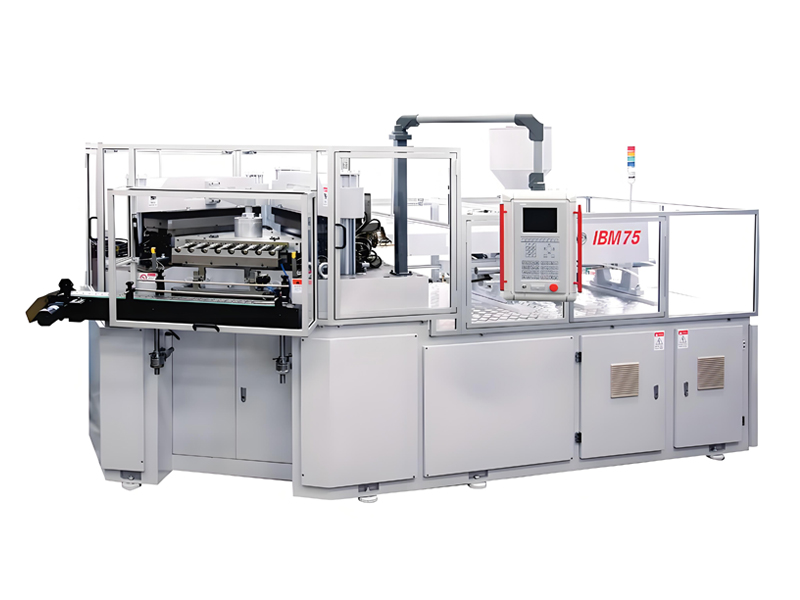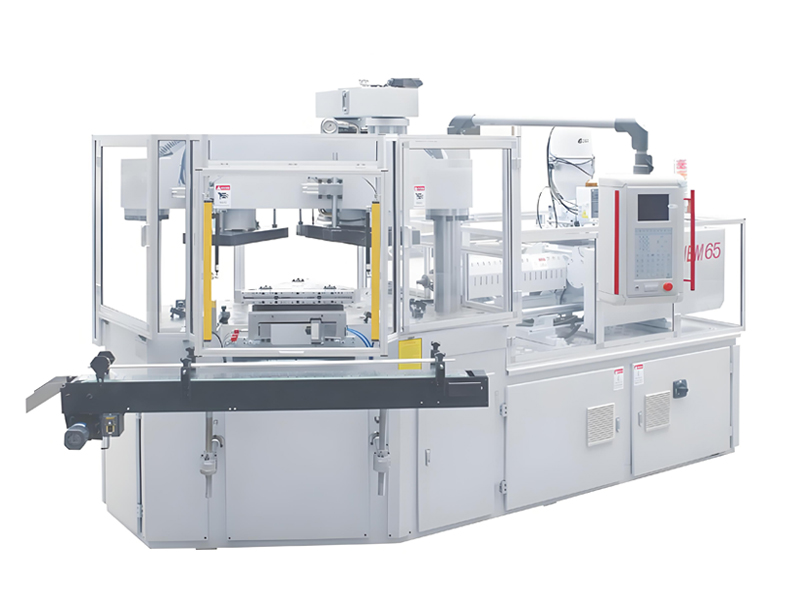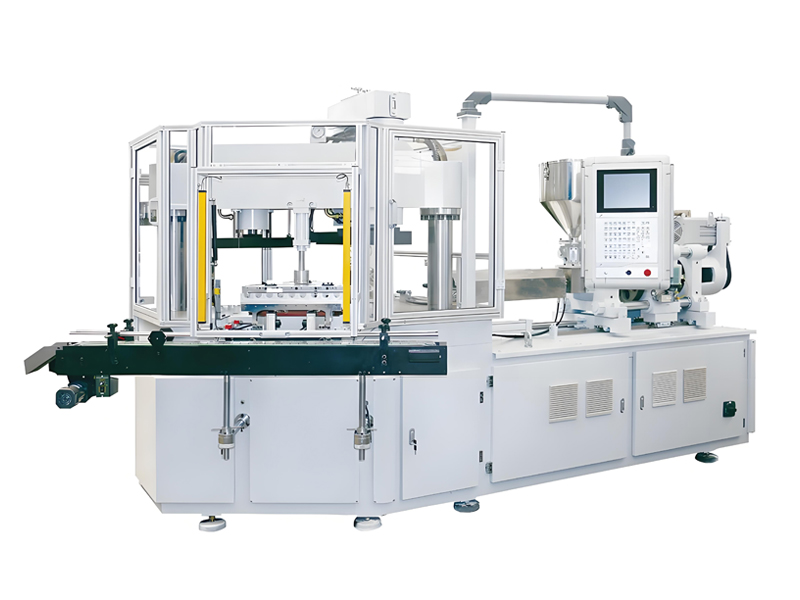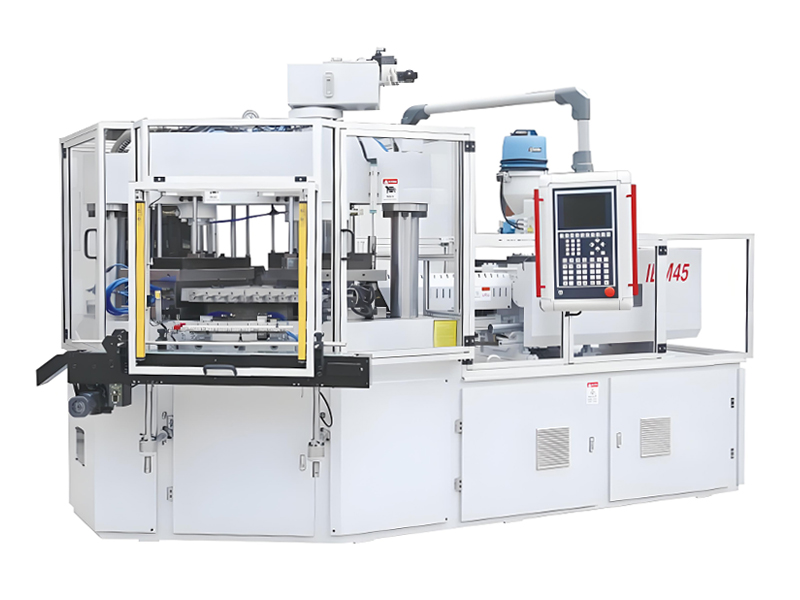
الحقن blow molding has become the process of choice for pharmaceutical, cosmetic, food, and drink containers that demand a precise neck finish, consistent wall thickness, and a clean flash-free appearance, and in 2026 the three-station one-step configuration is the dominant architecture for high-volume IBM production. Aibim, a Wanplas factory, has specialized in this process for more than twelve years and ships the IBM75, IBM65, and IBM55 Hybrid machines built around a single indexed turret where injection, blow, and ejection occur without ever removing the parison from the machine. This technical deep-dive explains the physical fundamentals of injection blow molding, walks through the three-station one-step flow station by station, details the critical process parameters that govern part quality, and quantifies the production advantages against two-step and extrusion blow molding alternatives. We reference CE and ISO manufacturing standards, FDA and EU 10/2011 contact requirements, and ASTM test methods, and we compare Aibim with established IBM suppliers such as Milacron, جومار, and Nissei ASB so engineers and buyers can judge the process on evidence rather than marketing.
أساسيات الحقن والنفخ
الحقن blow molding combines the precision of injection molding with the hollow-form capability of blow molding. Plastic raw material is first melted and injected into a parison mold, where it forms a precisely dimensioned tube with a finished neck and threads; this parison is then transferred to a blow station and expanded against a chilled blow mold by compressed air, and finally ejected at a third station. Because the parison is injection molded rather than extruded, its diameter, wall thickness, and neck geometry are controlled to tight tolerances, which is why IBM is favored for containers where the closure must seal reliably.
The defining advantage over extrusion blow molding is the absence of a scrap tail and a pinch weld. The parison already carries the finished neck, so the final container needs no post-mold trimming for the vast majority of articles, and there is no weld line across the base that could weaken a bottle. Over a production year this elimination of flash translates directly into resin savings and lower scrap-handling cost, which matters for both economy and sustainability. The three-station one-step process concentrates all three operations on one turret, which shortens the thermal path of the parison and preserves its temperature for the blow step.
Wanplas, as the parent brand of Aibim, positions the factory as its dedicated IBM specialist within a portfolio that spans extrusion blow, PET blow, and recycling equipment. That group context means Aibim’s three-station machines benefit from shared Wanplas engineering discipline and a unified service promise, while remaining focused purely on injection blow molding. For applications from 3 ml dropper bottles to 1000 ml cosmetic jars, the three-station one-step method offers a balance of quality and throughput that continuous packaging lines depend on.
The thermal window is the heart of the process: the parison must stay warm enough to blow yet cool enough at the neck to hold threads. The one-step turret minimizes the time between injection and blow, reducing parison temperature loss and allowing shorter cycles than a two-step layout where the parison is conditioned off-machine. This is one reason Aibim’s one-step design achieves the output rates its customers report in pharmaceutical and personal-care segments.
The process also lends itself to lightweighting, because the controlled parison lets engineers specify thinner sidewalls than extrusion blow molding typically allows while still meeting top-load and drop requirements verified by ASTM methods. Less resin per bottle lowers both material cost and the carbon footprint of each unit, an increasingly important purchasing criterion for global brands in 2026. Aibim supports this by supplying wall-thickness recommendations per article so customers can capture the saving without compromising the container’s functional performance or its appearance on the shelf.
A related variant worth distinguishing is two-step or reheat blow molding, where preforms are injection molded separately, conditioned, and then blown, often used for PET beverage bottles. The three-station one-step method integrates all steps on one turret and avoids the energy and handling of an intermediate preform stage for the resins Aibim targets. For non-stretch materials such as HDPE, PP, and PS, the one-step approach is both simpler and more compact, which is why Aibim concentrates its development there rather than competing in the PET beverage segment served by stretch-blow specialists.
بنية الآلة أحادية المرحلة ثلاثية المحطات
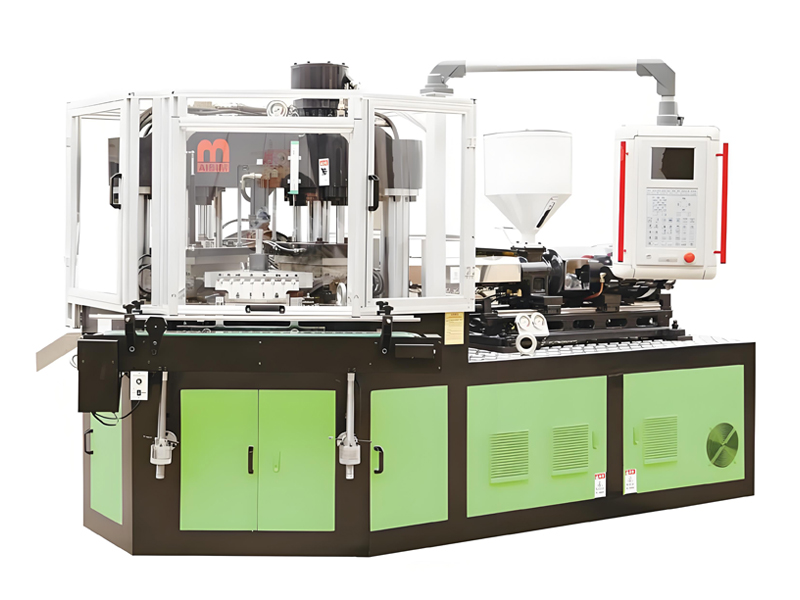
A three-station one-step IBM machine is built around a rotating turret that carries the core rods through three indexed positions, typically labeled injection, blow, and ejection. The turret indexes by one station after each cycle, so at any moment one parison is being injected, one is being blown, and one finished container is being ejected. This parallel operation keeps the machine productive even though each individual article takes several seconds to complete, because three articles are in process simultaneously on the same machine.
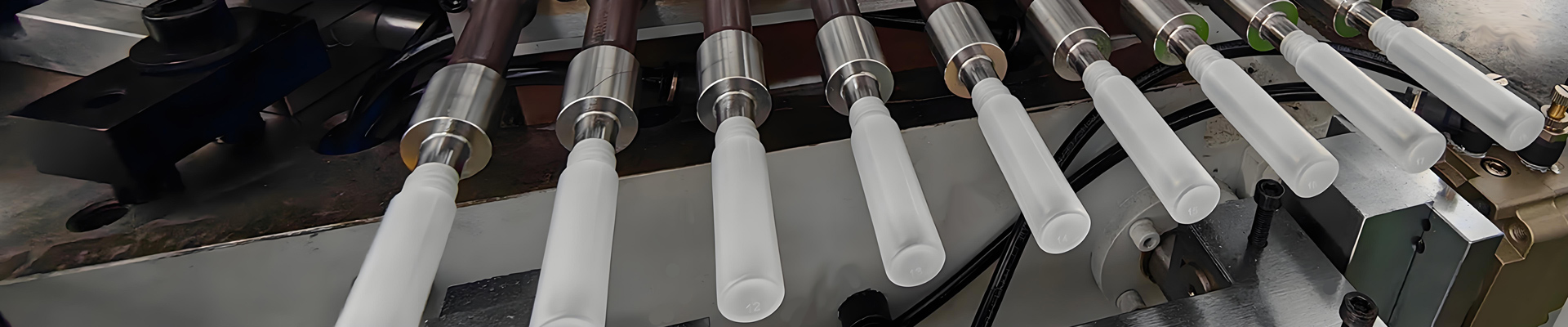
The injection station contains the plasticizing unit and the parison (core-rod) mold. Melt is injected around a core rod to form the parison with a finished neck. The blow station holds the blow mold and a blow pin that supplies compressed air; the parison on its core rod is transferred here and expanded. The ejection station strips the cooled container from the core rod and drops it onto a conveyor. Aibim’s IBM75, IBM65, and IBM55 Hybrid share this layout, differing mainly in platen size, clamp force, and the degree of electric assist.
The IBM55 Hybrid adds an electric servo assist to selected motions, reducing hydraulic demand and improving repeatability for sensitive cosmetic and pharmaceutical articles, while still retaining the same three-station one-step principle. The single-crossbeam, double-pole clamping framework used by Aibim enlarges the mold-setting space and provides rigid, parallel clamping that protects the neck finish from flash. The own CNC center at Aibim machines the critical parts, supporting tight tolerances on the turret and core-rod alignment that the process depends on.
Because the turret must index with repeatable precision across millions of cycles, Aibim’s in-house machining of the core-rod carriers and turret journals protects long-term accuracy and reduces wear-induced drift that would otherwise show up as neck variation. The double-pole clamping framework further stabilizes the parison mold during injection, so the neck threads form cleanly even at high cycle rates. These mechanical fundamentals are what allow the three-station process to deliver pharmaceutical-grade consistency; no amount of control tuning can compensate for a turret that loses positioning over time, which is why Aibim invests in its own CNC capability rather than outsourcing critical structures.
Cooling is distributed intelligently across the three stations rather than concentrated at one, which helps maintain cycle speed. The blow mold is chilled to set the container quickly, while the core rod temperature is managed so the parison releases cleanly at ejection without sticking. Aibim’s IBM55 Hybrid refines this further by driving selected motions electrically, reducing hydraulic oil demand and the associated heat, which in turn lightens the load on the facility’s cooling infrastructure. The net effect is a machine that fits comfortably into spaces where a conventional separate injection and blow line would not, an advantage repeatedly cited by cosmetic and pharmaceutical customers with constrained cleanroom footprints.
From a controls standpoint, an SD card stores parameter sets so a validated recipe for a given bottle can be reinstalled across multiple machines without manual re-entry, which is valuable for multi-line plants. The machine architecture also supports the PREFILL hydraulic system described in Aibim’s energy literature, giving the three-station process both precision and efficiency on a single, compact footprint suitable for cleanroom-adjacent installation.
تدفق العملية خطوة بخطوة
يمكن تحليل دورة الخطوة الواحدة إلى ثلاث عمليات محطات تتداخل في الوقت. فهم كل مرحلة ونطاق معلماتها أمر ضروري لتشخيص مشكلات الجودة وتحسين الإنتاج.
المحطة 1: حقن الباريسون
At the injection station, the plasticizing screw melts and meters the resin, and the melt is injected around a heated or temperature-controlled core rod inside the parison cavity. The result is a hollow tube with a fully formed neck, threads, and a closed or open bottom depending on the design. الحقن speed, melt temperature, and hold pressure determine parison wall uniformity; too low a temperature yields a short shot, while too high a temperature causes neck deformation. Aibim recipes set these per material, with HDPE, PP, and PS each having distinct thermal windows.
المحطة 2: النقل والنفخ
After injection, the turret indexes and the core rod carrying the warm parison moves to the blow station. A blow mold closes around the parison, and compressed air expands it against the cooled cavity wall. The short transfer distance in a one-step machine keeps the parison within its optimal blow temperature, so the material stretches uniformly and the wall thickness is controlled by mold geometry and blow pressure rather than by uncertain parison cooling. Blow pressure and timing are tuned so the container reaches the cavity everywhere without overstretching that would thin the wall at the shoulder.
المحطة 3: التبريد والإخراج
The blown container continues on the core rod to the ejection station, where it is cooled sufficiently to hold shape, then stripped by a stripper ring or ejector and discharged. Aibim’s stripper station uses a long-distance digital laser sensor for mold safety and a light curtain for personal safety, meeting CE requirements. Cooling time is the usual cycle limiter for thick-walled pharmaceutical bottles, and the one-step layout minimizes non-productive transfer time compared with separate operations. The finished container leaves the machine flash-free with a precise neck ready for capping.
Although the three stations run in parallel, the cycle time is governed by the longest single station operation, which for most bottles is the combined injection and cooling time at the first and second positions. Aibim’s process engineers therefore balance station timing so that no station waits on another, maximizing the turret’s effective output. The overlap is also why a three-station one-step machine occupies less floor space than running a separate injection press and a separate blow machine with intermediate conditioning, an important advantage in facilities where cleanroom area is expensive and strictly limited.
Throughout the flow, in-process monitoring guards quality. The stripper station’s laser sensor confirms the container has cleared the core rod before the next index, preventing collisions that could damage tooling, and the light curtain halts the turret if a presence is detected in the danger zone, satisfying CE machinery safety expectations. These interlocks are standard on Aibim machines and reflect the Wanplas group’s emphasis on operator protection as a design input rather than an afterthought. The result is a process that is not only efficient but also safe to run across multiple shifts with rotating crews.
معاملات العملية الرئيسية وتحسينها
الجودة and throughput in three-station IBM are governed by a handful of interdependent parameters. The table below lists typical parameter bands and their effect; exact values depend on resin, bottle size, and mold geometry. Optimization means finding the combination that yields a flash-free container with uniform wall thickness at the highest stable cycle rate.
مرجع المعلمات التمثيلي (زجاجة HDPE سعة 50 مل)
| Parameter | Typical Band | Primary Effect | Optimization Tip |
|---|---|---|---|
| Melt temperature | Medium-High per resin | Parison flow and neck definition | Use lowest stable temp to protect neck |
| الحقن speed | Medium | Parison wall uniformity | Raise until short shots disappear |
| Hold pressure | Medium | Neck and parison density | Sufficient to avoid sink at neck |
| Blow pressure | Medium-High | Wall conformity to cavity | Raise until full cavity fill, then stop |
| Blow timing | Short | Cycle time | Minimize without incomplete blow |
| Cooling time | High for thick wall | Dimensional stability | Balance against throughput target |
| Core rod temperature | Controlled warm | Parison release and blow | Tune to resin to avoid sticking |
Because these parameters interact, Aibim supplies validated starting recipes per article and material, and operators refine from there. The SD-card parameter storage lets a proven set be moved between an IBM65 and an IBM75 without redevelopment, which shortens new-product ramp time. In 2026 installations, remote monitoring options allow the Wanplas engineering team to review process data and suggest parameter adjustments, extending the optimization loop beyond the factory floor.
A subtle but important parameter interaction is between blow pressure and parison temperature at the moment of transfer. If the parison cools too much during indexing, even high blow pressure cannot achieve full cavity fill, producing short shots at the shoulder; if it is too hot, the material sags before air arrives and the wall distribution becomes uneven. The compact one-step turret minimizes transfer time precisely to keep this window wide and forgiving, which is why Aibim’s process is often easier to stabilize than a two-step layout where the parison is conditioned off-machine and more exposed to ambient variation.
For new product introduction, Aibim recommends a structured ramp: start from the material recipe, confirm parison fill at low speed, then raise rate while watching neck dimension and wall distribution. Because the SD card stores the validated set, the same article can later be reproduced on an IBM75 or IBM65 without re-engineering, which shortens time-to-market for seasonal cosmetic lines and pharmaceutical launches. This recipe portability is a quiet productivity advantage of the Aibim control architecture and a reason multi-line sites standardize on the Wanplas factory’s IBM platform.
IBM ثلاثية المحطات مقابل العمليات البديلة
تتنافس عملية IBM أحادية الخطوة ثلاثية المحطات بشكل أساسي مع القولبة بالنفخ بالبثق (EBM) ومع النفخ بالتمدد ثنائي الخطوة أو بإعادة التسخين (لـ PET). تؤطر المقارنة أدناه أين تفوز كل عملية، باستخدام مستويات تكلفة نسبية بدلاً من أرقام مطلقة.
| Attribute | Three-Station IBM (Aibim) | Extrusion النفخ | Two-Step / Stretch Blow |
|---|---|---|---|
| Neck finish precision | High | Medium | High |
| Flash / scrap | None (most articles) | Tail scrap present | Minimal |
| Material range | PE, PP, PS, ABS, SAN, TPU, PC, PCTG | PE, PP, PVC, PETG | PET, PP (stretch) |
| Wall-thickness control | High | Medium | High |
| Best container size | 3 ml to 1000 ml | Up to large volumes | Bottles, mainly PET |
| Relative machine cost | Medium | Low-Medium | High |
| Typical application | Pharma, cosmetic, food | Industrial, large containers | Beverage bottles |
Three-station IBM is the clear winner when a flash-free neck with bottle-grade threads is required in the 3 ml to 1000 ml range, which covers most pharmaceutical droppers, cosmetic jars, and food condiment bottles. Extrusion blow molding remains cheaper for very large or irregular hollow parts, while stretch blow is purpose-built for PET beverage bottles. Aibim’s focus on the IBM niche lets it optimize the three-station turret for exactly these precision applications rather than serving every blow molding segment.
Cost should be read alongside capability: while extrusion blow molding carries a Low to Medium machine cost that appeals to bulk industrial users, the downstream trimming, deflashing, and scrap-reprocessing equipment it requires can offset the initial saving for precision packagers. Three-station IBM’s Medium machine cost is balanced by minimal post-molding operations, so the total cost of producing a finished, capped-ready bottle is frequently competitive. Aibim’s application team builds this total-cost view into quotations so buyers compare like with like rather than machine sticker price alone, consistent with the Wanplas group’s transparent capacity and quality guarantees.
اعتبارات المواد والعيوب والمعايير والشركات المصنعة
Material selection shapes every parameter above. PE grades (HDPE, LDPE, LLDPE) are forgiving and widely used for pharmaceutical and food bottles; PP offers higher temperature resistance and clarity options for cosmetics; PS gives rigidity and gloss for display packaging; ABS, SAN, TPU, PC, and PCTG extend the range to engineering and high-clarity applications. Each resin has a distinct melt temperature and blow behavior, so Aibim maintains per-material recipes that the operator selects at the control panel.
Aibim’s stated application fields, pharmaceutics, food, drink, and cosmetic, map neatly onto this material menu: HDPE and PP dominate pharmaceutical and food contact bottles for their chemical resistance and regulatory acceptance, while PS and PCTG serve cosmetic display packaging that values clarity and surface finish. Matching the resin to the application is the first step in any new project, and Aibim’s team reviews the filled-product chemistry during quotation to confirm compatibility and to pre-select the correct parison and blow recipe before the machine ships.
Common defects in three-station IBM include short parison (low injection or temperature), neck flash (excess hold pressure or worn core), thin shoulder (insufficient blow pressure or timing), and sticking on the core rod (wrong core temperature). Because the process is one-step and the parison never leaves the turret, most defects trace to a single station’s parameters and are fast to isolate. The structured troubleshooting approach is to check the injection station first, then blow, then ejection, since the article moves in that order.
For regulated markets, containers must satisfy FDA requirements in the الولايات المتحدة and EU 10/2011 in Europe when they contact food or pharmaceutical products, and finished container performance is verified with ASTM test methods such as top-load and drop testing. Machine manufacturing follows CE safety and ISO 9001 quality management, with ISO 14001 covering environmental management of the production process. Aibim ships its lines with the relevant CE documentation and ISO-aligned quality records, and the Wanplas group supports validation through its shared service program.
On the supplier landscape, Aibim competes with Milacron, جومار, Nissei ASB, and Bekum. Aibim’s three-station one-step differentiation lies in the PREFILL hydraulic system, the IBM55 Hybrid electric-assist option, and the Wanplas group’s open-factory policy and annual spare-parts provision. The comparison below summarizes the field.
تحديد موقع الشركات المصنعة الممثلة لـ IBM
| Manufacturer | IBM Process Focus | Relative Cost Tier |
|---|---|---|
| Aibim (Wanplas factory) | Three-station one-step, IBM55 Hybrid | Medium |
| Milacron | Three-station IBM, servo options | Medium |
| جومار | Conventional IBM lines | Medium |
| Nissei ASB | One-step and stretch blow | High |
| Bekum | EBM and IBM variants | Medium |
In 2026, demand for precise, lightweight, and recyclable containers continues to pull packaging brands toward three-station IBM, and Aibim’s combination of process focus, hydraulic efficiency, and group-backed service makes it a credible alternative to longer-established suppliers for new capacity in Asia, Europe, and the Americas.
Recyclability is an area where material choice and process design meet: monolayer HDPE and PP bottles produced by three-station IBM are straightforward to recycle in existing streams, whereas multi-layer structures common in some barrier applications complicate end-of-life handling. Aibim advises customers on resin selection that satisfies both product protection and sustainability goals, and the flash-free process avoids the mixed-material scrap that extrusion blow can generate. For brands publishing environmental disclosures in 2026, the combination of lower scrap, lighter walls, and recyclable mono-materials makes three-station IBM a defensible choice in a packaging specification.
الأسئلة الشائعة
ما هي عملية قولبة النفخ بالحقن أحادية الخطوة ثلاثية المحطات؟
إنها طريقة IBM حيث يحدث الحقن والنفخ والإخراج في ثلاث محطات على قرص دوار مفهرس واحد دون إزالة الباريسون من الآلة. يُحقن الباريسون ويُنقل ويُنفخ ويُخرج في دورة واحدة متصلة، مما يحافظ على تجانس المادة والدقة الأبعادية.
كيف تختلف IBM ثلاثية المحطات عن قولبة النفخ بالبثق؟
Extrusion blow molding forms a parison by extruding molten plastic that is then pinched and blown, often leaving a scrap tail and a weld line. Three-station IBM injects a precisely dimensioned parison with no flash, giving a neck finish with bottle-grade threads and no post-mold trimming for most articles.
أي آلات Aibim تستخدم العملية أحادية الخطوة ثلاثية المحطات؟
تعمل ماكينات Aibim IBM75 وIBM65 وIBM55 Hybrid الكهربائية المساعدة جميعها بعملية الخطوة الواحدة ثلاثية المحطات وتغطي أحجام الحاويات من 3 مل إلى 1000 مل عبر تطبيقات الأدوية والغذاء والمشروبات ومستحضرات التجميل.
ما المواد التي يمكن معالجتها على آلة IBM ثلاثية المحطات؟
تشمل المواد النموذجية PE (HDPE، LDPE، LLDPE)، وPP، وPS، وABS، وSAN، وTPU، وPC، وPCTG. يؤثر اختيار المادة على درجة حرارة الباريسون وضغط النفخ ووقت التبريد، وكلها تُضبط لكل راتنج في وصفة الماكينة.
ما هي معايير الصناعة المطبقة على حاويات IBM؟
يجب أن تفي حاويات ملامسة الغذاء والأدوية بمتطلبات FDA وEU 10/2011 حسب السوق، ويتم التحقق من الأداء بطرق اختبار ASTM. يتبع تصنيع الماكينات سلامة CE وإدارة الجودة ISO 9001.
ما المزايا الإنتاجية الرئيسية لـ IBM ثلاثية المحطات؟
تشمل المزايا أعناقًا خالية من النتوءات بخيوط دقيقة، وعدم توليد خردة في معظم المنتجات، وتحكمًا محكمًا في سماكة الجدار لتوفير المواد، واتساقًا ممتازًا للحاويات، وبصمة مدمجة مقارنة بعمليات الحقن والنفخ المنفصلة.
هل IBM ثلاثية المحطات مناسبة لدرجات الشد مثل PET؟
تعالج IBM القياسية ثلاثية المحطات الراتنجات غير القابلة للتمدد مثل PP وHDPE وPS، بينما تضيف المتغيرات القابلة للتمدد (ISBM) قضيب تمدد لـ PET والمواد المماثلة. تركز منصة Aibim على النطاق الواسع من PP وPE وPS وPCTG المستخدم في التغليف الصيدلاني والتجميلي.
كيف تقارن آلات Aibim بخطوط Milacron و جومار لـ IBM؟
تتنافس Aibim مع Milacron وجومار في IBM ثلاثية المحطات، متميزة من خلال نظام PREFILL الهيدروليكي وخيار المساعدة الكهربائية IBM55 Hybrid وبرنامج خدمة مجموعة Wanplas بما في ذلك سياسة المصنع المفتوح وتوفير قطع الغيار السنوي.
الخلاصة
The three-station one-step injection blow molding process remains the most effective method for producing flash-free, neck-precise containers in the 3 ml to 1000 ml range, and Aibim’s IBM75, IBM65, and IBM55 Hybrid machines demonstrate how the architecture delivers both quality and throughput. By injecting a dimensionally controlled parison and blowing it on the same turret, the process eliminates scrap, tightens wall control, and shortens cycle time compared with separated operations. Validated to CE and ISO standards and meeting FDA and EU 10/2011 contact requirements with ASTM verification, the Aibim platform stands alongside Milacron, جومار, and Nissei ASB as a credible choice for pharmaceutical, cosmetic, food, and drink packaging. For teams specifying new capacity in 2026, the three-station one-step method backed by Wanplas group engineering offers a proven, efficient, and service-supported route to high-quality hollow packaging.
مع سياسة المصنع المفتوح لمجموعة Wanplas ووعود الخدمة المشتركة خلفها، تمنح منصة Aibim ثلاثية المحطات فرق التغليف مسارًا منخفض المخاطر لتوسيع السعة مع الحفاظ على جودة العنق واستخدام المواد وتكلفة التشغيل تحت تحكم محكم مع نمو الطلب خلال 2026 وما بعده.