Growth is the clearest sign that a manufacturer is doing something right, and growth in bottle and container production almost always leads to the same threshold question: when do I buy a second injection blow molding machine? Production scaling is not simply a purchasing decision; it is a multi-dimensional planning exercise that touches every corner of factory operations, from capacity modeling and investment return projections all the way through to floor layout redesign, workforce configuration, mold inventory strategy, and logistics flow. Getting the scaling plan right means the difference between smooth, profitable expansion and a costly, underutilized asset that drains working capital.
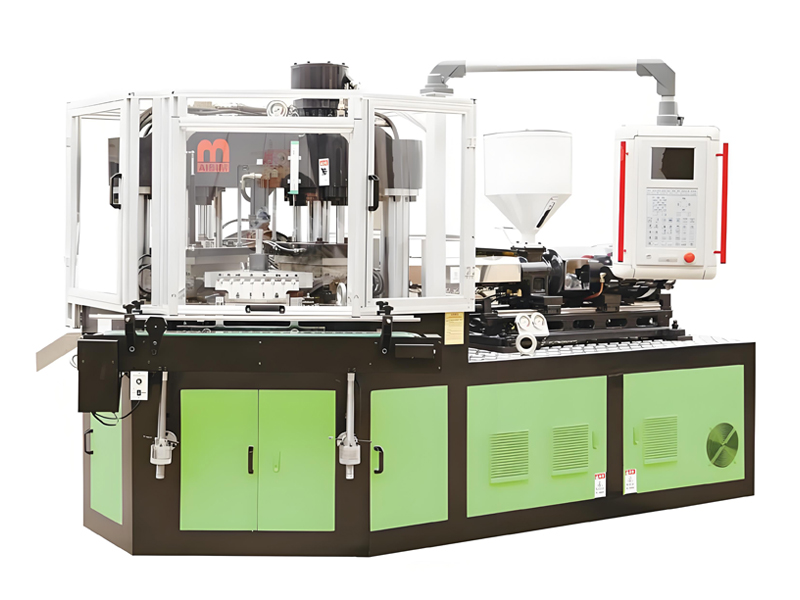
This guide provides a structured production scaling plan specifically for manufacturers considering adding a second injection blow molding (IBM) machine to an existing operation. It is designed for production managers, factory owners, and operations directors who already run one IBM line and need a methodical framework for evaluating whether and how to introduce a second unit. Throughout this article, we reference the injection blow molding product lineup from Aibim, a Wanplas factory with 12-plus years of experience in IBM technology, more than 40 countries served, and a newly expanded manufacturing facility with over 100 machine lines of annual output capacity. Aibim specializes in the IBM75, IBM65, and IBM55 Hybrid Electric series of three-station, one-step injection blow molding machines, which cover container sizes from 3 ml to 1,000 ml across the pharmaceutical, food, beverage, and cosmetic packaging segments.
By the end of this guide you will have a clear decision framework built around eight critical dimensions: when to scale, how to measure your current capacity ceiling, how to model investment returns without relying on specific currency figures, how to select the right second-machine model, how to plan mold compatibility, how to reconfigure your factory floor, how to manage workforce transitions, and how to coordinate two IBM machines in one production system.
متى يجب إضافة آلة حقن ونفخ ثانية؟
The decision to add a second IBM machine should be driven by objective capacity signals, not by a single large order or a temporary demand spike. Manufacturers that scale production reactively, based on a quarter of full order books, often find themselves with a new machine arriving just as demand softens. A disciplined scaling trigger relies on monitoring a handful of key performance indicators over at least two consecutive quarters.
الإشارة 1: تشبع السعة المستمر
The most straightforward trigger is when your existing IBM machine operates at or above 80% overall equipment effectiveness (OEE) for six months or longer. OEE combines availability, performance rate, and quality yield into a single number. An 80% OEE on a single-machine IBM line means that even with excellent scheduling and minimal downtime, you are effectively running out of headroom. When OEE crosses 85%, any unplanned stoppage, mold changeover, or preventive maintenance event creates a direct backlog.
الإشارة 2: تراكم الطلبات بما يتجاوز المدد الزمنية المقبولة
If your confirmed order backlog consistently pushes delivery dates beyond six to eight weeks, and your sales team reports that prospective customers are walking away because of lead-time concerns, you have a clear market-pull signal. In consumer-packaged goods, where brand owners launch seasonal promotions and product refreshes on tight deadlines, lead times beyond six weeks often disqualify a supplier from contention regardless of price or quality.
الإشارة 3: فقدان السعة الناتج عن التغيير
Single-machine IBM operations that serve a broad product portfolio suffer disproportionately from mold changeover downtime. Every time you stop a machine to swap molds, purge the plasticizing unit, and qualify the next production run, you lose productive hours. When changeover frequency reduces your effective operating time below 70% of available hours, the economics of running a single machine deteriorate. A second IBM machine allows you to dedicate each unit to a narrower range of bottle types, dramatically reducing changeover frequency on both machines.
الإشارة 4: توسيع مزيج المنتجات خارج منطقة الراحة لآلة واحدة
An IBM machine is optimized for a specific range of container sizes, materials, and cavitation counts. If your product roadmap calls for entering a new container size category that falls outside your existing machine’s sweet spot, adding a second machine sized for the new range is often more efficient than trying to stretch the existing one beyond its design window. For example, a manufacturer whose current IBM handles 10 ml to 200 ml eyedropper bottles may find that a move into 500 ml edible-oil containers calls for a larger injection unit and clamping frame that a complementary second machine can provide.
تقييم السعة: قياس سقف إنتاجك الحالي
Before committing to a second IBM machine, you need a quantified, defensible understanding of your current production ceiling. This means moving beyond “we seem busy” and calculating actual throughput capacity in bottles per hour (BPH) under realistic operating conditions. The capacity assessment forms the factual foundation for every subsequent decision, from machine sizing to ROI projections to floor-layout design.
الخطوة 1: تحديد السعة الاسمية
Start with the theoretical maximum throughput of your existing IBM machine for your most representative product. Nameplate capacity is the BPH the machine can achieve at 100% speed, 100% uptime, with zero defects. This number is a benchmark, not a target; no real-world operation achieves it. For an IBM75 machine producing a 30 ml pharmaceutical dropper bottle in an 8-cavity mold, nameplate capacity might be approximately 2,800 to 3,200 bottles per hour. For a 200 ml cosmetic cream jar in a 4-cavity layout on the same machine, it may be 1,200 to 1,600 BPH.
الخطوة 2: حساب ساعات التشغيل الفعلية
From total available hours in a year (8,760 for 24/7 operation, or approximately 5,200 for a two-shift, five-day schedule), subtract scheduled downtime: preventive maintenance, mold cleaning and changeover time, annual shutdowns, and holidays. Be honest. A factory that claims 330 production days per year often operates effectively for 280 to 300 days once you remove all scheduled and unscheduled stoppages.
الخطوة 3: تطبيق إنتاجية الجودة
Not every bottle that comes off the machine is a saleable unit. In pharmaceutical and cosmetic packaging, acceptable quality yield typically ranges from 96% to 98.5% for a well-tuned IBM machine. Deduct the reject rate from your effective throughput. A machine producing 1,500 BPH at 97% yield puts only 1,455 good bottles into inventory each hour.
الخطوة 4: مراعاة وزن مزيج المنتجات
If you produce multiple bottle types on the same machine, calculate a weighted-average BPH across your product portfolio, weighted by the proportion of total annual volume each product represents. This gives you a single, blended throughput number that represents your factory’s real-world output capability.
| Parameter | Value | Notes |
|---|---|---|
| Annual calendar hours | 5,200 h | 16 h/day, 5 days/week, 52 weeks |
| Scheduled downtime (PM, changeovers, holidays) | 520 h | ~10% of calendar hours |
| Net available hours | 4,680 h | After subtracting scheduled downtime |
| Unscheduled stoppages (estimated) | 374 h | ~8% unplanned: jams, minor faults, material issues |
| Real operating hours | 4,306 h | Availability = 82.8% |
| Weighted-average BPH (product mix) | 1,380 BPH | Blended across bottle sizes |
| الجودة yield | 97.2% | Good bottles / total produced |
| Annual effective good-bottle output | ~5.78 million bottles | 4,306 h x 1,380 BPH x 97.2% |
| Annual demand forecast (next 12 months) | ~7.80 million bottles | 35% capacity gap vs. effective output |
In the worked example above, the capacity gap of approximately 35% between current effective output and forecast demand is large enough that no amount of scheduling optimization or overtime can close it. The gap is structural, not temporary, which makes it a clear signal for a second-machine investment.
نمذجة العائد على الاستثمار لآلة IBM ثانية
Manufacturers frequently ask: “How quickly will a second IBM machine pay for itself?” The answer depends on product value, utilization rate, and operating-cost structure. Because raw currency figures vary dramatically by geography, tax regime, labor market, and energy tariff, this section uses a transparent index-point framework. All investment and cost figures are expressed relative to a baseline of 100 points, where 100 points represents the initial capital outlay for the second IBM machine, including freight, installation, commissioning, and one set of mold tooling.
نموذج تكلفة نقطة المؤشر
The full delivered-and-commissioned cost of a second IBM machine bundle is set at 100 points. This bundle includes the machine itself, one mold set (for example, a 6-cavity pharmaceutical dropper-bottle mold), factory acceptance testing, shipping, on-site installation, operator training, and commissioning to first-article approval. All other cost and return figures are expressed as multiples or fractions of this 100-point baseline.
| Cost / Return Element | Index Points | Comment |
|---|---|---|
| Second IBM machine + mold + installation / commissioning (baseline) | 100 | Delivered and commissioned cost |
| Annual incremental operating cost (energy, labor, consumables, maintenance) | 12-18 / year | Varies with local energy cost and labor rate |
| Annual incremental gross margin from second machine (moderate product mix) | 30-45 / year | Assumes ~75% utilization, moderate-value bottles |
| Annual incremental gross margin (high-value pharmaceutical / cosmetic bottles) | 50-70 / year | Premium packaging, 75% utilization |
| Estimated break-even (moderate product mix) | ~2.5-3.5 years | 100 / (30 to 45 – 15) average |
| Estimated break-even (high-value product mix) | ~1.5-2.5 years | 100 / (50 to 70 – 15) average |
عوامل حساسية العائد على الاستثمار الرئيسية
Three variables have outsized influence on the actual payback timeline. First, utilization rate: a 15-percentage-point swing in utilization (from 60% to 75%) can halve or double the break-even period because fixed costs are spread across more bottles. Second, end-product value: pharmaceutical dropper bottles, cosmetic cream jars, and food-grade condiment containers carry very different per-unit margins, and the IBM machine that manufactures them consumes roughly the same energy, floor space, and operator attention regardless of what it produces. Third, changeover economics: a second IBM that primarily absorbs changeover burden from the original machine improves the profitability of both units by increasing the effective operating hours on each, a benefit that pure unit-count comparisons often overlook.
Additionally, the energy-efficiency design of Aibim’s IBM series provides measurable operating-cost advantages. The PREFILL technology and variable displacement pump pressurizing system in the hydraulic circuit reduce power consumption by a minimum of 35% compared with conventional hydraulic IBM machines of equivalent output. This energy differential, compounded over the machine’s service life, materially improves the net-present-value calculation of the scaling investment.
اختيار الآلة: مطابقة IBM الثانية مع محفظة منتجاتك
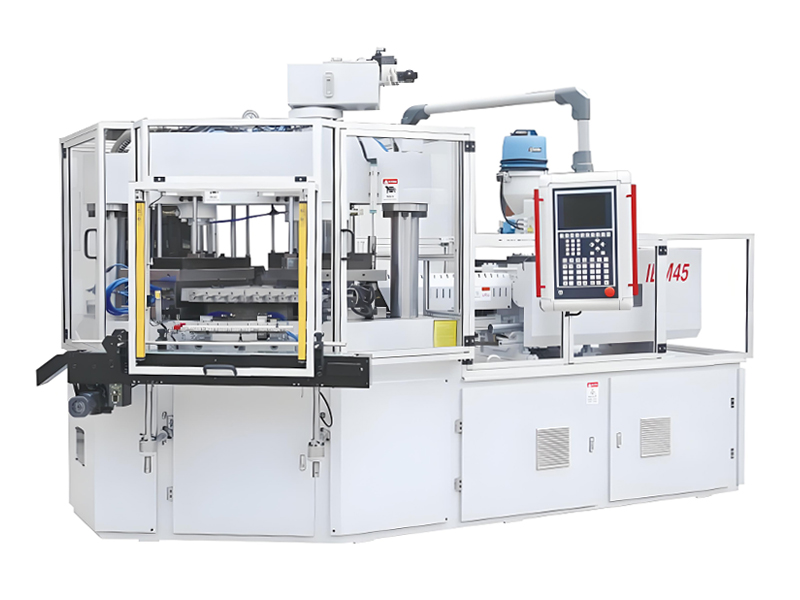
Choosing the right second IBM machine is not simply about buying a duplicate of your existing unit. The most effective scaling strategies often pair two machines with overlapping but distinct capability windows, so that together they cover a wider product range than either could alone. Aibim offers three IBM models that span the 3 ml to 1,000 ml container range, each with its own optimal application band.
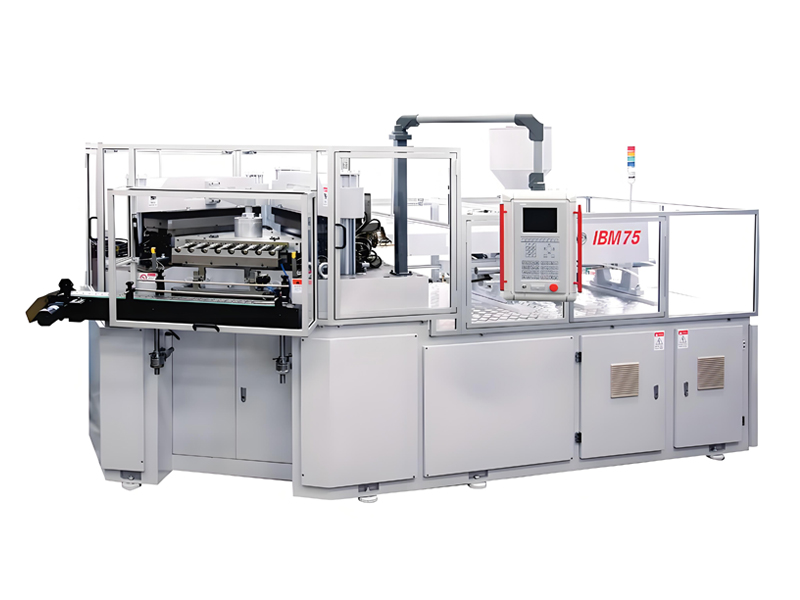
آلة IBM75 للحقن والنفخ
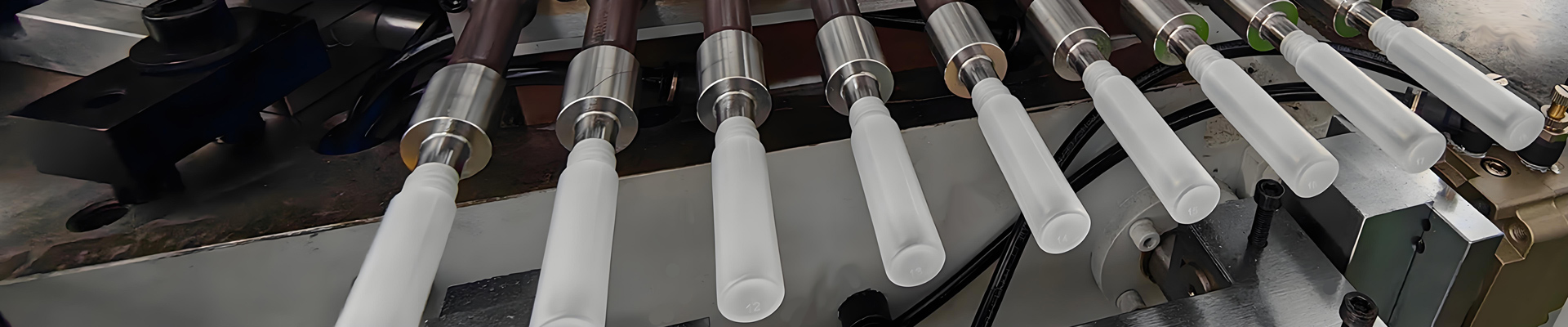
The IBM75 is Aibim’s largest-frame injection blow molding machine, designed for medium-to-large container production from approximately 10 ml up to 1,000 ml. Its three-station, one-step process integrates injection, blowing, and stripping in a single continuous cycle, producing dimensionally precise, flash-free bottles with consistent wall-thickness distribution and neck-finish accuracy that is essential for pharmaceutical closures and cosmetic dispensing systems.
The machine’s single-crossbeam, double-pole clamping framework provides an enlarged mold-setting space that accommodates multi-cavity tooling with generous daylight, simplifying mold changes and reducing mechanical stress across the clamping frame. CE certification includes a stripper station with long-distance digital laser sensor for mold safety and a light curtain for personal safety, making the IBM75 suitable for regulated pharmaceutical and food-contact production environments.
| Specification | IBM75 | Remarks |
|---|---|---|
| Container range | 10 ml – 1,000 ml | Optimal band: 50-750 ml |
| الحقن shot volume | ~200 cm³ | With plasticizing capacity for PE, PP, PS, ABS, SAN, TPU, PC, PCTG |
| Blow cavity capacity | ~750 cm³ | Max blow volume per cycle |
| Stations | 3 | الحقن / Blow / Stripping |
| Cavitation (max, container-dependent) | Up to 8 cavities | Smaller containers allow more cavities |
| Clamping force | 250 kN | Single-crossbeam, double-pole frame |
| Installed power | ~45 kW | PREFILL variable displacement pump tech |
| الطاقة saving vs. conventional hydraulic IBM | Min. 35% | PREFILL + variable displacement pump system |
| Approximate footprint (L x W) | 3.8 m x 2.5 m | Excluding auxiliary equipment |
| Typical applications | Pharma dropper bottles, cosmetic cream jars, food oil containers, oral liquid bottles | HDPE, PP, PETG, PCTG |
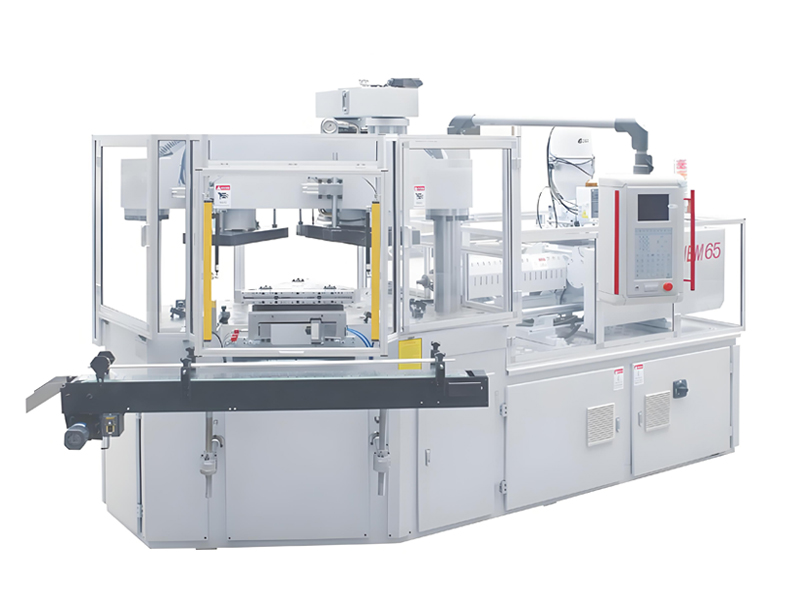
آلة IBM65 للحقن والنفخ
The IBM65 is Aibim’s mid-frame workhorse, optimized for small-to-medium containers in the 3 ml to 300 ml range. It shares the same three-station architecture as the IBM75 but with a smaller injection unit, reduced blow-cavity volume, and a more compact frame. The IBM65 is the go-to platform for pharmaceutical eyedropper bottles, oral suspension containers, cosmetic sample vials, and small-bore food dispensing bottles where dimensional precision, neck-finish consistency, and ultra-clean parting lines are non-negotiable.
| Specification | IBM65 | IBM55 Hybrid |
|---|---|---|
| Container range | 3 ml – 300 ml | 2 ml – 150 ml |
| الحقن shot volume | ~120 cm³ | ~80 cm³ |
| Blow cavity capacity | ~450 cm³ | ~250 cm³ |
| Stations | 3 | 3 |
| Cavitation (max) | Up to 6 cavities | Up to 4 cavities |
| Clamping force | 180 kN | 120 kN |
| Installed power | ~32 kW | ~22 kW (hybrid electric drive) |
| الطاقة saving | Min. 35% | Min. 35% + electric servo advantage |
| Footprint (L x W) | 3.2 m x 2.1 m | 2.8 m x 1.9 m |
| Processable materials | PE, PP, PS, ABS, SAN, TPU, PC | PE, PP, PS, PCTG, SAN |
| Typical applications | Pharma eye-drop bottles, cosmetic vials, food dispensing bottles | Small-bore pharma, cosmetic sampler bottles, food mini-containers |
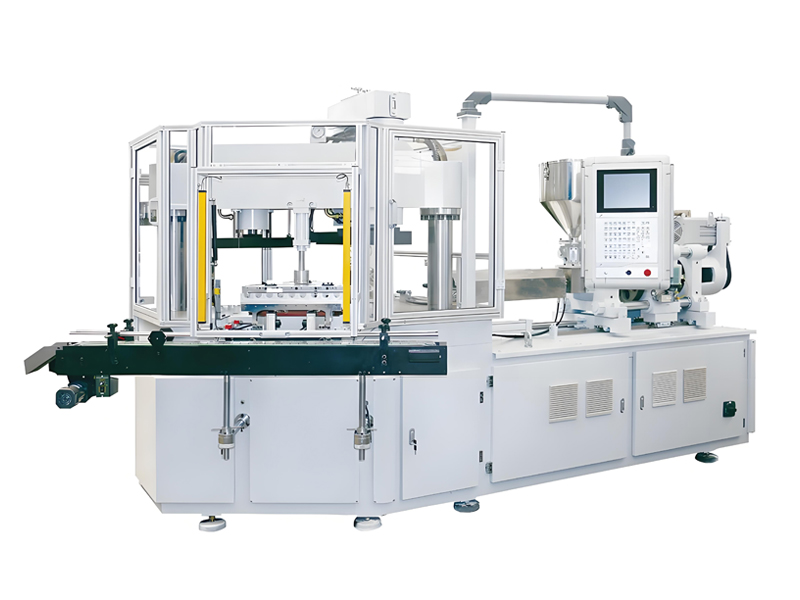
آلة القولبة بالنفخ بالحقن الكهربائية الهجينة IBM55
The IBM55 Hybrid is Aibim’s compact, energy-optimized platform for small-bottle production in the 2 ml to 150 ml range. It combines electric servo drive for the injection and mold-movement axes with a hydraulic system for blow and clamping functions, achieving a further reduction in energy consumption beyond the 35% baseline offered by the PREFILL technology. This machine is particularly well-suited for cleanroom installations in pharmaceutical and cosmetic settings where low particulate generation, quiet operation, and minimal thermal output into the production environment are valued. The IBM55 Hybrid’s compact footprint (2.8 m x 1.9 m) makes it the easiest model to integrate into an existing production hall without major structural modification.
ربط الصناعات التطبيقية
Aibim IBM machines, through the three-station injection blow molding process, serve four core packaging sectors. In pharmaceuticals, the machines produce eyedropper bottles, oral liquid containers, nasal spray bottles, and tablet desiccant vials in HDPE, PP, and PETG, meeting the neck-finish tolerances and wall-thickness uniformity required for child-resistant and tamper-evident closure systems. In cosmetics, IBM75 and IBM65 machines produce cream jars, lotion bottles, serum dropper bottles, perfume caps, and sample vials with high-gloss surfaces and tight dimensional control over dispensing-pump interfaces. In food and beverage, the machines manufacture edible-oil small-format bottles, condiment squeeze bottles, honey containers, sauce dispensers, and single-serve dairy packaging in food-grade HDPE and PP compliant with FDA and EU 10/2011 migration limits. In specialty packaging, IBM machines produce diagnostic reagent bottles, laboratory sample containers, and precision dispensers for industrial fluids.
توافق القوالب واستراتيجية التجاويف المتعددة
Adding a second IBM machine presents both a challenge and an opportunity for your mold inventory. The challenge is capital efficiency: you do not want to duplicate every mold set for the new machine. The opportunity is production flexibility: with strategic mold planning, two IBM machines with compatible mold-mounting dimensions can share a common mold library, dramatically reducing total tooling investment while expanding your production-configuration options.
قابلية تبادل القوالب بين طرازات Aibim IBM
Aibim’s IBM75, IBM65, and IBM55 Hybrid share a common mold-mounting interface philosophy within the same frame family. Molds designed for the IBM65 can physically mount on the IBM55 with appropriate adaptor plates, and molds built for the IBM75 can step down to the IBM65 for smaller-batch runs, provided the mold’s overall dimensions and heating-channel layouts are compatible with the target machine’s platen and temperature-control architecture. This interchangeability is most reliable when machines are ordered from the same generation and when the mold specifications are disclosed to the machine manufacturer during the order process, so that clamping-frame and spacing adjustments are made at the factory.
اقتصاديات القوالب متعددة التجاويف
Cavitation count is the single most influential variable governing per-bottle cost on an IBM machine. Doubling the number of cavities in a mold roughly doubles output per cycle while the machine’s cycle time, energy draw, and operator attention remain nearly constant. The limiting factors are injection-unit capacity (shot volume must cover all cavities plus the sprue and runner system), blow-clamp daylight, and the physical size of the mold that the machine’s platen can accommodate.
| Container Size | IBM75 (max cavities) | IBM65 (max cavities) | IBM55 (max cavities) | Typical BPH (per cavity count) |
|---|---|---|---|---|
| 2-10 ml | 8 | 6 | 4 | 2,200-3,200 (8 cav) |
| 15-30 ml | 6-8 | 4-6 | 3-4 | 1,800-2,800 (6 cav) |
| 50-150 ml | 4-6 | 3-4 | 2 | 1,200-2,000 (4 cav) |
| 200-500 ml | 2-4 | 1-2 | N/A | 600-1,200 (2-4 cav) |
| 500-1,000 ml | 1-2 | N/A | N/A | 400-800 (2 cav) |
تحسين استثمار القوالب
The most capital-efficient approach for a two-machine IBM setup is to invest in a set of core molds that can run on either machine for your highest-volume products, plus machine-specific molds for products that sit at the extremes of one machine’s capability window. When both IBM machines are Aibim units, the SD card parameter-storage feature allows you to transfer validated process recipes from one machine to the next with a few seconds of data transfer, eliminating the time and risk of manually re-entering temperature profiles, injection speeds, and blow-pressure curves. A mold that requires six hours to set up and validate on a single-machine operation may require under two hours on a second machine that receives the identical parameter set electronically.
تخطيط أرضية المصنع: المساحة والمرافق وتكامل المعدات المساعدة
Installing a second IBM machine is a factory-layout exercise, not merely an equipment drop-in. The additional machine, its material-feed systems, its mold-temperature controllers, its chilled-water connections, and the operator and material-flow space around it must all fit into a coherent zone that does not compromise the first machine’s productivity.
حساب المساحة
Each Aibim IBM machine requires not just its own footprint but a surrounding functional zone. The workspace around the machine needs minimum 1.5-meter access clearance on all sides for operator movement, mold-change access, maintenance reach, and safety-egress compliance. Raw-material staging (pellets or pre-dried resin in sealed containers), finished-product buffer (palletizing and temporary holding before transfer to the warehouse), and in-process quality-inspection station space must be added.
| Planning Item | IBM75 | IBM65 | IBM55 |
|---|---|---|---|
| Machine footprint (L x W) | 3.8 m x 2.5 m | 3.2 m x 2.1 m | 2.8 m x 1.9 m |
| Operational zone (with clearance) | ~55-65 m² | ~45-55 m² | ~35-45 m² |
| Installed power | ~45 kW | ~32 kW | ~22 kW |
| Cooling water requirement | 8-10 m³/h | 5-7 m³/h | 4-5 m³/h |
| Compressed air demand | 0.6-0.8 m³/min at 0.8 MPa | 0.4-0.6 m³/min at 0.8 MPa | 0.3-0.5 m³/min at 0.8 MPa |
| Mold temperature controller requirement | 2-3 zones | 2 zones | 1-2 zones |
تدقيق البنية التحتية للمرافق
Before the second IBM machine arrives, conduct a thorough utility-capacity audit of your existing infrastructure. The questions to answer include: can your main electrical panel absorb an additional 22 to 45 kW load without exceeding its rated capacity or requiring a transformer upgrade? Does your chilled-water plant have sufficient excess capacity to cool both machines plus their molds simultaneously during peak summer ambient temperatures? Is your compressed-air system sized for the combined demand of both blow-molding stations at peak cycle rates? Overlooking any of these three utility dimensions is one of the most common causes of delayed commissioning and sub-optimal early output from a second-machine installation.
مشاركة المعدات المساعدة مقابل الأجهزة المخصصة
Some auxiliary equipment can be shared between two IBM machines; other items need dedicated units. Shared auxiliaries might include the central resin-drying system, the main compressed-air supply, the chilled-water plant, and the factory-wide material-handling vacuum system. Dedicated auxiliaries per machine typically include mold-temperature controllers, hot-runner controllers (if applicable), and take-out or downstream automation. The decision to share or dedicate should be driven by physical proximity, peak demand overlap, and the risk tolerance for a single auxilary failure taking down both IBM lines simultaneously.
تخطيط القوى العاملة: تدريب المشغلين وإدارة الآلات المتعددة
الانتقال من تشغيل IBM واحد إلى إعداد آلتين يغير متطلبات القوى العاملة، لكنه لا يضاعفها. تركز استراتيجية المشغل المصممة جيدًا لآلتي IBM على التدريب المتقاطع والتوحيد ودور المشرف الذي يربط بين تياري الإنتاج.
نموذج مشغّل واحد وآلتان
In the most cost-efficient configuration, one operator per shift supervises both IBM machines when they are positioned within sight lines of each other. This is viable because IBM machines, unlike extrusion blow molding lines, have relatively self-contained cycles once the parameters are set. The operator’s primary tasks are resin loading, finished-bottle inspection at start of shift and periodically during the run, quality-data logging, and first-response troubleshooting. During mold changeovers or material-grade transitions, a second operator or a setup technician is temporarily assigned.
دمج فحص الجودة
In pharmaceutical and cosmetic production environments where lot traceability and statistical process control (SPC) are mandatory, the quality-inspection function scales with the number of production streams, not with the number of operators. One quality inspector per shift can manage in-process sampling, dimensional checks, visual-defect classification, and data recording for two IBM machines, provided the sampling plan is structured to stagger inspection intervals between the two lines so that peak inspection workload from both machines does not coincide.
التدريب على الكفاءة متعددة الآلات
Aibim’s IBM platform maintains a consistent control interface across the IBM75, IBM65, and IBM55 models, which dramatically reduces the training burden when adding a second machine. An operator who is certified on one Aibim IBM model can transfer to another with approximately one to two days of machine-specific familiarization. The SD card parameter-storage system allows the lead operator to load a validated process recipe directly, eliminating the risk of parameter entry errors during setup. Aibim provides on-site operator training during commissioning, covering machine operation, safety protocols, daily maintenance routines, mold change procedures, and basic process troubleshooting. The training curriculum typically spans three to five days per shift team and includes supervised production runs that qualify operators against documented competency checklists.
تنسيق العملية: مزامنة آلتين IBM على جدول إنتاج واحد
Running two IBM machines in one factory is not just “machine one plus machine two”; it is a production-scheduling exercise that must coordinate material consumption, changeover sequencing, quality-release timing, and downstream packaging throughput across two parallel production streams. Done well, the two machines complement each other. Done poorly, they compete for resources and generate confusion.
منطق جدولة الإنتاج
The most effective scheduling model for a two-machine IBM setup follows a simple rule: assign long-running, high-volume products to one machine as its “base load” and use the second machine for shorter runs, smaller batches, and products that require frequent material or mold changes. This minimizes changeover downtime on both machines because the base-load unit stays in production for multi-day or multi-week campaigns, while the flexible unit absorbs the changeover burden. Weekly production-planning meetings that coordinate the material-resin inventory, mold-availability calendar, and downstream packaging capacity are essential.
ثبات الجودة عبر آلتين
A common concern when adding a second IBM machine is whether bottles produced on the new unit will match the quality of bottles from the existing one. With injection blow molding, this risk is lower than with extrusion blow molding because IBM tooling (the injection cavity and core, and the blow mold) defines the bottle geometry with high repeatability independent of the specific machine, provided the two machines share the same parameter set. The SD card recipe-transfer capability on Aibim IBM machines ensures that the second unit receives the identical temperature-profile, injection-speed, cooling-time, and blow-pressure parameters that were validated on the first machine. A short qualification run with statistical comparison of critical-to-quality dimensions (neck inner diameter, wall thickness at designated measurement points, total fill volume, drop-impact pass rate) across 50-bottle sample sets from each machine provides documented evidence of equivalence before full production ramp-up.
إدارة انحراف معايير العملية
Over weeks and months of operation, two IBM machines running the same product may drift apart slightly due to differences in screw wear, heater-band aging, or hydraulic-component condition. A monthly cross-machine calibration routine that measures the actual melt temperature, injection pressure at the nozzle, and blow-air pressure at the blow-pin tip on both machines, adjusting offsets as needed, maintains process alignment and prevents the emergence of an invisible quality gap between machine-one and machine-two output.
الأثر على اللوجستيات والمواد الخام ومخزون السلع التامة
Doubling your IBM production capacity through a second machine has upstream and downstream effects that reach beyond the production floor. Raw-material procurement, resin inventory management, finished-goods warehousing, and outbound logistics all need to scale in coordination with the additional machine output.
توسيع نطاق شراء المواد الخام
A second IBM machine effectively doubles your resin consumption, provided you achieve target utilization. If your single IBM consumed, for example, 120 metric tons of HDPE per year, plan for 240 metric tons with the second machine at equivalent utilization. This volume change often triggers a step-change in procurement economics: you may now qualify for bulk-purchase pricing tiers, full-container-load deliveries, or silo-truck deliveries that were not economical at the smaller volume. Coordinate the ordering cadence with your resin supplier so that the inventory carrying cost of holding larger raw-material stocks is offset by the lower per-kilogram price of the larger order quantity. Additionally, verify that your resin storage area, whether silos, octabins, or bagged-pellet racking, has the capacity to hold the larger working inventory without congestion.
مخزون السلع تامة الصنع وتخطيط المستودعات
If your second IBM machine increases total output by, for example, 60-80% (factoring in some initial under-utilization during ramp-up), your finished-goods warehouse must absorb this incremental volume. The options are: expand existing warehouse racking and floor space, shift to a just-in-time delivery model that ships directly to the customer’s packaging line on a tighter schedule, or increase the share of make-to-order versus make-to-stock production. In pharmaceutical and cosmetic packaging, where mandatory quarantine periods for batch-release testing add several days of in-plant holding time before shipment, the warehouse impact is particularly pronounced and must be planned into the facility footprint from day one.
تدفق المواد الداخلي
The flow path of resin from storage to machine, and finished bottles from machine to warehouse, must avoid crossing and crisscrossing that creates congestion and safety hazards. When planning the floor layout for the second IBM machine, map the material-flow routes for both machines and ensure that resin-in and finished-bottle-out paths are unidirectional, separated, and clear of forklift or pallet-jack crossing points. A dedicated aisle behind each machine for finished-product removal, with a common resin-supply aisle in front, is a field-proven arrangement.
اختيار آلة Aibim IBM المناسبة لتوسعك
With a clear understanding of your capacity gap, product portfolio, floor-space availability, and workforce plan, you can now map your scaling requirements to a specific Aibim IBM model. The following selection matrix aligns common production-scaling scenarios with recommended IBM machine combinations, based on current single-machine operation, target annual output, dominant bottle size, and industry segment.
| Current Machine | Target Annual Output (Good Bottles) | Dominant نطاق حجم الزجاجات | Primary Industry | Recommended Second Machine | Rationale |
|---|---|---|---|---|---|
| IBM55 Hybrid | 4-6 million | 2-30 ml | Pharma / مستحضرات التجميل | IBM65 | Step up in cavitation and container range while keeping small-bottle precision |
| IBM65 | 6-10 million | 10-300 ml | Pharma / مستحضرات التجميلs / الغذاء | IBM65 (duplicate) or IBM75 | Duplicate for max mold sharing; IBM75 if expanding into >300 ml containers |
| IBM75 | 8-16 million | 50-1,000 ml | مستحضرات التجميلs / الغذاء / Pharma | IBM75 (duplicate) | Identical model for seamless mold sharing and operator transfer |
| IBM65 (current: pharma) | 5-8 million | 15-50 ml (pharma) + 200-500 ml (food) | Mixed: Pharma + الغذاء expansion | IBM75 | Keep IBM65 for small pharma; use IBM75 for larger food containers |
| IBM75 (current: cosmetics) | 10-14 million | 30-200 ml (current) + 500-1,000 ml (new) | مستحضرات التجميلs + الغذاء & Beverage | IBM75 (duplicate) | Second IBM75 dedicated to larger containers; original unit stays on medium bottles |
When in doubt about the optimal combination, Aibim’s application engineering team provides a configuration review based on your actual product drawings, material specifications, and annual volume projections. This service is included in the pre-sales support package and ensures that the second machine is right-sized for your specific portfolio rather than being selected from a generic catalog position.
الخدمة والدعم وتخفيف المخاطر لتوسعك
Adding a second IBM machine is a capital project that benefits from a manufacturing partner who provides structured support through commissioning, ramp-up, and ongoing production. Aibim, through its Wanplas parent brand, delivers a standardized service framework that de-risks the scaling investment across four dimensions.
اختبار القبول في المصنع قبل التسليم
Every Aibim IBM machine undergoes full factory acceptance testing before shipment, including a 72-hour continuous-operation run that verifies cycle-time stability, temperature-control accuracy, and mechanical reliability under production-representative conditions. Customers are invited to witness the factory test at Aibim’s manufacturing facility, either in person or via live video feed. This pre-delivery verification eliminates the risk of discovering a commissioning defect after the machine has crossed an ocean and been installed in your plant.
التركيب والتشغيل في الموقع
Aibim dispatches commissioning engineers to the customer’s factory for on-site installation supervision, connection verification, first-power-on testing, and production-parameter tuning. The engineer works alongside the customer’s maintenance and operations team throughout the process, transferring hands-on knowledge during every step. Commissioning concludes with a documented first-article inspection report that confirms the machine meets or exceeds the agreed-upon specification for cycle time, bottle quality, and energy consumption.
دعم ما بعد البيع وسياسة قطع الغيار
As a Wanplas factory, Aibim adheres to the Wanplas group after-sales policy, which includes USD 500 in free spare parts annually for each machine in operation. This credit covers wear components such as heater bands, seals, O-rings, and relay modules, reducing the out-of-pocket maintenance cost for the operator. Warranty-period coverage includes free replacement of any part that fails due to a manufacturing defect. Aibim maintains its own CNC machining center, which means that critical spare parts can be manufactured in-house on short lead times without depending on external subcontractors.
الدعم التشخيصي عن بُعد والمساعدة الفنية المستمرة
The IBM control system includes remote connectivity that allows Aibim’s technical support team to access PLC data, view alarm histories, and assist with parameter optimization remotely. This capability reduces the need for on-site service visits for non-mechanical issues and shortens the diagnostic time when a process fault occurs. Combined with the SD card parameter-storage and transfer feature, remote support enables factory-wide process standardization across multiple IBM machines, even when they are located in different geographical sites.
سياسة المصنع المفتوح
Aibim maintains an open-factory policy that welcomes customers to visit the manufacturing facility, inspect the production process, review quality-control documentation, and conduct trial runs on demonstration machines before committing to a purchase. This transparency is especially valuable for pharmaceutical and food-contact packaging buyers whose own customers or regulatory auditors may require evidence of the machinery supplier’s manufacturing quality system.
الأسئلة الشائعة
كيف أعرف أن الوقت قد حان لإضافة آلة قولبة نفخ بالحقن ثانية؟
You should consider adding a second IBM machine when your current line consistently exceeds 80% OEE, when order backlogs grow beyond six to eight weeks, when changeover frequency limits effective capacity below 70% of available hours, or when you begin turning down new business opportunities. A detailed capacity audit combined with order-forecast trend analysis over at least two consecutive quarters provides the clearest signal. If two or more of these indicators are active simultaneously, the decision moves from “consider” to “plan.”
هل يجب أن أشتري آلة IBM ثانية مطابقة أم طرازًا مختلفًا؟
If your current machine is well-matched to your product portfolio and you simply need more capacity of the same type, an identical model is the most capital-efficient choice because it enables full mold and tooling sharing, zero operator retraining, and common spare-parts inventory. If your product roadmap includes a new size category or material type that sits outside your current machine’s sweet spot, adding a complementary model (for example, an IBM75 alongside an existing IBM65) expands your capability window while still maintaining significant mold interchangeability within the Aibim platform.
ما الجدول الزمني النموذجي للعائد على الاستثمار لآلة IBM ثانية؟
The ROI timeline depends heavily on product value-add, utilization rate, and local operating conditions. With a baseline index of 100 points for a single-machine operation, plants that double effective output through a second IBM typically realize an incremental-return break-even within 18 to 30 months when utilization stays above 75%. High-value cosmetic or pharmaceutical packaging tends to accelerate this timeline to 15 to 24 months because the per-unit margin contribution is substantially higher than for commodity food bottles, while the machine’s operating cost remains nearly identical.
هل يمكنني تشغيل أنواع مختلفة من الزجاجات على آلتين IBM في نفس المصنع؟
Yes, and this is one of the strongest arguments for a multi-machine setup. Running pharmaceutical drop-dispenser bottles on one IBM machine while your second unit produces cosmetic cream jars gives you production flexibility and isolates changeover downtime so that a mold change on one machine does not stop all output. The key is to select IBM models with overlapping mold-mounting dimensions so that cavity tooling can be shared between machines where beneficial, reducing total mold investment.
ما مقدار مساحة الأرضية الإضافية التي تتطلبها آلة IBM ثانية؟
An IBM75 typically occupies a structural footprint of approximately 3.8 m by 2.5 m, while an IBM65 requires roughly 3.2 m by 2.1 m and the IBM55 Hybrid about 2.8 m by 1.9 m. However, total space planning must include operator aisles (minimum 1.5 m clearance around the machine), raw-material staging, finished-goods buffer zones, and auxiliary equipment including mold temperature controllers, chillers, and conveyors. A practical planning estimate for a second IBM75 with all ancillaries is approximately 55 to 65 m² of additional clear floor area.
هل أحتاج إلى مضاعفة القوى العاملة عندما أضيف آلة IBM ثانية؟
No. In most factory configurations, a single trained operator can supervise two adjacent IBM machines, especially when both units use the same Aibim control interface and share SD card recipe transfer. The incremental staffing need is typically one additional operator per shift plus one quality inspector shared across machines, not a full workforce duplication. Training cross-functional operators who can run both blow-molding stations and perform in-process quality inspection is the most cost-efficient staffing model for a two-machine IBM operation.
ما المرافق التي يجب تجهيزها قبل تركيب آلة IBM ثانية؟
You need to verify that your electrical supply can handle the additional installed power (22 to 45 kW depending on model), that chilled-water capacity has sufficient margin for cooling both machines and their molds simultaneously, and that compressed-air supply meets the combined peak demand. A thorough utility-capacity audit covering electrical load, cooling-water flow, and compressed-air volume before the machine arrives prevents costly rework and commissioning delays. In many cases, a chiller-capacity upgrade or an additional compressor is the largest hidden cost of a second-machine installation.
كيف أضمن أن زجاجات الآلة الثانية تطابق جودة زجاجات الآلة الأولى؟
الحقن blow molding produces inherently repeatable part geometry because the bottle dimensions are defined by the injection mold cavity and core, not by parison extrusion dynamics. When both IBM machines are Aibim units, you transfer the validated process recipe via SD card from the first machine to the second, ensuring identical temperature profiles, injection speeds, cooling times, and blow pressures. A short qualification run with statistical comparison of critical-to-quality dimensions across sample sets from both machines provides documented evidence of equivalence. A monthly cross-machine calibration routine maintains process alignment over the long term.
الخلاصة
Adding a second injection blow molding machine to your factory is a production-capacity milestone that transforms a single-stream operation into a flexible, resilient, multi-stream production system. The decision to scale should be grounded in objective capacity signals, not in short-term demand spikes: sustained OEE above 80%, multi-month order backlogs exceeding acceptable lead times, and changeover-driven capacity loss that erodes effective operating hours are the reliable indicators that a second machine is warranted.
A disciplined scaling plan addresses eight interdependent dimensions: capacity assessment using real operating data rather than nameplate assumptions, investment-return modeling that accounts for product-mix value, machine selection that aligns the second unit’s capability window with your product roadmap, mold-compatibility planning that minimizes duplicate tooling investment, factory-floor reconfiguration that creates a coherent two-machine production zone, workforce planning that leverages operator cross-training and shared quality-inspection resources, process coordination that synchronizes two parallel production streams without resource contention, and logistics scaling that ensures raw-material supply and finished-goods warehousing keep pace.
Aibim, a Wanplas factory with 12-plus years of injection blow molding specialization, 40-plus export countries, and a newly expanded manufacturing base with over 100 machine lines of annual capacity, offers three IBM platforms, the IBM75, IBM65, and IBM55 Hybrid, that collectively cover the 2 ml to 1,000 ml container spectrum. Each machine incorporates PREFILL variable displacement pump technology for energy savings of 35% or more, a three-station one-step process for flash-free bottle production, CE-certified safety systems, SD card recipe transfer for plug-and-play process standardization across machines, and an in-house CNC center for responsive spare-parts manufacturing.
Every Aibim IBM machine is backed by the Wanplas group’s after-sales commitment: factory acceptance testing with 72-hour continuous-operation verification, on-site installation and commissioning by factory-trained engineers, USD 500 in free annual spare parts per machine, warranty-period defect replacement, remote diagnostic connectivity, and an open-factory visitation policy. These service foundations, combined with Aibim’s application-engineering pre-sales support, ensure that your second IBM machine reaches full production output with minimal ramp-up friction.
If you are evaluating the addition of a second injection blow molding machine to your manufacturing operation, we invite you to share your current product specifications, volume projections, and factory-layout details for a tailored configuration recommendation. Aibim’s engineering team can provide a detailed machine-and-mold proposal, a capacity-gap analysis, and a timeline for installation and commissioning. Factory visits, sample trial runs, and live commissioning demonstrations are available to qualified buyers. Let your production scaling plan be built on a foundation of proven IBM technology, transparent service commitments, and a manufacturing partner who understands that the value of a second machine is measured not in its purchase price but in the profitable incremental output it delivers year after year.