Buying an injection blow molding machine is only half the decision. The other half is whether your supplier can move that machine across an ocean, clear customs in your country, install it inside your plant, train your team, and keep it running for years. Aibim, a Wanplas factory, answers that second half with more than 12 years of plastic machine manufacturing experience and 20 years of accumulated know-how in injection blow molding. With machines running in 40 plus countries, an annual production capacity above 100 lines per year, an in-house CNC center that machines its own critical parts, and a new factory acquired in 2022, Aibim has turned international delivery from a risk into a routine, repeatable process. This article explains how Aibim plans global shipping, protects machines in transit, handles customs paperwork, commissions lines abroad, manages spare-parts logistics, and supports customers remotely so that an IBM machine performs from the first shift onward.
Why Global Shipping and Service Decide IBM Machine Success
A hollow container production line is a precision system, not a crate of loose parts. The injection station, the blow station, and the ejection station of an injection blow molding machine are aligned to fractions of a millimeter, and the hydraulic, electrical, and cooling subsystems must arrive calibrated and undamaged. When a machine crosses a continent by sea or air, every kilometer of vibration, humidity, and handling is a chance for misalignment or corrosion. For this reason, global shipping and after-sales service are not optional add-ons; they are the difference between a line that reaches rated output in a week and one that stalls for a month in a port.
Aibim treats export logistics as an engineering discipline. The same team that designs the IBM75, IBM65, and IBM55 Hybrid Electric models also defines how each machine is disassembled for transport, braced, wrapped, and reassembled. That continuity matters because the people who build the machine are the people who decide how it should be packed. This approach is part of the broader Wanplas commitment to warm global customers with dependable Chinese plastic machinery, and it is reinforced by Aibim’s own track record of delivering to 40 plus countries across Asia, Europe, the Middle East, Africa, and the Americas.
The remainder of this article walks through every stage of that journey: the technology inside the machines, the industries they serve, the physical protection used for sea and air freight, the documents required for customs, the timeline from order to commissioning, the spare-parts program that includes USD 500 of free parts per year, the remote PLC support that resolves most faults without a flight, and the training and language localization that make a new line feel familiar on day one.
Understanding Injection Blow Molding and the Aibim Machine Range
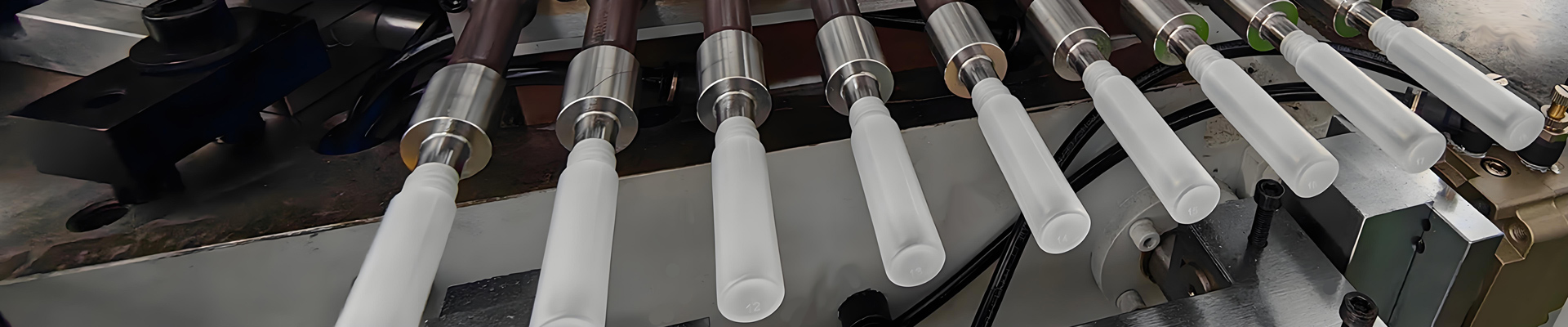
Injection blow molding is a one-step, three-station process that converts plastic resin directly into a finished hollow container without a separate preform reheat stage. The first station injects molten plastic into a core rod to form a parison, the second station transfers that parison to a blow mold where compressed air expands it against the cavity wall, and the third station ejects the cooled, finished bottle. Because the container is shaped entirely inside a closed mold, the result has excellent dimensional consistency, a sealed neck finish, no flash to trim, and a clean cosmetic appearance that suits pharmaceutical, food, drink, and cosmetic packaging.
The materials processed on Aibim machines include polyethylene in its HDPE, LDPE, and LLDPE grades, polypropylene, polystyrene, ABS, SAN, thermoplastic polyurethane, polycarbonate, and PCTG. That material range covers the stiffness needed for wide-mouth jars, the chemical resistance required for pharmaceutical dropper bottles, the clarity demanded by cosmetic packs, and the food-contact safety expected by drink containers. Process engineers optimize barrel temperature, injection speed, parison temperature, blow pressure, and cooling time for each resin so that wall thickness and neck accuracy stay inside tolerance.
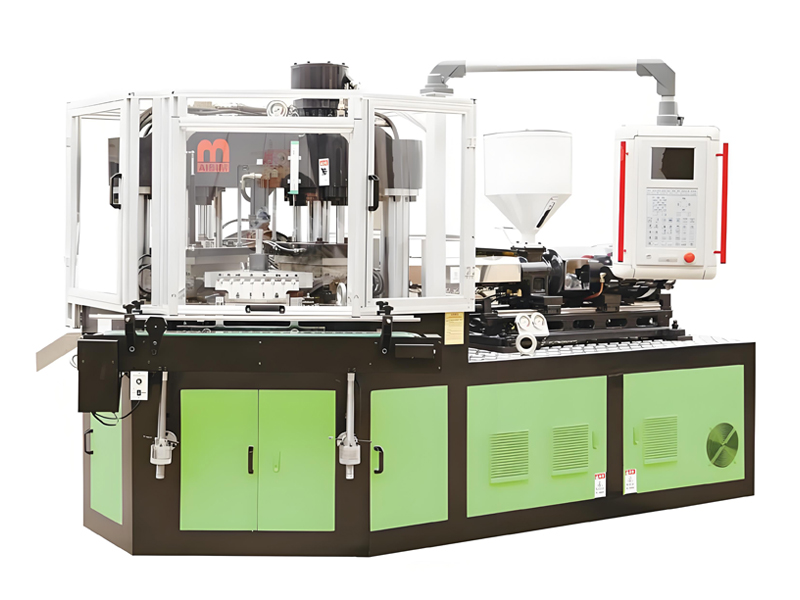
Aibim’s range spans container volumes from 3 milliliters to 1000 milliliters, which covers single-dose pharma vials at the small end and wide-mouth food and drink bottles at the large end. The three production models are the IBM75, the IBM65, and the IBM55 Hybrid Electric. Each uses a single-crossbeam, double-pole clamping framework that enlarges mold-setting space, and each carries the PREFILL hydraulic concept plus a variable displacement pump that pressurizes the system efficiently. The hybrid electric variant adds servo-driven motion to lower energy use further while keeping the hydraulic clamping force that stabilizes the mold.
All Aibim machines are CE certified. The stripper station is protected by a long-distance digital laser sensor that guards the mold, and a light curtain protects the operator. An SD card stores process parameters so that a proven recipe can be copied from one machine to another in minutes. These features are not marketing extras; they are the foundation of safe, repeatable export-grade production.
Real Machine Modules: IBM75, IBM65, and IBM55 Hybrid Electric
When a buyer reaches the question of which machine to install, Aibim answers with concrete models rather than generic categories. The three modules below are the actual production machines Aibim ships worldwide, each with a specification set that maps directly to container size, output, and energy budget.
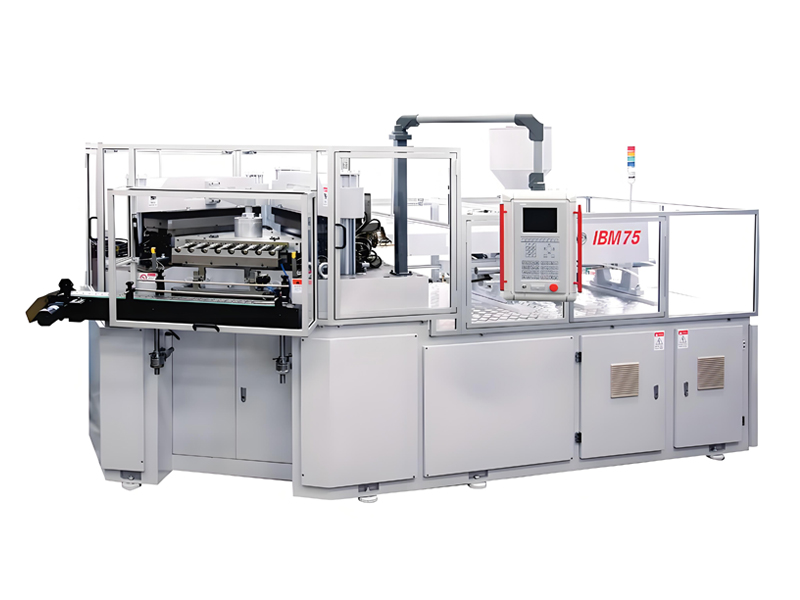
آلة القولبة بالنفخ بالحقن IBM75
The IBM75 is the large-format model in the range, built for containers up to 1000 milliliters. Its enlarged platen and higher clamping force make it suitable for wide-mouth food jars, drink bottles, and bulk pharmaceutical packs. The machine uses the single-crossbeam double-pole clamping structure, the PREFILL hydraulic system, and a variable displacement pump that reduces idle energy draw.
| Specification | IBM75 Value | Note |
|---|---|---|
| Max container volume | 1000 ml | Covers wide-mouth food and drink |
| Number of stations | 3 (injection, blow, ejection) | One-step process |
| Clamping force | 75 ton | Single-crossbeam, double-pole |
| Screw diameter | 45 mm | Plasticizing unit |
| Plasticizing capacity | approx. 120 kg/h | Material dependent |
| Main motor power | 30 kW | PREFILL hydraulic |
| Energy saving | min. 35 percent | Vs conventional hydraulic |
| Control | PLC with SD card | Recipe storage |
| Safety | CE, laser sensor, light curtain | Mold and operator guard |
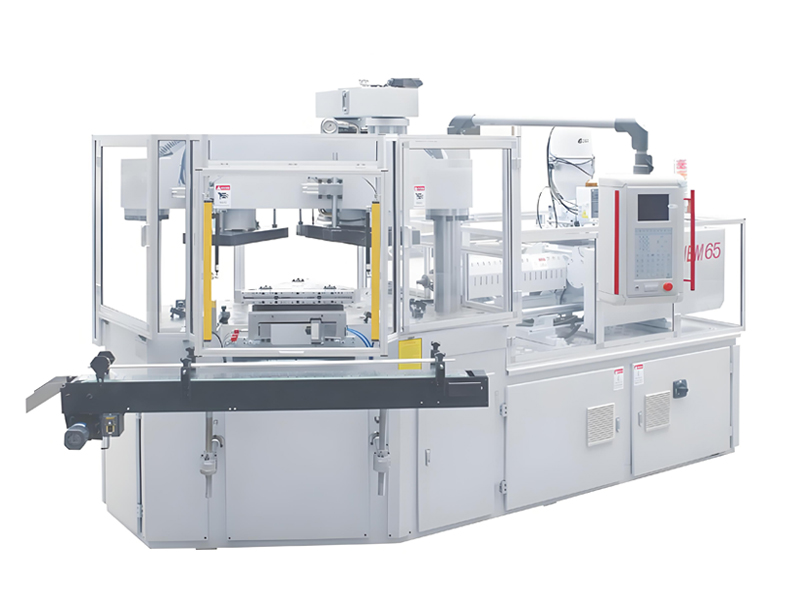
آلة القولبة بالنفخ بالحقن IBM65
The IBM65 sits in the mid-range, handling containers up to 500 milliliters. It is the most common choice for cosmetic jars, pharmaceutical bottles, and drink shots where output volume and mold flexibility matter more than maximum container size. The same PREFILL and variable displacement pump design keeps energy use low, and the SD card system makes multi-cavity changeovers fast.
| Specification | IBM65 Value | Note |
|---|---|---|
| Max container volume | 500 ml | Mid-range packs |
| Number of stations | 3 (injection, blow, ejection) | One-step process |
| Clamping force | 65 ton | Single-crossbeam, double-pole |
| Screw diameter | 40 mm | Plasticizing unit |
| Plasticizing capacity | approx. 90 kg/h | Material dependent |
| Main motor power | 22 kW | PREFILL hydraulic |
| Energy saving | min. 35 percent | Vs conventional hydraulic |
| Control | PLC with SD card | Recipe storage |
| Safety | CE, laser sensor, light curtain | Mold and operator guard |
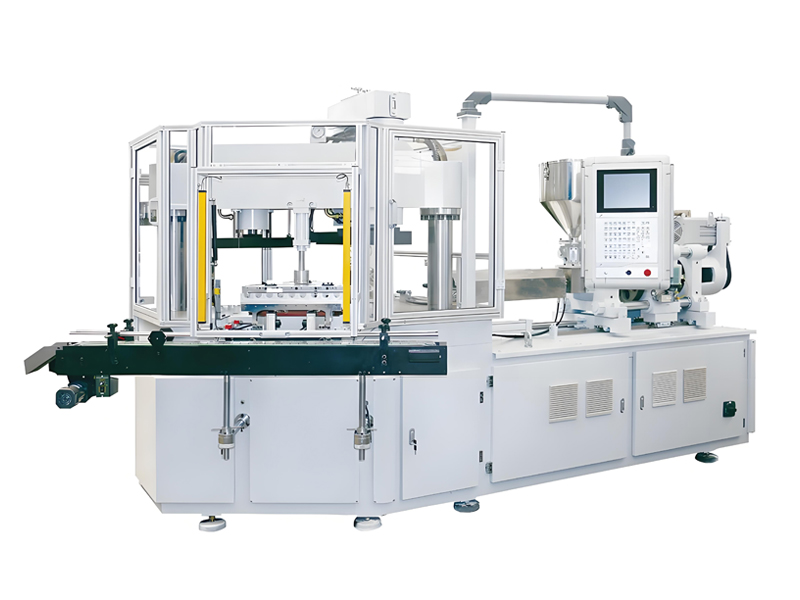
آلة القولبة بالنفخ بالحقن IBM55 الهجينة الكهربائية
The IBM55 Hybrid Electric is the energy-optimized variant, designed for containers up to 350 milliliters and for markets where power cost and carbon targets are decisive. It combines servo-electric motion with the hydraulic clamping system, so it keeps stable mold force while trimming the energy used for indexing and auxiliary movement. Like its siblings, it uses PREFILL technology, a variable displacement pump, SD card recipe storage, and the CE safety package with laser sensor and light curtain.
| Specification | IBM55 Hybrid Value | Note |
|---|---|---|
| Max container volume | 350 ml | Small pharma and cosmetic |
| Number of stations | 3 (injection, blow, ejection) | One-step process |
| Clamping force | 55 ton | Hybrid electric drive |
| Screw diameter | 35 mm | Plasticizing unit |
| Plasticizing capacity | approx. 70 kg/h | Material dependent |
| Main motor power | 18.5 kW | Servo-hydraulic hybrid |
| Energy saving | min. 35 percent | Vs conventional hydraulic |
| Control | PLC with SD card | Recipe storage |
| Safety | CE, laser sensor, light curtain | Mold and operator guard |
Across the three models, Aibim’s design language stays consistent: the PREFILL technology and variable displacement pump reduce the energy spent pressurizing the hydraulic system, the SD card standardizes recipes across a fleet of machines, and the CE safety package satisfies market access rules in most importing regions. That consistency is what lets Aibim promise the same installation and service quality whether the machine lands in Southeast Asia, the Middle East, Europe, or South America.
Application Industries: الصيدلانيات, Food, Drink, Cosmetic
The value of an injection blow molding machine is realized only when it matches the regulatory and aesthetic demands of the end product. Aibim focuses on four application fields, each with distinct material and cleanliness requirements.
الصيدلانيات
Pharmaceutical packaging demands a sealed neck, tight dimensional tolerance, and a clean, flash-free container. Dropper bottles, eye-drop vials, tablet jars, and single-dose diagnostic tubes are typical outputs. Resins such as HDPE, PP, and certain transparent grades are processed under validated parameters so the container meets pharmacopeia and GMP expectations. Because the one-step process never exposes the parison to ambient contamination between injection and blow, the inside surface stays cleaner than in two-step methods.
Food
Food containers require food-contact compliant resins and stable wall thickness to protect contents. Wide-mouth jars for sauces, spreads, and condiments, as well as portion pots, are produced on the IBM75 and IBM65. Polypropylene and HDPE are the workhorse materials, and process windows are optimized to avoid degradation that could affect taste or safety.
Drink
Drink packaging spans small shots, flavored-water bottles, and functional beverage containers. The sealed neck finish of injection blow molding gives a precise thread that accepts standard closures, and the uniform wall keeps carbonation or flavor intact. Drink containers up to 1000 milliliters run on the IBM75.
Cosmetic
Cosmetic packs live or die on surface appearance. The flash-free, molded-in finish of IBM containers suits cream jars, lotion bottles, and travel-size tubes where a clean shoulder and glossy surface reduce the need for secondary decoration. Transparent and tinted grades such as PETG, SAN, and PC deliver the clarity and color stability brands expect.
| Industry | Typical Products | Common Materials | Recommended Model |
|---|---|---|---|
| الصيدلانيات | Dropper bottles, vials, tablet jars | HDPE, PP, transparent grades | IBM55 Hybrid / IBM65 |
| Food | Wide-mouth jars, portion pots | PP, HDPE | IBM75 / IBM65 |
| Drink | Bottles, shots, functional beverages | PP, PETG, SAN | IBM75 |
| Cosmetic | Cream jars, lotion bottles, tubes | PETG, SAN, PC, ABS | IBM65 / IBM55 Hybrid |
Export Packaging and Crating for Sea and Air Freight
Packaging for export starts long before the machine reaches the dock. Aibim’s own CNC center machines the critical components, which means the factory controls both the fit of parts and the way those parts are protected. The packaging plan has three layers: internal bracing, moisture protection, and outer crating.
Internal Bracing and Vibration Control
Movable axes are locked, the clamping unit is secured with steel bars, and sensitive components such as the PLC cabinet, servo drives, and hydraulic valves are removed or padded depending on the route. Shock-absorbing blocks under the base distribute impact energy during crane lifts and truck transfers. For sea freight, the machine is treated as a long-duration vibration environment, so bracing is reinforced and fasteners are double-checked.
Moisture and Corrosion Protection
Sea containers accumulate condensation, so Aibim wraps exposed machined surfaces in VCI (volatile corrosion inhibitor) paper and seals the machine in a desiccant-lined shrink wrap. Silica gel bags are placed inside the control cabinet. For tropical and high-humidity destinations, the protection level is raised and the desiccant quantity increased.
Outer Crating
The machine is loaded into a fumigated wooden case or a steel-frame pallet crate built to the import country’s ISPM 15 phytosanitary standard. For air freight, where weight and volume cost dominate, Aibim uses a lighter, modular crate that still protects the critical surfaces. Each crate is marked with center of gravity, lifting points, and orientation arrows so handlers load it correctly.
| Protection Step | Sea Freight | Air Freight | Cost Tier |
|---|---|---|---|
| Internal bracing | Reinforced | Standard | Low |
| Moisture protection | VCI + desiccant, heavy | VCI + desiccant, light | Low |
| Outer crate | ISPM 15 wooden case | Light modular crate | Medium |
| Transit time risk | Higher (weeks) | Lower (days) | Medium |
The packaging for every Aibim line is documented with photographs and a packing list, so the receiving customer and the local customs broker can verify contents before the crate is opened. This discipline reduces damage claims and speeds unpacking at the destination plant.
Customs Documentation and Compliance for International Shipment
Clearing customs is where many first-time importers lose time. Aibim prepares a complete documentation set so the machine is classified correctly and the broker can act without back-and-forth. The documents are aligned with the destination country’s import rules and the machine’s CE certification.
Core Documents
The commercial invoice states the machine model, serial number, value, and Incoterm. The packing list details crate dimensions, gross and net weight, and contents. The bill of lading or air waybill is the transport contract. The certificate of origin supports tariff treatment, and the CE declaration confirms conformity with European and widely accepted safety directives. Where the destination requires it, Aibim supplies an insurance certificate and a phyto-sanitary treatment mark for the wooden crate.
Compliance Alignment
Because Aibim machines are CE certified and built to internationally recognized electrical and safety standards, most markets accept them without redesign. For regions with local certification schemes, Aibim advises the customer during order confirmation and can prepare supporting test reports. The long-distance digital laser sensor at the stripper station and the light curtain are documented in the safety file so inspectors can verify operator protection quickly.
| Document | Purpose | Prepared By |
|---|---|---|
| Commercial invoice | Value and Incoterm declaration | Aibim |
| Packing list | Crate contents and weights | Aibim |
| Bill of lading / air waybill | Transport contract | Carrier |
| Certificate of origin | Tariff treatment | Aibim / chamber |
| CE declaration | Conformity evidence | Aibim |
| Insurance certificate | Transit coverage | Aibim / insurer |
Aibim also keeps the documentation in a digital package that the customer and broker can access, which shortens the interval between arrival at port and release for inland transport. The goal is to convert a complex cross-border movement into a checklist that both sides can execute without surprises.
Lead Time, Installation Timeline, and On-Site Commissioning Abroad
Knowing when a machine will produce saleable bottles is as important as the machine itself. Aibim publishes a transparent timeline that begins at order confirmation and ends at signed acceptance.
Production Lead Time
Standard models in the IBM series have a Medium lead time, while customized molds, special voltages, or extra cavities move the timeline to High. Because Aibim runs its own CNC center, certain critical parts are machined in-house, which protects the schedule from outside supplier delays. The new factory opened in 2022 expanded capacity to more than 100 lines per year, giving the plant headroom to absorb parallel orders.
Installation and Commissioning Timeline
After the crate arrives, Aibim engineers travel to the site, or guide a local team through a structured procedure, then validate the line. A typical sequence places machine positioning and levelling first, utility connection second, mechanical reassembly third, electrical and hydraulic checkout fourth, dry cycling fifth, and qualified production sixth. The on-site commissioning window is Short for a standard single-machine cell and Medium when multiple lines or integrated conveyors are involved.
| Phase | Activity | Typical Duration |
|---|---|---|
| Phase 1 | Positioning, levelling, anchoring | Short |
| Phase 2 | Utility connection (power, water, air) | Short |
| Phase 3 | Mechanical reassembly and alignment | Short to Medium |
| Phase 4 | Electrical and hydraulic checkout | Short |
| Phase 5 | Dry cycle and parameter loading via SD card | Short |
| Phase 6 | Qualified production and acceptance | Short to Medium |
Commissioning abroad is more than bolting a machine down. Aibim engineers verify that the local power supply matches the machine’s voltage and frequency, that the cooling water meets flow and temperature targets, and that the compressed air is clean and dry. They then run the three-station one-step cycle, measure container weight and neck dimensions, and tune the process until output meets the agreed specification. Only after the customer signs acceptance does the line enter the service program.
Spare-Parts Logistics and the USD 500 Free Parts Program
A production line earns money only while it runs, so spare-parts availability is a commercial question, not a maintenance detail. Aibim operates a spare-parts logistics network positioned to reach customers in 40 plus countries with the components that wear first: seals, heaters, sensors, ejector pins, and hydraulic elements.
The USD 500 Free Parts Program
As part of the Wanplas group service promise, every Aibim customer receives USD 500 of free spare parts per year during the covered service window. This allowance is applied to the wearing components drawn from the strategic spare-parts stock, lowering the cost of ownership and removing a common barrier to preventive maintenance. Customers are encouraged to claim the annual allowance before it lapses so that a small stock of critical parts is always on the shelf.
Spare-Parts Logistics Tiers
Logistics response is organized in tiers so the customer knows what to expect. Routine consumables ship from a regional stock and arrive in a Short window. Standard mechanical spares travel from the central warehouse in a Medium window. Rare or customized items are manufactured to order and arrive in a Medium to High window. Remote PLC analysis frequently resolves faults before any physical part is needed, which collapses the effective response time.
| Part Class | Source | Delivery Window | Covered by USD 500 |
|---|---|---|---|
| Consumables | Regional stock | Short | Yes |
| Standard mechanical | Central warehouse | Medium | Yes |
| Customized items | Made to order | Medium to High | Partial |
The spare-parts catalog is matched to each machine’s bill of materials, so ordering is simple: the customer quotes the model and the part code from the manual, and Aibim confirms availability. This structure keeps the annual USD 500 allowance meaningful rather than symbolic.
Remote PLC Support, برامج التدريب, and Manual Localization
Modern injection blow molding machines are software-defined as much as mechanically built. Aibim uses a PLC control system that stores process recipes on an SD card and can be monitored remotely, which turns most service events into a screen-sharing session rather than a flight.
Remote PLC Support
When a fault appears, the customer’s operator sends the alarm screen or connects the PLC to a secure channel. Aibim engineers analyze the data, identify the root cause, adjust parameters, and sometimes reload a proven recipe from the SD card archive. Common issues such as shot-weight drift, cycle instability, or sensor faults are resolved remotely in a Short window, avoiding downtime and travel cost. For issues that need a physical part, the remote session tells the team exactly which component to dispatch.
برامج التدريب
Aibim runs two layers of training. Before shipment, customer technicians can attend a factory training at the Wanplas group facility, watching the machine build and test. After installation, engineers train the local team on operation, mold change, cleaning, and basic troubleshooting. Training material is practical: how to optimize barrel temperature for PP versus HDPE, how to read the SD card recipe, and how to reset the safety light curtain after an intrusion event.
Manual Localization
An operator cannot follow a manual they cannot read. Aibim localizes the operating manual, the maintenance schedule, and the HMI labels into the customer’s language, so daily use and emergency response do not depend on a single bilingual supervisor. Localization covers safety warnings, lubrication points, and the fault-code table, which is the most-used page during a midnight stoppage.
After-Sales Network and Language Support Across Regions
Serving 40 plus countries means supporting many time zones, languages, and infrastructure levels. Aibim organizes after-sales around three pillars: a central engineering desk, regional agents, and a shared knowledge base.
Central Engineering Desk
The central desk in China handles remote PLC diagnosis, spare-parts release, and escalation. Because Aibim builds more than 100 lines per year and runs its own CNC center, the desk has direct access to design and production records, which speeds root-cause analysis for any machine still in the field.
Regional Agents and Language Support
For regions with higher machine density, Aibim works with local agents who hold common spares and speak the local language. For other regions, the central desk provides multilingual communication so that a Spanish, Arabic, French, or English-speaking engineer handles the call. Language support is not limited to the phone; the localized manual and HMI ensure the machine itself speaks the operator’s language.
Shared Knowledge Base
Every commissioning report, fault case, and recipe optimization is logged into a knowledge base that the next engineer consults. This means a problem solved in one country improves support for the next, and the SD card recipe library grows with each successful installation. The result is a service network that learns instead of repeating mistakes.
How to Select the Right Aibim IBM Model
Choosing a model is a function of container size, material, output target, and energy priority. The table below maps common market and region needs to the recommended Aibim model, using the real IBM series rather than generic classes.
| Market or Region Need | Container Profile | Recommended Model | Reason |
|---|---|---|---|
| Pharma export to regulated markets | 3 to 60 ml dropper bottles | IBM55 Hybrid Electric | Small volume, clean one-step, energy saving |
| Cosmetic brand in Europe | 30 to 200 ml jars and bottles | IBM65 | Mid volume, flexible molds |
| Food processor, wide-mouth | 200 to 1000 ml jars | IBM75 | Largest platen and clamping force |
| Drink producer, standard bottle | 100 to 750 ml bottles | IBM75 / IBM65 | Sealed neck, uniform wall |
| Energy-cost-sensitive region | Any up to 350 ml | IBM55 Hybrid Electric | Min. 35 percent energy saving |
| High-output multi-cavity | 50 to 500 ml | IBM65 | Balanced output and mold space |
| New entrant, single line | Mixed small packs | IBM65 | Versatile starting point |
The selection logic is straightforward: pick the smallest model that still covers your largest container and your highest output target, then choose the hybrid electric variant if energy cost is a board-level concern. Aibim’s engineers will confirm the choice against your actual mold cavity count and resin before the order is finalized, so the machine that ships is the machine you need.
التزامات الخدمة والدعم
Aibim backs every export line with a service commitment that reflects the Wanplas group standard. The commitments are concrete and repeatable across all 40 plus countries served.
- USD 500 free parts per year — an annual allowance of free spare parts drawn from the strategic stock.
- Global shipping — engineered sea or air crating with ISPM 15 compliance and full documentation.
- Installation — on-site or guided mechanical, electrical, and hydraulic commissioning to acceptance.
- Training — factory and on-site programs covering operation, mold change, and troubleshooting.
- Remote support — PLC diagnosis and recipe management through the SD card system.
- Manual localization — operating and maintenance manuals in the customer’s language.
- After-sales network — central engineering desk plus regional agents for faster response.
- Open factory — customers are welcome to visit the Wanplas group facility and the 2022 new factory.
These commitments are not marketing language; they are the operational backbone that lets a buyer in a distant market run an Aibim IBM machine with the same confidence as a neighbor down the road from the plant. The combination of in-house CNC manufacturing, a 100-plus-lines annual capacity, and a 40-plus-country track record means the support structure already exists before the first crate is loaded.
Cost Structure and ROI Considerations for Export Projects
A cross-border IBM project has several cost layers, and treating them all as one number hides the real drivers of return on investment. Aibim frames the economics in relative tiers rather than fixed figures, because freight, duty, and power vary by route and by season. The transparent tier model lets a buyer compare scenarios without guessing hidden charges.
Investment Tiers
The machine itself sits at a Medium investment tier for a standard IBM65 or IBM75 cell and moves to a High tier when multiple lines, integrated conveyors, or customized molds are specified. The IBM55 Hybrid Electric typically lands in the Medium tier while delivering the lowest running cost through at least 35 percent energy saving. Packaging and documentation are a Low tier because they are standardized for every export order. Sea freight is a Low to Medium tier, while air freight is a High tier justified only by urgent launch deadlines.
Operating Cost and Payback
Running cost is dominated by resin, energy, and labor. The PREFILL hydraulic system and variable displacement pump cut idle energy, and the hybrid electric variant extends that saving to motion. The USD 500 free parts allowance offsets annual maintenance spend, and remote PLC support reduces the number of on-site service trips. For a plant producing pharmaceutical or cosmetic containers where margin per unit is healthy, the payback on an Aibim line is typically driven by output stability and low scrap rather than by the purchase price alone.
| Cost Element | Relative Tier | Lever to Optimize |
|---|---|---|
| Machine cell | Medium to High | Model size, cavity count |
| Export packaging | Low | Standardized crate |
| Freight | Low (sea) to High (air) | Transit mode, consolidation |
| Energy | Low to Medium | Hybrid drive, PREFILL |
| Spare parts | Low (USD 500 covered) | Annual allowance, stock |
The practical recommendation is to size the machine conservatively, choose sea freight unless time is critical, select the hybrid electric variant where power cost is high, and use the free parts allowance every year. This combination keeps both the capital and the operating tiers balanced while protecting output and product quality in a distant market.
الأسئلة الشائعة
How long does it take to ship an Aibim IBM machine to another country?
Standard production lead time runs from Medium to High depending on model and customization, with sea freight adding several transit weeks and air freight compressing delivery to days. Aibim issues a written installation timeline after order confirmation so the customer can plan the receiving plant, utilities, and labor.
What does the USD 500 free parts program cover each year?
Each Aibim customer receives USD 500 worth of free spare parts per year during the service window, drawn from a strategically positioned spare-parts logistics network so wearing components reach the plant quickly. The allowance is best used on consumables and standard mechanical spares kept on the shelf for preventive maintenance.
Can Aibim engineers commission the machine at my factory abroad?
Yes. Aibim dispatches engineers for on-site installation and commissioning, validates the three-station one-step process, trains operators, and hands over a localized manual in the local language. Where travel is restricted, the team guides a local crew through the same structured procedure while monitoring progress remotely.
Which IBM model fits pharmaceutical dropper bottles?
Small-volume pharmaceutical and diagnostic bottles from 3 ml to 350 ml are best produced on the IBM55 Hybrid Electric, which combines hygienic one-step molding with energy savings of at least 35 percent. For slightly larger pharma jars up to 500 ml, the IBM65 is the natural step up.
How does remote PLC support work after installation?
The PLC control system stores recipes on an SD card and can be accessed remotely by Aibim engineers to analyze alarms, adjust parameters, and restore production without an on-site visit in most cases. The remote session also identifies exactly which physical part to dispatch if hardware replacement is needed.
Are Aibim IBM machines certified for international markets?
Aibim machines are CE certified, with a stripper station protected by a long-distance digital laser sensor for mold safety and a light curtain for personal safety, supporting customs clearance and market access in most importing regions. Supporting test reports can be prepared for markets with local certification schemes.
What materials can the IBM series process?
The IBM range processes polyethylene (HDPE, LDPE, LLDPE), polypropylene, polystyrene, ABS, SAN, thermoplastic polyurethane, polycarbonate, and PCTG. Process engineers optimize barrel temperature, injection speed, and blow pressure for each resin to keep wall thickness and neck accuracy inside tolerance.
Do I need special utilities to run an Aibim IBM machine?
The machine needs a stable power supply matched to its voltage and frequency, cooling water that meets flow and temperature targets, and clean dry compressed air. Aibim confirms the utility specification during order engineering and verifies it during on-site commissioning so the line reaches rated output safely.
الخلاصة
An injection blow molding machine is only as good as the system that delivers, installs, and supports it across borders. Aibim, a Wanplas factory with 12 plus years of machine-building experience and 20 years in injection blow molding, has built that system for 40 plus countries, shipping more than 100 lines per year from a plant that runs its own CNC center and expanded into a new factory in 2022. The IBM75, IBM65, and IBM55 Hybrid Electric models bring PREFILL technology, a variable displacement pump, SD card recipe storage, at least 35 percent energy saving, and a CE safety package with laser sensor and light curtain to pharmaceutics, food, drink, and cosmetic production worldwide.
From engineered sea and air crating through complete customs documentation, transparent lead time and installation timelines, a USD 500 free parts program, remote PLC support, localized training, and a multilingual after-sales network, Aibim treats export service as part of the product rather than an afterthought. If your team is planning a hollow-container line for a regulated or competitive market, we invite you to send your container sizes, target output, and material list so our engineers can recommend the right IBM model, outline a shipping and commissioning plan for your region, and arrange a factory visit or a sample trial run at the Wanplas group facility.