- 1. What Makes a Jar “Wide Mouth” and Why It Is Hard to Mold
- 2. IBM vs ISBM vs EBM for Wide Mouth Jars
- 3. Six Core Challenges and Their Solutions
- 4. Material Selection for Wide Mouth Jars
- 5. Mold Design Principles for Wide Mouth IBM
- 6. Quality Inspection and Acceptance Criteria
- 7. Aibim Machines for Wide Mouth Jar Production
- 8. Application Industries and Typical Specs
- 9. Requirement to Model Selection Guide
- 10. Service, Support and How to Start
- 11. Frequently Asked Questions
What Makes a Jar “Wide Mouth” and Why It Is Hard to Mold
A wide mouth jar is defined by geometry, not by marketing language. In blow molding the controlling dimension is the neck-to-body diameter ratio, which is the finished neck opening diameter divided by the maximum body diameter of the container. A wide mouth jar carries a neck-to-body diameter ratio above 0.5, with the typical production window sitting between 0.55 and 0.85. By contrast a narrow neck bottle stays below 0.35, and many pharmaceutical dropper and beverage bottles sit well under 0.25. The moment the ratio climbs past 0.5 the part stops behaving like a bottle and starts behaving like a small open container, and that single change rewrites the way the parison must be formed, blown and ejected.
Wide mouth jars are produced across a broad range of opening sizes and volumes. The most common neck or finish diameters are 38 mm, 45 mm, 53 mm, 63 mm, 70 mm, 89 mm and 100 mm. Matching volumes usually run from 30 mL for sample and lab jars up to 1000 mL for food, confectionery and pet food containers. A 100 mm opening on a 1000 mL jar is at the upper edge of practical injection blow molding, while a 38 mm opening on a 120 mL jar is at the easy end of the range. The table below places these sizes on a single reference grid so the geometry is unambiguous before we discuss process behavior.
| Opening diameter (mm) | Typical volume range (mL) | Neck-to-body ratio | Common use |
|---|---|---|---|
| 38 | 30 – 250 | 0.55 – 0.70 | Sample jars, cosmetic cream cups, vitamin packs |
| 45 | 50 – 300 | 0.55 – 0.72 | Personal care, single-dose food |
| 53 | 100 – 400 | 0.58 – 0.75 | Cosmetic, pharmacy powder |
| 63 | 150 – 500 | 0.60 – 0.78 | Honey, sauce, supplement jars |
| 70 | 200 – 750 | 0.62 – 0.80 | Jam, nuts, body butter |
| 89 | 400 – 900 | 0.70 – 0.83 | Pet food, confectionery, lab storage |
| 100 | 500 – 1000 | 0.75 – 0.85 | Large food, protein, industrial samples |
The reason a wide mouth jar is harder to mold than a narrow neck bottle is not a single fault but four coupled mechanics and process causes. Understanding these four causes is the foundation of every solution discussed later in this article.
First cause: the blow-up ratio is locked down. In blow molding the blow-up ratio is the body diameter divided by the parison diameter at the point being blown. A narrow neck bottle is injected as a slim parison and blown outward many times, so the polymer stretches dramatically and fills the cavity. A wide mouth jar already starts with a parison that is nearly as wide as the final body, because the neck finish itself is wide. The available blow-up ratio collapses to roughly 2.0 to 3.5, sometimes less. With little stretch left, the polymer cannot redistribute itself to even out wall thickness, so the base and shoulder tend to stay thin while the body stays thick. This is the root of most wall balance complaints on wide mouth parts.
Second cause: the parison distribution is difficult to make uniform. Because the part is short and squat, the parison travels a short distance from the injection cavity to the blow cavity, but the cross-section changes are abrupt. The neck region must stay stiff and dimensionally exact, the shoulder must accept rapid expansion, and the base must fill without webbing. A uniform tubular parison that works for a tall bottle does not map onto a wide mouth jar, so the parison wall must be deliberately profiled along its length.
Third cause: the demolding path is obstructed. A narrow neck bottle is stripped off the core rod through a small opening, so the draft is gentle and the undercut risk is low. A wide mouth jar has a large opening and large side walls with threads or knurls, so the stripping travel is long and the friction against the core rod and cavity is high. The part wants to stick, gall, or stretch during ejection, and a single bad release can scar the sealing land.
Fourth cause: the neck lacks rigidity and deforms easily. The wide neck is both the largest opening and the most functionally critical surface. It carries the threads or snap feature, the sealing plane, and the torque load of the closure. Because the neck wall is necessarily thin relative to its diameter, it cools slowly and, if ejected while soft, relaxes into ovality or sink. A warped neck leaks, a low-torque neck cross-threads, and an out-of-round neck fails automated capping.
A wide mouth jar is hard not because any one step fails, but because the blow-up ratio, parison profile, release path and neck stiffness all push against each other at once. Injection blow molding is the process that gives the most control over all four at the same time.
Aibim is a Wanplas factory with more than twelve years of experience building injection blow molding machines and molds, exporting to over forty countries, with its own CNC machining center and an annual capacity above one hundred lines per year. The wide mouth jar is one of the most demanding parts that an IBM line is asked to make, and the rest of this guide explains how to design the process, the mold and the material so the part consistently passes spec.
IBM vs ISBM vs EBM for Wide Mouth Jars
Three blow molding routes can technically produce a wide mouth jar: injection blow molding (IBM), injection stretch blow molding (ISBM), and extrusion blow molding (EBM). They differ most at the neck finish, where the wide mouth jar lives or dies. The comparison below is a process-to-process benchmark, not a brand comparison, and it shows why IBM dominates precision wide mouth production.
| Attribute | Injection Blow Molding (IBM) | Injection Stretch Blow Molding (ISBM) | Extrusion Blow Molding (EBM) |
|---|---|---|---|
| Neck finish precision | Plus or minus 0.05 mm, no flash, no trim | Plus or minus 0.10 mm, no flash | Plus or minus 0.30 mm, flash requires trim |
| Minimum practical neck-to-body ratio | 0.50 and up (best for wide mouth) | 0.45 and up | 0.30 and up (best for very wide, low-precision) |
| Wall thickness uniformity | Good, controllable by parison profile | Excellent, biaxial orientation | Fair, parison programming needed |
| Material adaptability | PE, PP, PS, SAN, PC, PCTG, TPU | PET, PETG, PEN, some PP | PE, PP, PVC, PC, TPU |
| Scrap rate | Low, below 5 percent | Low, below 5 percent | Medium, flash and trim 15 to 25 percent |
| Cycle time | Medium | Medium | Medium |
| Mold complexity | Medium | Medium to High | Low |
| Cost level | Medium | Medium to High | Low |
The decisive column for a wide mouth jar is neck finish precision. The neck is the opening through which the product is filled and the closure is applied, and on a wide mouth jar that opening can be 100 mm across. IBM forms the neck by injecting molten polymer into a precision neck ring, so the threads, the sealing land and the inside diameter are fixed by steel, not by a cut parison. That yields a finish held to roughly plus or minus 0.05 mm with no flash and no secondary trimming operation. ISBM is excellent for oriented PET and gives the best wall distribution, but its neck precision and its material set (driven by PET and PETG) make it a second choice for PP and PS food jars. EBM is the cheapest route and handles very large openings, but the flash line and the plus or minus 0.30 mm neck tolerance force a trimming step and a looser closure fit, which is unacceptable for many food, pharmaceutical and cosmetic jars.
For a Wanplas group perspective, when a project needs a matched downstream line such as filling or a complementary extrusion process, those capabilities are supplied under the Wanplas name so the customer gets one accountable supplier rather than several disconnected vendors.
Choose IBM when the wide mouth jar must seal, thread and cap with near-zero variation and no post-trim. Choose ISBM for oriented PET wide mouth jars with maximum clarity and drop resistance. Choose EBM only when the opening is very large and the closure tolerance is loose.
Six Core Challenges and Their Solutions
The following six challenges are the ones encountered most often on wide mouth jar programs. Each is written as a loop: phenomenon, mechanism, parameter or structure countermeasure, and verification method. Use this structure on the shop floor to diagnose a failing part instead of guessing.
Challenge 1: Blow-up Ratio Limit Causes Base and Shoulder Wall Imbalance
Phenomenon. The body wall measures within tolerance but the base is thin enough to puncture on drop testing, and the shoulder shows local thinning near the transition to the neck. The part looks fine until it fails a 1.2 m drop or a top-load test.
Mechanism. The wide mouth geometry leaves only a 2.0 to 3.5 blow-up ratio. With little radial stretch available, the polymer cannot flow from the body into the base and shoulder during blowing. Where the parison was already thin, it stays thin; where it was thick, it stays thick. The classic symptom is a thick cylindrical body and a starved base.
Parameter and structure countermeasure. Profile the parison deliberately with a stepped core rod so the wall thickness tapers from the neck down to the base. A practical injection wall gradient runs from 1.5 mm at the neck region to 4.5 mm toward the base, putting more material where the blow-up ratio is lowest. Keep the blow-up ratio inside the 2.0 to 3.5 window by sizing the core rod diameter correctly, and apply a staged pre-blow: a low first pressure to seat the parison against the cavity, then a higher second pressure to complete the form. Avoid trying to compensate by raising blow pressure alone, which only bursts weak zones.
Verification method. Cut the jar at eight or more points (neck, shoulder, upper body, mid body, lower body, base radius, base center, side wall) and measure wall thickness. Confirm the thinnest point is above the drop-test minimum and that the ratio between the thickest and thinnest wall is inside the agreed spec. Re-run the drop test at 1.2 m full before releasing the setting.
Challenge 2: Neck Deformation and Ovality
Phenomenon. The neck opening measures out-of-round by more than the drawing allows, or it shows a visible sink on the sealing land. Caps cross-thread or leak on the torque test.
Mechanism. The wide neck wall is thin relative to its diameter and has a large surface area, so it cools more slowly than the body. If the part is stripped while the neck polymer is still soft, the land relaxes under its own weight and the clamping load, producing ovality and sink. Low crystallinity control in PP makes the effect worse because the amorphous skin is soft at higher temperatures.
Parameter and structure countermeasure. Give the neck ring its own independent cooling circuit so the neck can be brought to temperature faster than the body. Control neck crystallinity by holding the neck ring temperature in the correct band for the grade. Keep the demold temperature below 70 degrees C for polypropylene. Extend the residence time on the turret at the blow or cooling station so the neck sets before transfer. Add 0.2 to 0.5 mm to the neck wall thickness compared with a narrow neck design to raise its stiffness without changing the opening.
Verification method. Measure neck inside diameter at two perpendicular axes with a bore gauge and compute ovality as the difference. Run a torque test with the production closure at the specified application torque and confirm no cross-thread and no leak under the seal test. Check the sealing land with a flatness indicator referenced to the datum plane.
Challenge 3: Difficult Demolding and Surface Scoring
Phenomenon. The jar shows vertical score marks on the body or neck, or it sticks on the core rod and the take-out robot misses the part. Cycle stability drops and scrap climbs.
Mechanism. A wide mouth jar has a large internal surface dragged along the core rod during stripping, and the threads or knurls add local undercut. The release travel is long, so friction is high and any sticking point galls the surface. A 0.5 degree draft angle that works on a bottle is insufficient here.
Parameter and structure countermeasure. Increase the draft angle to 1 to 2 degrees, roughly double the bottle norm. Use a stripper air pulse with a timed sequence so a short burst of compressed air breaks the vacuum seal at the start of ejection. Add a mechanical stripper plate that pushes the jar uniformly off the core rod instead of relying on air alone. Polish the cavity and core rod to a surface finish of Ra 0.2 micrometer or better so the polymer does not grip. Use a release agent only when absolutely necessary and only in a controlled, documented dose, because excess agent blooms to the surface and spoils printing or labeling.
Verification method. Run a continuous block of cycles and count sticking or scoring events. Inspect the internal wall under raking light for score lines. Confirm the take-out robot picks every part across the block without a missed stroke.
Challenge 4: Shoulder and Corner Thinning with Drop Cracking
Phenomenon. The jar passes initial inspection but cracks at the shoulder or at an internal corner during filling, stacking or transport. The failure origin is a thin, highly stressed corner.
Mechanism. Sharp internal corners concentrate stress, and thin shoulders cannot absorb impact energy. If the core rod is too cold the parison freezes before it conforms; if too hot the parison sags. The wrong grade gives low impact strength at the use temperature.
Parameter and structure countermeasure. Run the core rod with zoned temperature control, typically 60 to 110 degrees C, so the parison stays formable long enough to fill the corners. Specify corner radii of R 2 mm or larger at every internal transition so stress does not concentrate. Choose a material with enough low-temperature impact, for example a polypropylene random co-polymer for improved toughness. Where the application allows, apply a short anneal step after molding to relax residual stress in the shoulder and corners.
Verification method. Section the shoulder and corners and confirm radii meet the drawing. Run the drop test at 1.2 m with the jar filled to rated volume, on each of the required impact orientations, and repeat after a cold-conditioning cycle if the market requires low-temperature performance.
Challenge 5: Long Cycle Time and Low Output
Phenomenon. The per-cavity cycle is longer than the commercial target, so the annual output falls short of the business plan even at full cavitation.
Mechanism. A wide mouth jar occupies more platen area per cavity than a bottle of the same volume, so cavity count is capped by the platen, not by the shot size. Cooling is slow because the thick neck and base hold heat, and the turret spends empty time moving between stations.
Parameter and structure countermeasure. Select a multi-cavity configuration that fits the platen, accepting that wide mouth jars rarely reach the cavitation of narrow neck programs. Drop the cooling water temperature to 8 to 15 degrees C and densify the water channels so heat leaves the mold faster. Use a servo-driven turret to shorten the non-productive transfer time between stations. Optimize the dry cycle by tightening the clamp open, transfer and close sequence without sacrificing safety.
| Cycle phase | Typical time (s) | Optimization lever |
|---|---|---|
| Injection and parison hold | 1.4 – 2.2 | Balance pack pressure, avoid over-pack |
| Transfer to blow station | 0.4 – 0.7 | Servo turret, shorten dead stroke |
| Blow and cooling | 2.0 – 4.0 | Water at 8 to 15 C, denser channels |
| Transfer to eject station | 0.4 – 0.7 | Servo turret timing |
| Demold and reset | 0.8 – 1.4 | Stripper plate, stripper air timing |
| Dry cycle total | 3.8 – 5.0 | Machine dependent |
Verification method. Time the actual molding cycle over a stable production block and compare each phase with the table above. Confirm the cooling phase, not the transfer phase, is the bottleneck; if transfer dominates, the gain comes from the servo turret rather than from colder water.
Challenge 6: Seal Face Flatness and Closure Fit
Phenomenon. The jar passes a static leak test but leaks after thermal cycling, stacking or shipping, or the closure applies uneven torque around the rim.
Mechanism. A wide mouth jar has a large sealing face, so a small absolute warp becomes a large leak path. Warp comes from uneven cooling across the wide land, from residual stress, and from a neck that was not fully set at demold. A mismatch between the thread form and the closure compounds the problem.
Parameter and structure countermeasure. Hold the seal face flatness to 0.15 mm or better by balancing the neck ring cooling and by gating the parison so the land fills symmetrically. Select the thread form to match the closure family: the 400, 415 and 425 series are the common continuous-thread finishes, and the choice sets the wall and torque behavior. For products needing a secondary barrier, design the land to accept an inner plug or an aluminum foil seal without distorting the plane. Validate the closure torque against the chosen finish so the cap seats uniformly.
Verification method. Measure seal face flatness with a dial indicator on a granite datum. Run a vacuum or pressure retention test on the filled, capped jar, then repeat after a thermal cycle. Confirm the application torque lands in the agreed range on every sampled unit.
Material Selection for Wide Mouth Jars
Material choice sets the ceiling on clarity, impact, temperature resistance and food contact compliance. The table below lists the materials that run on IBM and ISBM wide mouth programs with their processing window and compliance reference. Compliance names are given as plain text for verification against the official regulation text.
| Material | Melt temp (C) | Mold temp (C) | Demold temp (C) | Shrinkage (%) | Impact grade | Transparency | Food contact compliance |
|---|---|---|---|---|---|---|---|
| PP homo-polymer | 210 – 250 | 20 – 60 | < 70 | 1.5 – 2.0 | Medium | Opaque | FDA 21 CFR 177, EU 10/2011 |
| PP random co-polymer | 200 – 240 | 20 – 60 | < 70 | 1.4 – 1.9 | High | Opaque, slight clarity | FDA 21 CFR 177, EU 10/2011 |
| HDPE | 200 – 240 | 15 – 50 | < 65 | 1.5 – 2.5 | Medium-High | Opaque | FDA 21 CFR 177, EU 10/2011 |
| PS | 190 – 230 | 20 – 50 | < 60 | 0.4 – 0.7 | Low | High | FDA 21 CFR 177, EU 10/2011 |
| SAN | 220 – 260 | 50 – 80 | < 70 | 0.4 – 0.7 | Medium | High | FDA 21 CFR 177, EU 10/2011 |
| PET (ISBM) | 270 – 290 | 90 – 120 | < 90 | 0.2 – 0.5 | High | Very high | FDA 21 CFR 177, EU 10/2011 |
| PETG | 230 – 260 | 20 – 40 | < 65 | 0.3 – 0.6 | High | Very high | FDA 21 CFR 177, EU 10/2011 |
| PCTG | 240 – 270 | 30 – 60 | < 70 | 0.4 – 0.7 | Very high | Very high | FDA 21 CFR 177, EU 10/2011 |
| PC | 280 – 320 | 80 – 120 | < 100 | 0.5 – 0.7 | Very high | High | Check BPA compliance for baby-related items |
Polypropylene in homo-polymer or random co-polymer grade is the default for food jars such as jam, honey, nuts and confectionery because it resists heat, chemicals and grease while meeting food contact rules. The random co-polymer adds low-temperature impact, which helps jars that are filled hot or stored cold. HDPE serves pharmaceutical powder and tablet jars where squeezability and chemical resistance matter more than clarity. PS and SAN give transparent display jars for cosmetics and hardware, though their impact is lower so the wall must be tuned for drop performance. PET and PETG through ISBM produce the clearest wide mouth jars with the best barrier, but they need the higher stretch ratios and the hotter mold that ISBM provides. PCTG and PC deliver top impact and clarity for demanding items; for any baby-related product the PC grade must be verified for BPA compliance before use.
Mold Design Principles for Wide Mouth IBM
The mold is where the four difficulty causes are resolved in steel. Wide mouth IBM molds differ from bottle molds in three structural ways: turret layout, neck ring construction, and core rod rigidity.
Three-station and four-station turret layout. Aibim IBM machines use a three-station one-step process: injection, blow and ejection on a rotating turret. Some programs add a fourth station for extra cooling or in-mold labeling. A wide mouth mold occupies more platen area per cavity than a bottle mold, so the turret pitch and the platen size set the maximum cavity count directly. Plan the cavitation from the platen drawing, not from the shot size, because the wide body almost always runs out of platen before it runs out of polymer.
Neck ring split design and flash control. Because IBM injects the neck, the neck ring is a split steel insert that defines the finish. For a wide mouth jar the neck ring is large and must part cleanly without a flash line on the sealing land. Design the parting line away from the seal face, and hold the neck ring as a replaceable insert so wear does not force a full mold rebuild. Flash on the land is the fastest way to fail a closure leak test, so the neck ring fit is cut tighter than on a bottle mold.
Core rod length-to-diameter ratio and rigidity. The core rod forms the internal shape and carries the parison between stations. A wide mouth jar needs a large-diameter core rod, and a large-diameter rod is more prone to deflection than a slim bottle rod. Keep the rod aspect ratio conservative, support it at both ends where the machine allows, and specify a stiff, dimensionally stable grade so the inside diameter stays round across the run. A deflecting rod produces an out-of-round inside wall that no blow setting can fix.
Water channel layout and uniform temperature. Wide mouth jars need the neck cooled faster than the body, so the neck ring gets its own circuit while the body cavity gets another. Lay the channels to hold the mold temperature uniform within plus or minus 2 degrees C across the cavity face; a 5 degree C spread across a wide land is enough to warp the seal plane. Denser channels near the base and shoulder pull heat from the thick sections that otherwise dictate the cycle.
Mold material and maintenance. Use pre-hardened tool steel (P20-type) for the body and cavity where the loads are moderate, and stainless tool steel (420-type) for necks and cores that contact food-grade or corrosive compounds and need corrosion resistance with a polish-ready surface. The cavity and core rod are finished to Ra 0.2 micrometer or better for clean demolding. With routine cleaning, channel descaling and rod inspection, a well-built wide mouth IBM mold runs a long life; schedule a full refurbish at the cavitation and wear interval defined in the mold maintenance plan rather than waiting for a failure.
Quality Inspection and Acceptance Criteria
A wide mouth jar is accepted against dimensional, mechanical and sealing criteria. The table below is a ready acceptance checklist that maps each check to its limit and method.
| Check | Acceptance limit | Method |
|---|---|---|
| Capacity | Plus or minus 2 percent of rated volume | Fill to overflow, weigh or measure |
| Neck inside diameter | Per drawing, plus or minus 0.05 mm | Bore gauge at two axes |
| Neck ovality | Below drawing max, typically < 0.10 mm | Two-axis bore gauge |
| Seal face flatness | 0.15 mm or better | Dial indicator on datum |
| Wall thickness distribution | Minimum at or above spec, 8 plus points | Section and micrometer |
| Vertical top load | Per rated stack load in newtons | Compression test at set speed |
| Drop test | No leak or break at 1.2 m, full | Drop on required orientations |
| Seal retention | Hold vacuum or pressure per spec | Vacuum or pressure chamber |
| Light transmittance and haze | Per clarity grade for transparent jars | Haze meter or spectro |
Capacity is confirmed by filling the jar to the overflow line and weighing the contents against the rated volume, with the tolerance held to plus or minus 2 percent so filling lines stay accurate. Neck inside diameter and ovality are checked at two perpendicular axes because a wide mouth jar fails capping the moment the opening goes out of round. Seal face flatness is the single most important number for leak performance and is held to 0.15 mm or better. Wall thickness is measured at no fewer than eight points so a thin base or shoulder cannot hide in a single reading. Top load in newtons confirms the jar survives pallet stacking, and the 1.2 m full drop test confirms field performance. Transparent jars are additionally checked for light transmittance and haze so the display appearance is controlled.
Aibim Machines for Wide Mouth Jar Production
When the technical discussion reaches the question of which machine to run, Aibim offers a focused IBM lineup built for precision hollow parts including wide mouth jars. Two representative models are described below with specification tables that include the two numbers that matter most for this application: maximum bottle mouth diameter and maximum bottle volume.
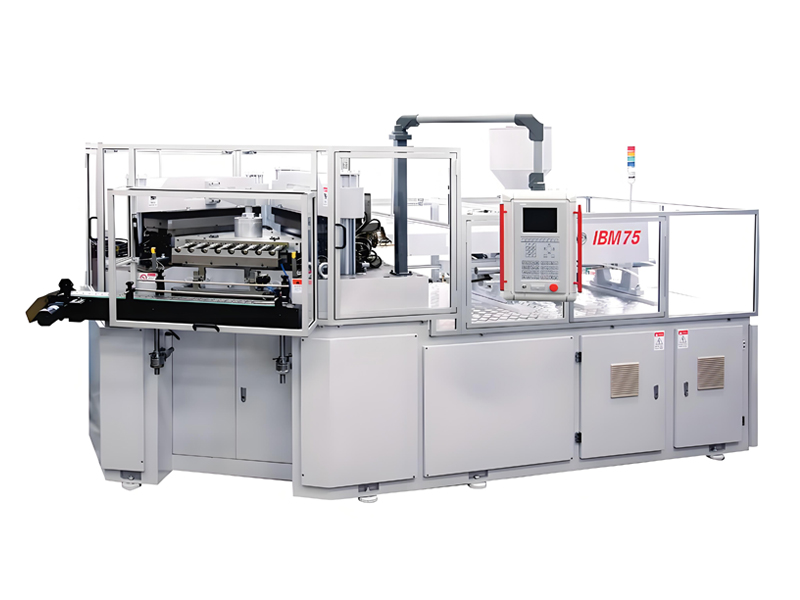
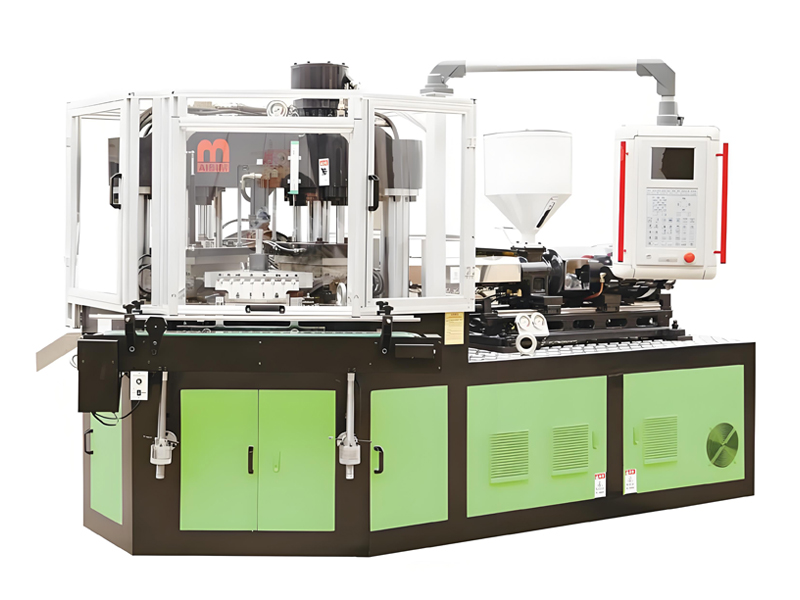
Aibim IBM75 Injection Blow Molding Machine
The IBM75 is the largest standard Aibim model and the natural choice for wide mouth jars up to 1000 mL and openings up to 120 mm. Its single-crossbeam, double-pole clamping framework enlarges the mold setting space, which is exactly what a wide mouth mold needs because the body footprint is large. The machine uses Aibim PREFILL technology with a variable displacement pump that cuts energy use by at least 35 percent compared with a conventional fixed-pump hydraulic unit.
| Specification | IBM75 value |
|---|---|
| Clamping force | 75 tf (750 kN) |
| Injection capacity (shot) | 600 cm3 |
| Screw diameter | 45 mm |
| L/D ratio | 20:1 |
| Maximum cavities | Up to 8 for small parts; 2 to 4 for wide mouth jars |
| Maximum bottle mouth diameter | 120 mm |
| Maximum bottle volume | 1000 mL |
| Platen size | 520 x 520 mm |
| Installed power | 30 kW |
| Dry cycle time | 4.5 s |
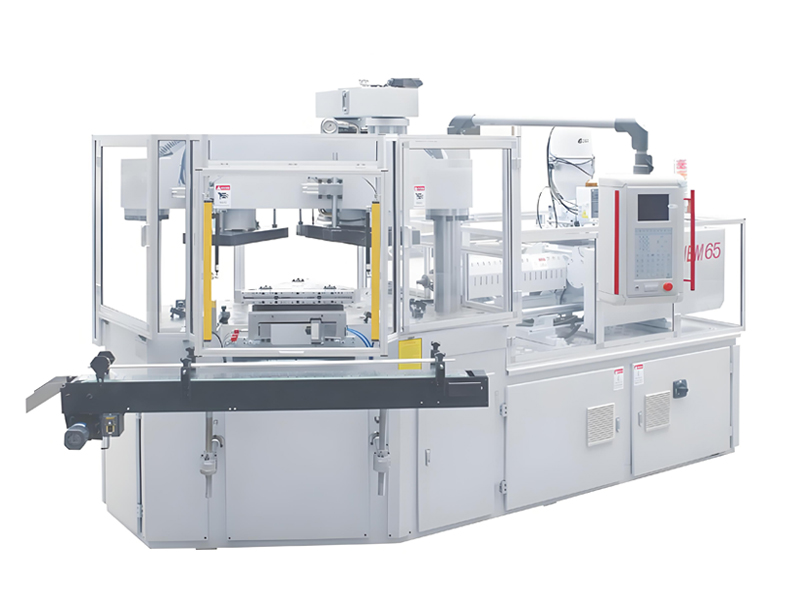
Aibim IBM65 Injection Blow Molding Machine
The IBM65 sits one step below the IBM75 and covers wide mouth jars up to 750 mL and openings up to 100 mm. It is the workhorse for food, cosmetic and pharmaceutical jars in the mid-volume band, with the same three-station one-step process and the same neck precision. Cavity count for a wide mouth jar is limited by platen space, so a 250 mL jar at 70 mm mouth can run four to six cavities while a 750 mL jar at 100 mm mouth runs two.
| Specification | IBM65 value |
|---|---|
| Clamping force | 65 tf (650 kN) |
| Injection capacity (shot) | 450 cm3 |
| Screw diameter | 40 mm |
| L/D ratio | 20:1 |
| Maximum cavities | Up to 6 for small parts; 2 to 3 for wide mouth jars |
| Maximum bottle mouth diameter | 100 mm |
| Maximum bottle volume | 750 mL |
| Platen size | 460 x 460 mm |
| Installed power | 25 kW |
| Dry cycle time | 4.0 s |
Aibim also offers the IBM55 Hybrid Electric model for smaller wide mouth jars up to 500 mL and openings up to 80 mm, where the electric clamp and servo plasticizing give the tightest energy and repeatability numbers for cleanroom and pharmaceutical use. All three models share the Aibim advantages: CE-certified safety with a stripper station laser sensor and light curtain, SD-card recipe storage that moves a proven setting from one machine to another, and the Wanplas group backing for service and spare parts.
Application Industries and Typical Specs
Wide mouth jars made by IBM serve industries where the opening, the seal and the clarity all matter. The combinations below are typical, not exhaustive, and each can be quoted as a concrete machine and mold configuration.
Food. Jam and honey jars at 63 to 100 mm opening and 250 to 500 mL in PP; nut and snack jars at 70 to 89 mm and 400 to 750 mL in PP; infant food jars at 53 to 63 mm and 100 to 250 mL in PP random co-polymer; confectionery jars at 63 to 89 mm and 200 to 500 mL in PP or transparent PETG through ISBM.
Health and supplement. Vitamin and protein jars at 53 to 89 mm and 200 to 750 mL in PP, often with an aluminum foil seal land and a tamper-evident closure.
Pharmaceutical. Tablet and powder bottles at 38 to 63 mm and 60 to 300 mL in HDPE or PP, where the neck precision supports a child-resistant closure and a desiccant fitment.
Cosmetic. Cream jars at 45 to 70 mm and 30 to 200 mL in SAN or PP; body butter and lotion jars at 63 to 89 mm and 200 to 500 mL in PP; mask jars at 70 to 100 mm and 250 to 500 mL in PP or PETG.
Daily chemical. Laundry bead and pod jars at 70 to 100 mm and 400 to 1000 mL in PP, designed with a child-resistant wide closure and a moisture barrier.
Pet food. Wet and dry pet food jars at 89 to 100 mm and 500 to 1000 mL in PP, where the wide opening eases scooping and the neck precision keeps the lid sealed.
Laboratory and sample. Sample and reagent jars at 38 to 63 mm and 30 to 250 mL in PP, PS or PCTG, where clarity and chemical resistance are both required.
Requirement to Model Selection Guide
The table below maps a customer requirement to a recommended Aibim model and cavity configuration. Cavity numbers are given for wide mouth molds and assume the platen-limited layout described earlier; final cavitation is confirmed at the mold design stage.
| Mouth diameter | Volume | Material | Annual output | Recommended model | Cavities | Key configuration |
|---|---|---|---|---|---|---|
| 38 – 45 mm | 30 – 150 mL | PP / PS | Low to medium | IBM55 Hybrid | 4 | Electric clamp, cleanroom option |
| 53 – 63 mm | 100 – 300 mL | PP / HDPE | Medium | IBM65 | 4 | Independent neck cooling |
| 63 – 70 mm | 200 – 500 mL | PP / PETG | Medium to high | IBM65 or IBM75 | 3 – 4 | Stepped core rod, stripper plate |
| 70 – 89 mm | 400 – 750 mL | PP | Medium to high | IBM75 | 2 – 3 | Dense cooling, servo turret |
| 89 – 100 mm | 500 – 1000 mL | PP | Medium | IBM75 | 2 | 120 mm max mouth, reinforced core rod |
| Up to 100 mm | 250 – 500 mL | PET / PETG (ISBM) | High | Wanplas ISBM line | Per project | Oriented clarity, barrier |
For projects that need an oriented PET or PETG wide mouth jar with maximum clarity and barrier, the Wanplas group supplies the matching ISBM line so the customer stays with one supplier and one service organization. For any configuration outside the table, Aibim engineers size the machine from the part drawing, the annual volume and the material data sheet rather than from a generic rule.
Service, Support and How to Start
Buying a wide mouth jar line is the start of a production relationship, not a one-time transaction. Aibim, as a Wanplas factory, backs every machine with the group’s shared service promises.
Factory testing before shipment. Each machine runs a continuity and performance test on the factory floor with the customer’s mold where available, so the line is proven before it leaves Zhangjiagang. The test records cycle time, cavity balance and first-piece dimensions.
Mold trial and first article inspection. The mold is trialed on the actual machine and a first article inspection report is issued against the drawing, covering neck diameter, ovality, seal face flatness, wall distribution and drop performance. The part is not released until the report is signed.
Installation and commissioning. Engineers support on-site installation and commissioning, transfer the proven recipe to the plant SD card, and train the local team to run, clean and maintain the line.
Spare parts policy. The Wanplas group provides USD 500 free parts every year for the covered machines, and damaged parts inside the warranty are replaced free of charge. This keeps a wide mouth jar line running without a large tied-up inventory.
Training and remote operation. Operators and maintenance staff are trained on the floor, and the machine supports remote monitoring so Aibim engineers can read the PLC data and respond to abnormal conditions without waiting for a site visit.
Open factory. Customers are welcome to visit the Aibim factory to audit the build, watch a trial run and review the CNC center that produces the machine parts.
If you are planning a wide mouth jar program, send your part drawing, target volume, material and annual output to Aibim. The engineering team will propose a machine model, a cavity layout and a process window, and invite you to the factory for a mold trial and a line audit before you commit. There is no substitute for seeing your jar come off the machine with the neck in tolerance and the seal flat.
Frequently Asked Questions
What neck-to-body diameter ratio defines a wide mouth jar?
A wide mouth jar has a neck-to-body diameter ratio above 0.5, typically 0.55 to 0.85. Narrow neck bottles sit below 0.35. The larger the ratio, the closer the opening is to the full body diameter, which changes the blow mechanics and makes wall distribution harder to control.
Why is injection blow molding preferred for wide mouth jars over extrusion blow molding?
IBM produces the neck finish by injection in a precision neck ring, so the opening is held to roughly plus or minus 0.05 mm with no flash and no post trim. For a wide mouth jar the opening is the critical sealing and filling surface, and IBM holds that surface to the tightest tolerance of the three processes.
Which material is best for a food contact wide mouth jar?
For most food jars such as jam, honey, nuts and confectionery, polypropylene in homo-polymer or random co-polymer grade is the first choice because of its heat resistance, chemical inertness and food contact compliance. Transparent display jars use PS, SAN or PETG, while HDPE serves pharmaceutical powder and tablet jars.
How many cavities can a wide mouth jar mold run in one IBM machine?
Cavity count is limited by platen area because a wide mouth jar occupies far more mold space than a narrow neck bottle of equal volume. On an Aibim IBM75 a 1000 mL jar up to 120 mm mouth may run two cavities, while a 250 mL jar at 70 mm mouth can run four to six cavities. Larger cavitation is possible only on smaller diameter parts.
What causes ovality or deformation of a wide mouth jar neck?
Ovality comes from thin neck walls, insufficient cooling of the neck ring, and demolding while the polymer is still soft. Countermeasures are an independent cooling circuit on the neck ring, holding demold temperature below 70 degrees C for PP, and adding 0.2 to 0.5 mm to the neck wall thickness.
What is the best blow-up ratio for a wide mouth jar?
Keep the blow-up ratio in the 2.0 to 3.5 range. Above that the parison cannot stretch evenly, so the shoulder and base thin out while the body stays thick. A stepped core rod profile and a 1.5 to 4.5 mm injection wall gradient let you keep the ratio inside the safe window.
How do I verify a wide mouth jar meets its quality spec?
Measure capacity at plus or minus 2 percent, neck inside diameter and ovality, seal face flatness at or below 0.15 mm, wall thickness at no fewer than eight points, top load in newtons, a 1.2 m full drop test, and seal retention under vacuum or pressure. Transparent jars also need light transmittance and haze checks.