Table of Contents
- Why Transparent IBM Bottles Cloud Up or Show Flow Marks
- The Physics of Transparency: Haze, Clarity, and Light Scattering
- How Injection Blow Molding Makes Clear Bottles
- Cloudiness: Five Root Causes and How to Eliminate Each
- Flow Marks: Root Causes and Countermeasures
- Four-Dimension Defect Countermeasure Matrix
- Material Drying Parameters
- Injection and Blow Molding Process Window
- Mold and Equipment Factors That Control Transparency
- Aibim IBM Machine Lineup for Transparent Bottles
- Material Transparency Comparison
- Requirement-to-Model Selection Guide
- Transparency Inspection and Quality Control
- Defect-Cause-Countermeasure Quick Reference
- Relative Cost and Investment of Countermeasures
- Aibim Service and Support
- Frequently Asked Questions
- Conclusion and Invitation
Why Transparent IBM Bottles Cloud Up or Show Flow Marks
Transparent bottles produced on injection blow molding (IBM) lines are in high demand for pharmaceutical, cosmetic, food, and beverage packaging because they let the consumer see the product and signal purity. Yet many producers discover that a bottle that should be crystal clear comes out cloudy, milky, or marked with wavy streaks called flow marks. Aibim, a Wanplas factory (Zhangjiagang AiBiM Plastics Machinery Co., Ltd.), has specialized in injection (stretch) blow molding machines for more than 12 years in machinery manufacturing and 20 years in the IBM field. Our three-station, one-step IBM lines run in 40-plus countries, are built with our own CNC center, and our 2022 new factory ships 100-plus lines per year for containers from 3 mL to 1000 mL. The slogan on every machine we build is simple: “Injection Blow Molding Machine Manufacturer.”
The single most useful fact for any engineer chasing clarity is this: core idea cloudiness and flow marks on an IBM transparent bottle are never one problem. They are four families of problems — crystallization, orientation and stress, cooling, and melt flow — and each family has its own machine, mold, process, and material countermeasures. A bottle can be cloudy because its polymer spherulites are too large, because residual moisture hydrolyzed the resin, because internal stress caused stress whitening, because the mold surface scattered light, or because trapped gas formed bubbles. Likewise, flow marks can come from the injection station, the blow station, the gate design, or the parison temperature profile. If you treat all “haze” as one defect, you will chase the wrong lever.
This article is a complete field manual. It explains the physical basis of transparency, walks through the IBM process, then breaks cloudiness and flow marks into their individual root causes with concrete fixes across the four dimensions of machine, mold, process, and material. It includes the four-dimension countermeasure matrix, a material drying table, an injection and blow process window, a defect quick-reference table with more than 14 rows, product specification tables for the IBM75, IBM65, and IBM55 Hybrid Electric machines, a requirement-to-model selection table, and a relative cost ranking so you can plan investment. By the end, you will be able to read a cloudy or streaked bottle like a diagnostic chart and pick the right correction.
The Physics of Transparency: Haze, Clarity, and Light Scattering
Transparency is not a single number; it is the result of how a polymer transmits and scatters light. Two measurements matter most. Clarity (or light transmittance) describes how much light passes straight through the wall. Haze is the percentage of transmitted light that is scattered more than 2.5 degrees from the straight path. A bottle can have high light transmittance yet still look milky if its haze is high, because the scattered light diffuses the image behind it. For a transparent pharmaceutical or cosmetic bottle, both high transmittance and low haze are required.
Light is scattered by any interface where the refractive index changes. In a clear amorphous polymer with no crystals, the refractive index is uniform and light passes through. In a semi-crystalline polymer, the crystalline regions have a different refractive index from the amorphous regions, so every spherulite boundary becomes a tiny scattering site. The larger and more numerous the spherulites, the higher the haze. This is why polypropylene, a semi-crystalline resin, tends to look translucent or milky unless it is quenched rapidly or modified with a clarifying agent, while polystyrene, SAN, PC, PCTG, and PMMA are naturally transparent because they are largely amorphous.
The main sources of scattered or lost light in an IBM transparent bottle are:
- Crystalline spherulites in semi-crystalline resins (PP, PE, PET when crystallized).
- Internal stress and birefringence from uneven cooling or orientation, which bends light differently across the wall.
- Surface defects — poor mold polish, orange peel, drag marks — that scatter light at the wall surface.
- Bubbles and voids from trapped gas or volatiles, each acting as a microscopic lens.
- Impurities and carbonized specks from contaminated material or degraded resin in the barrel.
- Hydrolytic degradation of PET, PC, or PCTG that was not dried, producing a white, brittle, hazy wall.
Two more physical effects deserve attention before moving to process. The first is refractive-index mismatch. Even within one amorphous resin, a region that is stretched (oriented) has a slightly different refractive index from a relaxed region. Where these regions meet at a sharp boundary, light bends and a faint line appears. This is the optical signature of frozen-in orientation, and it is why a bottle can look clear in the center yet show faint rings near the neck or shoulder where shear was highest. The second is surface scatter versus volume scatter. Surface scatter comes from the mold finish and is corrected by polishing; volume scatter comes from crystals, bubbles, and stress inside the wall and is corrected by material and process. A quick diagnostic is to wet the bottle surface with a clear oil: if the haze disappears, the problem is surface (mold) finish; if it remains, the problem is inside the wall (volume). This single test tells you whether to send the mold to the polisher or to re-tune the process and material.
Measurement discipline also matters. A haze meter gives a repeatable number, but the number is meaningless without a defined sample, light path, and reference. Establish a master sample for each bottle and measure it on the same instrument under the same conditions, then hold production parts to a tolerance band around that master. Visual grading under a standard light box is a useful secondary check, but it should never replace the numeric haze reading for release decisions. Remember that haze and light transmittance move independently: a bottle can stay bright yet grow hazier, so track both.
The table below summarizes how common IBM materials behave. Note that “transparency class” is a material property, but the actual bottle clarity is determined by how you process it. A naturally clear resin can still be ruined by bad drying or slow cooling.
| Material | Transparency class | Key clarity risk | IBM relevance |
|---|---|---|---|
| PP (homopolymer / copolymer) | Semi-crystalline | Spherulite growth, milky haze | Very common for pharmaceutics and food; needs quench + clarifier |
| HDPE / LDPE / LLDPE | Semi-crystalline | Naturally translucent, not clear | Used when clarity not required |
| PS | Amorphous | Brittle, low chemical resistance | Naturally clear, easy haze control |
| SAN | Amorphous | Needs drying; stress crack risk | Clear, rigid, good for cosmetics |
| ABS | Amorphous (with rubber) | Rubber phase scatters light slightly | Translucent, not fully clear |
| PC | Amorphous | Hydrolysis whitening if wet | Premium clear, high heat |
| PCTG / PETG | Amorphous copolyester | Hydrolysis; needs drying | Excellent clarity, tough, cosmetic-grade |
| PET (rare in IBM) | Semi-crystalline | Crystallizes fast, turns opaque | Usually ISBM; if IBM, control crystallization |
| TPU | Segmented, often hazy | Inherent softness/cloud | Specialty soft-touch bottles |
How Injection Blow Molding Makes Clear Bottles
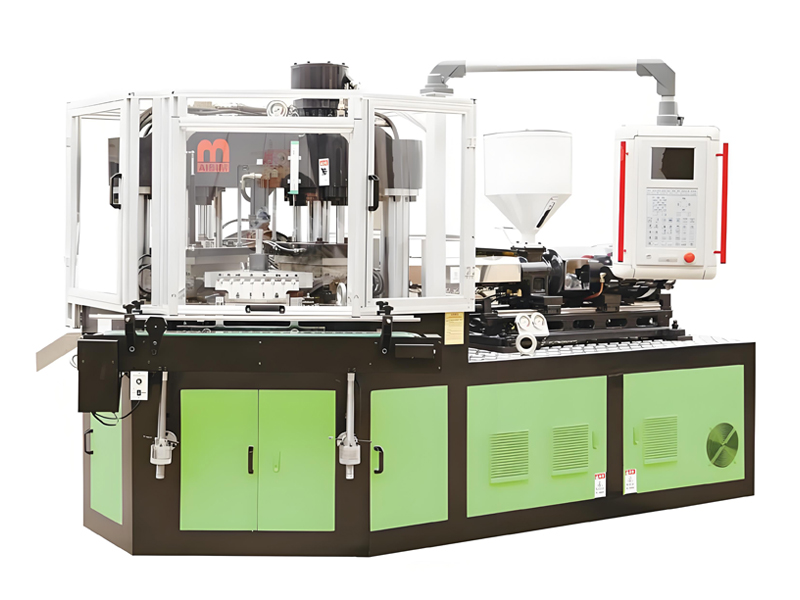
Injection blow molding is a one-step, three-station process that combines injection molding and blow molding on a single rotating machine. In the first station, the machine injects the melt into a parison (also called a preform) cavity around a core rod. In the second station, the heated parison on its core rod is transferred to the blow station, where compressed air expands it against a cold blow mold to form the bottle. In the third station, the finished bottle is stripped off the core rod. There is no flash, the neck finish is molded to high precision, and the parison wall thickness is uniform by design.
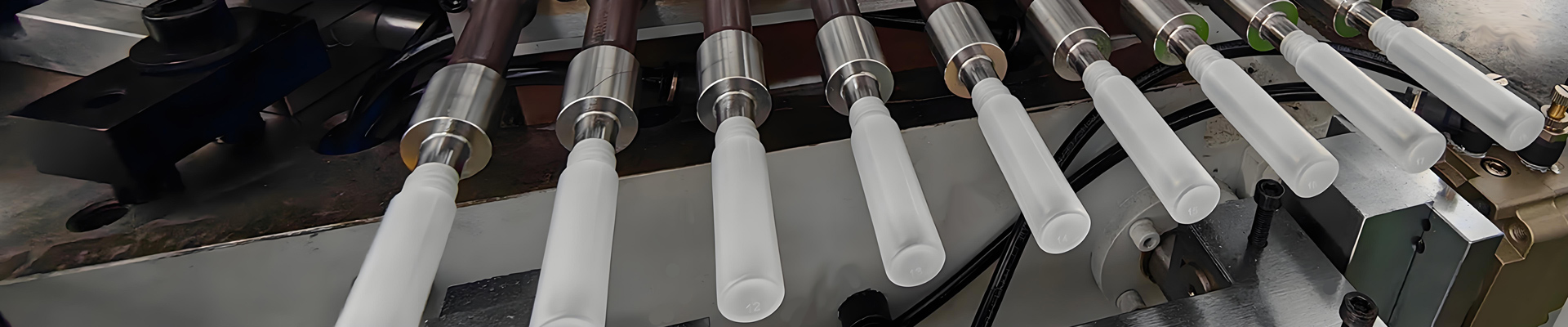
The core rod is the silent hero of IBM clarity. The parison is molded around a heated core rod at the first station, then the rod carries that parison, still at a controlled temperature, to the blow station. Because the parison never leaves the rod and is never dropped or re-gripped, its temperature profile is preserved and its surface is not scuffed by handling. At the blow station the rod acts as the internal blow mandrel: compressed air enters through it and expands the warm parison against the cold mold. The rod temperature, therefore, directly sets the parison temperature that the blow station sees — and parison temperature is the single biggest driver of even wall stretch and mark-free surfaces. Aibim machines hold this temperature with dedicated control so the parison arrives at blow neither too cold (which marks) nor too hot (which sags and thins).
This structure matters for clarity. Because the parison is injection-molded rather than extruded, its wall is consistent and free of the thickness variations and weld lines that often appear in extrusion blow molding. Because the whole cycle is one step inside the machine, the parison is not handled, cooled, and reheated as in a two-step process, so contamination and moisture pickup are minimized. The trade-off is that IBM is best suited to small, high-precision containers from 3 mL to 1000 mL — exactly the transparent pharmaceutical, cosmetic, and single-serve bottles where clarity is most valuable.
Compared with extrusion blow molding and two-step reheat blow, IBM gives the tightest control over wall uniformity, which is the foundation of even light transmission. The comparison below is technology-to-technology, not brand-to-brand:
| Process | Parison formation | Flash | Wall uniformity | Typical clarity control | Best container size |
|---|---|---|---|---|---|
| Injection blow molding (IBM) | Injection, 3-station one-step | None | Excellent | Very high, controlled parison temp | 3–1000 mL |
| Two-step blow (reheat) | Injection preform, then reheat-blow | None | Good | High, but reheating variance | 100 mL–2 L |
| Extrusion blow molding | Extruded parison | Some | Fair | Lower, wall variation | 50 mL–20 L+ |
Cloudiness: Five Root Causes and How to Eliminate Each
Cloudiness is the general term for unwanted haze. In IBM transparent bottles it usually traces to one of five causes. Diagnose by where the haze appears and under what condition, then apply the matching countermeasure.
Cause 1: Crystallization Haze (PP, PE, PET)
PP and PE are semi-crystalline. If the parison or bottle wall cools slowly, spherulites have time to grow into large light-scattering structures, and the bottle looks milky instead of clear. The fix is to force rapid, uniform cooling and to keep crystals small. Lower the blow mold temperature, increase coolant flow, and consider a nucleating or clarifying agent that multiplies the number of crystal nuclei so each spherulite stays tiny. For PET processed by IBM, control residence time and temperature so it does not crystallize into an opaque wall.
Cause 2: Hydrolysis and Degradation Haze (PET, PC, PCTG, SAN)
PET, PC, PCTG, and to a lesser degree SAN are hygroscopic. If they are not dried to a low moisture level before plasticizing, water reacts with the polymer chain during melt processing, breaking it and producing a white, brittle, hazy wall. The cure is disciplined drying in a dehumidifying dryer at the correct temperature, dew point, and residence time (see the drying table in section 7). Barrel temperature must also stay within the safe window so the melt does not degrade.
Cause 3: Stress Whitening and Internal Stress
When a bottle is cooled too fast or the parison temperature is uneven, frozen-in orientation and internal stress create birefringence that scatters light, and in severe cases visible stress whitening. Balance the holding pressure and cooling, keep the parison temperature profile even across the core, and avoid over-cooling that locks in stress. A polarized-light inspection (section 13) reveals stress you cannot see with the eye.
Cause 4: Impurities and Black Specks
Contaminated regrind, dust on pellets, or carbonized material baked onto the barrel wall or screw shows up as black dots and gray haze. Clean the material path, use a dehumidifying dryer with a clean hopper, purge the barrel regularly, and control barrel temperature so the resin does not over-shear and degrade. Material that has sat in a humid warehouse should be screened and re-dried.
Cause 5: Bubbles and Splay (Silver Streaks)
Water or volatile trapped in the melt becomes bubbles or silver streaks inside the wall, scattering light and looking foggy. The remedies are thorough drying, adequate barrel decompression and venting, and a segmented injection speed that prevents the melt front from trapping air. Excess back pressure that packs volatiles into the melt should also be reduced.
A Practical Diagnostic Order for Cloudiness
When a bottle comes out hazy, do not change five things at once. Work the cheapest, highest-probability cause first. Step one: confirm the material was dried to spec and the dryer dew point is correct — most “mystery haze” on PET, PC, and PCTG is simply water. Step two: wet the surface with clear oil; if haze stays, the problem is internal, so move to cooling and crystallization. Step three: check mold temperature and coolant flow; for PP, drop the mold temperature and add a clarifier. Step four: inspect the barrel and screw for carbon and contamination. Step five: only then consider mold re-polish or a new mold. This order fixes the majority of cases with the least spent, and it keeps your process change history clean so you can trust the result.
Flow Marks: Root Causes and Countermeasures
Flow marks are surface lines, ripples, or waves on the bottle — most visible on the shoulder and body. They are a flow-history defect: the melt or the parison moved in a way that left a visible record. They differ from cloudiness because they are directional and localized, not a uniform haze.
Injection-Station Flow Marks on the Parison
The parison is formed by injection, so its surface quality is set first. If the melt-front temperature is uneven, if injection speed or pressure is wrong, if the gate is poorly sized, or if cold material enters the cavity, the parison carries a snake-like mark that later appears on the bottle. Countermeasures: use segmented (profiled) injection speed, keep the hot runner and nozzle at a stable temperature, enlarge or reposition the gate to reduce shear, and make sure the mold temperature is uniform around the cavity.
Blow-Station Flow Marks and Stretch Lines
At the blow station, an uneven parison temperature profile or a poor wall-thickness transition causes the air to stretch the wall unevenly, leaving stretch lines. Control the parison temperature distribution, tune the pre-blow timing so the wall begins to expand before full pressure, and match blow pressure to the parison temperature. A parison that is too cold flows sluggishly and marks; one that is too hot sags and thins.
Jetting (Snake-Like or Spiral Marks)
Jetting happens when melt enters the cavity as a narrow jet through a gate that is too small or at too high an initial speed, freezing a worm-like pattern before the cavity fills. Enlarge the gate, lower the initial injection speed, and raise the melt temperature slightly so the front spreads instead of shooting.
Weld Lines
Where melt fronts meet — around the core rod or at multiple gates — a weld line can form. It is a thin ridge that catches light. Raise melt and mold temperature to improve fusion, improve venting so gas does not block the meeting front, and design the gate and runner so fronts meet in a low-visibility area.
Telling Injection Flow Marks from Blow Flow Marks
A fast way to localize a flow mark is to look at where it sits and how it runs. Marks that follow the parison injection direction and appear as regular ripples or a snake pattern are almost always set at the injection station and copied onto the bottle. Marks that run circumferentially or appear only after expansion, often on the body away from the gate, are set at the blow station by an uneven parison temperature or wrong pre-blow timing. Because the parison is formed first, any injection-station defect is “locked in” and cannot be removed by blow tuning — you must fix it where it started. This is why Aibim’s stable hot-runner temperature control and segmented injection profiling are central to a clean surface: they prevent the mark before the parison ever reaches the blow mold.
Four-Dimension Defect Countermeasure Matrix
The most reliable way to act on a defect is to view it across four dimensions — machine parameters, mold, process, and material — and pick the lever in each. The matrix below maps the common transparency defects to concrete actions.
| Defect | Machine / parameter | Mold | Process | Material |
|---|---|---|---|---|
| Cloudiness (crystallization) | Higher cooling capacity, stable barrel temp | More uniform cooling circuits, low Ra polish | Lower mold temp, faster cooling | Nucleating / clarifying agent for PP |
| Cloudiness (hydrolysis) | Dryer control, dew-point monitor | Clean feed, sealed hopper | Lower melt temp, shorter residence | Thorough drying of PET/PC/PCTG/SAN |
| Stress whitening | Even parison temp control | Balanced cooling | Lower holding pressure, balanced cooling | Lower-orientation grade if needed |
| Black specks | Barrel clean, temp control | Clean cavity | Regular purge, lower shear | Clean, screened resin; no wet regrind |
| Bubbles / splay | Back-pressure tuning, vent | Vent slots | Segmented speed, dry material | Dry resin; reduce volatiles |
| Injection flow marks | Stable hot runner, nozzle temp | Gate size/position, polish | Segmented injection speed | Proper viscosity grade |
| Blow flow marks | Parison temp zones | Blow mold surface | Pre-blow timing, blow pressure | Consistent lot |
| Jetting | Injection profiling | Larger gate | Lower initial speed, higher melt temp | Right MFI grade |
| Weld line | Temp control | Gate/runner design, vents | Higher melt/mold temp | Clean, dry resin |
| Surface roughness / orange peel | Stable clamp, temp | Mirror polish, Ra control | Adequate pack, cooling | Low-contamination resin |
Material Drying Parameters
Drying is the cheapest, highest-leverage clarity step for hygroscopic resins. The values below are typical engineering ranges for a dehumidifying dryer; the exact setting depends on the resin grade and the dryer model. Always confirm against the material supplier’s data sheet. PP is shown for completeness because light drying removes surface moisture even though PP is hydrophobic.
| Material | Dry temp (°C) | Dew point (°C) | Time (h) | Melt / process temp (°C) | Clarity note |
|---|---|---|---|---|---|
| PET (if used in IBM) | 150–180 | ≤ -40 | 4–6 | 260–290 | Must dry or hydrolyzes white |
| PC | 110–130 | ≤ -30 | 3–4 | 280–320 | Hydrolysis causes brittle haze |
| PCTG / PETG | 65–80 | ≤ -30 | 3–4 | 250–290 | Dry well; sensitive to moisture |
| SAN | 70–85 | ≤ -20 | 2–3 | 200–250 | Dry to avoid splay |
| PS | 70–80 | ≤ -20 | 1–2 | 180–240 | Low moisture need, easy clarity |
| ABS | 80–90 | ≤ -20 | 2–3 | 200–250 | Dry to prevent silver streaks |
| PP | 80–100 | ≤ -20 | 1–2 | 200–260 | Hydrophobic; light drying for surface moisture |
Injection and Blow Molding Process Window
The table below gives typical windows for the injection and blow phases of an IBM cycle. Treat these as starting points; optimize per material, bottle geometry, and cavity count. The blow pressures in IBM are generally lower than in stretch blow molding because the parison is already at blow temperature and only needs to be formed, not biaxially stretched.
| Parameter | Typical window | Purpose / effect on clarity |
|---|---|---|
| Rear barrel zone | 200–240 °C | Stable plasticizing, avoid degradation |
| Middle barrel zone | 220–255 °C | Uniform melt, fewer flow marks |
| Front / nozzle zone | 230–265 °C | Melt front quality at gate |
| Injection speed | 30–70% (segmented) | Too fast → jetting; too slow → cold flow marks |
| Injection pressure | 80–140 MPa (800–1400 bar) | Fill without over-shear |
| Holding pressure | 40–70% of injection | Pack without stress whitening |
| Mold (blow) temperature | 10–90 °C by material | PP low for clarity; PC/PCTG higher |
| Parison temperature | Near melt, 100–200 °C window | Even temp → even stretch, no marks |
| Pre-blow pressure | 6–12 bar | Start expansion before full pressure |
| Blow pressure | 8–20 bar | Form wall; too high can stress |
| Cooling time | 2–8 s | Quench crystals; longer for thick walls |
Mold and Equipment Factors That Control Transparency
No amount of process tuning rescues a poor mold. For transparent bottles the blow mold cavity should be polished to a high mirror finish — measured as low Ra (surface roughness). The lower the Ra, the less the surface scatters light. Visible orange peel or drag marks come straight from the mold surface and must be corrected by re-polishing, not by changing parameters.
Other mold factors include vent slots that let air escape so the wall seats fully against the cavity, uniform cooling circuits so the wall cools evenly without stress, and a temperature-controlled core rod that sets the parison temperature profile entering the blow station. On the machine side, the stability of the injection unit (steady shot, steady melt temperature), the precision of barrel temperature control, and the clamping accuracy that keeps wall thickness even all contribute to clarity. Aibim machines are built with our own CNC center so mold and core-rod precision are held tightly, and the single-crossbeam, double-pole clamping framework gives an enlarged, stable mold-setting space for even clamping.
Aibim IBM Machine Lineup for Transparent Bottles
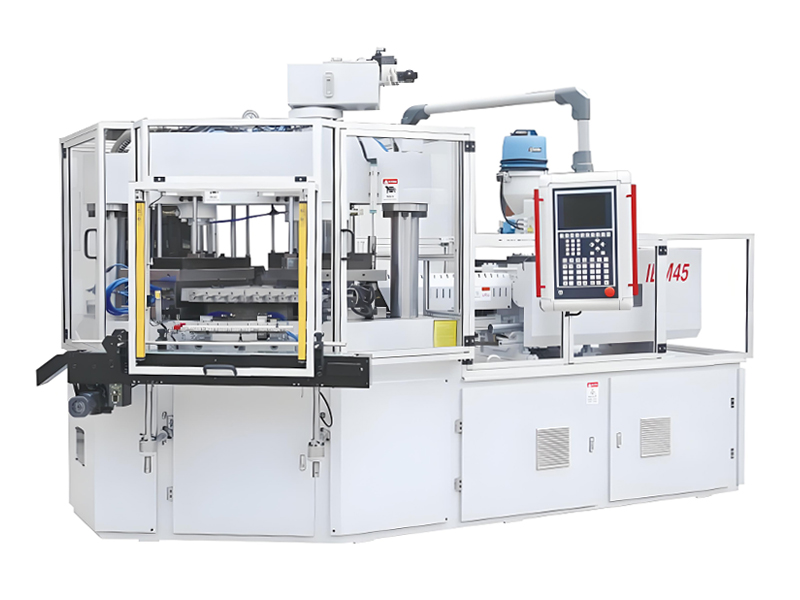
Aibim offers three IBM platforms that cover the full 3 mL to 1000 mL transparent container range. Each is a three-station, one-step machine with the PREFILL hydraulic technology, SD-card parameter storage, and the energy-saving package. The specification values below are typical engineering ranges for each model family; final figures are confirmed against the ordered configuration and cavity count.
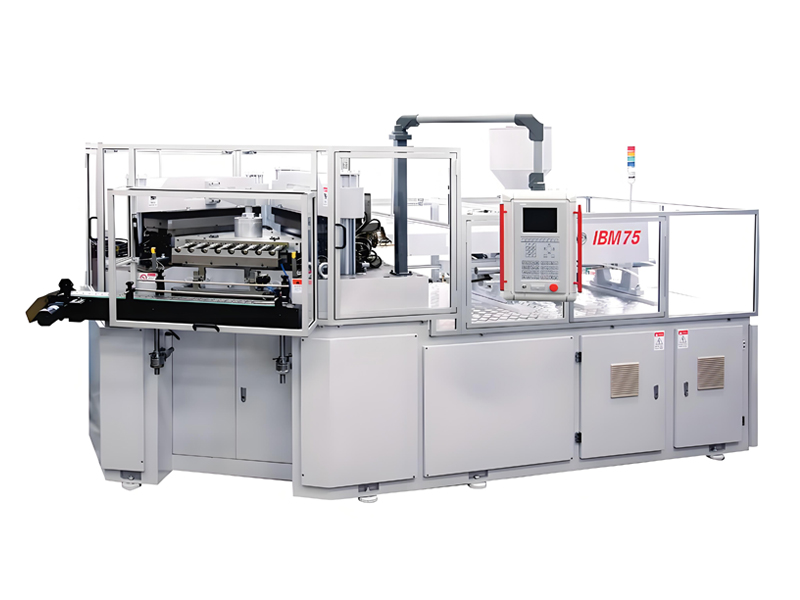
IBM75 Injection Blow Molding Machine
The IBM75 is the workhorse for mid-to-large transparent bottles up to 1000 mL — cosmetic essence bottles, pharmaceutical syrup bottles, and beverage sampling bottles. Its larger injection unit and clamping force support bigger parisons and more cavities.
| Specification | IBM75 (typical range) |
|---|---|
| Model | IBM75 |
| Injection screw diameter | 45–55 mm |
| Shot size (injection weight) | 200–400 g |
| Clamping force | 450–750 kN (approx. 45–75 ton) |
| Container volume range | 50–1000 mL |
| Stations | 3 stations, one-step (injection / blow / ejection) |
| Drying / heating zones | 4–6 zones (dehumidifying dryer + barrel) |
| Cycle time / output | 6–12 s cycle, output scales with cavities |
| Installed power | 30–55 kW |
| Dimensions & weight | approx. 4.5 × 1.8 × 2.2 m; 8–12 ton |
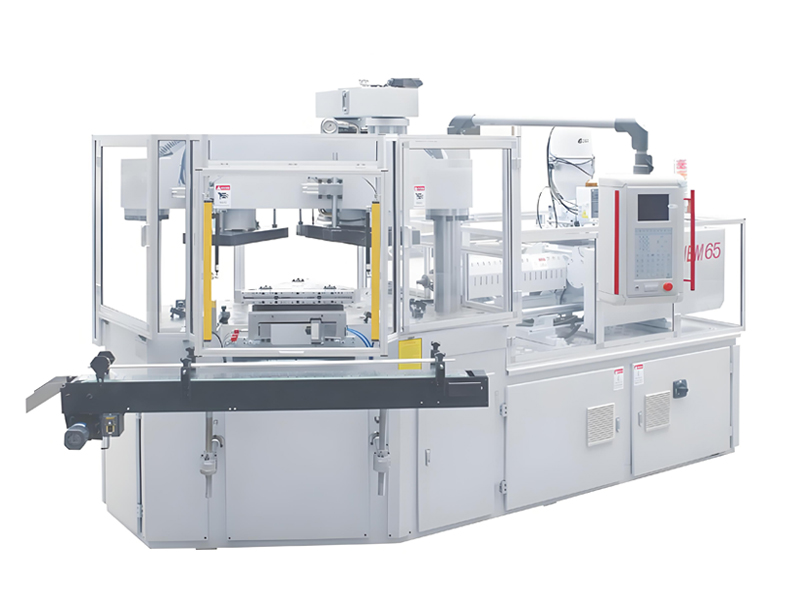
IBM65 Injection Blow Molding Machine
The IBM65 fits small-to-medium transparent bottles from 10 mL to 500 mL — eye-drop bottles, oral-liquid bottles, and cosmetic droppers. It is the most common choice for pharmaceutical clarity work because it pairs precise parison control with a compact footprint.
| Specification | IBM65 (typical range) |
|---|---|
| Model | IBM65 |
| Injection screw diameter | 38–48 mm |
| Shot size (injection weight) | 120–260 g |
| Clamping force | 350–550 kN (approx. 35–55 ton) |
| Container volume range | 10–500 mL |
| Stations | 3 stations, one-step (injection / blow / ejection) |
| Drying / heating zones | 3–5 zones |
| Cycle time / output | 5–11 s cycle, output scales with cavities |
| Installed power | 22–40 kW |
| Dimensions & weight | approx. 4.0 × 1.6 × 2.0 m; 6–9 ton |
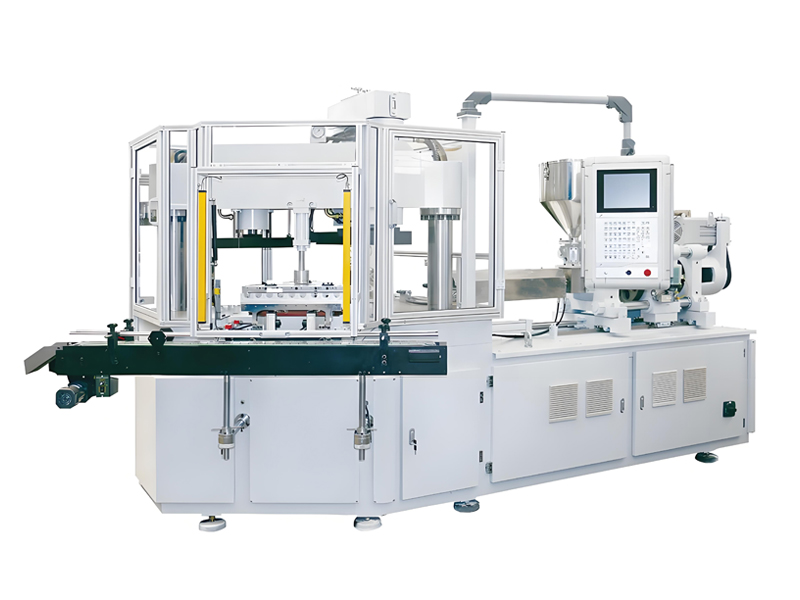
IBM55 Hybrid Electric Injection Blow Molding Machine
The IBM55 Hybrid Electric adds electric clamping and metering to the hybrid hydraulic package, giving the finest parison repeatability for the smallest, most demanding transparent bottles from 3 mL to 250 mL — micro-dose pharmaceutical vials and precision cosmetic samples. Its lower installed power and fast response suit clean-room and high-consistency production.
| Specification | IBM55 Hybrid (typical range) |
|---|---|
| Model | IBM55 Hybrid Electric |
| Injection screw diameter | 30–40 mm |
| Shot size (injection weight) | 60–150 g |
| Clamping force | 250–400 kN (approx. 25–40 ton) |
| Container volume range | 3–250 mL |
| Stations | 3 stations, one-step; hybrid electric/hydraulic |
| Drying / heating zones | 2–4 zones |
| Cycle time / output | 4–10 s cycle, output scales with cavities |
| Installed power | 15–30 kW |
| Dimensions & weight | approx. 3.5 × 1.4 × 1.9 m; 4.5–7 ton |
Material Transparency Comparison
The table ranks the IBM-processable materials by realistic transparent-bottle performance so you can match resin to the clarity target. “Clarity class” is the native material behavior; “IBM clarity result” is what a well-run Aibim line typically delivers.
| Material | Clarity class | IBM clarity result | Effort to stay clear | Typical transparent use |
|---|---|---|---|---|
| PCTG / PETG | Amorphous, very clear | Excellent | Medium (dry well) | Premium cosmetic, display bottles |
| PC | Amorphous, clear | Excellent | Medium-High (dry, temp) | High-heat pharma, reusable |
| SAN | Amorphous, clear | Very good | Medium (dry) | Cosmetic, rigid clear |
| PS | Amorphous, clear | Very good | Low | Single-use pharma, sampling |
| PP + clarifier | Semi-crystalline | Good (with quench) | Medium-High | Pharma, food, droppers |
| ABS | Amorphous, slightly hazy | Fair | Medium | Translucent, not fully clear |
| TPU | Soft, often hazy | Fair | High | Soft-touch specialty |
| HDPE / LDPE | Semi-crystalline, opaque | Poor (by nature) | Very High | Used when clarity not needed |
Requirement-to-Model Selection Guide
Use this table to move from a bottle requirement to a recommended Aibim model. The recommendation assumes a clear, defect-free target and a standard cavity count; very high output or unusual geometry may shift the choice.
| Container volume | Material | Transparency target | Output need | Recommended model |
|---|---|---|---|---|
| 3–50 mL | PP, PS, SAN, PC, PCTG | High | High | IBM55 Hybrid Electric |
| 10–250 mL | PP, PS, SAN, PC, PCTG | High | Medium-High | IBM65 or IBM55 Hybrid |
| 50–500 mL | PP, PS, SAN, PC, PCTG | High | Medium | IBM65 |
| 100–1000 mL | PP, PS, SAN, PC, PCTG | High | Medium-High | IBM75 |
| 250–1000 mL | PP, PCTG, PC | Premium | High | IBM75 |
| Micro-dose <15 mL | PP, PS, PC | Critical (pharma) | High repeatability | IBM55 Hybrid Electric |
Transparency Inspection and Quality Control
Clarity must be measured, not guessed. A haze meter quantifies the percentage of scattered light and is the standard instrument for release testing of transparent bottles. Pair it with a light-transmittance measurement and a visual comparison against an approved master sample under defined lighting. Wall-thickness uniformity should be checked with a thickness gauge, because even a clear wall looks uneven if thickness varies. Internal stress is best seen with a polarized-light (polariscope) inspection, which reveals frozen-in orientation invisible to the naked eye.
For production control, Aibim recommends a first-article confirmation on every new mold and material lot, then periodic batch sampling of haze, wall thickness, and visual clarity. Because Aibim machines store full process recipes on an SD card, the validated clarity recipe for a bottle can be saved and reloaded on any same-model machine, removing operator drift between shifts and between lines.
Defect-Cause-Countermeasure Quick Reference
The table below is the at-a-glance diagnostic. Match the symptom, read the likely cause, apply the fix. It covers more than 14 rows so most field cases are addressed.
| # | Symptom | Likely cause | Primary countermeasure |
|---|---|---|---|
| 1 | Milky PP bottle | Spherulite growth (crystallization) | Lower mold temp, faster cooling, add clarifier |
| 2 | White brittle PET/PC wall | Hydrolysis from wet resin | Dry to spec; check dew point |
| 3 | General stress whitening | Internal frozen-in stress | Balance holding/cooling; even parison temp |
| 4 | Black specks / gray haze | Contamination or barrel carbon | Clean path, purge, control barrel temp |
| 5 | Bubbles inside wall | Trapped moisture / volatiles | Dry resin; vent; reduce back pressure |
| 6 | Silver streaks (splay) | Gas in melt front | Dry, segment injection speed, vent |
| 7 | Snake-like shoulder mark | Jetting at gate | Enlarge gate; lower initial speed |
| 8 | Wavy body ripples | Injection flow mark | Segmented speed; stabilize hot runner |
| 9 | Stretch lines on body | Uneven parison temp at blow | Control parison temp; tune pre-blow |
| 10 | Thin ridge (weld line) | Melt fronts meet poorly | Raise temp; improve venting; gate design |
| 11 | Orange peel surface | Mold surface roughness | Re-polish cavity to low Ra |
| 12 | Drag marks | Mold finish / ejection | Polish, check ejection, draft |
| 13 | Cloudy only on thick sections | Slow cooling in thick areas | Improve cooling circuits; reduce thickness |
| 14 | Haze after storage | Post-crystallization or moisture | Stable material; dry storage; clarifier |
| 15 | Gloss loss vs. master | Mold polish or process drift | Recalibrate recipe via SD card; repolish |
| 16 | Cloudy ring at neck | Orientation / shear at gate area | Tune gate, speed, holding pressure |
Relative Cost and Investment of Countermeasures
Not every fix costs the same. The ranking below uses a baseline index of 100 for a standard clarity-optimized IBM setup, with relative investment shown as a level, an estimated percentage above baseline, and a multiple. No currency amounts are given; the intent is to help you prioritize.
| Countermeasure | Investment level | vs. baseline | Multiple | Index points |
|---|---|---|---|---|
| Process tuning (speed, pressure, temp) | Low | +0% | 1.0× | 100 |
| Material drying upgrade (dehumidifying dryer) | Low | +5% | 1.05× | 105 |
| Mold re-polish to mirror Ra | Medium | +15% | 1.15× | 115 |
| Clarifying / nucleating agent (per lot) | Low | +3% | 1.03× | 103 |
| Cooling circuit redesign | Medium | +20% | 1.20× | 120 |
| Gate / runner rework | Medium | +18% | 1.18× | 118 |
| New high-precision mold (CNC) | High | +60% | 1.60× | 160 |
| IBM55 Hybrid Electric upgrade | High | +70% | 1.70× | 170 |
| Full turnkey clarity cell (machine+mold+dryer) | Very High | +120% | 2.20× | 220 |
| Premium closed-loop optical QC line | Premium | +200% | 3.00× | 300 |
Aibim Service and Support
Choosing the right machine is only half the work; running it clear, every shift, is the other half. Aibim backs every line with the Wanplas group service commitments and Aibim-specific capabilities:
- Pre-shipment trial and inspection: each line is run and verified at the factory before delivery, including CE-certified safety — the stripper station uses a long-distance digital laser sensor to protect the mold, and a light curtain protects personnel.
- On-site installation and commissioning: Aibim engineers travel to the customer site to install, tune, and hand over the line against the agreed clarity and output targets.
- Spare parts policy: USD 500 free parts per year, plus free replacement of damaged parts within the warranty period.
- SD-card recipe management: process recipes — including validated clarity settings — are stored on an SD card and can be reloaded across machines, eliminating operator drift.
- Energy saving: PREFILL technology and a variable displacement pump give a minimum 35% energy saving versus conventional hydraulic units.
- Mold and sample development: Aibim designs and trials molds and produces bottle samples so the clarity target is proven before mass production.
- Training and open factory: operators are trained on-site, and customers are welcome to visit the Zhangjiagang factory to audit the workshop and witness trial runs.
- Transport, capacity, and quality guarantees: the Wanplas group promises transportation guarantee, production-capacity guarantee, and quality standards with compensation if quality fails.
Frequently Asked Questions
Why does my clear PP bottle look milky instead of transparent?
PP is a semi-crystalline polymer. If the parison or bottle wall cools slowly, spherulites grow large enough to scatter light, producing a milky haze. Raise cooling rate, lower mold temperature, and use a clarifying or nucleating agent to keep crystals small and the wall clear.
What causes flow marks on the bottle shoulder of an injection blow molding part?
Flow marks on the shoulder usually originate at the injection station. Uneven melt-front temperature, too-high initial injection speed, a small gate, or cold material produces a visible snake-like ripple. Use segmented injection speed, enlarge or relocate the gate, and stabilize hot-runner and mold temperature.
Do I need to dry PP before injection blow molding?
PP is hydrophobic and needs only light drying to remove surface moisture, but PET, PC, PCTG, SAN, PS, and ABS must be dried to a low moisture level in a dehumidifying dryer. Undried hygroscopic resins hydrolyze and turn white or foggy.
Which Aibim machine should I choose for a 100 mL transparent cosmetic bottle in PETG?
For a 100 mL PETG cosmetic bottle, the IBM75 covers up to 1000 mL and is the standard choice, while the IBM65 handles 10 to 500 mL. PETG requires thorough drying and a moderate mold temperature, both supported by the Aibim drying and temperature-control packages.
Can mold surface finish alone fix cloudiness?
Mold polish is necessary but not sufficient. A mirror finish reduces surface scattering, but internal crystallization, moisture, and stress whitening come from material and process. You need a four-dimension approach: machine, mold, process, and material together.
How is injection blow molding different from two-step blow molding for clarity?
IBM forms the parison by injection in the first station, so the parison wall is uniform, flash-free, and precisely controlled, giving better wall consistency and fewer weld lines than many two-step or extrusion blow routes. The one-step three-station process also reduces contamination and handling haze.
What is the minimum energy saving of Aibim IBM machines?
Aibim IBM machines use PREFILL technology and a variable displacement pump, and the line saves a minimum of 35% energy consumption compared with conventional hydraulic units of similar size.
Conclusion and Invitation
Cloudiness and flow marks on transparent injection blow molding bottles are solvable once you stop treating them as one problem. They are the visible result of four underlying families — crystallization, orientation and stress, cooling, and melt flow — and each has a clear lever across the machine, mold, process, and material dimensions. Dry hygroscopic resins, quench semi-crystalline walls, polish the mold to a mirror finish, segment the injection, and control the parison temperature, and clarity follows.
Whether you run pharmaceutical vials, cosmetic essence bottles, food sampling bottles, or transparent health-product containers, Aibim — a Wanplas factory with 12-plus years of machine-building experience, 20 years in the IBM field, and 100-plus lines shipped per year from our 2022 Zhangjiagang plant — can configure the right IBM75, IBM65, or IBM55 Hybrid Electric line for your clarity target. We invite you to send us your bottle sample, the material you plan to use, and your transparency goal. Our engineers will propose the process and machine configuration to eliminate haze and flow marks, and we welcome you to send samples for molding trials and to visit our factory for a live test run and audit.