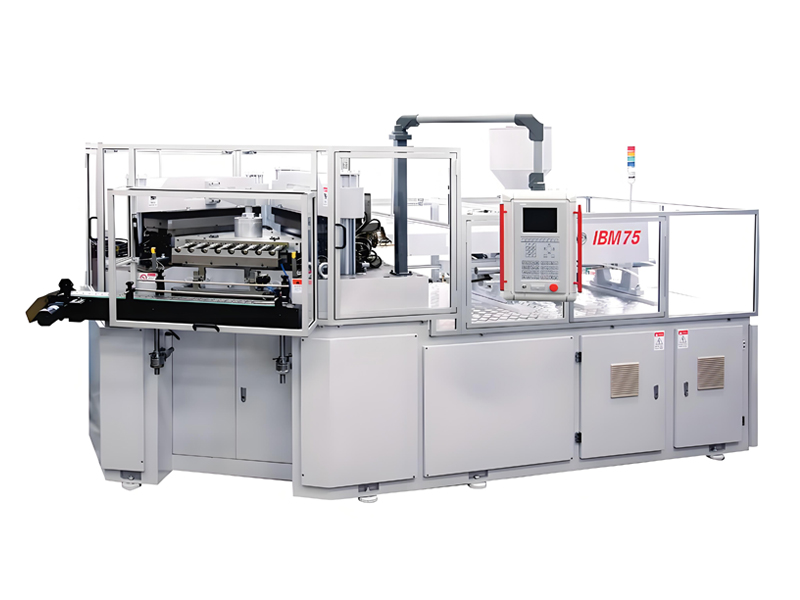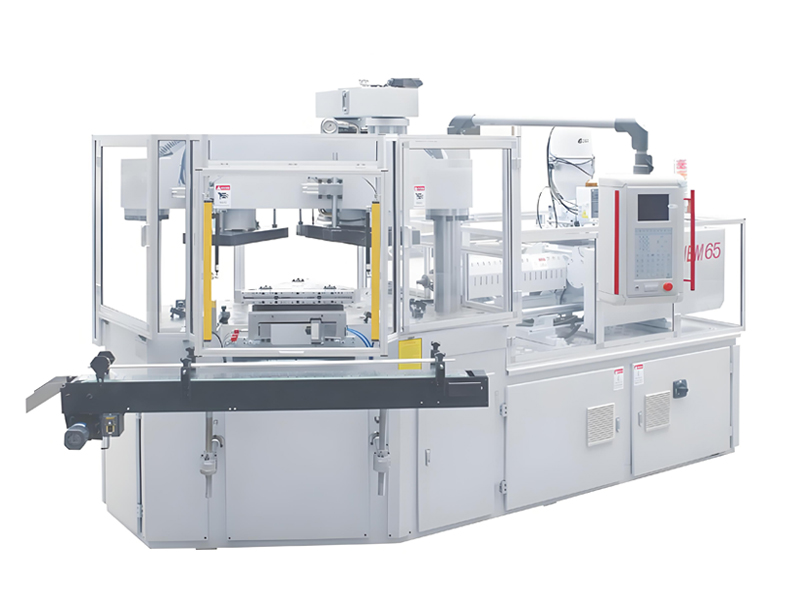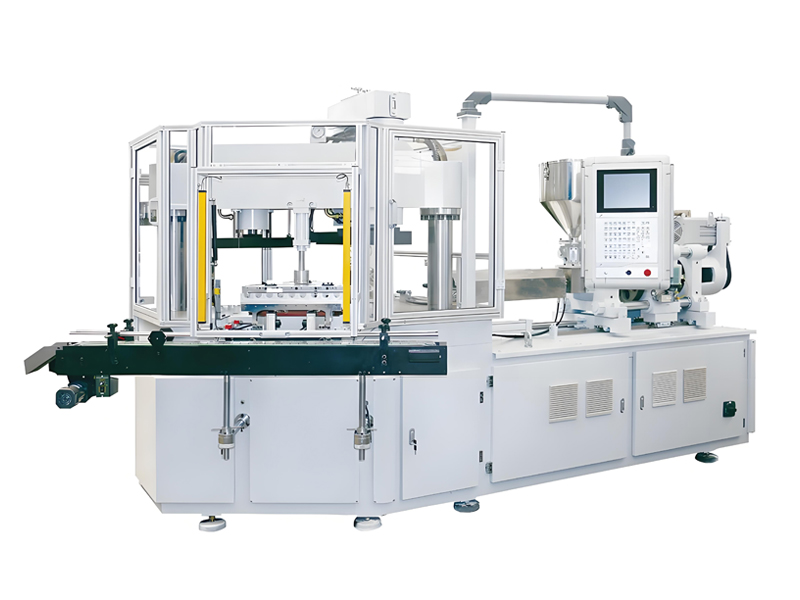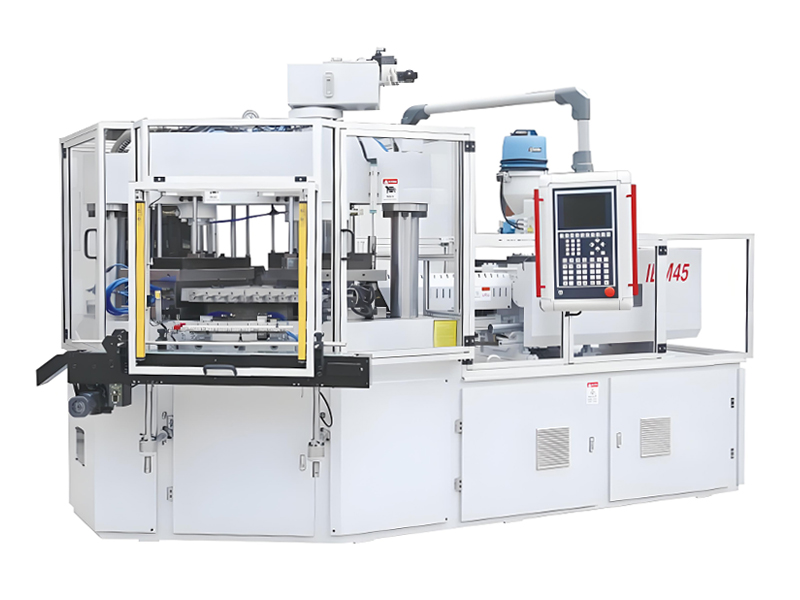
Color consistency is the difference between a premium pharmaceutical, cosmetic, or food container and a rejected lot. On an injection blow molding (IBM) machine, color is not set once and forgotten. It is the outcome of a chain that starts at the masterbatch let-down ratio, passes through the dosing feeder, the barrel temperature profile, the screw mixing action, and the two-stage thermal history of the preform and the blown bottle, and ends at the spectrophotometer on the inspection bench. This article explains how to control color consistency on IBM machines with concrete, plant-ready numbers: CIELAB and ΔE tolerances, masterbatch addition ranges, dosing accuracy, barrel setpoints for PP, HDPE, LDPE, PS, and PET, screw and back-pressure settings, and a statistical process control (SPC) routine that keeps every cavity on target. Aibim, a Wanplas factory, builds IBM75, IBM65, and IBM55 Hybrid electric injection blow molding machines for bottles from 3 mL to 1000 mL, and the guidance below is written for exactly that class of three-station, one-step equipment.
Understanding the Color Difference Quantification System in IBM Production
You cannot control what you cannot measure, and color is measured in a strict, standardized way. The international language of color difference is the CIELAB system, also published as ISO 11664. A color is described by three coordinates: L* for lightness from black (0) to white (100), a* for the green to red axis, and b* for the blue to yellow axis. A white HDPE bottle will show a high L* near 95 to 98, a small positive b* from the natural resin yellowness, and a near-zero a*. A blue masterbatch shifts a* and b* toward negative values. The value that matters to a quality manager is not any single coordinate but the total distance between two colors, written as ΔE.
The classic formula is ΔE*ab, the Euclidean distance in CIELAB space. It is simple and widely understood, but it has a known weakness: it over-penalizes lightness differences and under-weights hue differences at high chroma, so two blues that look clearly different to the eye can report a misleadingly low ΔE*ab. The modern replacement is ΔE00, also called CIEDE2000, defined in the ASTM E308 calculation route and harmonized with ISO 11664. ΔE00 applies weighting functions for lightness, chroma, and hue, plus a rotation term that fixes the blue region where the old formula failed. For colored IBM bottles, ΔE00 is the better acceptance metric, and most premium programs now specify ΔE00 rather than ΔE*ab.
Practical acceptance is graded by where the comparison is made. Within a single production batch, the bottles should be essentially indistinguishable, so the within-batch limit is tight. Between batches made weeks apart, a slightly wider band is realistic because raw material lots and ambient conditions drift. Against the approved customer standard, the band is widest because the standard itself may be an aged physical chip. The table below is a workable grading scheme used by cosmetic and pharmaceutical molders.
Color Acceptance Grading Table
| Comparison Level | Metric | Typical Limit | Tight Program Limit | Notes |
|---|---|---|---|---|
| Within batch (cavity to cavity, bottle to bottle) | ΔE00 | ≤ 0.5 | ≤ 0.4 | Controlled by dosing and barrel stability |
| Between batches (same recipe, different lots) | ΔE00 | ≤ 1.0 | ≤ 0.8 | Controlled by masterbatch lock and resin b* check |
| Versus approved customer standard | ΔE00 | ≤ 1.5 | ≤ 1.2 | Use ISO 105-A02 gray scale for visual backup |
| Yellowness index (white bottles) | YI per ASTM E313 | ≤ 4.0 | ≤ 2.5 | PP long residence degrades gray; watch PET yellowing |
| Hiding power (opacity) | Contrast ratio | ≥ 0.98 | ≥ 0.99 | Thin walls reduce measured contrast ratio |
The instrument itself matters as much as the math. A spectrophotometer measures reflected light across the visible spectrum and computes CIELAB. Two optical geometries dominate. The 45 degree / 0 degree geometry illuminates the sample at 45 degrees and reads the specular-reflected (gloss) component excluded at normal 0 degree viewing; it approximates how the human eye sees a matte or low-gloss bottle and suppresses gloss interference, which is why many molders prefer it for textured or soft-touch cosmetic bottles. The d/8 degree geometry uses a diffuse sphere (integrating sphere) and can include or exclude the specular component; it is the standard for opaque plastics and gives repeatable numbers across glossy and matte surfaces when the specular is excluded. The rule is simple: pick one geometry and lock it. Switching between 45/0 and d/8 between incoming inspection and line audit is a classic source of a false ΔE alarm.
Metamerism is the final measurement trap. Two bottles can match under one light source and diverge under another because their spectral curves cross. A bottle approved under D65 daylight may look off under A (incandescent) or TL84 (retail fluorescent) store lighting. The metamerism index (MI) quantifies this: measure ΔE00 under D65, A, and TL84, and the maximum pairwise difference is the MI. Keep MI at or below 0.5 for cosmetic and retail packaging so the bottle looks right on the shelf, not only in the QC room. For pharmaceutical bottles judged mainly under controlled lighting, MI is less critical, but it is still worth recording.
Masterbatch Let-down Ratio: Coverage, Cost, and Mechanical Trade-offs
The masterbatch let-down ratio is the single biggest lever on color, and also on cost. It is the percentage of color masterbatch by weight in the total blend with natural resin. Too little and the color is weak, the hiding power fails, and the substrate shows through; too much and you pay for pigment you do not need while risking mechanical-property loss, plate-out on the mold, and slower cycle time from higher viscosity. The starting point is the masterbatch supplier recommendation, but the numbers below are the field ranges that work on IBM machines for small precision bottles.
Recommended Masterbatch Addition by Color Family
| Masterbatch Type | Typical Let-down | Coverage Note | Cost Level |
|---|---|---|---|
| General-purpose color | 1 to 4 percent | Standard for most pastel and mid-tone bottles | Medium |
| White (TiO2 based) | 2 to 5 percent | Higher for thin-wall and high opacity needs | Medium to High |
| Black (carbon black) | 1 to 2.5 percent | Carbon black is high tint strength, low addition suffices | Low to Medium |
| Colored (organic pigment) | 1.5 to 4 percent | Bright organics need upper range for depth | High to Very High |
| High-coverage TiO2 system | 3 to 6 percent | Blocks UV and substrate for pharma and personal care | High |
The table above sets the floor and ceiling. The harder decision is the trade-off, because adding more masterbatch is never free. Pigment concentrates displace a small fraction of the base resin, and at high loadings the masterbatch carrier and pigment act as a filler that can lower impact strength and elongation, especially in brittle resins like PS and SAN. Titanium dioxide is a particularly stiff, abrasive filler; pushing white to 5 or 6 percent can raise melt viscosity, increase screw torque, and accelerate barrel and screw wear. The table below frames the trade-off so the color engineer and the tooling engineer can agree on a number.
Addition Level Versus Coverage, Cost, and Property Trade-off
| Let-down | Hiding Power | Color Depth Stability | Mechanical Impact | Material Cost |
|---|---|---|---|---|
| 0.5 to 1 percent | Low (translucent) | Very sensitive to dosing error | Negligible | Low |
| 1 to 2 percent | Moderate | Acceptable with good feeder | Low | Low to Medium |
| 2 to 4 percent | Good to high | Robust for most programs | Low to moderate | Medium |
| 4 to 6 percent | Very high | Forgiving, but watch viscosity | Moderate to high (brittle resins) | High to Very High |
The practical rule for IBM is to set the let-down at the lowest level that still meets the hiding-power and ΔE00 targets, then hold it there with a gravimetric feeder. On a 5 to 50 gram shot, 2 percent masterbatch is only 0.1 to 1.0 gram of pigment per shot; that tiny mass is exactly why dosing accuracy, covered next, dominates the result far more than it would on a multi-kilogram extrusion run.
Dosing Accuracy: Volumetric vs Loss-in-Weight Feeders for Intermittent IBM
Injection blow molding is not a continuous process. The injection unit plasticizes a measured shot, the mold closes, the preform is injected, the index table rotates the preform to the blow station, and the bottle is formed. Color masterbatch is therefore added per shot, not in a steady stream. This single fact changes the entire feeding strategy compared with extrusion compounding, where Wanplas’s Kerke factory supplies twin-screw extruders that take a continuous volumetric or loss-in-weight stream into a steady melt.
A volumetric feeder meters by volume, typically with a rotating auger or vibratory tray, and assumes the bulk density of the masterbatch is constant. Its real-world accuracy is about plus or minus 3 to 5 percent. A loss-in-weight feeder instead sits on a load cell and measures the actual mass leaving the hopper over time, controlling the auger speed to hit a target loss rate; its accuracy is about plus or minus 0.5 percent. The gap is large, and on a small IBM shot it is decisive.
Feeder Technology Comparison for IBM Color Dosing
| Parameter | Volumetric Feeder | Loss-in-Weight Feeder |
|---|---|---|
| Typical accuracy | ± 3 to 5 percent | ± 0.5 percent |
| Measurement basis | Volume (assumes bulk density) | Actual mass on load cell |
| Sensitivity to bulk density | High (pellet size, moisture) | Low |
| Best use on IBM | Dark colors, wide tolerances | Pastels, pharmaceutics, tight ΔE |
| Capital cost | Low | Medium to High |
| Per-shot (batch) dosing | Possible but coarse | Preferred, tightly closed loop |
The core requirement is batch dosing, meaning the feeder must deliver one precisely weighed micro-charge synchronized to each injection shot rather than flow continuously. On modern IBM controls this is done by triggering the gravimetric feeder from the machine cycle: the controller requests a dose, the feeder delivers and confirms the mass, and only then does the injection begin. If the dosed mass deviates beyond a set window, the shot is rejected before it is made. This per-shot confirmation is what brings cavity-to-cavity color under control.
Small shots amplify every error. At a 5 gram shot and 2 percent let-down, the masterbatch portion is 0.1 gram. A volumetric error of plus or minus 4 percent is plus or minus 0.004 gram, which sounds tiny but is plus or minus 4 percent of the color itself, enough to move ΔE by several tenths. Worse, the minimum reliable metering resolution of a coarse auger may be larger than the target dose, so the feeder rounds to the nearest step and the color oscillates shot to shot. A loss-in-weight feeder with fine auger and high-resolution load cell keeps the resolution well below the target, so the color stays put. For reference, a 50 gram shot with the same 2 percent still only carries 1 gram of masterbatch, so even at the upper end of the IBM shot range the color mass remains small and the dosing precision requirement stays strict.
The hopper and the mixing must also be considered. On IBM, the natural resin and the masterbatch are usually blended in a hopper mixer or dosed side by side into the throat. A hopper mixer with too long a residence time allows segregation, because masterbatch pellets often differ in size and bulk density from the natural resin; the finer or denser fraction migrates to the center or the wall, and the last bottles of a run come out different from the first. Keep hopper residence short, use a masterbatch matched in pellet size to the base resin, and prefer a gravimetric side-dosing arrangement where the masterbatch is metered directly at the throat over a pre-blended gaylord. For white and TiO2-heavy systems, which are abrasive and tend to segregate, side dosing with a loss-in-weight feeder is strongly recommended.
Barrel Temperature Profiles and Screw Configuration for Uniform Color
Even a perfectly dosed masterbatch will look inconsistent if the melt is not homogenized. Color uniformity in IBM is built in the barrel, where the screw must melt, mix, and disperse the pigment into a single-phase melt before the preform is injected. Temperature, screw geometry, back pressure, and screw speed all act together, and the operator tunes them as one system.
The barrel is divided into zones from feed to nozzle. Each resin has a working window, and the zones are set as a gentle gradient that rises toward the nozzle so the melt stays fluid and fully plasticized without overheating. The nozzle is run 5 to 10 degrees C above the final zone to prevent freeze-off at the gate. The table below lists the standard windows for IBM-grade resins. Note that PET here means an IBM or ISBM preform grade that is dried and processed hot; PET is the most heat-sensitive for color because it yellows quickly.
Barrel Temperature Windows by Resin
| Resin | Barrel Zone Range (°C) | Nozzle Above Last Zone | Color Risk if Off-Window |
|---|---|---|---|
| PP | 190 to 230 | + 5 to 10 °C | Long residence degrades gray; low temp un-melts pigment |
| HDPE | 180 to 215 | + 5 to 10 °C | Shear burn at high end, streaks at low end |
| LDPE | 170 to 200 | + 5 to 10 °C | Narrow window; easy to over-shear |
| PS | 200 to 240 | + 5 to 10 °C | Brittle; yellowing and plate-out if too hot |
| PET | 265 to 285 | + 5 to 10 °C | > 6 min residence yellows; acetaldehyde rises |
The screw is the mixing engine. IBM injection screws typically run a length-to-diameter ratio (L/D) of 20:1 to 24:1, shorter than a compounding screw because the shot is small and the cycle is fast. The compression ratio, the ratio of feed-channel depth to metering-channel depth, is usually 2.5 to 3.2; a higher compression ratio increases shear and therefore dispersion, which helps pigment breakdown, but it also raises melt temperature and shear heating. For masterbatch-heavy or TiO2-heavy jobs, bias toward the upper compression ratio and add a dedicated mixing element.
The mixing head, often a Maddock mixing element or a similar fluted mixing section near the screw tip, is where the final homogenization happens. A Maddock element forces the melt through restrictive lands and relaxes it repeatedly, wiping out temperature and composition gradients that a simple metering section leaves behind. For color work it is close to mandatory: without it, you see streaks and shade bands along the bottle. On Aibim machines the screw design is optimized for the small shot and short residence of IBM, and the mixing head is selected to match the let-down and resin viscosity.
Back pressure is the operator’s daily tuning knob for color. Raising back pressure during plasticizing slows the screw return and increases the shear work done on the melt, which improves pigment dispersion and tightens shade. The working range is about 3 to 10 bar. Too low, and the masterbatch stays as poorly wetted clusters that read as specks or light streaks. Too high, and the extra shear generates heat that pushes the melt above the safe window, risks degradation, lengthens the plasticizing time, and can darken the color through thermal history. The curve is therefore an inverted-U: raise back pressure until streaks disappear and shade stabilizes, then stop. A good starting point is 5 to 6 bar for PP and HDPE, 4 to 5 bar for LDPE, and 6 to 8 bar for PS and PET where dispersion demand is higher.
Screw rotation speed sets both output and shear heat. The IBM range is roughly 60 to 120 rpm. Higher rpm plasticizes faster but generates more viscous heating and can overload the mixing head, while lower rpm gives more residence for homogenization at the cost of cycle time. For color-critical runs, favor the lower-to-middle of the range (60 to 90 rpm) so the melt sees steady shear rather than spikes. The companion variable is residence time, the time the melt spends hot in the barrel. PET must stay under about 6 minutes total thermal exposure or it yellows and loses intrinsic viscosity; PP tolerates more but prolonged residence at temperature degrades and the bottle reads gray. Manage residence by matching shot size, screw recovery, and cycle time so the melt is used promptly rather than cooked.
IBM-Specific Color Challenges: Dual Heat History, Wall Thickness, Cavity Variation
Injection blow molding has a color difficulty that extrusion blow molding and most injection molding do not: the article sees two separate thermal cycles. First the preform is injection molded in the injection station, where the masterbatch is dispersed and the base shade is set. Then the preform is conditioned and blown at the blow station, where it is reheated or held and expanded against a cold mold. Each thermal pass can shift the color slightly, and the two passes together define the final bottle shade. A preform that looks perfect can blow into a bottle that is a touch lighter or darker simply because of the second heat history, so color must be judged on the finished bottle, never on the preform alone.
Wall thickness is the next trap. The bottle wall is not uniform. The body is blown thin, the shoulder transitions, and the neck and base are thick. Thin walls carry less pigment mass per unit area, so their hiding power drops and the natural resin or any background shows through, making the thin body read lighter than the thick neck. This is not a dosing error; it is physics. The control is twofold: keep the masterbatch let-down in the upper part of the recommended range for thin-wall jobs, and control the wall-thickness distribution so the thinnest section still clears the hiding-power target. A contrast ratio of 0.98 or better is the usual proof that even the thinnest area is opaque.
Multi-cavity tools add cavity-to-cavity variation. An IBM machine with an eight- or twelve-cavity mold injects a preform into each cavity through its own gate. If the manifold temperature is not balanced, or if gate sizes and cooling differ by a few percent, each cavity sees a slightly different shear and thermal history, and the bottles come off with a small cavity-to-cavity ΔE. The index table makes this worse if its stations are not at uniform temperature: a preform sitting in a cooler conditioning station enters the blow stage differently from one in a warmer station. The remedy is to balance manifold and mold temperatures, verify gate diameters, and, during setup, sample every cavity and measure each one rather than trusting a single bottle.
Key point: on a multi-cavity IBM line, the tightest color control comes from measuring one bottle from every cavity on every setup and plotting them together. A single sampled bottle can hide a cavity-to-cavity ΔE that a customer will see across a display pack.
These IBM-specific effects explain why a color that was stable on a single-cavity sampling device can drift on a production multi-cavity machine. They also explain why the dosing and barrel discipline in the earlier sections is not optional: any variation you allow upstream is multiplied by the two heat histories and the wall-thickness gradient downstream.
Batch-to-Batch Consistency Management
Consistency across a single shift is one thing; consistency across months of production is the real test. The discipline that delivers it is batch management of the inputs.
First, lock the masterbatch. Buy masterbatch against a fixed pigment formulation, assign each delivery a lot number, and retain a sealed sample of every lot. When a lot is approved, record its measured L*a*b* and use that as the reference for the run. Do not mix two masterbatch lots in one job without re-measuring; even two lots of the same color code from the same supplier can differ by a few tenths of ΔE, enough to breach a tight program. If a lot change is forced, requalify the color on the actual IBM machine, not only on a lab mixer.
Second, control the natural resin background. Natural, unpigmented PP is not colorless; its b* (yellow-blue axis) typically ranges from about 0.5 to 2.5 depending on grade and antioxidant package. That background yellowness shifts the final shade of a white or pastel bottle. Measure the b* of every resin lot on incoming inspection and flag lots outside the agreed band, because a high-b* resin with a low let-down white will read cream rather than pure white. The resin supplier’s lot certificate is a starting point, not a substitute for your own spectro check.
Third, manage regrind. Clean in-house regrind from the same color and resin can be blended back at 0 to 20 percent without a major shade shift, and doing so lowers material cost. Above 20 percent, or with mixed colors, the background shifts and metamerism risk rises. Lock the regrind percentage in the recipe, keep the regrind the same color as the virgin, and re-measure ΔE after any change. Never blend regrind from a different pigment family into a colored job; the result is a muddy, drifting shade that no barrel setting can fix.
Fourth, control color changes. When switching from one color to another, purge the barrel with a dedicated purging compound or natural resin until the old pigment is gone. Judge cleanliness by pulling a strand or short shot and measuring it, not by eye alone; a faint residual can survive several shots and then appear as a streak in a customer lot. Document the purge quantity and the acceptance ΔE so the next changeover is repeatable. Aibim machines support recipe storage on an SD card, so a qualified color recipe including purge volume can be reloaded exactly across machines and shifts.
Troubleshooting Matrix for Color Defects
When a shade goes wrong, the fastest path back to spec is a structured matrix that links the symptom to the cause, the check, the fix, and the verification. The table below covers the six common IBM color defects.
Color Defect Troubleshooting Matrix
| Symptom | Possible Causes | Check Points | Adjustment | Verification |
|---|---|---|---|---|
| Light color (weak) | Low masterbatch, feeder under-dose, high regrind, thin wall | Feeder mass per shot, regrind %, wall map | Raise let-down, recalibrate feeder, lower regrind | ΔE00 vs standard ≤ 1.5, contrast ratio ≥ 0.98 |
| Dark color (heavy) | Over-dose, masterbatch lot stronger, low base resin | Feeder mass, masterbatch lot L*a*b*, shot weight | Lower let-down, requalify lot, check shot | ΔE00 vs standard, repeat per cavity |
| Streaks | Poor dispersion, low back pressure, no mixing head, cold barrel | Back pressure, barrel zones, screw type | Raise back pressure 5 to 8 bar, raise zone 5 to 10 °C, add mixing head | Visual plus spectro scan along bottle |
| Spots (specks) | Agglomerated pigment, contamination, degraded masterbatch | Masterbatch sieve, hopper cleanliness, residence | Sieve masterbatch, clean hopper, reduce residence | Microscope count, spectro spot check |
| Cavity-to-cavity ΔE | Unbalanced manifold, gate variance, station temp spread | Per-cavity ΔE map, gate diameters, station temps | Balance manifold, equalize gates, tune index table | Sample every cavity, within-batch ΔE ≤ 0.5 |
| Batch-to-batch drift | Resin b* shift, masterbatch lot change, ambient swing | Resin b*, masterbatch lot, retained samples | Lock lots, control resin b*, reload recipe | Between-batch ΔE00 ≤ 1.0 vs retained |
Use the matrix as a live checklist, not a post-mortem. When a defect appears, work top to bottom: confirm the feeder mass first (most defects start there), then barrel and screw, then cavity balance, then input lots. Verifying with the spectrophotometer at each step prevents the common mistake of changing three things at once and never learning which one worked.
In-Process Inspection and Statistical Process Control
Measurement discipline turns a capable machine into a consistent process. The routine below is sized for pharmaceutical and cosmetic IBM lines where the customer audits the data.
Take a first-article measurement at setup on a conditioned, fully cooled bottle, using the locked spectrophotometer geometry and the three light sources D65, A, and TL84. Record L*a*b*, ΔE00 versus the standard, YI, and contrast ratio. Only release the run when all are in band. During production, sample at least every 30 to 60 minutes and, on multi-cavity tools, pull one bottle from every cavity on each check so cavity-to-cavity drift cannot hide. Plot ΔE00 on a control chart with the center line at the standard and action limits at the within-batch and between-batch bands.
Inspection Frequency and SPC Targets
| Activity | Frequency | Sample | Target |
|---|---|---|---|
| First-article check | Every setup | Conditioned bottle | ΔE00 ≤ 1.5 vs standard |
| Routine in-process check | Every 30 to 60 min | One per cavity | Within-batch ΔE00 ≤ 0.5 |
| Process capability | Per shift or lot | Charted ΔE00 | Cpk ≥ 1.33 |
| Opacity check | Per setup, then daily | Thinnest wall area | Contrast ratio ≥ 0.98 |
| Yellowness check | Per setup, then daily | White and clear bottles | YI per ASTM E313 ≤ 4.0 |
| Retained sample archive | Per lot | Sealed, labeled | Agreed customer period |
The capability index ties it together. Cpk at or above 1.33 means the process spread is small enough that, even with normal variation, the shade stays inside the tolerance band with comfortable margin. If Cpk falls below 1.33, the process is not capable and the answer is not to tighten the spec but to fix the input: better dosing, balanced cavities, or locked lots. Whiteness and yellowness indexes per ASTM E313 catch the subtle graying and yellowing that overall ΔE can miss on near-white bottles, and the contrast ratio confirms hiding power where walls are thin.
The standards that frame this work are, as plain text, ASTM D2244 for color tolerances and calculation of color differences, ASTM E308 for computing color values from spectral data, ISO 11664 for the CIELAB system, ISO 105-A02 gray scale for visual shade grading, and ASTM E313 for yellowness and whiteness indexes. None of these are links; they are the references your QC report should cite so the data is defensible in a customer audit.
Operator Workflow and Aibim Machine Capabilities
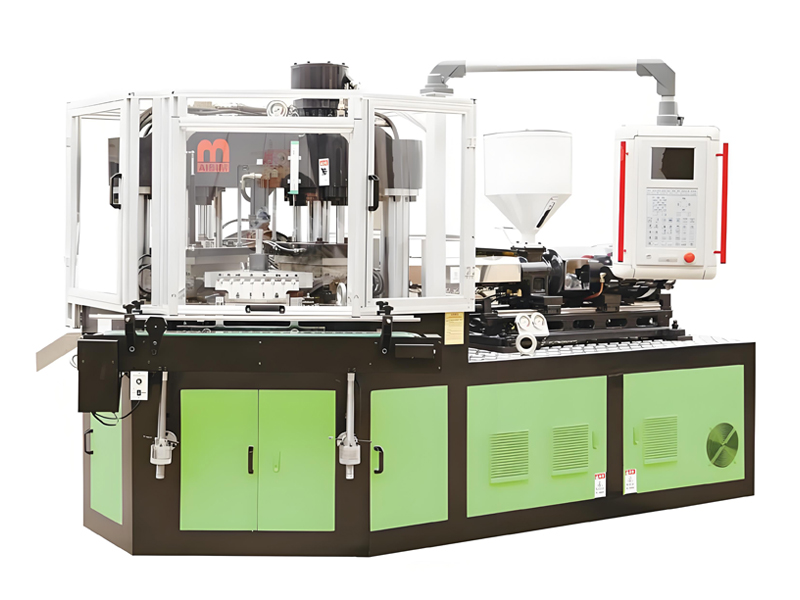
Putting the above into a repeatable routine is what separates a one-off good bottle from a year of good bottles. On Aibim IBM machines, the three-station, one-step design means injection, conditioning, and blow happen on one index table, which keeps the dual heat history tight and repeatable once stations are balanced. The IBM75, IBM65, and IBM55 Hybrid electric models cover the 3 mL to 1000 mL precision-bottle range for pharmaceutical, food, drink, and cosmetic customers, and they share the Wanplas brand quality standards and after-sales policy, including an annual free spare-parts allowance and on-site installation support.
A practical setup sequence reads as follows. Lock the masterbatch and resin lots and record their L*a*b*. Set the gravimetric feeder for batch dosing at the agreed let-down, confirm the per-shot mass, and run a short purge. Set the barrel zones to the resin window from the table, with the nozzle 5 to 10 degrees C above the last zone. Select a screw with L/D 20:1 to 24:1, compression ratio 2.5 to 3.2, and a Maddock mixing head; start back pressure at 5 to 6 bar for polyolefins or 6 to 8 bar for PS and PET. Run screw speed in the 60 to 90 rpm band and tune residence so PET stays under 6 minutes. Inject the preform, blow, and measure the first article on the locked spectrophotometer at D65, A, and TL84. Sample every cavity, plot ΔE00, and only then release. Through the run, re-check every 30 to 60 minutes and reload the saved recipe from the SD card on shift change so the color settings are identical shift to shift.
Aibim’s PREFILL hydraulic technology and variable displacement pump reduce energy use by at least 35 percent compared with conventional fixed-pump systems, and the stable, closed-loop hydraulic and control platform helps hold barrel and station temperatures steady, which is exactly what color consistency needs. For electric precision, the IBM55 Hybrid pairs servo axes with the same three-station process, giving fine control of recovery and back pressure that further tightens shade. For masterbatch supply, note that Wanplas’s Kerke factory builds the twin-screw compounding extruders used to manufacture the color and filler masterbatches themselves, while Wanplas’s Apollo factory serves extrusion blow molding and YuDa factory serves PET stretch blow molding; together the Wanplas network covers the full bottle-production spectrum, but for small precision IBM bottles Aibim is the specialist.
The most common mistake plants make is treating color as a dosing-only problem. It is not. Dosing sets the target, but the barrel temperature profile, the screw mixing head, the back pressure, the two heat histories, the wall-thickness gradient, and the cavity balance all decide whether the bottle actually lands on that target. Control them as one system, measure with a locked spectrophotometer and ΔE00, and hold Cpk at or above 1.33, and color consistency on IBM machines becomes routine rather than luck.
Frequently Asked Questions
What is an acceptable ΔE value for colored IBM bottles?
Most pharmaceutical and cosmetic IBM programs accept within-batch ΔE at or below 0.5, between-batch ΔE at or below 1.0, and ΔE versus the approved customer standard at or below 1.5. Tighter programs use ΔE00 and hold within-batch values under 0.4. The exact band should be written into the color specification agreed with the customer before production starts.
Why is a loss-in-weight feeder better than a volumetric feeder for masterbatch on IBM machines?
IBM is an intermittent, shot-by-shot process. A volumetric feeder delivers by volume with typical accuracy of plus or minus 3 to 5 percent, which at a 5 to 50 gram shot magnifies color variation. A loss-in-weight feeder weighs the actual dosed mass and controls to plus or minus 0.5 percent, dramatically reducing cavity-to-cavity and batch-to-batch color drift.
How do barrel temperature settings affect masterbatch dispersion?
Each resin has an optimal barrel window: PP 190 to 230 degrees C, HDPE 180 to 215 degrees C, LDPE 170 to 200 degrees C, PS 200 to 240 degrees C, PET 265 to 285 degrees C. A stable gradient plus a nozzle 5 to 10 degrees C above the final zone keeps melt viscosity uniform, which lets the mixing head and back pressure disperse the masterbatch consistently.
Why do thin wall sections look lighter than thick sections on the same IBM bottle?
Thin walls carry less pigment mass per unit area, so opacity and hiding power drop and the substrate shows through, making the bottle appear lighter. The neck and base typically read darker because they are thicker. Control wall-thickness distribution and keep masterbatch let-down in the upper part of the recommended range for thin-wall jobs.
What causes cavity-to-cavity color difference on a multi-cavity IBM machine?
The index table moves the preform through injection, conditioning, and blow stations. If station temperatures differ, or if cavity gates and cooling vary, each cavity sees a slightly different thermal and shear history. That produces cavity-to-cavity ΔE. Balance manifold and mold temperatures, verify gate sizes, and sample every cavity during setup.
How much regrind can I add without shifting the color?
For most IBM color programs, 0 to 20 percent clean in-house regrind is tolerable if the regrind is the same color and resin. Above 20 percent, or with mixed colors, the background shifts and metamerism risk rises. Lock the regrind percentage per recipe and re-measure ΔE after any change.
How often should color be checked during an IBM production run?
Take a first-article measurement at setup, then sample at least every 30 to 60 minutes and pull one bottle from every cavity on multi-cavity tools. Plot ΔE on a control chart, target Cpk at or above 1.33, and retain archived samples for the agreed customer period.
Which standards apply to color measurement of plastic bottles?
Key references are ASTM D2244 for color tolerances, ASTM E308 for calculation of color from spectral data, ISO 11664 for the CIELAB system, ISO 105-A02 gray scale for visual shade grading, and ASTM E313 for yellowness and whiteness indexes.
Conclusion
Color consistency on injection blow molding machines is an engineered outcome, not a happy accident. It begins with a masterbatch let-down chosen at the lowest level that still meets hiding power and ΔE00 targets, is protected by a loss-in-weight feeder running per-shot batch dosing, and is finalized in the barrel through a resin-specific temperature profile, a mixing-head screw, and disciplined back pressure. The IBM-specific realities of a two-stage heat history, a wall-thickness gradient, and cavity-to-cavity variation then demand measurement on the finished bottle with a locked spectrophotometer geometry and a metamerism check under D65, A, and TL84. Manage lots, resin background, regrind, and purge as a system, and verify with a control chart that holds Cpk at or above 1.33. Aibim, a Wanplas factory, builds the IBM75, IBM65, and IBM55 Hybrid electric machines and the process stability features, including PREFILL hydraulics and SD-card recipe storage, that make this routine achievable on precision bottles from 3 mL to 1000 mL. With the numbers in this article as your baseline, color becomes a controlled variable you can defend in any customer audit.