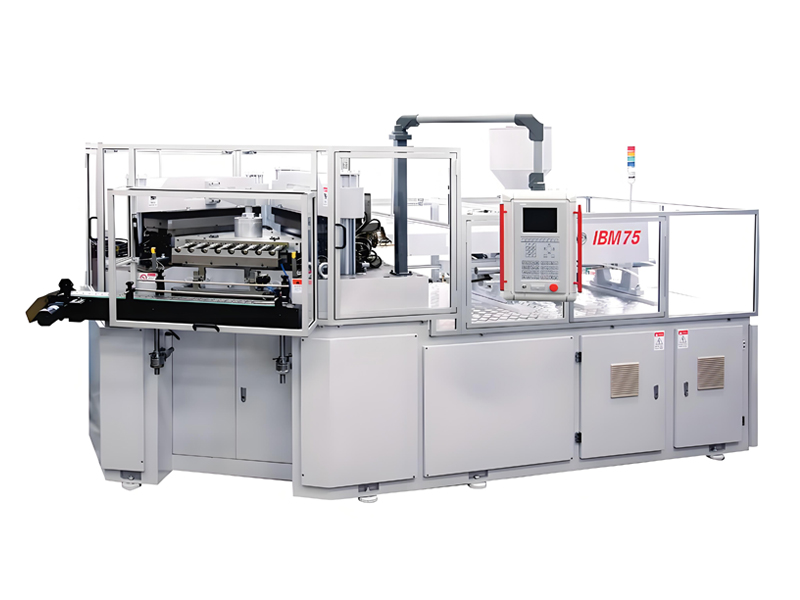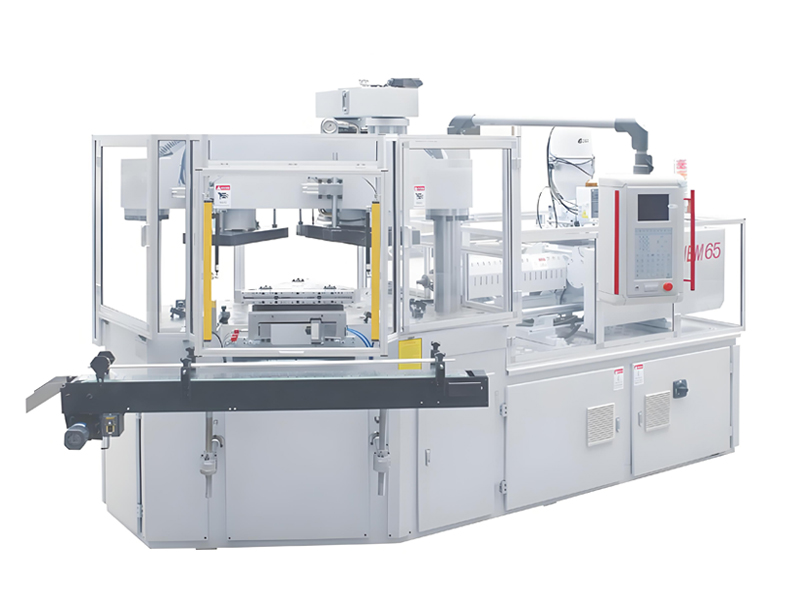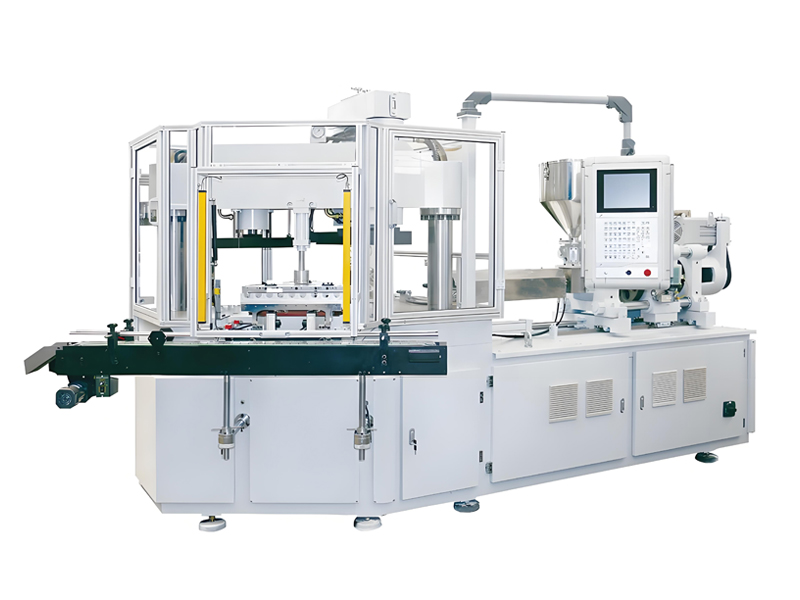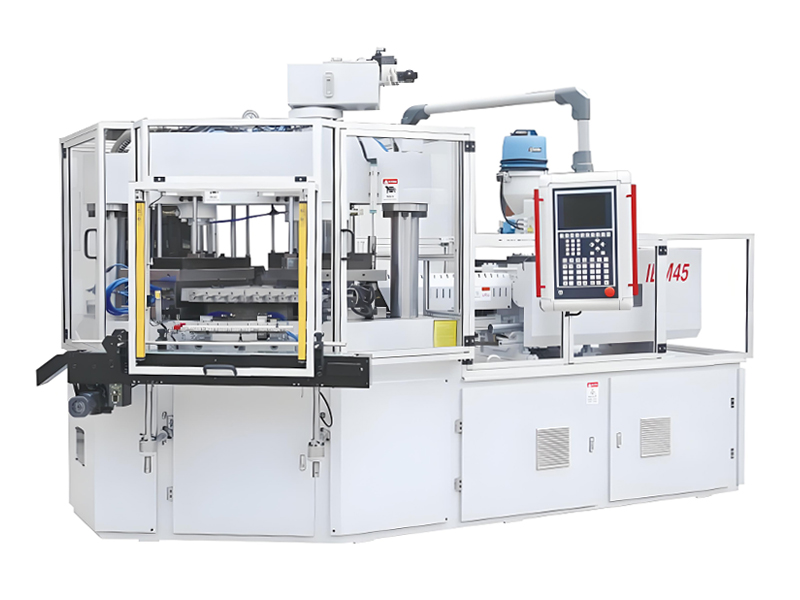
Picking between injection blow molding and injection stretch blow molding is less about which machine is “better” and more about which physics your bottle needs. Both start by injecting molten plastic, but only one of them stretches the material to align its molecules. That single difference decides clarity, strength, barrier, weight, and which resin makes sense. Injection blow molding (IBM) forms the container by blowing a parison with compressed air, with no stretching. Injection stretch blow molding (ISBM) adds a stretch rod that pulls the preform lengthwise while air blows it outward, creating biaxial orientation. Aibim, a Wanplas factory, builds both routes into its IBM75, IBM65, and IBM55 Hybrid electric machines for containers from 3ml to 1000ml. This article maps the real application-scenario differences between IBM and ISBM so a buyer can match process to product with confidence in 2026.
What Is Injection Blow Molding (IBM)?
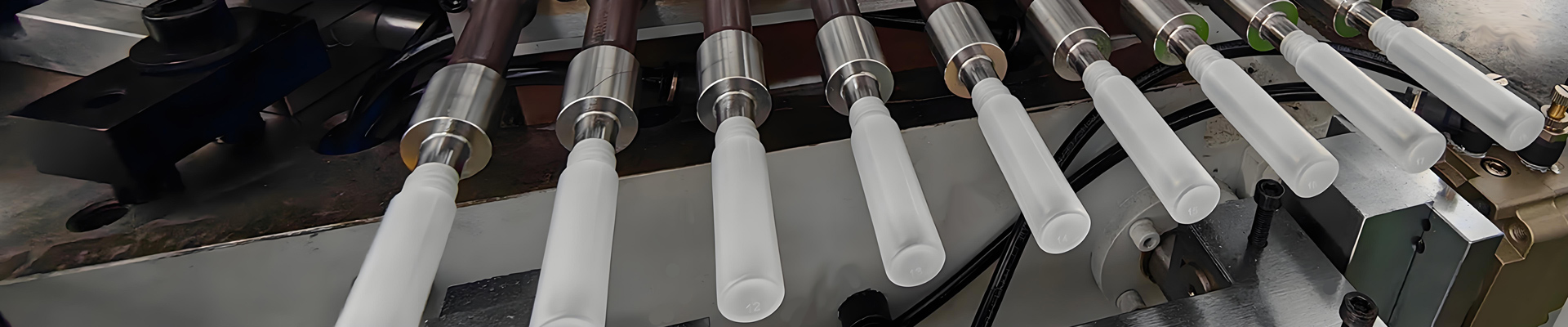
Injection blow molding is a hollow-container process in which a parison is first injection molded around a core rod, then transferred to a blow station where compressed air expands it against a cooled cavity. The key point is that the parison is shaped only by air pressure; there is no mechanical stretching of the polymer. The result is a container whose molecules are essentially in their molded, unoriented state.
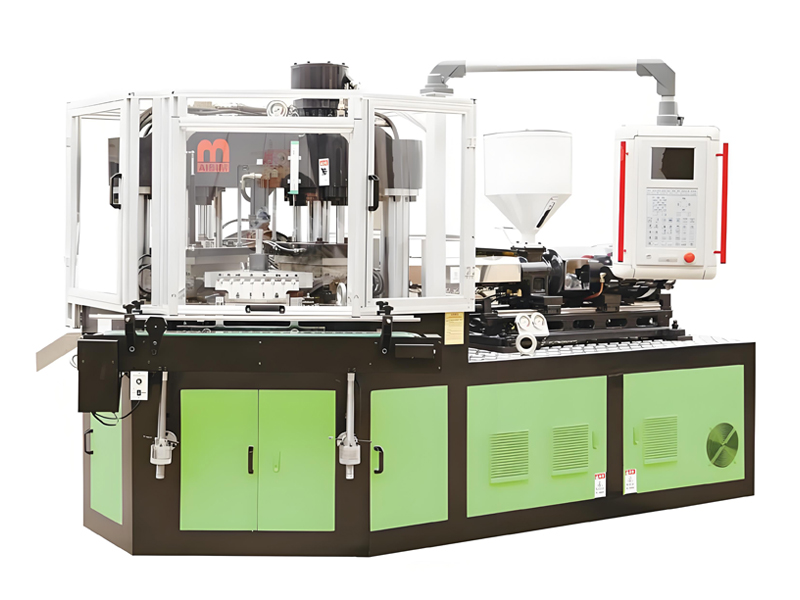
Aibim’s three-station one-step IBM machine performs this in a single integrated frame. At station one the parison with finished neck and thread is injected; at station two it is blown; at station three it is stripped. Because the neck is injection molded, it carries sharp, flash-free threads and accurate sealing surfaces. The absence of stretching means IBM is forgiving across many resins that do not stretch-orient well, including PE, PP, PS, ABS, SAN, TPU, PC, and PCTG.
IBM’s strength is dimensional control and material flexibility rather than thin-wall lightweighting. A pharmaceutical dropper bottle in PP, a cosmetic jar in PCTG, or a food container in HDPE all benefit from IBM’s precise neck and its freedom from a stretch step that could distort a non-orienting resin. Aibim reinforces this with its PREFILL hydraulic system and, on the IBM55 Hybrid electric, a hybrid electric drive, while CE-certified safety sensing at the stripper station and a light curtain protect operators.
Operationally, IBM is a closed thermal loop: the parison stays warm from injection to blow, so no reheat oven is needed and energy is not spent reheating a cold preform. Aibim’s PREFILL and variable-displacement pump technology cuts total energy consumption by at least thirty-five percent versus a fixed pump. For producers whose value lies in precision, hygiene, and resin variety, IBM is the natural default.
IBM also suits products where a slightly heavier, unoriented wall is an advantage rather than a penalty. Drop-resistant pharmaceutical and laboratory bottles, for instance, benefit from the toughness of an unoriented PE or PP wall that absorbs impact without the directional weakness a poorly controlled orientation step could introduce. Because there is no stretch rod to coordinate, the process is mechanically simpler and easier to validate, which matters when a container must clear regulatory expectations for food or pharmaceutical contact. Aibim’s CE-certified safety systems and the Wanplas brand’s documented quality standards give buyers the traceability such programs require.
What Is Injection Stretch Blow Molding (ISBM)?
Injection stretch blow molding begins like IBM—a preform (often with a finished neck) is injection molded—but then adds a decisive second action: a stretch rod extends axially into the heated preform while blow air expands it radially. The combination of longitudinal pull and radial expansion produces biaxial orientation, aligning polymer chains in two directions. That orientation is what gives the finished bottle its high strength-to-weight ratio, sparkling clarity, and low gas permeability.
ISBM is most famously the technology behind PET bottles for water, carbonated soft drinks, juices, edible oil, and personal-care liquids. PET responds to biaxial stretching by crystallizing and orienting in a way that transforms a soft preform into a rigid, clear, pressure-worthy bottle. The same principle is applied to some PP and specialty clarified resins where heat-setting or orientation brings specific benefits.
ISBM can be executed in one-step (preform made and stretched in one integrated machine) or two-step (preform injected, conditioned, then reheated and stretch-blown, often on separate equipment). Aibim designs injection (stretch) blow molding machines that cover both IBM and ISBM needs, so a buyer can standardize on one supplier and one control philosophy across a mixed product portfolio. This flexibility is valuable when a plant runs PET beverage bottles alongside PP or PE precision containers.
The physics matters for selection. Without stretching, a PET bottle would be soft, hazy, and unable to hold carbonation. With stretching, the same gram weight of PET becomes a bottle that survives filling, stacking, and shelf life while using less material. ISBM therefore dominates applications where lightweighting, clarity, and barrier are commercial necessities rather than nice-to-haves.
Stretch ratio control is the engineer’s main lever in ISBM. The longitudinal stretch set by the rod and the radial expansion set by blow pressure together define how much the polymer chains align, which in turn sets clarity, top-load, and barrier. Too little stretch leaves haze and weakness; too much can whiten the material or thin the base. Aibim’s enlarged mold-setting space and single-crossbeam, double-pole clamping framework hold the preform and cavity in precise registration so the stretch is repeatable bottle to bottle, and the SD-card recipe stores the exact rod-and-air profile so a validated bottle can be reproduced on any machine in the fleet without re-deriving the window.
Head-to-Head Comparison
The table below contrasts IBM and ISBM on the attributes that decide application fit. Read it alongside the scenario sections that follow.
Comparison Matrix: IBM vs ISBM
| Attribute | Injection Blow Molding (IBM) | Injection Stretch Blow Molding (ISBM) |
|---|---|---|
| Stretching step | None (air only) | Axial rod + radial blow (biaxial) |
| Molecular orientation | Unoriented | Biaxially oriented |
| Primary resins | PE, PP, PS, ABS, SAN, TPU, PC, PCTG | PET dominant; some PP/specialty |
| Clarity | Resin-dependent, often translucent | High (especially PET) |
| Top-load / pressure strength | Good for non-pressurized | High, suits carbonation |
| Gas barrier | Resin-dependent | Improved by orientation |
| Lightweighting potential | Moderate | High |
| Neck and thread quality | Injected, precise | Injected, precise |
| Best container types | Pharma, cosmetic, food, drink small bottles | Beverage, water, juice, oil, CSD bottles |
| Energy profile (one-step) | Lower (no reheat) | Lower in one-step; higher in two-step reheat |
Process. IBM is simpler: inject parison, blow, strip. ISBM adds the stretch-rod motion and, in two-step form, a reheat oven. The extra step is the source of ISBM’s performance but also of its resin focus.
Material versatility. IBM is the broader platform because it does not rely on a resin’s ability to orient. Aibim runs PE, PP, PS, ABS, SAN, TPU, PC, and PCTG on IBM. ISBM is optimized for PET and a handful of stretch-friendly resins, so its material range is narrower by design.
Part performance. For non-pressurized, precision containers, IBM delivers everything required: accurate neck, clean finish, chemical resistance. For carbonated or clarity-critical bottles, ISBM’s orientation is non-negotiable. Neither is “stronger” in absolute terms; each is stronger for its target duty.
Production economics. One-step IBM avoids reheat energy and keeps a compact footprint. One-step ISBM shares that advantage for in-machine stretching, while two-step ISBM pays the reheat tax that two-step routes always carry. Aibim’s machines manage both within one control philosophy, which simplifies training and spare-parts planning for mixed lines.
Throughput and OEE Considerations
Overall equipment effectiveness looks different for the two routes. IBM concentrates the cycle in one integrated frame, so losses are visible in a single monitored system and easier to act on. One-step ISBM shares that concentration, while two-step ISBM splits OEE across preform injection and stretch-blow lines, meaning a stoppage in either stage drains buffers before output recovers. For a plant balancing mixed IBM and ISBM jobs, standardizing on Aibim’s injection (stretch) blow molding platform keeps one training curriculum, one spare-parts family, and one recipe format, which raises effective OEE simply by removing the overhead of running two unrelated machine cultures on the same floor.
Process and Mold Structure Differences
The mold and core-rod system differ in one crucial component: the stretch rod. In IBM, the core rod carries the parison and the blow air does all the shaping. In ISBM, a stretch rod enters the preform before or during blow, lengthening it while air presses it outward; the mold must accommodate both the rod motion and the preform’s expansion without marking the part.
The table below captures the structural distinction.
Mold and Flow Structure Comparison
| Element | IBM | ISBM |
|---|---|---|
| Core rod | Shapes and carries parison | Carries preform; stretch rod adds axial pull |
| Stretch mechanism | None | Axial stretch rod + radial blow |
| Orientation | Not created | Biaxial, controlled by rod and air |
| Preform temperature | Warm from injection (one-step) | Reheated to stretch window (two-step) or warm (one-step) |
| Blow cavity design | Shapes by air pressure | Shapes by stretch + air, tuned for orientation |
| Typical resin focus | Broad thermoplastic range | PET-centric |
For buyers, the structural takeaway is that ISBM demands tighter thermal and mechanical coordination—the stretch must happen within a narrow temperature window or the bottle gains haze, neck deformation, or weak spots. Aibim’s single-crossbeam, double-pole clamping framework and enlarged mold-setting space give the alignment needed for stable ISBM, while SD-card parameter storage lets a tuned stretch-and-blow recipe move cleanly from one machine to another.
Material Compatibility and Orientation
Whether a resin benefits from stretching decides which process fits. PET is the champion of orientation; PE and PP orient poorly in the same sense and usually do not need to; specialty resins like PCTG and PC have their own clarity story without stretching. The table below maps common resins to the better-suited process.
Material Suitability: IBM vs ISBM
| Resin | IBM fit | ISBM fit | Guidance |
|---|---|---|---|
| PET | Possible | Excellent | Use ISBM for bottles, IBM only for non-oriented PET parts |
| PP | Excellent | Good (specialty) | IBM default; ISBM for heat-set PP where needed |
| HDPE / LDPE / LLDPE | Excellent | Limited | IBM preferred for squeeze and chemical bottles |
| PS | Excellent | Limited | IBM for clarity-stiff cosmetic and food pots |
| PC / PCTG | Good | Possible | IBM for premium cosmetic jars; clarity without stretch |
| ABS / SAN | Good | Rare | IBM for engineering-look containers |
| TPU | Good | Rare | IBM for flexible specialty packs |
The practical rule: if the product’s value depends on biaxial orientation—carbonation resistance, sparkling clarity, or minimal weight—ISBM with PET is the answer. If the value depends on neck precision, chemical resistance, or a resin that does not orient, IBM covers more of the need on one machine. Aibim’s ability to run both on the IBM75, IBM65, and IBM55 Hybrid electric makes it straightforward to keep a mixed portfolio on one supplier’s platform.
Application Scenarios by Industry
The clearest way to choose is by end-use scenario. Each industry leans toward one process for concrete reasons.
Pharmaceutical. IBM leads for medicine bottles, droppers, and diagnostic containers. The injected neck gives tamper-evident, dimensionally exact closures, and the minimal handling path supports clean, documented production. ISBM is used only when a PET pharma bottle needs clarity or barrier that orientation provides. Aibim’s CE-certified safety and Wanplas quality standards align with validated pharma lines.
Cosmetic and personal care. IBM suits jars, cream pots, and precise dispenser bottles in PP, PS, PC, or PCTG where surface finish and thread accuracy matter more than carbonation. ISBM appears for clear PET personal-care bottles where shelf appeal demands sparkle and light weight. Both routes coexist in a typical cosmetic plant, which is why Aibim’s dual-capability machines fit well.
Beverage. ISBM is the default for water, carbonated soft drinks, juices, teas, and sports drinks in PET. Biaxial orientation delivers the pressure resistance and clarity that filling lines and consumers expect, plus the lightweighting that lowers freight and resin cost. IBM is the wrong tool for carbonated PET because it cannot create the orientation that holds CO2.
Food and edible oil. ISBM handles edible-oil and sauce bottles in PET where clarity and barrier reduce spoilage. IBM handles smaller food containers, condiment pots, and squeeze bottles in PE or PP where orientation is irrelevant and chemical resistance or squeeze-ability leads.
Chemical and industrial. IBM dominates for household-chemical and laboratory bottles in HDPE or PP, where squeeze, chemical resistance, and a reliable neck beat clarity. ISBM is rare here unless a clear PET chemical bottle is specifically required.
Scenario summary: choose ISBM when the bottle must be clear, light, and pressure- or barrier-worthy in PET; choose IBM when the bottle must be precise, chemical-resistant, or made from a non-orienting resin for pharmaceutical, cosmetic, food, or industrial use.
For plants serving several of these segments, the mixed-line strategy is increasingly common: a beverage line runs ISBM PET bottles while a pharmaceutical or cosmetic line runs IBM containers on adjacent machines. Aibim’s injection (stretch) blow molding range supports both on one supplier’s platform, so the plant avoids maintaining two unrelated technologies, two training paths, and two spare-parts inventories. The decision then becomes a per-SKU choice—PET and pressurized go to ISBM, precision and chemical-resistant go to IBM—rather than a risky all-in bet on a single process that cannot serve the whole portfolio.
Container Performance: Clarity, Strength, Barrier
Three performance dimensions separate the two processes most visibly.
Clarity. ISBM PET bottles are famously clear because orientation reduces haze and the process avoids the stress patterns unoriented parts can show. IBM clarity depends on the resin: PS and PCTG look clear, while PE and PP are naturally translucent or opaque. If “see-through sparkle” is the brand, ISBM PET wins.
Strength. Biaxial orientation multiplies top-load and impact strength per gram, which is why ISBM PET bottles survive filling, capping, and palletizing at low weights. IBM containers are strong enough for their non-pressurized duties but do not gain that orientation multiplier, so they are usually thicker-walled for the same duty.
Barrier. Orientation tightens the polymer structure, slowing gas and moisture transmission. For carbonated drinks this is essential; for sensitive foods and some cosmetics it extends shelf life. IBM barrier is whatever the base resin provides, which is perfectly adequate for most non-carbonated, short-shelf-life, or opaque products.
Weight. ISBM’s lightweighting is a strategic advantage: less PET per bottle lowers resin cost and transport emissions across millions of units. IBM lightweighting is more limited because the part is not orientation-reinforced, so wall sections stay heavier for equivalent performance. The trade-off is that IBM’s heavier wall can be an advantage for drop resistance in some pharmaceutical and chemical uses.
These performance dimensions should be weighed against the product’s real duty rather than against an ideal. A translucent HDPE IBM chemical bottle does not need sparkle or CO2 resistance, so ISBM’s clarity and orientation bring no commercial value while adding process complexity; IBM’s chemical resistance and squeeze-ability are what the buyer actually pays for. Conversely, a carbonated drink in unoriented PET would fail on the shelf regardless of how pretty the label is, so ISBM’s orientation is not a luxury but a requirement. Mapping each bottle to the performance dimension that protects the brand—clarity, pressure, barrier, or toughness—is the most reliable way to avoid over- or under-engineering the container.
Advantages of IBM
- Broad resin range. PE, PP, PS, ABS, SAN, TPU, PC, and PCTG run without needing orientation behavior.
- Precise neck and thread. Injection-molded necks are flash-free and dimensionally stable for tamper-evident closures.
- Lower contamination risk. One-step routes keep the parison inside one machine, supporting pharma and cosmetic hygiene.
- Energy efficiency. No reheat oven; Aibim’s PREFILL hydraulics cut consumption by at least thirty-five percent.
- Compact and simple. One integrated machine, lower labor, smaller footprint than two-step lines.
- Fast changeover. SD-card recipe storage clones tuned settings across the fleet.
IBM is the efficient, flexible choice for precision containers in non-orienting or specialty resins, exactly the pharmaceutical, food, drink, and cosmetic segments Aibim serves.
Advantages of ISBM
- Biaxial orientation. Stretch plus blow aligns molecules for strength and clarity unattainable without stretching.
- Sparkling clarity. PET ISBM bottles are clear and clean-looking, ideal for beverage and personal-care branding.
- Carbonation capability. Oriented PET holds CO2, making ISBM the only route for carbonated drinks.
- Barrier improvement. Orientation slows gas and moisture transmission, extending shelf life.
- Lightweighting. Less resin per bottle lowers material and freight cost at scale.
- Brand appeal. Light, clear, premium-feeling bottles support shelf differentiation.
ISBM is the engineered answer for clear, light, pressure-worthy PET bottles where orientation is the product’s performance backbone.
When to Choose Which
Use the decision guide below, then validate against resin and volume. Aibim’s dual IBM/ISBM machines let you standardize even when the answer is “both.”
Selection Decision Guide
| If your bottle must… | Choose | Why |
|---|---|---|
| Hold carbonation | ISBM (PET) | Only orientation resists CO2 pressure |
| Be sparkling clear and light | ISBM (PET) | Orientation gives clarity and lightweighting |
| Use PE, PP, PS, PC, PCTG precisely | IBM | No orientation needed; broader resin fit |
| Have a tamper-evident pharma neck | IBM | Injected neck, minimal handling |
| Resist chemicals / squeeze | IBM (HDPE/PP) | Chemical resistance and flexibility lead |
| Maximize barrier shelf life | ISBM (PET) | Orientation improves barrier |
| Run mixed resin portfolio | Both (Aibim I(S)BM) | One platform, one control philosophy |
A dependable rule: if the bottle is PET and clear, light, or pressurized, ISBM is the route; if the bottle is a precision, chemical-resistant, or non-orienting-resin container for pharmaceutical, cosmetic, food, or industrial use, IBM is the route. Plants with both needs should consider Aibim’s injection (stretch) blow molding machines that cover IBM and ISBM on one supplier platform.
Cost Comparison
Cost is best read as total cost of ownership. The table uses qualitative labels because absolute figures vary by configuration, region, and resin; the relative ranking guides the decision.
Relative Cost Profile
| Cost element | IBM (Aibim one-step) | ISBM (one-step / two-step) |
|---|---|---|
| Machine acquisition | Medium to High | Medium to High (Higher for two-step reheat) |
| Energy per bottle | Low | Low (one-step) to Medium (two-step reheat) |
| Resin per bottle | Medium (thicker walls) | Low (lightweighted PET) |
| Labor per bottle | Low | Low (one-step) to Medium (two-step) |
| Material flexibility value | High (broad resins) | Medium (PET-centric) |
| Brand/performance value | Medium | High (clarity, barrier, light weight) |
| Maintenance spread | Low (one machine) | Low (one-step) to Medium (two-step) |
IBM tends to win on per-bottle energy and simplicity for precision containers, while ISBM can win on resin and freight cost at very high PET volumes thanks to lightweighting. Aibim’s PREFILL hydraulic IBM75 and IBM65 and the IBM55 Hybrid electric keep the IBM operating cost low, and the Wanplas brand’s annual free spare-parts support helps control lifetime cost across either route.
Frequently Asked Questions
What is the main difference between IBM and ISBM?
IBM blows the parison with air only, producing an unoriented part. ISBM adds a stretch rod that pulls the preform lengthwise while air expands it radially, creating biaxial orientation that boosts strength, clarity, and barrier. ISBM is built around PET; IBM suits a wider resin range including PE and PP.
Which is better for carbonated drink bottles?
Injection stretch blow molding is the right choice for carbonated beverages because biaxial orientation gives PET the pressure resistance and low gas permeability needed to hold CO2. IBM without orientation cannot deliver that performance in thin-wall PET.
Can Aibim machines do both IBM and ISBM?
Yes. Aibim, a Wanplas factory, designs injection (stretch) blow molding machines across the IBM75, IBM65, and IBM55 Hybrid electric models, supporting both IBM and ISBM routes for containers from 3ml to 1000ml.
Which process gives better neck and thread quality?
Both mold the neck by injection, so both deliver precise threads. IBM’s one-step route keeps the neck free of extra handling, which is valued in pharmaceutical and cosmetic closures where flash and contamination must be minimal.
Is ISBM only for PET?
PET is the dominant ISBM resin because it stretch-orients so well, but PP and some clarified resins are also run in ISBM for heat-setting or specialty needs. IBM remains the broader choice for PE, PS, ABS, SAN, TPU, PC, and PCTG.
How does Wanplas support Aibim IBM and ISBM buyers?
The Wanplas brand backs Aibim with shared quality standards, annual free spare-parts support, and an open-factory policy. Aibim contributes more than twelve years of plastic machine experience, service to more than forty countries, and an annual capacity above one hundred lines from its 2022-purchased factory.
Which process is better for cosmetic jars?
For premium cosmetic jars in PCTG, PC, PS, or PP where finish and thread accuracy lead, IBM is usually preferred. ISBM PET is chosen when the brand needs a clear, light, sparkling bottle. Many cosmetic plants run both, which Aibim’s dual-capability machines support on one platform.
Conclusion
Injection blow molding and injection stretch blow molding solve different problems with different physics. IBM blows without stretching, giving precise necks, broad resin compatibility, and efficient one-step production for pharmaceutical, food, drink, and cosmetic containers in PE, PP, PS, and specialty resins. ISBM adds biaxial orientation, delivering the clarity, strength, barrier, and lightweighting that PET beverage and personal-care bottles require. The selection is scenario-driven: match the process to the bottle’s duty—pressure, clarity, resin, and hygiene—rather than to a generic preference. Aibim, a Wanplas factory, supports both routes on its IBM75, IBM65, and IBM55 Hybrid electric machines for 3ml to 1000ml containers, backed by PREFILL hydraulic efficiency and the Wanplas brand’s quality and service promises, so buyers can standardize on one trusted platform whether their portfolio leans toward precision IBM parts or oriented ISBM bottles.