A well-trained injection blow molding operator is the difference between a stable production line and a line that loses bottles to scrap, downtime, and inconsistent weight. Aibim, a Wanplas factory with more than 12 years of experience in plastic machine manufacturing and 20 years focused on injection blow molding, has built its operator curriculum around one simple principle: teach the process first, then the machine, then the judgment that separates a beginner from a troubleshooter. This article lays out the complete IBM machine operator training curriculum, from three-station process fundamentals through advanced defect diagnosis and predictive maintenance, using the real Aibim IBM machine platform as the training bench. Whether you run a pharmaceutical oral-liquid line, a cosmetics bottle cell, or a daily-chemical small-bottle shop, the structure below gives you a repeatable path to qualify operators at four progressive levels.
The business case for structured training is direct. An untrained operator tends to react to symptoms: he raises pressure when a bottle looks thin, adds cooling when it deforms, and bumps temperature when the neck short-fills, often stacking changes until something coincidentally works. A trained operator reads the symptom as a clue, isolates the variable, and restores the process window without disturbing the parts that were already correct. Over a year of production the second behavior protects weight, protects tooling, and protects the energy budget, which is why the curriculum is framed as an investment in process stability rather than a cost of onboarding. Aibim ships more than 100 lines per year and supports customers in over 40 countries, and the single factor that most predicts a smooth startup is whether the customer invested in operator qualification before the machine arrived.
IBM Process Fundamentals for New Operators
Injection blow molding is a one-step, three-station process that converts plastic resin directly into a finished hollow container without a separate parison handling step. The clearest way to teach a new operator the IBM principle is to walk the core rod around the rotating turret and explain what happens at each station, because the entire machine logic is built around that rotation.
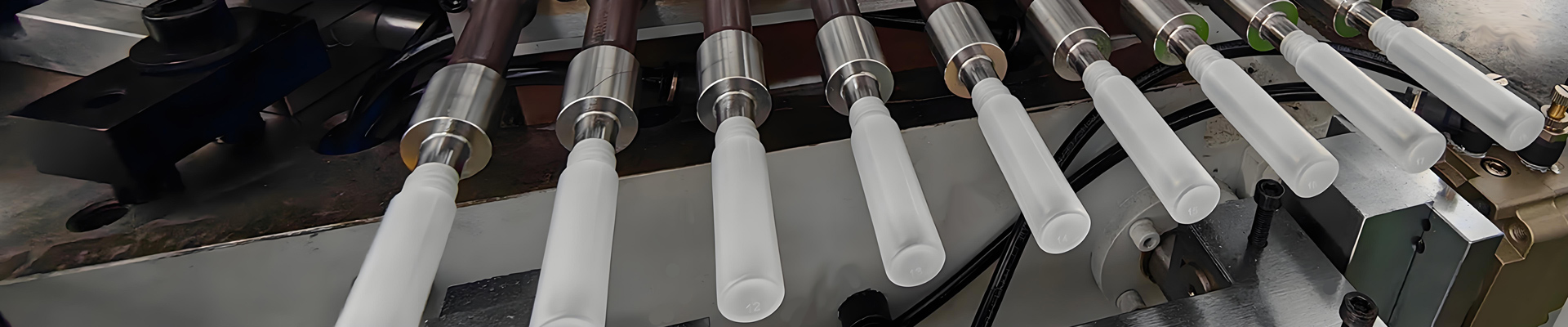
The first station is the injection station. Polymer melt is plasticized in the barrel, then injected into a preform cavity where it forms a hollow tube-like parison around a heated steel core rod. The core rod is not simply a mandrel; it is the carrier that transfers the parison from the injection station to the blow station and, at the same time, the internal blow channel through which compressed air later expands the parison against the blow cavity wall. This dual role is the single most important concept for an operator to internalize, because almost every setup, timing, and temperature decision traces back to keeping the core rod within its thermal and mechanical window.
The second station is the blow station. The turret indexes 120 degrees and the parison, still on the core rod, enters the blow mold. Compressed air enters through the core rod, expands the hot parison against the cooled blow cavity, and forms the final bottle shape, neck finish, and thread in a single blow. The timing of blow delay, blow pressure, and cooling at this station governs wall-thickness distribution, neck concentricity, and surface quality.
The third station is the stripper station. After the turret indexes another 120 degrees, the finished bottle is stripped from the core rod, the bottle is ejected, and the core rod returns to the injection station to begin the cycle again. On a three-station machine the turret divides 360 degrees into three equal 120-degree index steps; some configurations describe the motion as repeated 180-degree or 120-degree indexing depending on station pitch, but the operational takeaway for the operator is identical: the core rod visits three stations in sequence and never stops in a free position.
A core rod in IBM does two jobs at once: it carries the parison and it delivers the blow air. Train the operator to protect the core rod and most process problems become manageable.
The contrast with extrusion blow molding (EBM) is a teaching point that pays off later in defect diagnosis. In IBM the parison is injected, not extruded, so the process produces no flash and no scrap tail. There is no flash to trim and no regrind loop to manage at the machine. That is why IBM is favored for pharmaceutical, cosmetic, and food containers where a flash-free neck finish and clean bottle body matter. A new operator should be able to state this difference without hesitation, because it explains why IBM neck threads are sharp and why the bottle mouth does not need a post-trim operation.
Finally, the fundamentals lesson must cover the one-step nature of the process. Because injection, blowing, and stripping happen on a single indexed turret, the parison never cools on a separate conveyor and never requires a reheating oven as in two-step stretch blow molding. The operator controls one integrated thermal cycle rather than two disconnected ones. This integration is the reason IBM cycle times stay in the 8 to 20 second range and the reason the curriculum spends so much time on temperature coordination across stations.
Machine Architecture and Core Subsystems
Before an operator is allowed to touch a running machine, the curriculum teaches the architecture module so that every button on the HMI maps to a real mechanical function. Aibim IBM machines use a single-crossbeam, double tie-bar clamping framework with an enlarged mold-setting space, and some configurations use a toggle clamp. Understanding the clamping system tells the operator where mold alignment force comes from and why mold mounting must be square.
The injection unit is built around a reciprocating screw inside a barrel. For the Aibim IBM series the screw diameter typically ranges from 35 to 60 mm with an L/D ratio of 18 to 22, and injection pressure reaches 100 to 160 MPa. Operators learn to read these numbers on the HMI because shot size, recovery time, and melt homogeneity all depend on screw diameter and L/D. A longer L/D improves plasticizing uniformity but lengthens recovery; the curriculum teaches the trade-off rather than a single fixed setting.
The hot runner manifold feeds the preform cavities. Because IBM forms the parison directly, the hot runner must deliver balanced melt to every cavity around every core rod. Operators are taught to recognize hot-runner imbalance as a root cause of weight drift and short shots, and to understand that a clogged or poorly tuned manifold cannot be fixed by raising injection pressure alone.
Core rod temperature control is handled by an oil temperature controller holding the core rod at 60 to 120 degrees Celsius. This is a subsystem unique to IBM and central to training. If the core rod is too cold the parison skins over and sticks; if too hot the parison sags and the neck distorts. The operator must learn the relationship between core-rod oil temperature, barrel melt temperature, and blow timing as one coupled system.
The hydraulic and servo system drives clamp, injection, and turret indexing. Aibim machines use PREFILL technology with a variable displacement pump that reduces energy use by at least 35 percent compared with conventional hydraulic machines. Operators learn to read system pressure, distinguish normal pump noise from cavitation, and recognize when the servo response has degraded. The PLC and HMI parameter pages are the operator’s daily workspace: recipe pages, temperature zones, timing pages, and alarm history. Aibim stores recipes on SD cards so a qualified process setting can be carried across machines, and the curriculum includes a lesson on exporting, labeling, and reloading recipes without overwriting a good one.
The Four-Level Operator Training System
The Aibim operator curriculum is organized into four progressive levels. Each level has a defined number of training hours, a content scope, an assessment method, and a pass line. The matrix below is the backbone of the program and the document every plant manager should keep on file.
| Level | Focus | Training Hours | Core Content | Assessment Method | Pass Line |
|---|---|---|---|---|---|
| Level 1 | Safety and Basic Operation | 40 | LOTO, light curtain, two-hand start, e-stop reset, warm-up curve, mold mounting and alignment | Written safety test + supervised start-up | 100 percent on safety; 80 percent theory |
| Level 2 | Process Parameter Control | 60 | Barrel zones, injection speed, holding, blow pressure, blow delay, cooling, cycle time | Set 3 recipes + weight stability check | 85 percent; weight in tolerance |
| Level 3 | Defect Diagnosis and Troubleshooting | 80 | Wall thickness, flash, sticking, short shot, bubbles, haze, deformation, weight drift | Fault simulation + root-cause write-up | 90 percent correct diagnosis |
| Level 4 | Maintenance and Predictive Upkeep | 40 | Core rod polish, hot runner clean, hydraulic oil NAS 8, mold water descaling | Preventive plan + hands-on service | Completed checklist signed off |
The four levels are cumulative. A Level 2 operator must already hold Level 1; a Level 3 troubleshooter must be fluent in Level 2 parameters. Plants that try to shortcut this sequence usually discover the gap when a complex defect appears and nobody can separate a parameter error from a mechanical fault. The total program is 220 instructor hours plus supervised floor time, which is why Aibim recommends running the curriculum alongside production rather than as a one-week crash course.
Level 1: Safety and Basic Operation
Level 1 is non-negotiable and the only level with a zero-tolerance pass line on safety. The curriculum opens with lockout/tagout (LOTO): every operator must demonstrate how to isolate electrical, hydraulic, and pneumatic energy before opening a guard or entering the mold area. The lesson is repeated until the sequence is muscle memory, because IBM machines combine a hot barrel, a high-pressure hydraulic clamp, and a rotating turret, and any one of those can injure.
The light curtain and two-hand start are taught as the two independent protective layers on the stripper and clamp side. Operators learn why the light curtain must never be bypassed with a wedge, and why the two-hand start exists even when an experienced operator feels he can “save a second.” The e-stop reset lesson covers the difference between a momentary trip and a latched fault: a latched fault means the root cause is still present and the machine must not be forced back into cycle.
The warm-up curve is the first real process lesson at Level 1. A cold barrel and cold core rod cannot make a good bottle, and forcing production before thermal soak cracks heater bands and stresses the screw. Operators are trained to follow the warm-up curve printed on the HMI: barrel zones ramp to setpoint, the core-rod oil unit reaches 60 to 120 degrees Celsius, and only then does the turret begin indexing with melt. Mold mounting and alignment closes Level 1: the single-crossbeam double tie-bar framework demands a square, evenly torqued mold, and an operator who learns to seat and align a mold correctly prevents a whole class of flash and mis-strip defects later.
Level 2: Process Parameter Control
Level 2 turns the machine from a guarded box into a controllable process. The core teaching tool is the material-to-temperature-to-pressure reference table, which the operator must be able to reproduce from memory for the four common IBM resins.
| Material | Barrel Temperature Window (C) | Holding Pressure (% of Injection) | Blow Pressure (MPa) | Blow Delay (s) | Typical Cycle (s) |
|---|---|---|---|---|---|
| PP | 190 to 230 | 30 to 60 | 0.6 to 0.9 | 0.2 to 0.6 | 9 to 18 |
| PE | 170 to 210 | 30 to 60 | 0.6 to 0.9 | 0.2 to 0.6 | 8 to 16 |
| PS | 180 to 220 | 30 to 60 | 0.6 to 0.9 | 0.2 to 0.6 | 10 to 20 |
| PET | 260 to 290 | 30 to 60 | 0.6 to 0.9 | 0.2 to 0.6 | 12 to 20 |
The lesson on injection speed grading teaches that a single fixed speed is rarely optimal: a slower fill at the gate reduces shear and jetting, while a faster mid-flight fill keeps the parison hot and uniform. Holding pressure is set at 30 to 60 percent of injection pressure to pack the neck and compensate shrinkage without over-packing the preform. Blow pressure of 0.6 to 0.9 MPa is taught as a window, not a number: too low and the bottle does not fully form the thread; too high and the parison thins at the base. Blow delay of 0.2 to 0.6 seconds controls how much the parison relaxes before expansion, which directly sets wall distribution. Cooling time and the overall cycle of 8 to 20 seconds are the productivity levers, and the operator learns to shorten the cycle only after quality is locked, never before.
Level 3: Defect Diagnosis and Advanced Troubleshooting
Level 3 is where an operator becomes an asset rather than a button-pusher. The teaching method is fault simulation: the instructor deliberately induces a defect and the trainee must trace it to the root cause and prescribe the correction. The defect table below is the working reference for the whole level and must be posted at the line.
| Defect | Likely Cause | Diagnosis Clue | Corrective Action |
|---|---|---|---|
| Wall thickness uneven | Blow delay wrong, parison temperature uneven | Thin side repeats by cavity position | Adjust blow delay 0.2 to 0.6 s; rebalance hot runner |
| Bottle neck flash | Cavity clamp not square, core rod worn | Flash at parting line of neck | Realign mold, inspect core rod, check clamp tonnage |
| Core rod sticking | Core rod too cold, release agent gone, contamination | Parison torn on stripper station | Raise oil temp 60 to 120 C; polish core rod; clean |
| Neck short shot | Injection pressure low, barrel too cold | Incomplete thread or finish | Raise injection pressure, raise barrel zone, raise hold |
| Bubbles in bottle body | Moisture, trapped gas, degraded resin | Internal voids, silver streak | Dry material, lower melt temp, raise back pressure |
| White haze / blush | Over-high blow pressure, stretch too fast | Milky surface, lost clarity | Lower blow pressure, slow blow, check mold temp |
| Demolding deformation | Premature strip, insufficient cooling | Oval neck, soft body after eject | Increase cooling time, delay strip, lower core temp |
| Weight drift | Shot size variation, barrel wear, hot runner leak | Gram weight climbs or falls over shift | Recalibrate dosing, check screw, inspect manifold |
| Neck eccentricity | Core rod bent, cavity off-center | Thread not concentric with body | Replace or true core rod, reposition blow cavity |
| Base thinning or rupture | Blow too late, parison cooled at base | Holes or pale thin base | Shorten blow delay, raise core rod temp at base |
| Surface streaks / splay | Volatiles, burn, contaminated regrind | Lines along bottle body | Dry resin, lower back pressure, clean barrel |
| Black specks | Degraded material, dead spot in barrel | Dark dots on clear bottle | Purge barrel, reduce residence, check heater band |
| Poor neck thread | Mold cavity damaged, shot short | Broken or shallow thread | Inspect cavity, raise injection, repair mold |
| Dimensional out of spec | Mold temp drift, cooling unstable | Height or diameter drift over time | Stabilize mold water, verify chiller, log trend |
The discipline taught at Level 3 is to change one variable at a time. A trainee who raises temperature, pressure, and blow delay simultaneously has not learned anything, because he cannot tell which change fixed the defect. The curriculum enforces single-variable experimentation (OFAT) from the first simulated fault, and the root-cause write-up must state the observed clue, the hypothesis, the single change made, and the measured result. That written trail is what lets a plant build its own defect library over time.
Level 4: Maintenance and Predictive Upkeep
Level 4 trains the operator to protect the machine rather than only run it. The headline skill is core rod polishing: the core rod surface sets the entire bottle interior finish, and a micro-scratched rod transfers that scratch to every bottle. Trainees learn the correct stone grade, the direction of travel, and the inspection light angle that reveals a rod ready for refurbishment.
Hot runner cleaning is taught as a scheduled task, not a panic response. A manifold disassembled and cleaned on a rhythm does not suddenly leak at the worst moment. Trainees learn to map the manifold, label every heater and thermocouple, and reassemble to torque so the thermal balance returns exactly to the logged baseline. Hydraulic oil cleanliness is controlled to NAS 8; the operator learns to read a particle counter sample, recognize when the filter element is due, and understand that dark oil is a symptom, not the disease. Mold water descaling closes the level: calcium in the cooling circuit silently lengthens cycle time and destabilizes dimensions, so a descaled water line is a quality control action, not a housekeeping chore.
Predictive upkeep means the operator logs trends: weight drift, cycle creep, core-rod polish date, oil sample result, and cooling-water delta-T. When those trends move together the machine is telling the team something is coming. The Level 4 graduate is the person who schedules the intervention before the breakdown, which is the most valuable habit a bottle plant can build.
Aibim Machine Platform for Hands-On Training
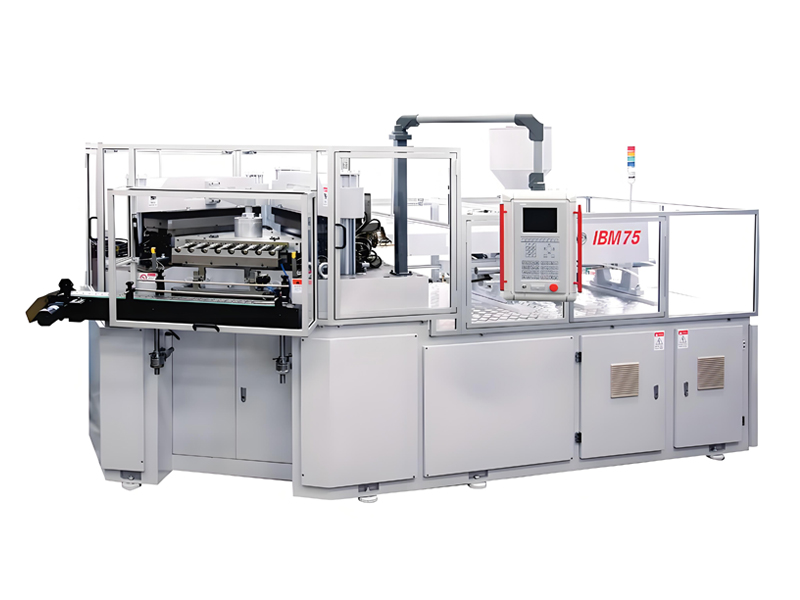
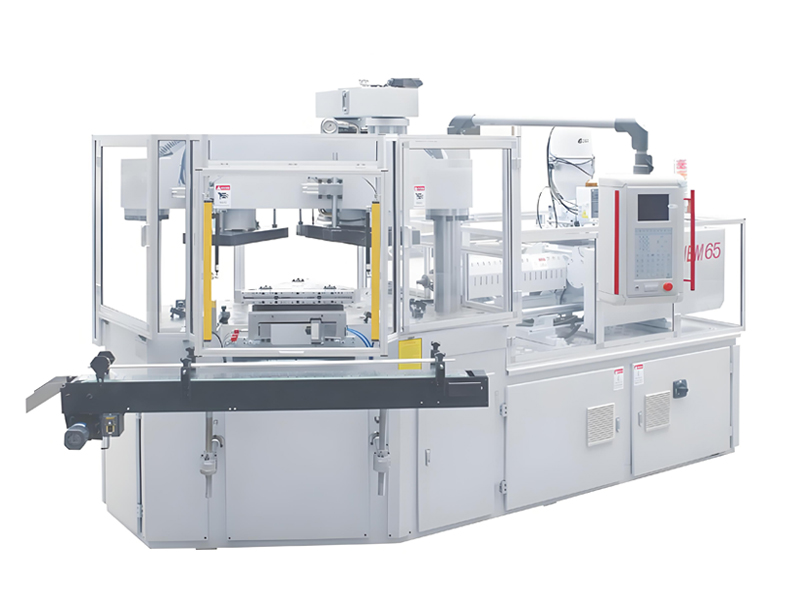
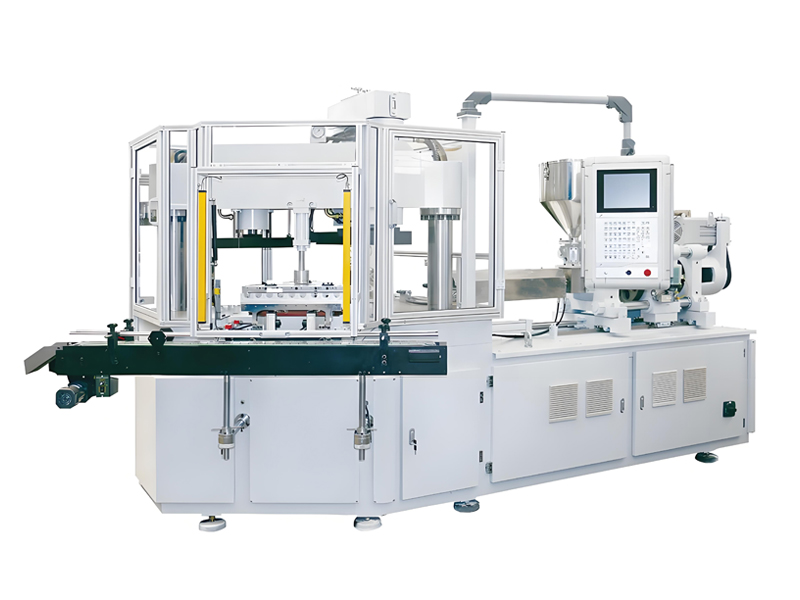
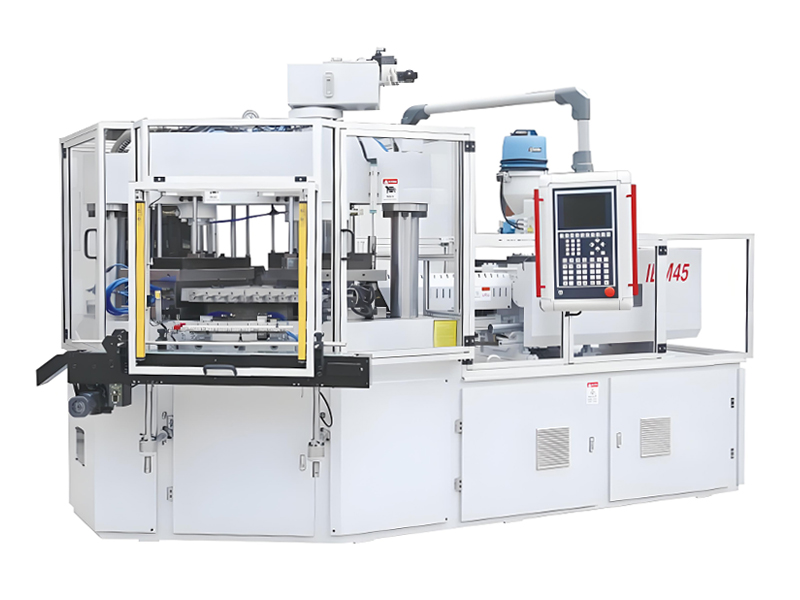
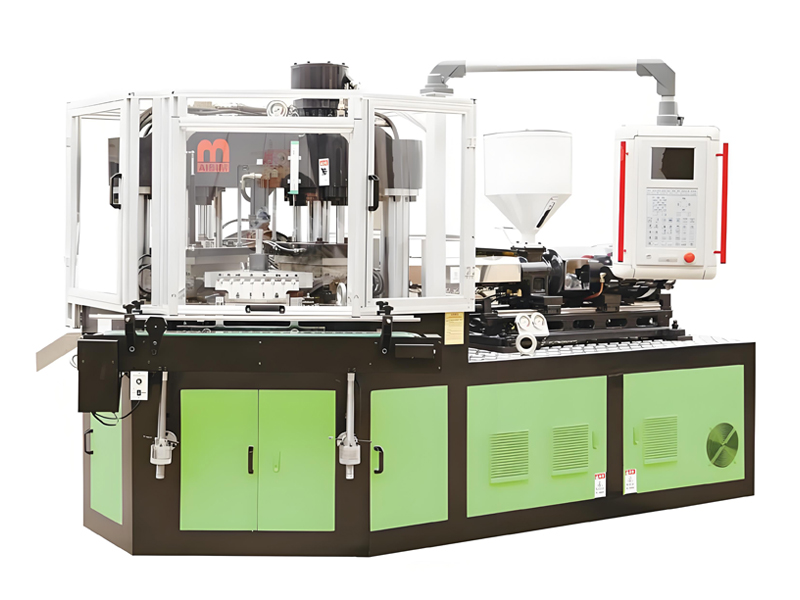
The Aibim IBM series is the physical bench for this curriculum. Built by Aibim, a Wanplas factory, these are three-station one-step injection blow molding machines covering containers from 3 ml to 1000 ml, with CE-certified safety including a digital laser sensor at the stripper station and a light curtain for personal protection. The two platforms most used for operator training are the IBM75 and the IBM65; a hybrid-electric IBM55 is also available where energy targets are strictest.
IBM75 Specification
| Parameter | IBM75 (representative) |
|---|---|
| Clamping framework | Single crossbeam, double tie bars |
| Screw diameter | 50 mm (series range 35 to 60 mm) |
| L/D ratio | 20:1 (series 18 to 22) |
| Injection pressure | up to 150 MPa (series 100 to 160) |
| Cavity number | up to 12 (depends on bottle size) |
| Bottle volume range | 5 to 1000 ml |
| Core rod temperature | oil temperature controller 60 to 120 C |
| Installed power | about 38 kW |
| Energy saving | minimum 35 percent via PREFILL technology |
| Processable material | PP, PE, PS, PET, SAN, ABS, PC, PCTG, TPU |
IBM65 Specification
| Parameter | IBM65 (representative) |
|---|---|
| Clamping framework | Single crossbeam, double tie bars |
| Screw diameter | 42 mm (series range 35 to 60 mm) |
| L/D ratio | 20:1 (series 18 to 22) |
| Injection pressure | up to 150 MPa (series 100 to 160) |
| Cavity number | up to 8 (depends on bottle size) |
| Bottle volume range | 3 to 500 ml |
| Core rod temperature | oil temperature controller 60 to 120 C |
| Installed power | about 28 kW |
| Energy saving | minimum 35 percent via PREFILL technology |
| Processable material | PP, PE, PS, PET, SAN, ABS, PC, PCTG, TPU |
Exact figures vary by cavity configuration, bottle geometry, and requested voltage, so Aibim confirms the final specification at quotation. What does not change is the training value: both platforms expose the operator to the same three-station logic, the same core-rod temperature control, and the same HMI recipe pages, so a trainee qualified on one can transfer to the other with a short familiarization.
Teaching Methodology and Assessment Design
The curriculum is delivered through five linked methods. Theory covers the physics and the why, taught in short modules with the reference tables above as handouts. Simulator work lets a trainee change parameters on a logged training recipe without touching production resin, so mistakes cost nothing. Shadowing pairs the trainee with a Level 3 or Level 4 operator for a defined number of supervised cycles, with the mentor signing off each task.
Single-variable experimentation (OFAT) is the practical core: every parameter change during training is isolated and recorded, building the habit that carries into real troubleshooting. Assessment sampling closes each level with measured output: a Level 2 trainee must hold bottle weight within a tolerance band of plus or minus 2 percent, hold bottle neck inner diameter to its specified tolerance, and hold verticality (bottle standing straight) within the customer limit. These three numbers are the only honest proof that training worked, which is why the curriculum measures output, not attendance.
Application Industries and Training Emphasis
Aibim IBM machines serve pharmaceutical, food, drink, and cosmetic production, and each industry shifts the training emphasis because the failure that matters is different.
Pharmaceutical oral-liquid bottles demand clean necks and tight weight control, so Level 2 training stresses neck inner-diameter tolerance and clean-room handling, while Level 3 spends extra time on contamination-driven defects such as black specks and splay. Eye-drop bottles are small, often 3 to 30 ml, with precise dropper tips, so core-rod polish quality and micro-cavity alignment get extra Level 4 attention. Cosmetic bottles live or die on surface appearance, so Level 3 training weights heavily toward haze, blush, and wall-thickness evenness, because a cloudy wall is a reject even when the bottle is functionally fine. Daily-chemical small bottles run high cavity counts for throughput, so Level 2 emphasizes cycle time discipline and Level 4 emphasizes hot-runner balance across many cavities.
This industry lens is why the same four-level curriculum produces different specialists: a pharma operator and a cosmetic operator both passed Level 3, but the pharma operator can defend a sterile neck and the cosmetic operator can defend a flawless wall. A plant should state its primary industry up front so the training hours are weighted correctly.
Requirement-to-Model Selection Guide
The final planning tool pairs a production requirement with the right Aibim platform, so a new line is staffed and trained on the machine it will actually run.
| Requirement | Recommended Model | Why |
|---|---|---|
| 3 to 30 ml dropper / eye-drop bottles | IBM65 | Fine core-rod control, up to 8 cavities, tight neck tolerance |
| 30 to 200 ml cosmetic / pharma bottles | IBM65 or IBM75 | Mid-volume flexibility, surface-quality training focus |
| 200 to 1000 ml daily-chemical bottles | IBM75 | Larger shot, up to 12 cavities, higher throughput |
| Strict energy target, small bottles | IBM55 Hybrid Electric | Electric assist lowers consumption beyond the 35 percent baseline |
| PET or PC clarity bottles | IBM75 | Higher barrel temperature window to 290 C for PET |
| Multi-resin trial line | IBM75 | Broad material range PP, PE, PS, PET, SAN, ABS, PC, PCTG, TPU |
Operator Skill Assessment Scoring
Each level ends with a scored assessment. The scoring sheet below is the standard Aibim evaluation used during on-site training and remote review. It keeps grading consistent across trainers and plants.
| Skill Item | Weight | Pass Standard | Scoring Note |
|---|---|---|---|
| LOTO procedure | 20 | 100 percent correct sequence | Zero tolerance; one miss fails |
| Safe start and e-stop reset | 10 | No guard bypass, correct reset | Observe under load |
| Warm-up curve compliance | 10 | Follows HMI curve, no early cycle | Check log timestamp |
| Recipe set and SD card use | 15 | 3 recipes, no overwrite of good one | Label and save discipline |
| Weight stability plus or minus 2 percent | 20 | Held over 30 minutes | Weigh every 5 minutes |
| Neck inner diameter tolerance | 10 | Within customer spec | Pin gauge check |
| Verticality | 10 | Bottle stands true | Fixture or dial gauge |
| Defect root-cause write-up | 5 | OFAT method shown | Review written report |
A trainee scoring below the pass line on any zero-tolerance item repeats that item before advancing. The sheet is archived with the machine’s recipe history so a plant can prove operator competence during an audit, which matters most in pharmaceutical and food supply chains.
Service, Support, and Continuous Training
Training does not stop at the factory door. Aibim, as a Wanplas factory, supports the operator curriculum with services that keep skills current after commissioning. Every machine is tested before shipment, so the line arrives already validated against the customer’s bottle sample rather than tuned cold on the floor. Installation and commissioning are carried out by engineers who also run the first on-site training session, so the Level 1 to Level 2 handoff happens on the real machine with real resin.
The Wanplas group service promise includes USD 500 free parts every year, which keeps a spare core rod, heater band, or seal in stock without a budget fight, and that ready inventory is what lets a Level 4 operator act on a predictive signal instead of waiting. On-site training for new shifts, remote operation and maintenance support through the PLC data link, and an open-factory policy that welcomes customers to visit the workshop and watch the IBM line run are all part of the same support chain. A plant that sends an operator back to the Aibim factory for a refresher closes the loop between the classroom and the bench.
Frequently Asked Questions
How long does it take to fully qualify an IBM operator?
The four-level curriculum is 220 instructor hours plus supervised floor time, typically spread across eight to twelve weeks alongside production. Level 1 safety is completed first and cannot be skipped, after which Levels 2, 3, and 4 build on each other in sequence. A plant running a single product can compress the later levels by weighting training hours toward its industry, but the total assessed competence should not be rushed, because a shortcuts operator is the most common source of recurring scrap. Aibim recommends scheduling the program so each level overlaps the previous one on the real line rather than running as isolated classroom weeks.
What is the difference between IBM and extrusion blow molding that operators must know?
IBM injects the parison around a core rod on a three-station turret and produces no flash and no scrap tail, while extrusion blow molding extrudes a parison that is clamped and blown, leaving flash to trim. Operators must understand this because it explains why IBM necks are sharp, why there is no regrind loop, and why defect diagnosis on IBM centers on the core rod rather than on a parison cut. The one-step nature of IBM also means the operator manages a single coupled thermal cycle instead of two disconnected ones, which is a key reason cycle times stay in the 8 to 20 second band.
Why is the core rod temperature so important in training?
The core rod acts as both the parison carrier and the blow air channel, and it is held at 60 to 120 degrees Celsius by an oil temperature controller. Too cold and the parison skins and sticks; too hot and it sags and the neck distorts. Core rod control links directly to sticking, short shots, and demolding deformation, which is why Level 1 and Level 3 both return to it. Trainees are taught to read the oil unit setpoint against the barrel melt temperature as one coupled system rather than two separate numbers on the HMI.
How does Aibim avoid operators guessing during troubleshooting?
The curriculum enforces single-variable experimentation, or OFAT. When a defect appears, the trainee states the observed clue, forms one hypothesis, changes exactly one parameter, and records the result. This discipline builds a written defect library and stops the habit of changing temperature, pressure, and timing at once, which teaches nothing and hides the true root cause. Over a year of operation a plant that logs every OFAT trial accumulates a troubleshooting manual written in its own resin and bottle language.
Which Aibim model should a cosmetic bottle line choose for training?
Cosmetic bottles between 30 and 200 ml are well served by the IBM65 or IBM75, with training weighted toward surface quality, haze, and wall-thickness evenness. For larger daily-chemical bottles up to 1000 ml the IBM75 with up to 12 cavities is the better bench, while a strict energy target on small bottles points to the IBM55 hybrid-electric platform. The selection table in this article maps each requirement to a model, and the same four-level curriculum applies to all three because the three-station logic and HMI recipe pages are shared across the IBM series.
What proof of competence does a plant get after training?
Each level ends with a scored assessment covering LOTO, safe start, warm-up compliance, recipe and SD card use, weight stability within plus or minus 2 percent, neck inner diameter tolerance, verticality, and a defect root-cause write-up. The signed scoring sheet is archived with the machine recipe history, giving auditable proof of operator competence for pharmaceutical and food supply chains. Aibim retains a copy of the scoring during remote support sessions so an engineer can confirm the operator level before advising on a process change.
Does the training cover predictive maintenance or only running the machine?
Level 4 is dedicated to predictive upkeep: core rod polishing, hot runner cleaning on a schedule, hydraulic oil cleanliness to NAS 8, and mold water descaling. Operators learn to log weight drift, cycle creep, polish dates, and oil samples so they can schedule intervention before a breakdown, which is the most valuable habit a bottle plant can build. The Wanplas group USD 500 free parts every year policy keeps the consumable inventory on hand so a Level 4 operator can act on a predictive signal immediately instead of waiting for a purchase order.
Can one trained operator run both the IBM65 and IBM75?
Yes, with a short familiarization. Both platforms share the same three-station logic, the same core-rod oil temperature control, and the same HMI recipe pages, so the leap is mostly about shot size, cavity count, and cycle discipline rather than new principles. Aibim treats cross-model qualification as a half-level top-up: the operator repeats the Level 2 recipe set and the Level 3 defect drill on the second machine, then the scoring sheet is extended with the second model noted. This keeps a plant flexible when production shifts between small dropper bottles and larger daily-chemical containers.
Conclusion
A trained IBM operator is not someone who can press start; he is someone who can explain the three-station process, set parameters from a material table, trace a defect to its root cause with one variable at a time, and protect the machine with predictive upkeep. The four-level Aibim curriculum gives plants a repeatable path from safety basics to advanced troubleshooting, built on the real IBM75, IBM65, and IBM55 platforms and measured by weight, neck, and verticality rather than by attendance. Aibim, a Wanplas factory, backs the program with pre-shipment testing, on-site commissioning and training, USD 500 free parts every year, remote support, and an open-factory policy. If you are planning operator qualification for a new or expanding injection blow molding cell, send your bottle specifications and target output and we will propose a tailored machine configuration, arrange a factory visit, and run a sample trial on the bench so your team trains on the exact bottles you will produce.