Injection blow molding (IBM) is the process of choice when a container’s neck must accept a screw cap that seals on the first try, every time. The reason is structural: in IBM the bottle neck is not trimmed, pinched or welded from a soft parison, it is injection molded in a rigid, hardened cavity around a precision core rod. That single design fact gives the neck a dimensional accuracy of roughly plus or minus 0.05 to 0.10 millimeter, an order of magnitude tighter than what extrusion blow molding can deliver on a cut neck. For pharmaceutical vials, oral-liquid bottles, eye-drop bottles, cosmetic droppers and other small precision containers between 3 and 500 milliliter, this precision is the difference between a closure that torques cleanly and one that leaks on the shelf. This article explains how IBM neck precision is built, measured and protected, from thread geometry and sealing surfaces through the tolerance chain in the mold and machine, the verification tests that prove a leak-proof fit, and the defect diagnosis tree you can use when a seal fails.
Why the IBM Bottle Neck Is Born Precise
The bottle neck is the most dimensionally demanding feature of any rigid plastic container, because it is the only part that must mate with a separate, mass-produced closure. Everything else on the bottle can flex, vary in wall thickness and tolerate modest variation; the neck cannot. A screw cap is manufactured to a fixed internal geometry, and the bottle neck must match that geometry within tight limits or the cap will cross-thread, seat poorly or leak. The way the neck is formed therefore dictates whether the package is reliable.
In extrusion blow molding (EBM), the neck is created by pinching the top of an extruded parison between the two halves of a blow mold. The polymer at that moment is a soft, still-flowing tube, so the thread is effectively cut or welded from a molten curtain. Parison swell, uneven wall distribution and flash at the pinch line all introduce variation, and the achievable neck accuracy is typically only plus or minus 0.20 to 0.40 millimeter. For many industrial and household containers that is acceptable, but for a pharmaceutical or cosmetic closure it leaves too little margin.
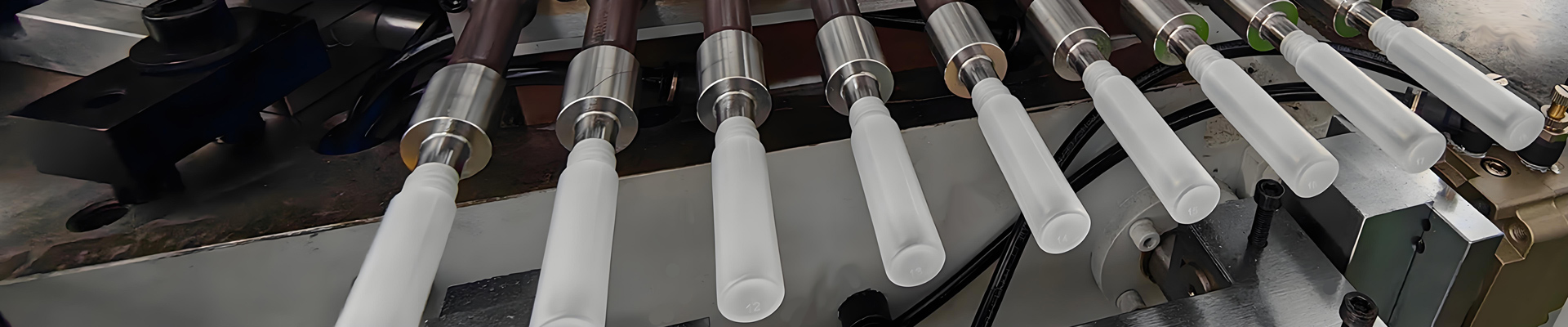
Injection blow molding reverses the sequence. The neck is injection molded first, in a closed cavity, against a hardened steel core rod. The molten polymer freezes against steel that was ground and polished to micron accuracy, so the neck inherits the cavity accuracy directly. After the necked parison (the “preform” in IBM terminology) cools on the core rod, it is transferred to the blow station and expanded into the body. The body can vary slightly; the neck stays as precise as the steel that formed it.
The neck in IBM is a molded feature, not a trimmed edge. That is why IBM neck accuracy reaches plus or minus 0.05 to 0.10 millimeter while EBM cut necks sit at plus or minus 0.20 to 0.40 millimeter.
This accuracy is the core reason IBM dominates pharmaceutical packaging (vials, oral-liquid bottles, eye drops, nasal sprays) and high-value cosmetics (serums, essences, creams, lotions). When a regulator or a brand demands a verified seal, the molded neck is the foundation. Aibim, a Wanplas factory, has built IBM machines around this principle for more than a decade, and the consistency of the neck is the first thing engineers evaluate when they qualify a new container.
Anatomy of an IBM Bottle Neck
A screw-cap bottle neck is a small, highly specified component. Every dimension on it exists to perform one of three jobs: engage the cap threads, seal the product, or locate and protect the closure. Understanding each element is the first step to tuning precision, because you cannot control what you have not decomposed.
Thread Form: Buttress, Trapezoidal and Round
The thread is the helical feature the cap engages. Three forms dominate plastic bottle finishes. The buttress thread has a steep leading face and a shallow trailing face; it resists axial push-off and is common on closures that must not back off under internal pressure. The trapezoidal (sometimes called modified buttress or “L” thread) is the general-purpose continuous thread used on most cosmetic and pharmaceutical screw caps, balancing engagement, easy capping and good seal force. The round thread is gentler, used where a soft snap or frequent open-close cycle is expected.
The thread is specified by several interacting numbers. Thread height typically runs 0.6 to 1.2 millimeter. Pitch, the axial distance between adjacent thread crests, runs 2.5 to 6.0 millimeter depending on finish size. The number of thread starts (single, double or triple) changes how fast the cap advances: a single-start thread gives a long, secure travel; a triple-start thread lets the cap close in fewer turns, which matters on high-speed filling lines. The lead angle, the helix angle of the thread, usually sits in the 3 to 8 degree band; a higher lead angle speeds capping but reduces axial holding, so it must be matched to the closure and the application torque.
On an IBM machine these thread parameters are frozen into the neck-ring cavity and the core rod, not adjusted on the fly. That is why cavity design and core rod accuracy matter more than any process dial for the thread itself. Aibim machines hold the core rod neck section to a tight tolerance so the thread it forms is repeatable cavity-to-cavity and shot-to-shot.
Finish Specification Systems: GPI, SPI and Metric Series
Bottle necks are not free-designed for every product; they follow published finish standards so that caps from any compliant supplier will fit. The most widely used family in North America is the GPI (Glass Packaging Institute, historically SPI) continuous-thread series: 400, 410, 415 and related. The numeric code carries meaning. A finish written as 24/410 means a 24 millimeter nominal outer diameter at the thread and a 410-style sealing configuration. Common IBM-relevant finishes include 18/410, 20/410, 24/410 and 28/410.
The pharmaceutical world adds its own variants. The PP28 finish is a 28 millimeter neck widely used for parenteral and oral-liquid closures and is the base for child-resistant (CRC) caps. European practice references DIN 168 for bottle necks and closures. When you specify a neck you must state both the diameter series and the sealing style, because two 24 millimeter necks with different sealing configurations will not accept the same cap.
Specifying to a standard, rather than a private drawing, is strongly recommended for IBM production. Standards give you a qualified closure supply chain, simplify validation and make audit trail easier. Aibim applications engineers routinely match a customer’s target capacity and closure to the correct GPI, PP28 or DIN finish before the mold is cut.
Sealing Surface: The Real Seal Happens Here
The thread gets the cap on; the sealing surface keeps the product in. The sealing land is the annular face or ring against which the cap liner, plug or land presses. Three geometries are common. A plug seal uses an inward-projecting ring on the cap that enters the neck bore and seals on the inner wall. A top seal (land seal) uses the flat top face of the neck, compressed by the cap liner or a linerless land. An inner-ring seal uses a raised ring on the neck interior that the closure engages. Each demands a different level of flatness and surface quality.
For a reliable seal the neck top face flatness should be 0.05 millimeter or better, and the surface roughness should be Ra 0.8 micrometer or finer. Rougher or wavy sealing faces let the liner bridge micro-gaps and leak under pressure or after aging. Linerless closures are stricter still: because there is no compressible liner to fill imperfections, the neck sealing face flatness should reach 0.03 millimeter. These numbers are not decorative; they are the boundary between a package that passes vacuum-decay testing and one that fails it.
Support Ring, Tamper-Evident Band and Bore
Below the thread sits the support ring (sometimes called the ledge or shoulder), the flange that the capping chuck and filling line puck locate against. It must be flat and concentric so the bottle stands and feeds squarely. The tamper-evident band, where present, is the break-away ring below the support ring that separates when the cap is first opened; its geometry must release cleanly without cracking the neck. The bore, the inner diameter of the neck above the body, controls fill-tube entry and closure plug engagement, and is held to about plus or minus 0.08 millimeter.
All of these features are molded together in the neck ring, which is why neck-ring quality and cooling dominate neck precision. The thread may be the headline, but the support ring, sealing land and bore are what make the bottle run on a filling line without jamming, tipping or leaking.
Dimensional Tolerance Chain in Mold and Machine
Neck precision is not the output of one adjustment; it is the accumulated result of a chain of tolerances from the core rod, the neck ring, the cooling system, the shrinkage model and the demolding temperature. Tune any one link and the others shift. The sections below walk the chain in the order it physically acts on the polymer.
Core Rod: The Backbone of the Neck
The core rod is the steel shaft the neck is molded around. Its neck-section diameter and profile are the master dimensions, so the rod is finished to plus or minus 0.01 millimeter. It is hardened to Rockwell C 52 to 58 to resist wear from repeated molding and ejection, then coated. Typical coatings are titanium nitride (TiN) or hard chrome at 0.01 to 0.03 millimeter thickness; the coating reduces friction, improves release and protects the polished surface from abrasion by glass-filled or pigmented resins.
Because the core rod carries the internal neck geometry (bore, thread root, plug-seal diameter), any wear or coating loss shows up directly as bore growth or thread-root rounding. Aibim machines use a hardened, coated core rod as standard, and the rod is a routinely inspected wear item during preventive maintenance.
Neck Ring and Split Cavity: The External Geometry
The neck ring (or split cavity) forms the outside of the neck: thread crest, pitch, support ring and sealing land. Because it is split to allow the threaded shape to release, the parting-line mismatch between the two halves must be 0.02 millimeter or less. Any mismatch becomes a visible fin on the thread and a leak path under the cap. Clamping force must be sufficient to keep the split faces closed during injection; if it is low, flash forms. Flash on the neck should be held under 0.03 millimeter, because even a hairline fin prevents the cap from seating squarely and breaks the seal.
The neck ring is therefore a high-precision, high-wear component. It is ground, polished and sometimes textured for release, and it is the component most likely to need refurbishment as volume builds. Tight parting-line control and adequate clamping are the two process levers that protect it.
Neck Cooling: Where Accuracy Is Frozen In
Cooling sets the final dimension. The neck must freeze before it can relax or distort, and it must freeze evenly to avoid ovality. On IBM machines the neck-ring cooling water is run cold, typically 8 to 15 degrees Celsius, and the core rod neck section is held 15 to 25 degrees Celsius cooler than the body section so the neck solidifies first and keeps its shape while the body is still forming. Cooling time at the neck is usually 3 to 8 seconds depending on resin and wall.
Uneven neck cooling is the classic cause of ovality above 0.15 millimeter and of a sealing land that is flat on one side and bowed on the other. Balanced water flow, clean cooling channels and a correctly tempered core rod are the controls that keep the neck round and the sealing face flat.
Shrinkage Compensation: Designing the Cavity to the Resin
Every resin shrinks as it cools from melt to solid, so the cavity is deliberately made larger than the target dimension by the material shrinkage rate. Get the rate wrong and the finished neck is systematically off-size. Typical mold shrinkage values are polypropylene 1.2 to 2.0 percent, HDPE 1.5 to 3.0 percent, PET-G 0.4 to 0.7 percent and polystyrene 0.4 to 0.7 percent. The cavity is calculated against the exact grade and colorant, because fillers and pigments shift shrinkage.
This is why a neck that was perfect for PP will be wrong for HDPE if the same cavity is reused without rework. The shrinkage model is part of the mold design, not a process setting, and it must be revisited whenever the resin changes.
Demolding Temperature: The Last Guard Against Thread Deformation
Even a well-molded neck can deform during ejection if it is too hot. The neck should be demolded below 60 degrees Celsius to prevent thread relaxation, and for polypropylene the recommendation is tighter, below 55 degrees Celsius, because PP is soft and creep-prone near its demold point. Aibim’s three-station one-step layout gives the neck a dedicated cooling window before transfer and ejection, which is a structural advantage for holding thread shape.
The table below consolidates the key dimensional control items, their target tolerances and the detection methods used on the line and in the lab.
Key Dimensional Control Items and How They Are Checked
| Control item | Target tolerance | Typical detection method |
|---|---|---|
| Neck outer diameter / thread OD | plus or minus 0.05 to 0.10 millimeter | Optical comparator, vision gauge |
| Thread pitch | plus or minus 0.05 millimeter | Thread pitch gauge, CMM |
| Sealing surface flatness | 0.05 millimeter or better (0.03 for linerless) | Optical flat, CMM |
| Sealing surface roughness | Ra 0.8 micrometer or finer | Surface roughness tester |
| Neck bore | plus or minus 0.08 millimeter | Bore gauge, air gauge |
| Ovality | 0.15 millimeter or less | Roundness instrument |
| Support ring flatness | 0.10 millimeter or less | CMM, height gauge |
| Flash on parting line | 0.03 millimeter or less | Visual, profilometer |
| Parting line mismatch | 0.02 millimeter or less | Mold check, CMM |
Common Bottle Finish Specifications Mapped to Capacity
Selecting a finish starts with the capacity you need and the closure you want. The table below maps the most common IBM-relevant finishes to their neck inner diameter, thread pitch and typical capacity range. Treat the diameters as nominal guidance; the controlling document is always the specific GPI, PP28 or DIN drawing for the closure you have qualified.
| Finish / system | Neck inner diameter (millimeter) | Thread pitch (millimeter) | Typical capacity range | Typical use |
|---|---|---|---|---|
| 18/410 (GPI) | 14.0 to 14.5 | 2.5 to 3.0 | 15 to 100 milliliter | Dropper, serum, eye care |
| 20/410 (GPI) | 16.0 to 16.5 | 2.5 to 3.0 | 30 to 150 milliliter | Lotion, toner, essence |
| 24/410 (GPI) | 20.0 to 20.5 | 3.0 to 4.0 | 100 to 300 milliliter | Shampoo, pharma, cream |
| 28/410 (GPI) | 24.0 to 24.5 | 4.0 to 6.0 | 200 to 500 milliliter | Wide-mouth cream, lotion |
| PP28 (pharma) | about 24.0 | 4.0 | 50 to 500 milliliter | Oral liquid, CRC compatible |
| GPI 400 series | varies by size | 4.0 to 6.0 | 100 to 1000 milliliter | Continuous thread, general |
| GPI 410 series | varies by size | 4.0 | 30 to 500 milliliter | Cosmetic screw cap |
| GPI 415 series | varies by size | 4.0 to 6.0 | 100 to 1000 milliliter | Wide-mouth |
| DIN 168 (EU) | per DIN drawing | 3.0 to 4.0 | 50 to 500 milliliter | European standard |
| CRC (child resistant) | per closure | 4.0 | 30 to 250 milliliter | PP28-based safety closure |
Notice the pattern: smaller capacities use smaller diameters and finer pitches, larger capacities use wider necks and coarser pitches for faster capping. The 18/410 and 20/410 finishes dominate the 3 to 150 milliliter cosmetic and pharmaceutical segment that IBM serves best, while 24/410 and 28/410 extend into the 100 to 500 milliliter cream and lotion range. PP28 is the pharmaceutical workhorse because it supports both standard and child-resistant closures under one neck geometry.
Torque and Leakage Verification Methods
A precise neck is only proven when a real cap seals it. Verification has two halves: torque, which confirms the cap engages and stays engaged, and leakage, which confirms the seal holds product and pressure. Both belong in incoming and in-process quality control, and both should be repeated after aging.
Torque Testing: Application, Opening and Retention
Application torque is the torque applied when the cap is screwed on, usually by an automatic capper. For an 18/410 finish this typically lands in the 8 to 15 inch-pound band, which converts to about 0.9 to 1.7 Newton meter. Too low and the cap can back off; too high and the cap may crack the neck or be impossible for the end user to open. Opening torque is measured by re-torquing the cap after it has been applied and rested; the standard checks it 24 hours later and expects at least 60 percent torque retention, meaning the cap has not loosened from creep or relaxation.
Torque retention is the real test of a good neck-to-cap pair, because a neck that is slightly oversized or has a wavy sealing land will let the cap relax. If retention drops below 60 percent, the neck sealing face or the cap liner is the first thing to inspect.
Leakage Testing: From Pressure to Trace Gas
Positive-pressure leak testing pressurizes the sealed bottle to 0.05 to 0.15 megapascal and holds for 30 to 60 seconds while monitoring for bubbles or pressure drop. It is simple, fast and good for production sampling. Vacuum-decay testing is preferred for pharmaceutical packs: the sealed bottle is placed in a vacuum chamber and the pressure decay is measured, resolving micro-pores as small as 5 to 20 micrometer. Helium mass-spectrometry leak detection uses a trace helium atmosphere and a mass spectrometer for the most sensitive work. Dye immersion to ASTM D3078 submerges the capped bottle under vacuum with a colored dye and checks for penetration.
Mechanical validation complements the seal tests. Drop testing to ASTM D2463 drops the filled bottle from 1.2 to 1.8 meter and checks for leak or failure. Stack (compression) testing loads the bottle in a column to confirm the neck and body do not deform and leak under pallet load. Finally, accelerated aging at 45 degrees Celsius and 75 percent relative humidity for 30 to 90 days, followed by re-testing torque and leak, confirms the seal survives the product shelf life.
| Test | Parameters | Acceptance / decision criteria |
|---|---|---|
| Application torque (18/410) | 0.9 to 1.7 Newton meter (8 to 15 inch-pound) | Cap seats, no strip, no crack |
| Opening torque after 24 hours | measure re-open torque | torque retention 60 percent or more |
| Positive pressure leak | 0.05 to 0.15 megapascal, 30 to 60 seconds | no bubble, no pressure drop |
| Vacuum decay (pharma) | vacuum chamber, sensitivity 5 to 20 micrometer | decay within instrument limit |
| Helium mass spec | trace helium, spectrometer | leak rate below spec |
| Dye immersion (ASTM D3078) | submerge under vacuum with dye | no dye penetration |
| Drop test (ASTM D2463) | 1.2 to 1.8 meter, filled | no leak or structural failure |
| Stack test | loaded column, ambient | no deformation leak |
| Accelerated aging | 45 degrees Celsius, 75 percent RH, 30 to 90 days | retest torque and leak, pass |
Material and Cap Matching for a Reliable Seal
The neck and the cap are a pair, and the pair, not either part alone, decides the seal. Material choice drives both the neck shrinkage (and therefore its final dimension) and the cap behaviour.
Resin Choice and Shrinkage
Polypropylene is the most common IBM resin for pharma and cosmetics because it is light, chemical resistant, fatigue resistant and easy to mold; its mold shrinkage of 1.2 to 2.0 percent is moderate. HDPE shrinks more, 1.5 to 3.0 percent, and is used where squeezability or moisture barrier matters. PET-G and polystyrene shrink far less, 0.4 to 0.7 percent, giving naturally tighter necks but different chemical and impact profiles. PC and ABS sit in the 0.4 to 0.7 percent band as well and are chosen for clarity or toughness. Because shrinkage sets the cavity size, the resin is fixed before the neck ring is cut, and changing resin means re-evaluating the cavity.
| Material | Mold shrinkage (percent) | Recommended demold temperature | Notes for neck precision |
|---|---|---|---|
| Polypropylene (PP) | 1.2 to 2.0 | below 55 degrees Celsius | Most common; soft near demold, watch cooling |
| HDPE | 1.5 to 3.0 | below 60 degrees Celsius | Higher shrink, cavity sized larger |
| PET-G | 0.4 to 0.7 | below 60 degrees Celsius | Low shrink, naturally tight neck |
| Polystyrene (PS) | 0.4 to 0.7 | below 60 degrees Celsius | Brittle; good dimensional stability |
| PC / ABS | 0.4 to 0.7 | below 60 degrees Celsius | Clarity or toughness variants |
Bottle-to-Cap Material Pairing
The simplest, most recyclable pairing is a PP bottle with a PP cap: same polymer, easy to recycle together. An HDPE bottle is often paired with a PP cap, which is acceptable for most markets though the two polymers must be separated at reclaim. The closure liner is the next decision. A polyethylene foam liner is the general-purpose choice; an induction-seal aluminum foil liner gives a tamper-evident, hermetic seal after a cap-sealing tunnel and is widely used in pharma and high-value cosmetics. Linerless caps skip the liner and depend entirely on neck-land precision.
Linerless designs are attractive for cost and recyclability, but they shift the burden of sealing onto the neck. Where a lined cap tolerates a sealing-face flatness around 0.05 millimeter, a linerless cap wants 0.03 millimeter and a finer roughness, because there is no compressible layer to absorb imperfection. Move to linerless only after the neck process is demonstrated capable of that tighter window.
Defect Diagnosis Tree When the Seal Fails
When a sealed bottle leaks or a cap will not seat, the cause is almost always in the neck. The diagnosis tree below connects the visible defect to its likely root cause and the mold or process countermeasure. Use it as a first-pass checklist before changing resin or cap supplier.
| Defect | Likely root cause | Mold / process countermeasure |
|---|---|---|
| Short thread (incomplete) | Low melt temp, low injection pressure or speed, cold core rod neck | Raise melt temp in window, raise injection pressure and speed, balance core rod neck temp |
| Flash at parting line | Low clamping force, worn split cavity | Increase clamping force, refurbish or replace neck ring |
| Ovality above 0.15 millimeter | Uneven neck cooling, core rod deflection | Balance neck-ring cooling water, check core rod straightness and support |
| Top face depression | Insufficient holding pressure or time, local shrink | Raise holding pressure and holding time, verify shrinkage model |
| Support ring deformation | Hot demold, ejector mis-set | Lower demold temperature below 60 degrees Celsius, adjust stripper timing |
| Cap will not fully seat | Pitch or bore mismatch to closure | Verify cavity vs closure spec, re-cut neck ring to matched drawing |
| Leakage under seal test | Sealing face rough or unflat, liner issue | Polish sealing face, tighten flatness to 0.05 or 0.03 millimeter, check liner |
| Abnormal CRC open or close force | Wrong thread engagement, band geometry | Re-profile thread engagement, verify tamper band vs closure |
The two most frequent real-world findings are a worn neck ring (flash and ovality) and a sealing face that drifted out of flatness (leak under vacuum decay). Both are caught early by the dimensional checks in the control table above, which is why a measured neck check at startup and per shift pays for itself in rejected lots avoided.
What Aibim IBM Machines Bring to Neck Precision
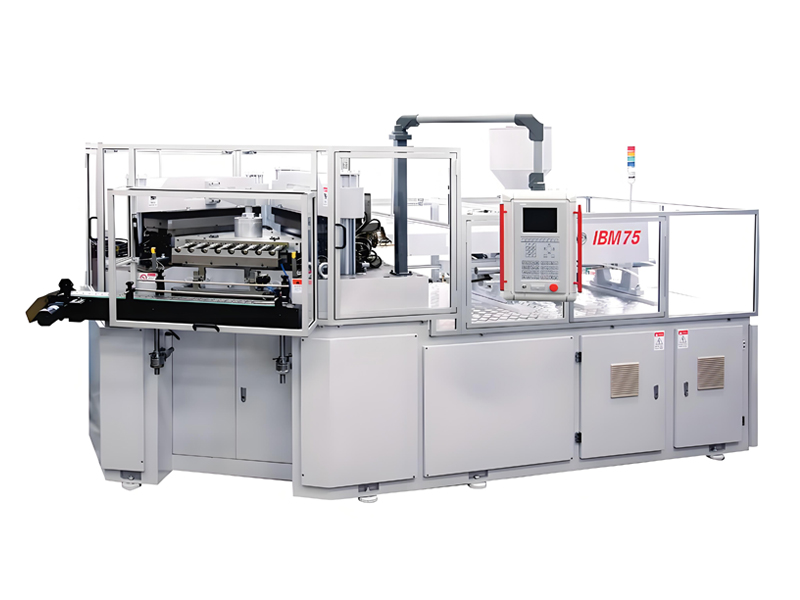
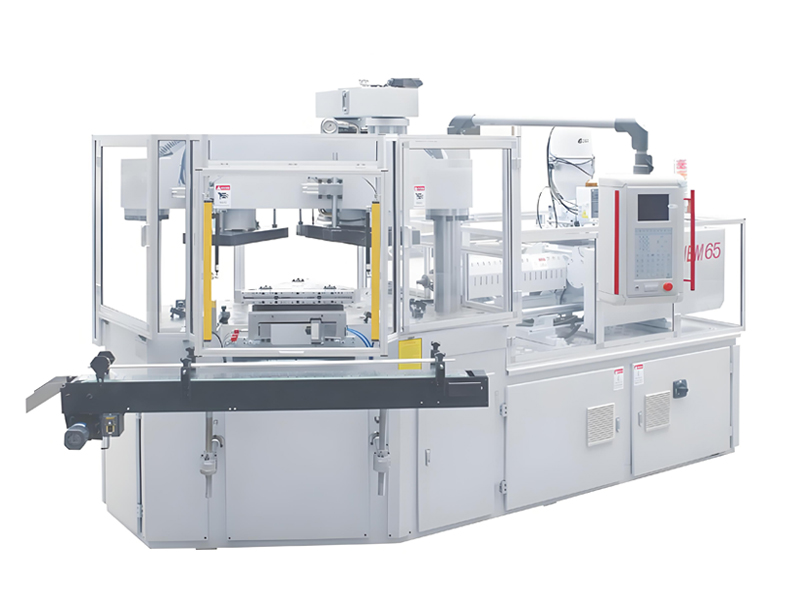
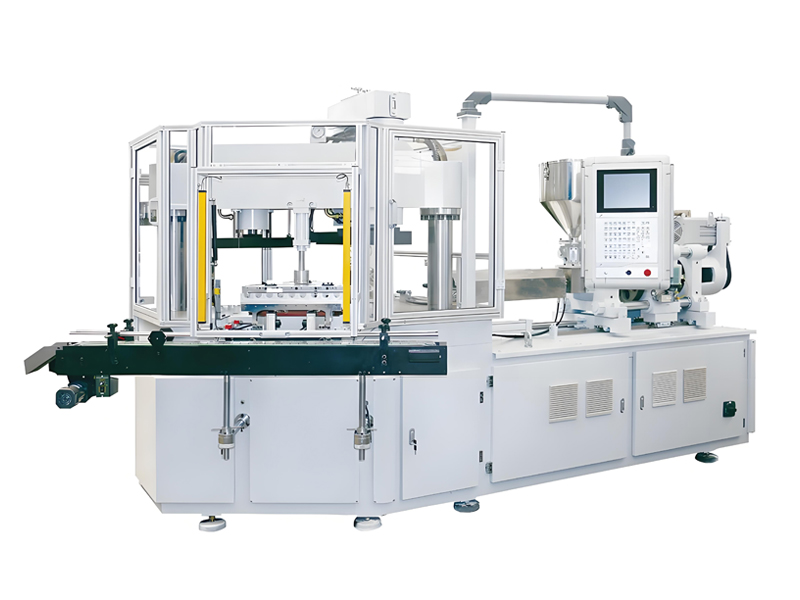
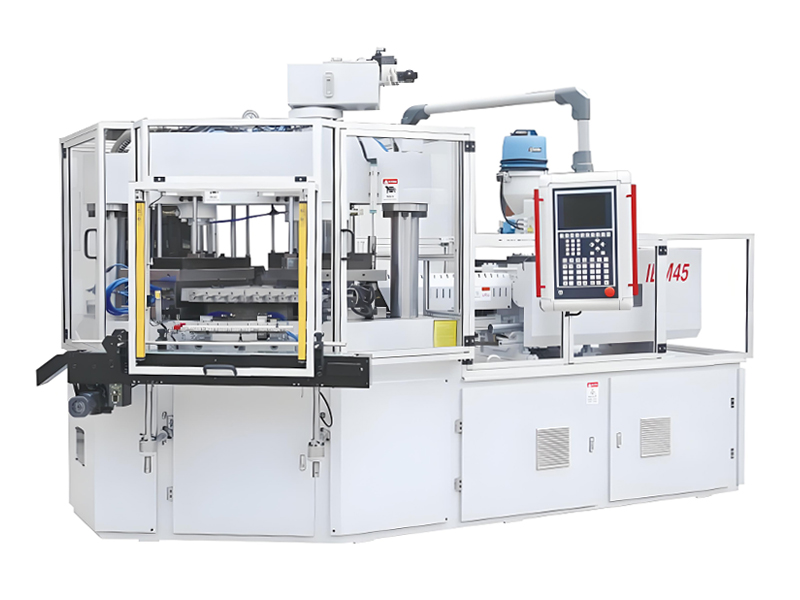
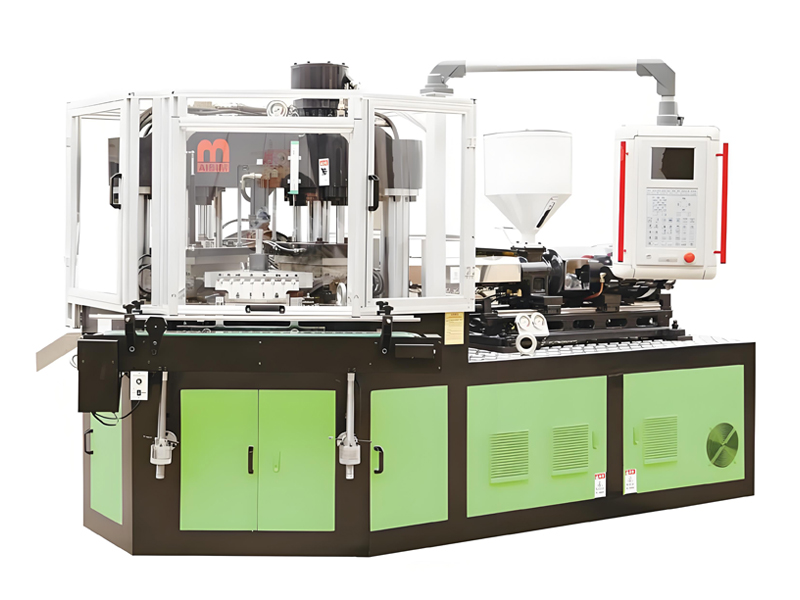
Aibim, a Wanplas factory, specializes in injection blow molding machines and has more than 12 years of experience building them, with a background of 20 years in the IBM process itself. The product line is built around the three-station, one-step process that is ideal for neck precision: injection of the necked parison, transfer, blow molding of the body, and ejection all happen on one machine without reheating or re-handling the neck. The models are the IBM75, the IBM65 and the IBM55 Hybrid Electric, covering containers from about 3 milliliter up to 1000 milliliter.
Several design features matter directly for neck accuracy. Aibim’s PREFILL technology and variable-displacement pump pressurizing in the hydraulic system reduce energy use by a minimum of 35 percent while giving stable, repeatable injection pressure, which is what keeps every neck the same shot after shot. The single-crossbeam, double-pole clamping framework gives an enlarged, rigid mold-setting space so the neck ring closes squarely. The core rod is hardened and coated, and the machine carries its own CNC center for producing and maintaining precision parts. New factory space purchased in 2022 supports an annual capacity above 100 lines, and the machines are shipped to more than 40 countries.
For neck-critical work the IBM55 Hybrid Electric is attractive because the electric clamping and transfer reduce mechanical variation, and the IBM65 and IBM75 cover larger cosmetic and pharmaceutical bottles. All models process the IBM-relevant resins: PE (HDPE, LDPE, LLDPE), PP, PS, ABS, SAN, TPU, PC and PCTG. Processable applications span pharmaceutics, food, drink and cosmetic packaging, exactly the segments where leak-proof screw-cap fit is regulated or brand-critical.
Within the Wanplas group, Aibim is the factory for injection blow molding while sister factories cover adjacent needs; for example, when a customer also needs PET bottles, Wanplas’s YuDa factory supplies PET blow molding machines, and for extrusion blow molding of larger containers the group’s Apollo factory is the specialist. Positioning Aibim as the IBM expert keeps the neck-precision conversation focused on the right process.
Standards and Process Validation You Must Meet
Neck precision is validated against a stack of standards that differ by market and product. For child-resistant closures, ISO 8317 defines the functional requirements and testing for reclosable child-resistant packaging, and ISO 13127 covers the mechanical test methods for child-resistant and senior-friendly closure systems. Torque and closure performance reference ASTM D2063 for screw-cap torque and ASTM D3078 for bubble-leak (dye immersion) testing; drop performance follows ASTM D2463. Pharmaceutical primary packaging must meet USP chapter 671 for containers and closures, and the quality system for pharmaceutical packaging materials aligns with ISO 15378, which applies Good Manufacturing Practice to primary packaging. Food-contact compliance runs through GB 4806.7 in China and EU 10/2011 in Europe, both governing plastic materials and articles intended to contact food.
Validation is not a one-time event. A robust IBM neck program qualifies the mold, locks the process window (melt temperature, injection pressure and speed, neck cooling temperature and time, demold temperature), samples torque and leak at startup, and then re-confirms after accelerated aging. Because resin lots and cap lots vary, the neck dimensional check plus a daily torque and leak sample is the control that keeps a validated state valid. Aibim supplies process documentation and parameter storage (SD card) so a qualified window can be moved between machines without re-deriving it.
Frequently Asked Questions
What level of neck dimensional accuracy can an IBM machine achieve?
An injection blow molding machine forms the bottle neck by injecting molten polymer against a core rod in a hardened neck ring, so the neck is produced as a precision molded feature rather than a cut or pinched tube. Typical neck dimensional accuracy lands in the range of plus or minus 0.05 to 0.10 millimeter, which is roughly two to four times tighter than the plus or minus 0.20 to 0.40 millimeter range typical of extrusion blow molding cut necks. That accuracy is the reason IBM is selected for pharmaceutical and cosmetic primary packaging.
Why does IBM produce a more precise bottle neck than extrusion blow molding?
In extrusion blow molding the parison is a soft extruded tube that is pinched at the top to form the neck, so the thread is essentially cut or welded from a molten curtain and is subject to parison swell, wall variation and flash. In IBM the neck is injection molded in a closed, dimensionally rigid cavity around a precision core rod, which freezes the thread geometry against hardened steel. The difference is the same as comparing a machined thread to a trimmed edge: the molded thread carries the steel cavity accuracy directly.
Which finish specification should I choose for a 30 mL cosmetic serum bottle?
A 30 mL serum or essence bottle most often uses an 18/410 or 20/410 continuous-thread finish paired with a dropper, pump or snap cap. The 18/410 finish gives a neck inner diameter around 14.0 to 14.5 millimeter with a pitch near 2.5 to 3.0 millimeter, which suits small-dose dispensing. If the closure is a standard screw cap, confirm the closure spec matches the neck pitch and sealing land before cutting the mold, because a mismatch is the most common cause of a cap that will not seat fully.
How is cap sealing performance verified on IBM-produced bottles?
Sealing is verified with torque testing and leak testing. Application torque for an 18/410 finish typically sits in the 0.9 to 1.7 Newton meter band, opening torque is re-measured after 24 hours and should retain at least 60 percent of the applied torque, and leak performance is confirmed by positive-pressure tests at 0.05 to 0.15 megapascal held for 30 to 60 seconds, vacuum decay for pharmaceutical packs, dye immersion to ASTM D3078, and drop testing to ASTM D2463. Accelerated aging at 45 degrees Celsius and 75 percent relative humidity for 30 to 90 days is used to confirm retention.
What causes short threads or incomplete neck forming on an IBM machine?
Short or incomplete threads usually trace back to the injection stage: melt temperature too low, injection pressure or speed insufficient, the core rod neck section too cold, or the neck-ring cavity not fully filled before the material freezes. Raise melt temperature within the resin window, increase injection pressure and speed, verify the core rod neck temperature is in balance with the body, and confirm the neck ring is clean and at the correct temperature. If the defect is localized, check for a worn or contaminated cavity.
How does material shrinkage affect neck thread dimensions?
Every resin shrinks as it cools, and the neck cavity must be enlarged by the material shrinkage rate to land at the target dimension. Typical mold shrinkage is about 1.2 to 2.0 percent for polypropylene, 1.5 to 3.0 percent for HDPE, and only 0.4 to 0.7 percent for PET-G and polystyrene. If the wrong shrinkage value is used, the finished thread will be undersized or oversized and the cap will not engage correctly, so the cavity design must be tied to the exact resin and grade running on the machine.
Can IBM bottles use linerless caps, and what does that require?
Yes. Linerless caps rely on a precise land-to-land or plug-to-seal contact and therefore demand a tighter neck sealing surface, commonly a flatness of 0.03 millimeter or better and a low surface roughness. A lined cap tolerates a slightly rougher or less flat sealing face because the liner compresses to fill the gap. If you move from a lined to a linerless closure, tighten the neck sealing-surface flatness and roughness control before changing the cap, or leakage will appear even though the thread looks correct.
Which Aibim machine model fits small-volume pharmaceutical containers?
Aibim, a Wanplas factory, builds the IBM55 Hybrid Electric, IBM65 and IBM75 three-station one-step injection blow molding machines covering roughly 3 to 1000 milliliter containers. For small-volume pharmaceutical vials, dropper bottles and oral-liquid bottles in the 3 to 100 milliliter range, the IBM55 Hybrid Electric or IBM65 is typically selected, while the IBM75 handles larger cosmetic and pharmaceutical bottles up to about 1000 milliliter. All models use the same precision neck-forming principle around a hardened core rod.
Conclusion
Bottle neck precision is the foundation of a leak-proof screw-cap fit, and injection blow molding earns that precision by molding the neck in a rigid, hardened cavity around a precision core rod rather than trimming it from a parison. Holding plus or minus 0.05 to 0.10 millimeter against the EBM benchmark of plus or minus 0.20 to 0.40 millimeter is what makes IBM the right process for pharmaceutical vials, oral-liquid bottles, eye drops and high-value cosmetics. The precision is built from a chain: hardened coated core rod within plus or minus 0.01 millimeter, a split neck ring with parting-line mismatch under 0.02 millimeter and flash under 0.03 millimeter, balanced neck cooling at 8 to 15 degrees Celsius, shrinkage-compensated cavity design per resin, and demolding below 60 degrees Celsius. It is proven by torque retention above 60 percent after 24 hours and by leak tests from positive pressure through vacuum decay and dye immersion, then re-confirmed after accelerated aging. Aibim, a Wanplas factory, delivers this capability through its IBM55, IBM65 and IBM75 three-station one-step machines with PREFILL technology and a rigid clamping frame. For any brand where a leaking cap is unacceptable, tuning the neck on an IBM machine is the first and most decisive investment in package reliability.