Importing an injection blow molding machine into Southeast Asia is rarely a technical problem. The machine works; the paperwork is what fails. Buyers in Jakarta, Ho Chi Minh City, Bangkok, Kuala Lumpur and Manila regularly discover that a well-specified three-station IBM line sits in a container yard for weeks because a tariff heading was guessed, a certificate of origin listed a product description that did not match the commercial invoice, or nobody told the manufacturer that the plant runs on 60 Hz. Each of those failures is avoidable, and each of them is decided long before the machine is loaded.
This guide is written for pharmaceutical packaging converters, cosmetic bottle producers and nutraceutical packers who are moving into injection blow molding for the first time, and for experienced importers who want a single reference covering all the major ASEAN markets. It combines the engineering side, because customs classification and safety compliance both depend on how the machine actually works, with the trade side: harmonised system headings, duty and value added tax structures, preferential origin under the China-ASEAN Free Trade Area, mandatory national certification schemes such as SNI, TISI, SIRIM and the Philippine PS scheme, electrical adaptation, container selection, wood packaging treatment and engineer mobility. Throughout, relative cost is expressed as Low, Medium, High, Very High or Premium rather than as figures, because tariff schedules, freight markets and exchange rates move constantly and only the current official schedule of the importing country should be relied upon.
Aibim, a Wanplas factory based in Zhangjiagang, has built injection blow molding machines and moulds for more than a decade, with roughly twenty years of accumulated experience in the I(S)BM process, an in-house CNC machining centre, a plant acquired in 2022 with capacity for over one hundred lines per year, and installations in more than forty countries. A substantial share of those installations sits in ASEAN. The compliance patterns below reflect what actually happens at Tanjung Priok, Cat Lai, Laem Chabang, Port Klang and Manila, not a theoretical reading of the tariff book.
What You Are Actually Importing: Injection Blow Molding Machine Technology
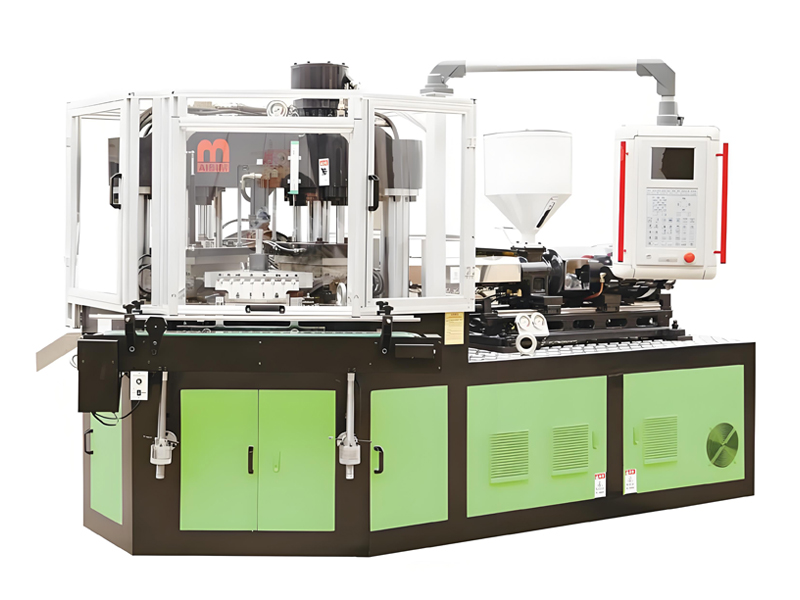
An injection blow molding machine is a single-piece of capital equipment that performs two distinct plastics processes in one clamping unit, which is precisely why customs officers, standards bodies and insurers all treat it differently from a conventional injection molding machine. Understanding the three-station architecture is not academic: it determines the tariff heading, the applicable machine safety standard, the installed power, the footprint and the container you will need.
How the Three-Station, One-Step Process Works
The heart of an IBM machine is a horizontal indexing shaft carrying three sets of core rods, sometimes called blow pins or mandrels. The shaft rotates 120 degrees per cycle, so that every set of core rods visits three fixed stations in sequence while the clamping unit opens and closes around them.
At the injection station, the plasticized melt is injected from a reciprocating screw barrel through a hot runner manifold into a preform cavity that closes around the core rod. The neck finish, including the thread, the sealing surface and any tamper-evident bead, is formed here by steel-on-steel contact between the neck insert and the core rod. Because the neck is injected rather than pinched, thread accuracy of the order of plus or minus 0.05 mm is achievable and repeatable across cavities.
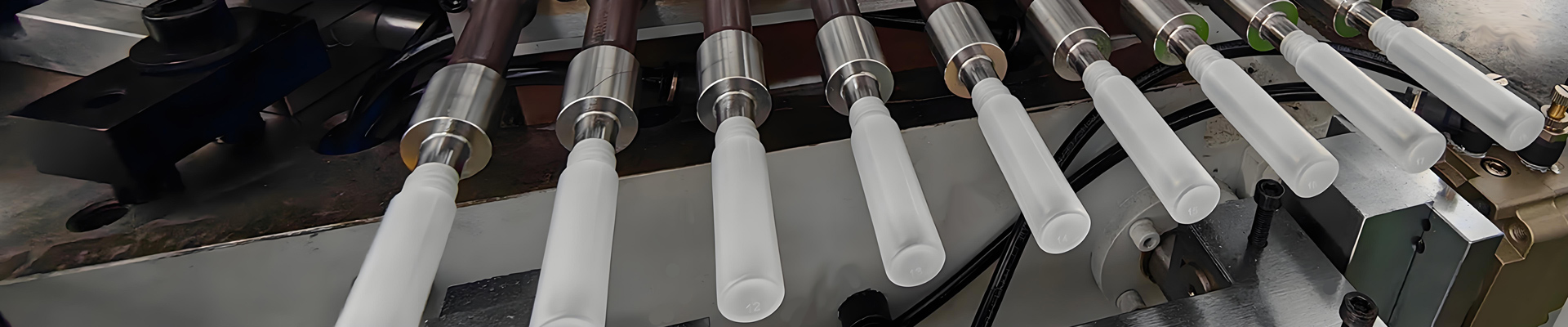
The shaft then indexes 120 degrees and carries the still-hot preform, retained on the core rod, into the blow station. Compressed air is delivered through the centre of the core rod, inflating the preform against a chilled blow cavity. Because the preform never loses contact with the core rod, the neck geometry produced at station one is preserved exactly, and there is no pinch-off line, no tail and no flash to trim.
A further 120-degree index brings the finished bottle to the ejection or stripper station, where a stripper plate pushes the container off the core rod onto a conveyor or into a take-out chute. The core rod, now empty, returns to the injection station and the cycle repeats. On Aibim machines the stripper station is monitored by a long-distance digital laser sensor that confirms complete part removal before the clamp closes again, protecting the mould from a costly crash, while a light curtain protects the operator.
Two consequences follow from this architecture and both matter commercially. First, the process generates no runner-free scrap in the sense that extrusion blow molding does: there is no flash, no deflashing station, no trimming press and no regrind loop. Second, cycle time is governed by the slowest of the three stations, which is almost always injection plus preform cooling, so the machine designer’s real job is balancing core rod temperature control against injection fill time.
Injection Blow Molding Compared With Extrusion Blow Molding and Injection Stretch Blow Molding
Buyers frequently arrive with a quotation for the wrong process, and customs authorities occasionally classify against the wrong heading for the same reason. The three hollow-forming routes differ in how the parison or preform is created and in what the finished container can do.
| Criterion | Injection Blow Molding (IBM) | Extrusion Blow Molding (EBM) | Injection Stretch Blow Molding (ISBM) |
|---|---|---|---|
| Parison or preform formation | Preform injected onto core rod | Parison extruded, pinched by mould | Preform injected, then axially stretched |
| Flash and trimming | None; no deflashing required | Flash at pinch-off and tail; trimming needed | None |
| Neck thread accuracy | Highest, around plus or minus 0.05 mm | Moderate; calibrated or trimmed neck | High |
| Typical container volume | 5 to 500 mL | 100 mL to 1000 L | 200 mL to 5 L |
| Core materials | PP, HDPE, LDPE, PS, PC, PETG | HDPE, PP, PVC, PC, multilayer | PET, PP, PEN |
| Handleware capability | No | Yes | Limited |
| Best-fit end use | Pharmaceutical, cosmetic, nutraceutical small bottles | Detergent, lubricant, agrochemical, jerrycans | Water, carbonated drinks, edible oil |
Within the Wanplas brand this split is handled by separate specialist factories. Aibim builds the injection blow molding machines described here; Wanplas’s Apollo factory covers extrusion blow molding from small containers up to very large industrial volumes; Wanplas’s YuDa factory covers PET stretch blow molding. Naming the correct process on the purchase order is the first step towards naming the correct tariff heading on the customs declaration.
Machine Classes, Clamping Force and Realistic Output
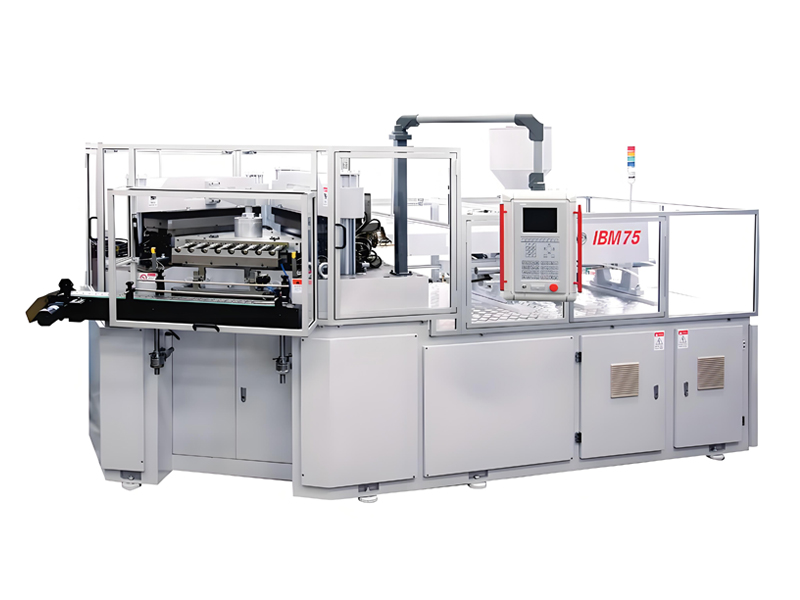
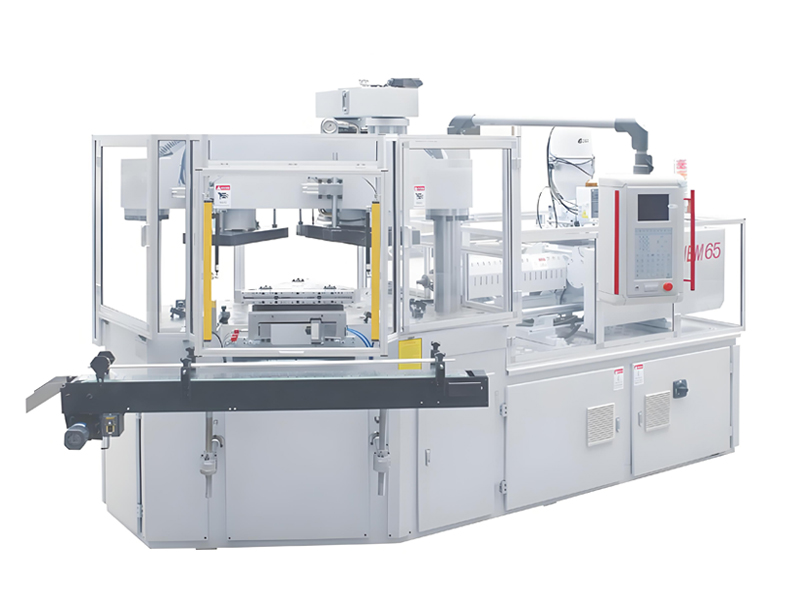
Commercially available injection blow molding machines for the pharmaceutical and personal care segment cluster into a fairly narrow band. Clamping force typically runs from about 30 to 120 tonnes, shot weight from roughly 30 to 500 grams, and output from around 1,200 to 4,800 pieces per hour depending on cavitation, wall thickness and resin. Aibim’s current range is built around the IBM55 Hybrid Electric, the IBM65 and the IBM75, covering containers from 3 mL up to 1000 mL, with the practical sweet spot between 5 and 500 mL.
| Machine Class | Clamping Force | Shot Weight | Typical Cavities | Output Range | Typical Container |
|---|---|---|---|---|---|
| Compact (around 30 T) | 30 to 45 T | 30 to 90 g | 4 to 8 | 1,200 to 2,200 pcs/h | 5 to 60 mL vials, sample bottles |
| Mid range (around 55 to 65 T) | 55 to 70 T | 90 to 250 g | 6 to 16 | 2,000 to 3,600 pcs/h | 30 to 200 mL syrup and cosmetic bottles |
| Large (around 75 to 120 T) | 75 to 120 T | 250 to 500 g | 8 to 24 | 2,800 to 4,800 pcs/h | 100 to 500 mL supplement and pharmacy bottles |
Aibim’s hydraulic system uses a proprietary PREFILL arrangement together with variable displacement pump pressurizing technology, which the factory measures as a minimum 35 percent reduction in energy consumption against a comparable fixed-displacement machine. That figure matters for the import file as well as the utility bill, because installed kilowatts drive the transformer sizing, the cable schedule and, in some jurisdictions, the electrical installation approval. The machine also stores full parameter sets on an SD card, so a validated recipe developed during factory acceptance testing in China can be reloaded on site without re-optimising every parameter — a genuine advantage when the commissioning engineer’s visa window is short.
Materials and Pharmaceutical Packaging Compliance
Injection blow molding is dominated by polyolefins and styrenics, with polycarbonate and PETG occupying specialist niches. The resin choice affects both the machine specification and the regulatory dossier your customer in Southeast Asia will need.
- Polypropylene random copolymer is the workhorse for pharmaceutical bottles: good clarity, autoclavability, melt processing typically in the 190 to 230 degree Celsius range, low extractables profile and wide availability of pharmaceutical grades with regulatory support files.
- HDPE gives excellent moisture barrier and chemical resistance for tablet and capsule containers, processed at roughly 180 to 220 degrees Celsius, and is the default for solid dose packaging.
- LDPE and its softer copolymers are used for squeezable dropper bottles and eye-drop containers where controlled deformation is required.
- Polystyrene offers glass-like clarity and dimensional stability for diagnostic and cosmetic containers, with the trade-off of brittleness and limited chemical resistance.
- Polycarbonate and PETG serve premium cosmetic and specialised medical containers; both require careful drying, PC typically around 120 degrees Celsius for three to four hours and PETG around 65 degrees Celsius for four hours, and PC needs a melt temperature well above the polyolefin band.
Where the container will hold a medicinal product, the buyer’s regulatory affairs team will ask about USP Class VI biological reactivity testing, ISO 10993 biocompatibility evaluation, FDA 21 CFR 177.1520 status for olefin polymers, European Pharmacopoeia monographs 3.1.3 and 3.1.5 for polyolefines and for polyethylene with additives used in containers for parenteral preparations, and, where Chinese resin is used, GB 4806.7 for food contact plastics. These are resin and article requirements rather than machine requirements, but the machine builder must support them: hot runner and screw materials free from unwanted contact contaminants, cleanroom-ready guarding, oil-free take-out where specified, and full material traceability for product contact surfaces. Buyers supplying regulated markets in Indonesia, Vietnam, Thailand and the Philippines increasingly write these clauses into the machine purchase contract, so raise them before the deposit rather than during factory acceptance testing.
HS Code Classification: The Single Biggest Duty Lever
Nothing on an import file moves the landed cost as much as the harmonised system heading, because the heading determines the duty rate, whether a preferential rate can be claimed, whether an import licence is triggered and whether a mandatory certification scheme applies. For plastics machinery the relevant universe sits inside Chapter 84, and the classification argument for injection blow molding turns on which operation gives the article its essential character.
Why 8477.30 Usually Wins Over 8477.10
HS 8477.10 covers injection-moulding machines and HS 8477.30 covers blow-moulding machines. An IBM machine contains a complete injection unit, so the temptation to declare 8477.10 is understandable. In practice most ASEAN customs administrations accept 8477.30, on the reasoning that the injection stage produces only an intermediate preform while the blowing stage produces the finished commercial article. Machines marketed as injection stretch blow molding equipment follow the same logic.
The practical risk is asymmetric. In most ASEAN tariff schedules both headings attract low or zero duty for capital machinery, so the financial difference is often small; but a mismatch between the heading on the certificate of origin and the heading assigned by the importing customs office is one of the most common triggers for a Form E verification request, and that request can hold the container for weeks. The remedy is simple and cheap: request an advance tariff ruling from the importing country’s customs authority before shipment, using the machine’s technical description, photographs and process flow. Indonesia, Thailand, Malaysia, the Philippines, Vietnam and Singapore all operate an advance ruling mechanism.
Do Not Bundle the Moulds and the Auxiliaries
A frequent and expensive error is invoicing the moulds inside the machine line item. Moulds for injection or compression moulding of rubber and plastics fall under HS 8480.71 and are assessed separately. Bundling them can distort the declared value of the machine, trigger a valuation query, and in some jurisdictions forfeit a machinery duty exemption that the moulds would not have qualified for anyway. Auxiliaries follow their own logic as well.
| Item Shipped | Usual HS Heading | Classification Notes | Common Dispute |
|---|---|---|---|
| Complete injection blow molding machine | 8477.30 | Blow-moulding machines for working plastics | Officer reclassifies to 8477.10 because of the injection unit |
| Stand-alone injection molding machine | 8477.10 | Injection-moulding machines | Rarely disputed |
| Blow moulds and preform moulds | 8480.71 | Injection or compression type moulds for rubber or plastics | Bundled into the machine value and queried on valuation |
| Machine spare parts (screw tip, check ring, platen parts) | 8477.90 | Parts of machinery of heading 8477 | Generic descriptions rejected as insufficient |
| Water chiller | 8418.69 | Refrigerating or freezing equipment | May attract a national certification requirement |
| Dehumidifying dryer and drying hopper | 8419.39 or 8419.89 | Drying machinery for solid materials | Split between drying and heat-treatment subheadings |
| Air compressor for blowing air | 8414.80 | Air or gas compressors | Pressure equipment rules may apply to receivers |
| Hopper loader and central feeding system | 8428.20 or 8479.89 | Pneumatic conveyors or other machinery | Heading depends on conveying principle |
| Electrical control cabinet shipped loose | 8537.10 | Boards and panels for electric control | Most likely item to trigger SNI, TISI, SIRIM or PS scrutiny |
One further point on classification strategy: if the control cabinet ships bolted to the machine as an integral part of a single functional unit, it is normally classified with the machine and the electrical certification question is much easier. Shipping it loose to save container height can convert a straightforward machinery import into an electrical product import subject to a national mark. This is one of the few situations where saving container space is a false economy.
Country-by-Country Import Duty, VAT and Licensing in Southeast Asia
Southeast Asia is not one market. Duty rates on capital machinery are low or zero almost everywhere, but the indirect tax layer, the licensing layer and the certification layer differ sharply, and it is those layers, not the duty, that determine how long the machine sits at the port. The following country notes describe the structure; always confirm the current rate against the importing country’s published tariff schedule for the specific eight or ten digit national line.
Indonesia
Indonesia is the largest ASEAN market for small-volume pharmaceutical and cosmetic packaging and also the most procedurally demanding entry. Import duty on capital equipment in Chapter 84 generally falls in the zero to 5 percent band, and can be reduced to zero under ACFTA with a valid Form E. Value added tax, known locally as PPN, sits in the 11 to 12 percent range following the phased increase, and an income tax prepayment known as PPh Pasal 22 is collected at the border at 2.5 percent for holders of an importer identification number and 7.5 percent for importers without one.
The licensing layer is where projects stall. An importer must hold a business identification number issued through the online single submission system, and must hold the correct category of importer identification number, the Angka Pengenal Importir. API-P is for producers importing goods for their own use, while API-U is for general traders importing for resale. Choosing the wrong category is a classic and painful error: a factory holding only API-U may be unable to import a machine for its own production, and a factory holding API-P may be blocked from importing goods it intends to sell on. Certain goods appear on the LARTAS restricted and prohibited list and require additional approvals. Selected electro-technical products fall under mandatory SNI certification, and a K3L registration covering safety, health, environment and security applies to specified goods. All declarations pass through the Indonesia National Single Window.
The compensating advantage is the investment facility. Companies holding an approved investment plan can obtain a master list of machinery eligible for import duty relief, which can reduce the duty burden on a full production line from Medium to Low. The master list must be approved before shipment and the machine description must match exactly, so the application timeline has to be built into the delivery schedule rather than bolted on afterwards.
Vietnam
Vietnam has become the fastest-growing destination for injection blow molding capacity in the region, driven by generic pharmaceutical manufacturing and contract cosmetics. Under ACFTA most machinery lines carry zero import duty when accompanied by a Form E. Value added tax on machinery is in the 8 to 10 percent band, reflecting the temporary reduction measures Vietnam has applied in recent years to the standard 10 percent rate.
Vietnam does not impose a general type-approval scheme on plastics machinery, but it does require a declaration of conformity for products falling within national technical regulations, and it maintains a list of machinery, equipment and materials with strict occupational safety requirements administered by the labour ministry. Equipment on that list must undergo technical safety inspection by a designated organisation, typically before it is put into service rather than at the border. Air receivers, lifting equipment and certain pressure components attached to a machine line are the items most likely to be caught.
The critical Vietnamese rule for machinery importers is Decision 18/2019/QD-TTg on used equipment. A second-hand machine must generally be under ten years old and must conform either to a Vietnamese national technical regulation or to the corresponding standard of a G7 country, Korea or an equivalent jurisdiction, evidenced by a conformity assessment from a designated inspection body. Buyers attracted by a refurbished machine from a European converter regularly discover at Cat Lai or Hai Phong that the manufacturing year cannot be documented, and the container is re-exported. For most ASEAN buyers, a new machine avoids an entire regulatory category.
Thailand
Thailand combines a mature plastics processing base with one of the most generous investment promotion regimes in the region. Import duty on plastics machinery ranges from zero to about 10 percent depending on the national line, again reducible to zero under ACFTA. Value added tax is 7 percent, the lowest standard rate among the large ASEAN economies.
Certain electrical products are subject to compulsory Thai Industrial Standards Institute certification, shown by the TISI mark. Industrial machinery as such is generally outside the compulsory list, but loose electrical components and consumer-type items packed with a machine can be caught. The bigger opportunity is investment promotion: a promoted project can obtain exemption from import duty on machinery, which for a full line moves the duty burden from Medium to Low or zero. The promotion certificate and the machinery list must be in place before the goods arrive. Declarations are filed through the Thai electronic customs system and the national single window, and a licensed customs broker with plastics machinery experience is worth more than the fee difference against a generic broker.
Malaysia
Malaysia applies import duty on machinery typically in the zero to 5 percent band, with many capital goods lines already at zero, and a sales tax under the sales and service tax framework at a standard rate of 10 percent on taxable goods. Licensed manufacturers can obtain exemption from sales tax on machinery and equipment used directly in manufacturing under the exemption schedules, which is a routine but paperwork-intensive application.
Electrical equipment is subject to SIRIM certification and the associated approval requirements, and certain goods require an approved permit from the trade ministry. As in Indonesia, the machine itself is usually unproblematic while a loose control cabinet, a stand-alone chiller or a compressor can attract a certification requirement. Investment authority incentives cover import duty and sales tax exemption on machinery not produced locally, and the application should be filed well before the vessel sails. Port Klang and Penang both handle machinery regularly and inland haulage to the industrial parks in Selangor, Johor and Penang is straightforward.
Philippines
The Philippines applies duties under the ASEAN Harmonised Tariff Nomenclature, with machinery lines commonly in the 1 to 3 percent band, and levies value added tax at 12 percent, the highest standard indirect tax rate among the major ASEAN markets. Preferential treatment for Chinese-origin machinery is claimed under ACFTA with Form E; goods sourced from another ASEAN member state instead use the ATIGA Form D.
Product certification is administered by the Bureau of Philippine Standards under the trade department, through the PS licence for locally certified products and the Import Commodity Clearance scheme for imported goods on the mandatory list. Industrial machinery is generally outside the mandatory list, but electrical items shipped alongside can be inside it. Registered enterprises under the investment board or an economic zone authority can import machinery with duty and tax incentives, which is the standard route for export-oriented packaging converters. The Philippines is also the one major ASEAN manufacturing market operating on 60 Hz power, which is discussed in detail below and which must be settled at the order stage.
Singapore
Singapore is the simplest customs environment in the region and the most common regional hub for spare parts stock. Import duty is zero on machinery. Goods and services tax applies at 9 percent and is recoverable by GST-registered businesses. Permits are declared electronically and clearance is typically same day for straightforward machinery consignments.
There is no mandatory type approval for industrial plastics machinery, but the Workplace Safety and Health framework places duties on the occupier and on any person who supplies machinery for use at work, which in practice means the machine must be safe, adequately guarded and accompanied by proper information for use. Buyers in Singapore therefore ask for a full safety file even though no border certificate is required. Many regional groups import into Singapore first, hold spare parts there, and re-export to their Indonesian, Vietnamese or Philippine plants; where that re-export happens, plan the origin documentation carefully, because a Form E cannot simply be recycled after a break in direct consignment.
Cambodia, Myanmar and Laos
The frontier markets share a common profile: low industrial base, wide duty bands and heavier reliance on discretionary licensing. Import duty on machinery typically falls in a zero to 15 percent range depending on the national line and the prevailing schedule, with value added tax commonly around 10 percent. ACFTA preferences apply and are worth claiming.
Cambodia routes inspection through the Camcontrol authority alongside the customs department, and imports usually require an import licence or permit depending on the commodity. Myanmar operates a licensing regime administered by the trade ministry with periodic changes to the licensable list, and foreign exchange procedures can be the practical bottleneck rather than the tariff. Laos is landlocked, so the machine will normally transit through Thailand or Vietnam, which introduces a transit declaration and a second set of handling risks. In all three markets, the direct consignment rule under ACFTA needs particular attention when the goods transit a third country.
Southeast Asia Import Tax and Certification Comparison
| Country | Import Duty Band | VAT / GST / SST | Mandatory Certification Exposure | Import Licence | FTA Route | Used Machinery Restriction |
|---|---|---|---|---|---|---|
| Indonesia | 0 to 5 percent | PPN 11 to 12 percent, plus PPh 22 at 2.5 or 7.5 percent | SNI on selected electro-technical items; K3L registration | API-P or API-U, business identification number, LARTAS checks | ACFTA Form E; RCEP available | Conditional, subject to trade ministry rules |
| Vietnam | 0 percent under ACFTA for most machinery | VAT 8 to 10 percent | Declaration of conformity; occupational safety inspection list | Generally none for new machinery | ACFTA Form E; RCEP available | Strict: Decision 18/2019/QD-TTg, age limit ten years |
| Thailand | 0 to 10 percent | VAT 7 percent | TISI mark on certain electrical products | Generally none; investment promotion list if claiming relief | ACFTA Form E; RCEP available | Permitted with conditions and inspection |
| Malaysia | 0 to 5 percent | Sales tax 10 percent, exemption available for licensed manufacturers | SIRIM certification for electrical equipment | Approved permit for specified goods | ACFTA Form E; RCEP available | Permitted, approval may be required |
| Philippines | 1 to 3 percent under AHTN | VAT 12 percent | PS licence or Import Commodity Clearance from DTI-BPS | Generally none; incentives require registration | ACFTA Form E from China; ATIGA Form D intra-ASEAN | Permitted with conditions |
| Singapore | 0 percent | GST 9 percent | No type approval; Workplace Safety and Health duties apply | Electronic permit declaration only | Not needed for duty, may matter on re-export | No specific age restriction |
| Cambodia | 0 to 15 percent | VAT around 10 percent | Camcontrol inspection | Import permit commonly required | ACFTA Form E | Case by case |
| Myanmar and Laos | 0 to 15 percent | VAT or commercial tax around 10 percent | Limited formal schemes; ministry approval | Import licence commonly required | ACFTA Form E | Case by case; transit rules apply for Laos |
Read that table with one caution in mind. The certification column describes exposure, not certainty. Whether an individual shipment is caught depends on the exact national tariff line, on how the goods are described and on whether electrical assemblies travel loose or integrated. The correct professional response is to send the packing list and the electrical schedule to a local customs broker for review at the quotation stage, not after the vessel has sailed.
Certificates of Origin: ACFTA Form E, RCEP and Form D
A certificate of origin is the cheapest duty reduction available to a machinery importer, and the most frequently botched document in the file. Under the China-ASEAN Free Trade Area, a valid Form E reduces the applicable duty on most Chapter 84 machinery lines to zero in the ASEAN member states, which converts the duty component of landed cost from Medium to negligible.
What Form E Actually Requires
Three conditions must all hold. First, the origin criterion: for machinery the usual route is a regional value content of at least 40 percent, calculated on the free-on-board value using either the build-up or build-down method. A machine substantially manufactured and assembled in China from Chinese castings, platens, hydraulic components and control hardware will comfortably meet this, but a machine that is largely an assembly of imported European drives and controls may not, and the exporter must be able to prove the calculation if the certificate is challenged.
Second, the direct consignment rule: the goods must be shipped directly from China to the importing ASEAN member state. Transhipment through a third port is acceptable where it is justified by geographical or transport reasons and the goods remain under customs control without any operation other than unloading, reloading and preservation. Storing a machine in a Singapore warehouse for six months and then trucking it to Malaysia can break the chain and forfeit the preference.
Third, documentary consistency: the description of goods, the quantity, the marks, the invoice number and the consignee on the Form E must match the commercial invoice, the packing list and the bill of lading exactly. This is where most rejections originate.
The Four Classic Form E Rejection Triggers
- Description mismatch. The invoice says “IBM75 injection blow molding machine with 8-cavity mould” while the Form E says “plastic machine”. Customs raises a verification request and the preference is suspended until the issuing authority replies, which can take many weeks.
- Third-party invoicing. Where the invoice is issued by a trading company in a third country, the third-party invoicing box on the Form E must be ticked and the details declared. An unticked box on a third-party invoice is treated as a discrepancy.
- Back-to-back certificates. When goods move through an intermediate ASEAN member state, a back-to-back Form E is required from that state’s issuing authority, and it must reference the original certificate. Attempting to present the original after a break in consignment fails.
- HS heading mismatch. The Form E shows 8477.30 and the importing customs office insists on 8477.10, or vice versa. Because the preferential rate is normally the same, importers underestimate this, but the discrepancy alone is enough to trigger retrospective verification.
Choosing Between ACFTA and RCEP
The Regional Comprehensive Economic Partnership overlaps with ACFTA for China-to-ASEAN trade, and both are available to a Chinese exporter shipping into an ASEAN member state. For most plastics machinery lines, ACFTA Form E already delivers a zero rate and remains the default because issuing authorities, brokers and customs officers all have long experience with it. RCEP becomes interesting in three situations: where a specific national tariff line offers a better staged rate under RCEP than under ACFTA; where the origin calculation is easier under RCEP’s cumulation rules because components are sourced from other RCEP parties such as Japan or Korea; and where the exporter is approved for self-declaration of origin, which removes the lead time of obtaining a paper certificate. The practical rule is to have the broker compare both preferential rates for the exact national line before the shipping documents are finalised, then choose one and keep every document consistent with that choice.
Note also that intra-ASEAN movements use a different instrument entirely. If a Philippine buyer purchases through a Malaysian or Thai stockholder and the goods have acquired ASEAN origin, the ATIGA Form D applies rather than Form E. Mixing the two is a common error in regional distribution structures.
Machine Safety and Electrical Compliance for ASEAN Sites
No ASEAN member state operates a border-enforced machinery safety directive equivalent to the European system, yet machine safety documentation is requested on the majority of injection blow molding projects in the region. The reason is commercial rather than regulatory: multinational pharmaceutical customers, contract manufacturing clients, insurers and lenders all ask for it, and a plant that cannot produce a safety file may fail a customer audit even though it passed customs without difficulty.
The Standards That Buyers Actually Ask For
The reference framework is the European machinery legislation, Directive 2006/42/EC, supported by harmonised standards. For hollow forming equipment the relevant type-C standards are EN 422 covering safety requirements for blow moulding machines and EN 201 covering injection moulding machines; an injection blow molding machine draws on both because it contains an injection unit and a blowing station within one guarded envelope. Functional safety of the guarding interlocks, the light curtain and the emergency stop circuit is evaluated to ISO 13849-1, with performance level d and category 3 architecture being the normal expectation for the clamping area of a hollow forming machine. Electrical safety of the machine as installed is assessed to IEC 60204-1.
Aibim supplies CE certified machines as standard, with a light curtain protecting the operator zone and a long-distance digital laser sensor at the stripper station confirming part removal before the clamp closes. Competing machines from Jomar, Nissei ASB and Uniloy are built to the same standards family, so a buyer comparing quotations should be comparing the completeness of the safety file, not merely the presence of a mark. Ask specifically for the declaration of conformity, the list of standards applied, the risk assessment summary, the safety circuit diagram with the performance level calculation, and the instruction handbook in English.
Voltage and Frequency: The 60 Hz Trap
Electrical adaptation is the most under-managed technical issue in ASEAN machinery imports, and it is entirely preventable. Most of the region runs on 50 Hz at 380 to 415 volts three phase, which matches the standard Chinese export configuration. The Philippines is the exception, running at 60 Hz, and that single difference has consequences throughout the machine.
An induction motor wound for 50 Hz will turn roughly 20 percent faster on 60 Hz, so a four-pole motor rated at about 1,450 revolutions per minute will run near 1,750. For a fixed displacement hydraulic pump this means higher flow and a shorter dry cycle, which sounds attractive until the electrical consequences are considered. At constant terminal voltage and higher frequency, the magnetic flux in the motor falls, available torque falls with it, and the motor can be driven into overload when the pump reaches full working pressure. Motor cooling fans, contactor coils, timers, transformer ratings and inverter parameters are all affected. A machine delivered on the wrong frequency does not usually fail outright: it under-performs, runs hot, trips intermittently and never reaches the rated output that the buyer’s payback calculation assumed.
The correct approach is to declare the exact supply — voltage, frequency, phases and earthing arrangement — on the purchase order. The factory then specifies a motor wound for the target frequency or a dual-frequency motor, sets the correct drive and inverter parameters, sizes the control transformer for the local control voltage, and configures the heater band circuits accordingly. Heater bands themselves are resistive and largely frequency-insensitive, but they are voltage-sensitive, so a machine wired for 415 volts and connected to 380 volts will heat slowly and hold temperature poorly.
Southeast Asia Power Supply and Machine Adaptation
| Country | Typical Industrial Supply | Frequency | Earthing Practice | Required Machine Adaptation |
|---|---|---|---|---|
| Indonesia | 380 V three phase | 50 Hz | TN-S or TT common | Standard export build; confirm voltage tolerance and site earthing |
| Vietnam | 380 V three phase | 50 Hz | TN-S typical in industrial parks | Standard export build; check voltage dips in older parks |
| Thailand | 400 V three phase | 50 Hz | TN-C-S or TT | Standard export build; confirm heater band voltage rating |
| Malaysia | 415 V three phase | 50 Hz | TN-S predominant | Specify 415 V heaters and control transformer tap |
| Philippines | 230 V or 460 V three phase | 60 Hz | TN-S with local variations | Critical: 60 Hz motor winding, revised drive parameters, matched transformer |
| Singapore | 400 V three phase | 50 Hz | TN-S | Standard export build; full electrical documentation expected |
| Cambodia | 400 V three phase | 50 Hz | TT common outside major parks | Add voltage stabiliser where supply is unstable |
| Myanmar and Laos | 400 V three phase | 50 Hz | TT common | Stabiliser and generator compatibility check strongly advised |
Two site-side points deserve emphasis. Where the supply is unstable, a voltage stabiliser ahead of the machine protects the servo drives and the temperature controllers, and is far cheaper than replacing a burnt drive after a brownout. Where the plant runs on a standby generator, confirm the generator’s ability to absorb the regenerative load and the starting current of the hydraulic pump motor; a machine that runs perfectly on grid power can trip a marginally sized generator every cycle.
Packing, Container Selection, Incoterms and Documents
Physical logistics for injection blow molding equipment is manageable because the machines are compact relative to extrusion lines, but the details still decide whether the consignment clears smoothly. A 30-tonne class IBM machine occupies roughly 4.5 by 1.6 by 2.2 metres and weighs in the region of 5 to 8 tonnes, which puts it inside standard container dimensions if the hopper, the loader and any tall auxiliaries are removed and packed separately.
Choosing the Right Container
| Container Type | Usable Internal Dimensions | Best Fit for IBM Shipments | Relative Freight Cost | Watch Out For |
|---|---|---|---|---|
| 20GP | About 5.9 by 2.35 by 2.39 m | Single compact machine up to about 45 T clamping, hopper removed | Low | Payload limits at some ports; height clearance after skid |
| 40GP | About 12.03 by 2.35 by 2.39 m | Machine plus moulds, chiller, dryer and compressor | Medium | Weight distribution over the container floor |
| 40HQ | About 12.03 by 2.35 by 2.69 m | Full line with tall auxiliaries left assembled | Medium | Inland road height limits in some provinces |
| Open top (OT) | 40GP footprint, roof removed | Machine that exceeds door height but fits the floor plan | High | Tarpaulin sealing and rain ingress; crane needed both ends |
| Flat rack (FR) | Open sides and roof | Over-width assemblies or fully assembled tall lines | Very High | Out-of-gauge surcharges; weather protection is your problem |
| LCL consolidation | Shared container space | Spare parts, moulds, small auxiliaries only | Low per unit, High per risk | Handling damage, longer transit, extra deconsolidation charges |
For a single machine with its moulds and a modest auxiliary package, a 40HQ is usually the sweet spot: it avoids the out-of-gauge surcharges of flat rack, it protects the machine from weather, and it leaves enough space to pack the mould crates and spare parts securely. Reserve open top and flat rack for genuinely oversized consignments, and never ship a complete machine as LCL — the handling risk in a consolidation warehouse is out of proportion to the saving.
Main gateway ports are well established. Tanjung Priok serves Jakarta and Tanjung Perak serves Surabaya; Cat Lai serves Ho Chi Minh City and Hai Phong serves the north of Vietnam; Laem Chabang serves the Eastern Seaboard industrial zone in Thailand; Port Klang and Penang serve the Malaysian peninsula; Manila handles most Philippine machinery imports. Confirm inland haulage separately, because the cost and permitting for a low-bed truck plus a mobile crane at the plant is frequently overlooked in the delivery plan and is not included in a sea freight quotation.
Incoterms: Who Carries Which Risk
| Term | Export Clearance | Main Carriage | Insurance | Import Duty and VAT | Suitability for ASEAN IBM Projects |
|---|---|---|---|---|---|
| EXW | Buyer | Buyer | Buyer | Buyer | Only for buyers with an established China forwarding agent |
| FOB | Seller | Buyer | Buyer | Buyer | The regional default; buyer controls freight and schedule |
| CIF | Seller | Seller | Seller, minimum cover unless upgraded | Buyer | Good for first-time importers; upgrade cover to ICC (A) |
| DAP | Seller | Seller | Seller | Buyer | Workable compromise where buyer holds the licences |
| DDP | Seller | Seller | Seller | Seller | High risk in ASEAN: seller often cannot hold local licences or reclaim VAT |
DDP deserves a specific warning in the Southeast Asian context. In Indonesia the importer of record must hold the correct importer identification number; in Malaysia the sales tax exemption is tied to the licensed manufacturer; in the Philippines and Thailand the investment incentives belong to the registered enterprise. A Chinese seller acting as importer of record under DDP typically cannot access any of these, cannot recover input value added tax, and may be exposed if the local agent used for clearance makes an error. FOB with a competent local broker, or CIF with insurance upgraded to Institute Cargo Clauses (A) all-risks cover including loading and unloading, is the safer structure for capital equipment.
ISPM 15 Wood Packaging and the Document Set
Every ASEAN member state enforces ISPM 15 for solid wood packaging material. Crates, skids, blocks and dunnage must be heat treated or fumigated and stamped with the IPPC mark showing the country code, the treatment provider code and the treatment code. An unmarked crate is not a paperwork inconvenience: it results in quarantine hold, on-site fumigation, destruction of the packaging or re-export, all at the importer’s cost and all while demurrage accrues. Plywood and processed wood-based panels are exempt, which is why many machinery exporters use plywood cases over heat-treated skids.
The document set travelling with an injection blow molding machine should include, at minimum: the commercial invoice; the packing list with crate-by-crate dimensions and weights; the bill of lading; the certificate of origin, normally Form E; the ISPM 15 treatment statement or fumigation certificate; the insurance policy or certificate; the machine instruction handbook in English; the electrical schematic and hydraulic circuit diagram; the CE declaration of conformity and the supporting test report; the factory acceptance test report signed by both parties; and the recommended spare parts list. Where the customer produces pharmaceutical packaging, add the material certificates for product contact components. Sending scanned copies to the broker before the vessel arrives, rather than couriering originals afterwards, is the single easiest way to compress clearance time.
Installation, Commissioning and After-Sales Across Southeast Asia
A machine that clears customs quickly can still lose months at the commissioning stage if engineer mobility is not planned. Immigration rules for technical service visits differ across the region and none of them tolerate an engineer arriving on a tourist entry and being found working on a plant floor.
Engineer Mobility and Visas
- Indonesia requires a foreign worker placement plan and the corresponding work permit, with a limited-stay permit for longer assignments. Short technical visits can sometimes be handled under a business visa arrangement, but the classification must be confirmed with the sponsoring company’s legal advisor before travel.
- Vietnam requires a work permit for foreign technicians, with a statutory exemption route for short assignments under a defined threshold of days. The exemption confirmation still has to be applied for; it is not automatic.
- Thailand requires a non-immigrant business visa together with a work permit, or entry under one of the digital and expert visa schemes. Processing time is meaningful and should be started when the machine is booked for shipment.
- Malaysia uses a professional visit pass for short-term technical work sponsored by the local company.
- Philippines uses a special work permit attached to a temporary visitor visa for short commissioning assignments.
- Singapore uses a short-term work pass administered through the manpower authority.
Because visa lead times are unpredictable, remote commissioning has become a standard fallback rather than an emergency measure. Aibim machines store complete parameter sets on an SD card, so a validated production recipe developed during factory acceptance testing can be transferred to the machine on site and loaded without a lengthy re-optimisation. Combined with a video link to the control screen and a locally trained maintenance technician at the machine, remote support can bring a line into stable production even when the engineer’s entry is delayed. Where the customer is producing regulated pharmaceutical packaging, plan for a physical visit anyway for the installation and operational qualification stages.
Spare Parts Strategy for a Remote Site
The wear items on an injection blow molding machine are predictable, and stocking them locally is far cheaper in downtime terms than air-freighting a part from China after a failure. A sensible starter kit covers the screw tip and check ring assembly, heater bands for each barrel zone and the hot runner, thermocouples, a complete hydraulic seal kit, filter elements, a spare set of core rods or blow pins, spare neck inserts, proportional valve coils, contactors and the light curtain transmitter and receiver. Core rods deserve particular attention: they are precision components that determine neck quality, they are exposed to repeated thermal cycling, and a damaged rod takes the whole cavity out of production.
The Wanplas brand backs its factories with an annual free spare parts allowance, free replacement of parts damaged within the warranty period, and an open factory policy that welcomes customers to inspect production before shipment. Practically, ASEAN buyers should also agree a training plan: five to ten days of on-site training is the normal window, covering mould change, parameter adjustment, preventive maintenance intervals, hydraulic and lubrication schedules, and fault diagnosis on the human-machine interface. Training two operators and one maintenance technician rather than one person each protects the plant against staff turnover, which in the region’s industrial parks can be significant.
The Import Mistakes That Cost the Most Time
Across ASEAN projects, the same failures recur with striking regularity, and almost all of them are decided in the two weeks before shipment rather than at the port. The table below maps each failure to its practical consequence and to the preventive action.
| Mistake | Where It Bites | Typical Consequence | Preventive Action |
|---|---|---|---|
| Guessing the HS heading | All markets | Physical examination, reclassification, back duty and penalty exposure | Obtain an advance tariff ruling before shipment |
| Form E description not matching the invoice | All ACFTA markets | Retrospective verification request; preference suspended for weeks | Cross-check certificate, invoice, packing list and bill of lading line by line |
| Importing used equipment into Vietnam without age proof | Vietnam | Refusal of entry and re-export at the importer’s cost | Buy new, or secure the manufacture-year certificate and conformity assessment first |
| Not declaring 60 Hz supply | Philippines | Motor overload, heat rise, intermittent trips, output below the rated figure | State voltage, frequency, phases and earthing on the purchase order |
| Wood packaging without the IPPC mark | All markets | Quarantine hold, fumigation, destruction or re-export plus demurrage | Require ISPM 15 treated and stamped crates, or plywood cases |
| Wrong importer identification category | Indonesia | Unable to import own-use capital equipment; goods stranded | Confirm API-P versus API-U against the intended use before ordering |
| Missing national certification on loose electrical items | Indonesia, Malaysia, Thailand, Philippines | Port storage while SNI, SIRIM, TISI or PS documentation is arranged | Ship the control cabinet integrated with the machine; pre-screen the packing list |
| Bundling moulds into the machine value | All markets | Valuation query and potential loss of a machinery duty exemption | Invoice moulds separately under HS 8480.71 |
| Applying for investment incentives after arrival | Indonesia, Thailand, Malaysia, Philippines | Relief refused because the machinery list was not approved in advance | File the master list or promotion application before the vessel sails |
| Choosing DDP to simplify the purchase | All markets | Seller cannot hold local licences or recover input tax; disputes on arrival | Use FOB or CIF with ICC (A) cover and a local broker |
The pattern is consistent. Failures cluster around documentation consistency, advance approvals and unstated site conditions, not around the machine itself. A buyer who fixes the tariff heading, the origin certificate, the electrical specification, the packing treatment and the incentive application before the container is stuffed will almost always clear within the normal window.
Frequently Asked Questions
What HS code applies to an injection blow molding machine?
Most customs administrations in Southeast Asia classify a complete three-station injection blow molding machine under HS 8477.30 as a blow-moulding machine, on the basis that blowing is the operation that gives the finished container its shape. Some officers argue for HS 8477.10 because the machine contains a full injection unit. Moulds are classified separately under HS 8480.71 and stand-alone chillers, dryers and compressors carry their own headings. Because the classification also drives certification exposure, obtain an advance ruling from the importing country’s customs authority before the goods ship.
Do I need ACFTA Form E to import an IBM machine from China into ASEAN?
Form E is not compulsory, but without it the shipment is assessed at the Most Favoured Nation rate rather than the ACFTA preferential rate, which is zero or close to zero on most machinery lines. To qualify, the machine must meet at least 40 percent regional value content, must be shipped on a direct consignment basis, and the certificate must match the invoice, the packing list and the bill of lading exactly. Where the goods pass through an intermediate ASEAN state, a back-to-back Form E is required from that state.
Why does 60 Hz power in the Philippines affect an injection blow molding machine?
A hydraulic pump motor wound for 50 Hz runs roughly 20 percent faster on 60 Hz, but at the same terminal voltage the magnetic flux falls, available torque falls with it, and the motor can overload when the pump reaches working pressure. Inverter and servo parameters, timer settings, control transformer taps and motor cooling all need to be reconfigured as well. Declare the exact voltage, frequency, phase count and earthing arrangement on the purchase order so the factory can build the machine correctly rather than adapting it on site.
Is ISPM 15 marking mandatory for machinery packing into Southeast Asia?
Yes. All ASEAN member states enforce ISPM 15 on solid wood packaging material. Crates, skids and dunnage must be heat treated or fumigated and carry the IPPC mark with the country code, the treatment provider code and the treatment code. Unmarked wood typically results in a quarantine hold followed by on-site fumigation, destruction of the packaging or re-export, with demurrage accruing throughout. Plywood cases are exempt, which is why many machinery exporters prefer them.
Can I import a used injection blow molding machine into Vietnam or Indonesia?
Vietnam applies Decision 18/2019/QD-TTg to used machinery: the equipment must generally be under ten years old and must comply with a Vietnamese national technical regulation or the corresponding standard of a G7 country, Korea or an equivalent jurisdiction, supported by a conformity assessment from a designated body. Indonesia allows used capital goods only under specific trade ministry conditions and additional approvals. In both markets the documentation burden and the refusal risk are high enough that a new machine is usually the lower-risk purchase.
Which national certifications should I budget time for?
Indonesia applies SNI to selected electro-technical products plus K3L registration; Thailand applies the TISI mark to certain electrical items; Malaysia applies SIRIM certification to electrical equipment together with an approved permit for specified goods; the Philippines applies the PS licence or Import Commodity Clearance through DTI-BPS. Complete industrial machinery is usually outside these mandatory lists, but loose control cabinets, chillers and compressors are frequently inside them. Have a local broker screen the packing list at the quotation stage.
How long does clearance normally take once the vessel arrives?
With a complete and consistent document set, Singapore is typically same-day, Malaysia, Thailand and Vietnam commonly clear within a few working days, and Indonesia and the Philippines take longer because of the additional licensing and inspection layers. Every one of those timelines extends dramatically if a certificate of origin is queried, if a certification requirement was missed or if the classification is challenged. Front-loading the paperwork is worth far more than choosing a faster vessel.
What should be agreed on installation and training before I place the order?
Agree the scope in writing: the number of engineer-days on site, who applies for the work permit or technical visit pass, the number of personnel to be trained, the acceptance criteria for output rate and reject rate, the remote support arrangement if visas are delayed, and the recommended spare parts kit. Five to ten days of on-site training is the normal window for an injection blow molding line, covering mould change, parameter adjustment, preventive maintenance and fault diagnosis. Train at least two operators and one maintenance technician.
Conclusion
Importing an injection blow molding machine into Southeast Asia is a solvable engineering and documentation problem, not a gamble. Duty rates on capital machinery are low across the region and are usually eliminated entirely by a correctly prepared ACFTA Form E, so the real variables are the indirect tax layer, the national licensing and certification schemes, and the site conditions that must be designed into the machine before it is built. Indonesia demands the most preparation because of the importer identification categories, the SNI and K3L exposure and the investment master list timing. Vietnam is straightforward for new machines and unforgiving for used ones. Thailand and Malaysia reward early engagement with their investment authorities. The Philippines carries the highest value added tax rate and the only 60 Hz supply among the major manufacturing markets. Singapore is the cleanest entry and the natural regional parts hub.
The technical side of the decision should not be lost in the compliance detail. A three-station, one-step injection blow molding machine produces containers with no flash, no trimming operation and neck thread accuracy of the order of plus or minus 0.05 mm, which is exactly what pharmaceutical, nutraceutical and premium cosmetic packaging demands in the 5 to 500 mL range. Aibim, a Wanplas factory with an in-house CNC machining centre, a plant expanded in 2022 to over one hundred lines of annual capacity and installations in more than forty countries, builds the IBM55 Hybrid Electric, IBM65 and IBM75 to CE requirements with light curtain protection, laser-monitored stripper stations, PREFILL hydraulics delivering a minimum 35 percent energy saving, and SD card parameter portability that makes remote commissioning realistic.
Before signing a purchase order, settle six things: the tariff heading confirmed by an advance ruling, the origin instrument and its supporting value content calculation, the national certification exposure screened against your packing list, the exact electrical supply at your plant, the container type and the ISPM 15 packing specification, and the installation and training scope with a named remote-support fallback. Buyers across ASEAN who work through that list before the deposit is paid consistently commission on schedule. Contact the Aibim technical team with your container specification, target output and site power details, and the machine can be configured, documented and packed for your market from the start rather than corrected at the port.